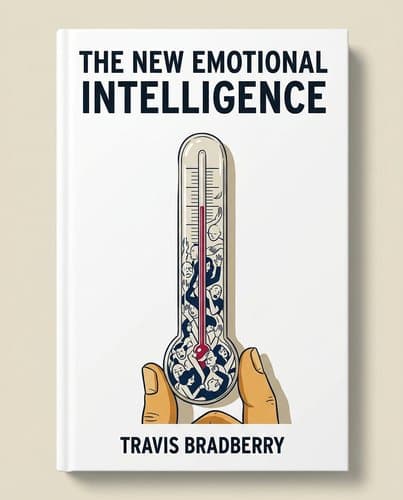
230836473_the-new-emotional-intelligence
by Travis Bradberry
The gap between who you are when calm and who you become when triggered costs you relationships, opportunities, and credibility—and emotional intelligence is…
In Brief
The gap between who you are when calm and who you become when triggered costs you relationships, opportunities, and credibility—and emotional intelligence is the only tool that closes it. Master concrete techniques like body-scanning emotions, identifying personal triggers, and arguing the opposing view to transform reflexive reactions into deliberate responses.
Key Ideas
Daily emotional check-ins build awareness
Set a timer at two or three points during the day, stop, breathe, and name what you are feeling right now — not what caused it, just what it is. This one practice builds the emotional identification muscle that most people never develop.
Locate emotions in your body
When a strong emotion hits, locate it in your body before you act on it: knot in the stomach, tightening in the chest, racing heart. Treating it as a physical event rather than a judgment about the situation creates enough distance to choose a response instead of enacting a reflex.
Trace triggers back to source
Identify your specific triggers — the people, situations, or conditions that reliably hijack your behavior — and trace each one to its actual source. The anger at your colleague is often borrowed anger from somewhere older. Knowing that breaks the automatic loop.
Recognize when you dismiss emotions
After a difficult interaction, ask whether you dismissed your own discomfort as 'being too sensitive' or made excuses for the other person's behavior. Both are signals worth taking seriously, not suppressing.
Argue their position before yours
The next time you are in conflict with someone, try arguing their position out loud before stating your own. It forces you to access cognitive empathy even when emotional empathy is unavailable — and it usually surfaces at least one valid point you hadn't considered.
Practice rewires your emotional pathways
Emotional intelligence is neuroplastic: repeated practice of identifying, sitting with, and choosing responses to emotions builds new neural pathways. Old reactive patterns don't disappear, but they atrophy. The architecture changes with use.
Who Should Read This
People working on personal growth in Behavioral Psychology and Cognitive Psychology, especially those tired of generic motivational advice.
The New Emotional Intelligence
By Travis Bradberry
11 min read
Why does it matter? Because the gap between who you are when calm and who you become when triggered is costing you more than you think.
By the time you notice you're angry, the chemistry has already happened. Cortisol is circulating. The hippocampus — the part of your brain that handles memory and clear thinking — is already compromised. Your conscious mind didn't authorize this. It just inherited the consequences. This is the problem with every piece of advice you've ever received about controlling your emotions: it assumes the decision is yours to make, when physiologically, you're often just narrating what your body already decided. The gap between who you are at your best and who you become under pressure isn't a character flaw. It's an engineering problem. And like any engineering problem, once you understand the actual machinery, intervention becomes possible. This book is about learning to read what your emotions are actually telling you, before they've already made your decisions for you.
Your Body Made Its Decision Before Your Brain Did
Imagine you're in a meeting when your manager dismisses your idea in front of the room. Before you've finished processing what just happened, your chest tightens, your jaw sets, your hands may even shake slightly. You didn't decide any of that. Your body decided for you — and it did so by running a program older than language, older than conscious thought.
Here's what actually happened: the moment you registered the threat, your heart sent a chaotic, irregular signal to your brain — think of a stock market chart on a crash day, spiking and lurching in every direction. Your brain read that signal and responded by flooding your bloodstream with adrenaline and cortisol. Blood was rerouted away from your internal organs toward your limbs and muscles. Your body was preparing you to fight or run, because as far as your ancient stress machinery was concerned, the threat in that conference room and a predator at the mouth of a cave are the same emergency.
The system is genuinely remarkable under the right conditions. People fleeing real danger routinely do things — sprint distances, lift objects, clear obstacles — that they can't reproduce once the threat has passed. The stress hormones temporarily reconfigure their physical capacity. The cost attached to that surge: while cortisol and adrenaline are running the show, the chemistry responsible for immune function, cellular repair, and the biological processes that slow aging gets suppressed entirely. The body runs on a hard either/or switch. Defense or maintenance. Never both.
Which means the first problem with trying to manage your emotions through willpower is that you're showing up after the chemistry has already changed.
Sustained Stress Isn't Just Uncomfortable — It's Destroying You Cell by Cell
Stress is not a mood. It is a biological state — and running it continuously is dismantling your body at the cellular level whether you feel particularly stressed or not.
With the stress response already running, the repair machinery is offline. The body can be in fight-or-flight mode or growth-and-repair mode, but not both — and every hour spent in sustained reactivity is an hour the immune system, cell repair, and the processes that slow aging sit idle. That trade-off made evolutionary sense when a threat lasted a few minutes and resolved. What it was never designed to absorb is the modern version, where the stressor doesn't resolve, it just cycles. A difficult boss on Monday, a financial worry on Tuesday, a tense commute on Wednesday. Each event triggers the response. Each one keeps the repair machinery switched off a little longer. This is not the body under pressure. This is the body running a chronic deficit.
The accumulated cost of that deficit shows up in the disease data. Sustained stress is linked to rising rates of stroke, heart disease, immune deficiencies, and certain cancers — not as dramatic single-event collapses but as the slow arithmetic of a system that never fully gets to recover. The people carrying the highest sustained stress loads are, consistently, the people in the worst health. That correlation isn't incidental. It's the predictable output of years spent in a state the body was only ever supposed to occupy briefly.
Managing how you respond to anger, frustration, or anxiety isn't a personality refinement. It's a decision about whether your immune system gets to function today. The stakes are biological — and the accumulation is quiet enough that most people don't notice it until the bill arrives.
Only 36% of People Can Name What They're Feeling — and That Ignorance Is Expensive
How often do you think you know what you're feeling? The honest answer, statistically, is: less often than you think. Research puts the number of people who can accurately identify their emotions as they occur at around 36 percent. That means roughly two out of every three people are making decisions — about their relationships, their teams, their careers — while running on an emotional misreading of their own internal state.
The Korn Ferry Hay Group found a precise organizational cost attached to that gap. Among leaders who scored high on emotional self-awareness, 92 percent had teams rated as high-energy and high-performing. Leaders who scored low? They created negative work climates 78 percent of the time. The split is striking enough to sit with: self-awareness alone — not strategy, not technical skill, not charisma — predicted team performance that reliably.
Take a CTO who's genuinely good at their job. They understand the systems they manage. But they play favorites, shut out employees they've decided they dislike, and when someone raises this behavior directly, they deny it and turn the accusation around. The people working for them don't experience this as incompetence. They experience it as hostility. The CTO doesn't see the pattern because they have no working map of what they're actually feeling, so they can't trace how their emotional state is producing their behavior. Without that map, the feedback loop that would let them course-correct doesn't exist.
The counterintuitive piece is that the fix isn't to feel less or suppress what's coming up. Negative emotions aren't the problem — they're data. Frustration is telling you something about an unmet expectation. Anxiety is pointing at a threat you haven't consciously acknowledged yet. The failure isn't feeling them. It's not having the vocabulary to name them precisely enough to hear what they're saying. 'Feeling bad' is noise. 'Feeling overlooked' tells you something specific: that you expected recognition and didn't get it, which means you can decide whether to ask for it, let it go, or reconsider the relationship. 'Feeling bad' leaves you stewing. 'Feeling overlooked' gives you somewhere to go.
Feelings Don't Need to Be Fixed — They Need to Be Held
Think of a distressed infant — screaming, inconsolable, overwhelmed by something she can't name. What calms her isn't an explanation. Her mother doesn't diagnose the problem or coach her toward a more positive emotional state. She just holds her. Within minutes, sometimes seconds, the crying stops. The same emotion that felt catastrophic a moment ago transforms — sometimes into its opposite, the child laughing where she was just wailing. Nothing was fixed. The feeling was held until it moved on its own.
Adults work by the same mechanism. A feeling is a physiological event: nerve cells firing, blood flow shifting, adrenaline rising. The unpleasantness is real. What makes it feel monstrous is the story layered on top — the belief that the sensation itself is dangerous and must be stopped. Strip that story away and what you're left with is just a sensation, uncomfortable but not catastrophic, with a natural lifespan if you let it run.
Most of us never let it run. The moment something difficult surfaces, we reach for something to make it stop — a drink, a distraction, an outburst, a strategic retreat into numbness. Those behaviors feel like coping. They're the source of the damage. The compulsion to drink, to explode, to avoid doesn't come from feeling too much. It comes from refusing to feel at all. Because the underlying sensation never got to complete its cycle, it stays pressurized, waiting for the next trigger.
Awareness is the adult equivalent of the mother's arms. When you turn your attention toward a feeling rather than away from it — locating it in the body, noticing the specific sensations, breathing into the area where it lives — you create a container around it. The feeling doesn't disappear immediately, but it stops owning you. You can be flooded with anger and still register that the trees outside the window have nothing to do with it. That gap between the emotion and your awareness of the emotion is where choice lives. The feeling runs its course and then, reliably, it changes — not because you forced it to, but because you finally let it.
Steve Jobs Paused for Ten Seconds and That Was the Whole Answer
The Apple Developer Conference, 1997. Steve Jobs had just returned to the company he co-founded after a decade away, and someone in the audience used the Q&A to publicly humiliate him — questioning his vision, his competence, his judgment. The room waited. Jobs said nothing for several seconds. He took a slow breath. He reached for his water and drank. Then, calmly: 'You know, you can please some of the people some of the time...' Another long pause. Then he continued, composed, measured, without counterattacking.
That pause is the whole curriculum.
Most people assume emotional intelligence means suppressing the reaction — keeping the lid on, staying visibly unruffled, projecting calm as a kind of performance. What Jobs demonstrated is different. He didn't suppress anything. He inserted time between the trigger and the response, and in that gap ran a specific sequence: notice what just hit you, let the initial surge pass through without acting on it, then choose how to respond from something other than the raw flood.
Psychologist Daniel Goleman, who spent two decades mapping how emotions work in high-stakes settings, calls the alternative 'emotional hijacking' — what happens when primitive threat-response circuitry fires before the thinking brain gets involved. Your body has already committed to a course of action. The counterattack is forming in your mouth before you've decided to make it. Self-management isn't willpower applied after the fact; it's catching the hijack early enough that you still have options.
The practical sequence has three moves. First: name the emotion precisely — not 'I feel bad' but 'I feel humiliated' or 'I feel cornered.' Second: trace it to its actual source, because the emotion you're feeling is often aimed at the wrong target. Resentment toward a boss may have nothing to do with the boss; it may be an old injury finding a new face. Third: act from that recovered clarity. In practice, that's the difference between firing back at the person who just embarrassed you in public and asking, with genuine curiosity, what they think you're missing. Same moment. Completely different move.
None of this requires staying calm. It requires staying present long enough to let your thinking brain catch up to your chemistry.
The People Who Make You Worst Are Your Best Teachers
The people who frustrate you most are doing you a favor — they're pointing directly at something unexamined inside you.
Here's the mechanism. A trigger is any person, situation, or condition that reliably produces an emotional reaction and pushes you toward a predictable behavior. The manager who dismisses your ideas. The colleague who interrupts. The friend who's perpetually late. Your body responds the same way every time — chest tightening, voice rising, a familiar urge to withdraw. What feels like a reasonable reaction to an unreasonable person is actually a program running on autopilot. And autopilot programs have authors.
Trace the trigger back far enough and you usually find someone who isn't in the room. The manager who makes you feel invisible may have nothing to do with why you're furious — she may just share a posture, a dismissive half-smile, or a habit of interrupting with the person who first taught you that your voice didn't matter. You're not reacting to her. You're reacting to the file she accidentally opened. Once you see that, the reaction stops feeling inevitable. You're not at the mercy of her mood anymore — you're dealing with something from your own history that has a name and, crucially, a location that isn't her office.
The person who genuinely makes life hardest for everyone around them has a specific internal profile: high neuroticism paired with low agreeableness. High neuroticism means their internal world is chronic turbulence — anxiety, anger, and negativity running nearly continuously. Low agreeableness means they have no particular interest in containing any of it for your benefit. Their internal weather becomes your problem. Knowing this doesn't make the person easier to like, but it makes their behavior less personal. They're not targeting you. They're high-pressure weather that happens to be standing near you.
The difficult person is the practice.
The Person Who Can Name Three Types of Sadness Has a Real Advantage Over You
What if your ability to empathize with another person isn't a personality trait you were born with or without — but a physiological capacity you're either exercising or letting atrophy?
Watch someone wince and something in your body responds before your brain has named what you're seeing. Sit with someone in genuine joy and something in you shifts toward theirs. That's not sentiment — it's circuitry. And like any circuitry, it responds to use. People who multitask through conversations, attention split between the person in front of them and whatever's on their phone, are literally keeping that system from activating. The capacity doesn't disappear, but it dims.
Training it back up starts somewhere simpler than most people expect: vocabulary. Someone who can only register that they feel 'bad' is working with the emotional equivalent of a blurry map. Someone who can distinguish between irritable, frustrated, anxious, or grieving has a precise location — and that precision determines what response is even possible. You can't address grief with the same move you'd use on irritability. The specificity isn't semantic refinement. It's the difference between noise and signal.
From that base, three distinct empathy skills open up. The first is cognitive — understanding what someone else is experiencing without necessarily feeling it yourself, the way a physician grasps a patient's condition without being consumed by it. Intuitive, and relatively easy to maintain. The second is emotional — actually feeling another person's state in your own body, which deepens intimacy but carries a real cost when unmanaged: the person who absorbs everyone's distress has nothing left. The third, compassionate empathy, holds both: you understand, you feel something of it, and you're moved to respond — without drowning. It's the hardest to sustain precisely because it requires you to stay present in two places at once.
Gaslighting Works Because It Exploits the One Thing You Trust Most: Your Own Memory
Paula doesn't notice the lights dimming at first. That's the point. Her husband Gregory dims the gas lamps by fractions, tells her the light is exactly as it always was, and within months she has stopped trusting the evidence of her own eyes — which is precisely what he needed, because a wife who doubts her perception can't effectively resist a husband trying to commit her and take her inheritance. That's the plot of the 1944 film that gave the tactic its name. The word 'gaslighting' didn't emerge from academic psychology. It emerged from a story about a man who understood something precise: you don't have to overpower someone if you can simply dismantle the instrument they use to detect that they're being overpowered.
What makes it so effective — and why intelligent, perceptive people fall for it — is that it targets the reference point you'd need to recognize the manipulation. Memory, perception, emotion: each is a tool you rely on to assess whether something is wrong. Gaslighting attacks those tools directly. The gaslighter withholds information while pretending not to understand, counters accurate memories by accusing the victim of jumbling things up, denies promises that were plainly made. Two tactics are especially precise. Pathologizing frames the victim's accurate perception as a symptom — suggesting they're unstable, nudging them toward a therapist. Discrediting seeds that diagnosis among friends and family, then reports back the manufactured consensus: 'Everyone thinks you've been acting strangely.' The support network that might validate the victim's reality is quietly cut off, under the guise of concern.
The three stages of what follows explain why people don't simply leave. Stage one: the gaslighter says something so outrageous the victim assumes there's been a misunderstanding. Stage two: the victim starts compulsively gathering evidence to prove their own sanity, already desperate for the gaslighter's approval. Stage three is the one that should stop you cold. The victim is now actively trying to prove the gaslighter correct — arguing against themselves, second-guessing memories they know are accurate, presenting the case for their own unreliability — because winning that approval is the only exit they can still imagine. The instrument of self-knowledge has been fully inverted.
Sustained self-doubt produces the same chronic stress response as any other threat: cortisol elevated, repair chemistry suppressed, the body running defense instead of maintenance. The damage isn't metaphorical. Externally manufactured uncertainty about your own perception is a physiological event, running continuously, and the bill arrives the same way all chronic stress bills do — quietly, over time, in your health. The first defense isn't confrontation. Name precisely what you're feeling and locate it in your body. Then hold it long enough to ask whether the doubt you're experiencing originated inside you — or was handed to you by someone who needed you to carry it.
The Feeling You've Been Avoiding Is the One Worth Staying With
The whole book funnels into one uncomfortable truth: you were never the problem. The avoidance was. Every time you reached for your phone mid-argument, poured a drink when something formless pressed against your chest, or told yourself you were being too sensitive — you weren't coping. You were interrupting a signal before it finished transmitting. Emotions aren't noise that high-functioning people learn to suppress. They're data, and fairly precise data at that, if you let them complete their sentence. The distressed infant doesn't need fixing. She needs holding. You work the same way. The most sophisticated emotional move available to you is also the simplest one: stop, find the feeling in your body before it finds its way into your behavior, name it precisely enough that it tells you something, trace it to its actual source, and then — from that small recovered interval — choose. That gap between the trigger and the response is not empty space. It's where you live.
Notable Quotes
“You know, you can please some of the people some of the time, but …”
“Are you introvert or extrovert?”
“I think what they say about Christianity is not real!”
Frequently Asked Questions
- What is The New Emotional Intelligence about?
- The New Emotional Intelligence (2025) examines why people behave differently under stress than they intend to, and presents research-backed practices for closing that gap. It teaches readers to identify emotions in real time, trace their triggers to root causes, and build empathy through deliberate technique. The book focuses on rewiring reactive patterns through neuroplasticity so that consistent, values-aligned behavior becomes the default. Bradberry argues that emotional intelligence develops through repeated practice of identifying and choosing responses to emotions, making behavioral change neurologically sustainable.
- What are the key practices from The New Emotional Intelligence?
- The book emphasizes a foundational practice: set a timer at two or three points during the day, stop, breathe, and name what you are feeling right now — not what caused it, just what it is. This one practice builds the emotional identification muscle that most people never develop. Additionally, Bradberry teaches locating emotions in your body before acting—treating physical sensations (knot in the stomach, tightening in the chest, racing heart) as a physical event rather than a judgment about the situation, creating distance to choose a response instead of enacting a reflex.
- How does The New Emotional Intelligence explain emotional change?
- Bradberry explains that emotional intelligence is neuroplastic: repeated practice of identifying, sitting with, and choosing responses to emotions builds new neural pathways. Old reactive patterns don't disappear, but they atrophy. The architecture changes with use. The book teaches that identifying your specific triggers—the people, situations, or conditions that reliably hijack your behavior—and tracing each one to its actual source breaks the automatic loop. For instance, anger at a colleague is often borrowed anger from somewhere older. Understanding this distinction transforms reactive behavior into intentional choice.
- What conflict resolution technique does The New Emotional Intelligence recommend?
- The book recommends a specific conflict technique: when in conflict with someone, argue their position out loud before stating your own. It forces you to access cognitive empathy even when emotional empathy is unavailable — and it usually surfaces at least one valid point you hadn't considered. Bradberry also advises reflecting after difficult interactions, asking whether you dismissed your own discomfort as 'being too sensitive' or made excuses for the other person's behavior. Both are signals worth taking seriously, not suppressing.
Related Book Summaries
Read the full summary of 230836473_the-new-emotional-intelligence on InShort