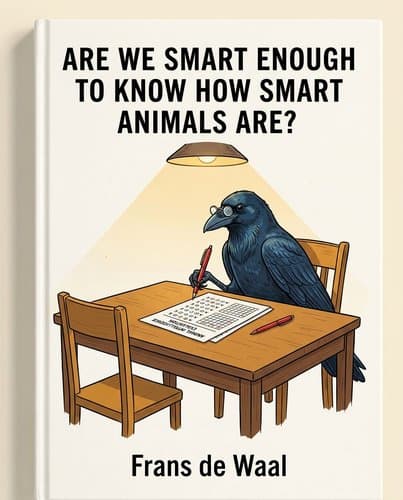
26530322_are-we-smart-enough-to-know-how-smart-animals-are
by Frans de Waal
Every time scientists declared a cognitive ability uniquely human—tool use, planning, self-recognition—animals proved them wrong. Frans de Waal reveals that…
In Brief
Every time scientists declared a cognitive ability uniquely human—tool use, planning, self-recognition—animals proved them wrong. Frans de Waal reveals that the real barrier to understanding animal minds wasn't their intelligence, but the flawed, human-centric tests we used to measure it.
Key Ideas
Test Design Failures Mask Cognitive Abilities
Before accepting a negative result about animal cognition, ask whether the test matched the animal's sensory system, anatomy, and ecological priorities. Most historical failures were failures of test design — the gibbons weren't cognitively limited, the task was anatomically wrong for them.
Critical Anthropomorphism Guides Rigorous Testing
Anthropodenial — the reflexive denial of humanlike mental processes in other species — is as scientifically distorting as naive anthropomorphism. The corrective is critical anthropomorphism: use human intuitions about a species to generate testable hypotheses, then run rigorous experiments.
Uniquely Human Claims Predict Future Reversals
Treat every 'uniquely human' cognitive capacity claim as a prediction about where the next reversal will come from. Tool use, face recognition, episodic memory, future planning, self-recognition, and cooperation have all already been found in non-human species. The pattern is the data.
Test Conditions Dramatically Alter Apparent Abilities
The Clever Hans problem cuts both ways: animals can appear smarter than they are (a horse appearing to do arithmetic), but they also appear far less capable than they are when tested by near-strangers of another species, under artificial conditions, using instruments designed for human hands.
Ask What Problem, Not How Human
The right question when studying any animal's cognition is not 'how close to human?' but 'what cognitive problems does this animal need to solve?' Each species evolved the intelligence its ecology demands — comparing them on a single scale produces rankings, not understanding.
Animals Plan and Remember When Tested Properly
Future planning and specific episodic recall are not uniquely human. The 'present-tense animal' was a philosophical assumption carried forward from behaviorism. When the tests are appropriate and the conditions are right, chimpanzees plan days ahead, scrub jays manage perishable food caches across time, and individual chimps recall single events from years prior.
Who Should Read This
Science-curious readers interested in Biology and Evolution who want to go beyond the headlines.
Are We Smart Enough to Know How Smart Animals Are?
By Frans de Waal
8 min read
Why does it matter? Because decades of animal intelligence research was actually measuring human blind spots.
Science spent most of the twentieth century producing a very tidy picture of what animals can and cannot think. The research was careful, the controls were rigorous, the conclusions arrived with confidence: animals could learn, react, and adapt — but they could not plan, empathize, recognize themselves, or understand the minds of others. These were human capacities. Full stop. No chimpanzee looked in a mirror and saw itself. No crow planned for a winter it hadn't yet experienced. No dog had any theory of what the dog beside it was feeling. The evidence was in; the question was closed. What the researchers forgot to ask was whether their tests could have detected such abilities even if they existed. Every experiment was designed by a human, administered by a human, and built around what seemed cognitively significant from a human vantage point. Frans de Waal's career is one long demonstration of what that error cost us — and a running record of what happens when you design tests around the animal instead. The wall between human and animal minds, it turns out, was always in the design.
The Test Was Built for Human Hands
At the National Zoo in Washington, Preston Foerder and Diana Reiss hung fruit just out of reach above a young elephant bull named Kandula. They placed sticks on the ground nearby: the standard tool-use test, the same one researchers had run on elephants for decades. Kandula walked past every stick. Then, after a while, he started kicking a large square box. He nudged it across the enclosure in a straight line, parked it beneath the fruit, placed his front legs on top, and reached up with his trunk. Problem solved.
What took decades to figure out: an elephant's trunk is its nose. Gripping a stick doesn't just feel awkward — it blocks the animal's nasal passages, cutting off the very sense it uses to locate and identify food. Asking an elephant to grab a stick is roughly equivalent to blindfolding a child and asking them to find Easter eggs. The test wasn't measuring elephant intelligence. It was measuring what happens when you design a task around primate hands and then run it on an animal that doesn't have any.
Once the researchers varied the setup, moving the box behind a barrier out of Kandula's line of sight, the elephant walked away from the food, retrieved the box from memory, and came back. Only a handful of species reliably do this: walking away from a goal to fetch a tool requires holding the solution in mind while the problem temporarily disappears from view. Kandula did it without hesitation.
The problem runs deeper than any single experiment. Every test was built to reveal what experimenters could already imagine finding, calibrated to their hands, their bodies, their idea of what a tool even is. When an animal scores poorly, we log it as data. We don't ask whether we asked the right question.
This is what makes the problem so persistent. The categories themselves — success, failure, capability, limitation — were filled in before the animal walked into the room. The question "can this species use tools?" presupposes that your version of tool use is the version that counts. Kandula answered a different question entirely. He just happened to answer it correctly.
What Science Called 'Parsimony' Was Sometimes Just Motivated Denial
In 1955, a new operant conditioning program launched at the Yerkes Primate Center in Florida, modeled on standard rat-lab protocols, including drastic reductions in body weight to maintain what researchers called food motivation. Within two years, the program fell apart. Staff had been secretly feeding the apes at night. When Skinner later reflected on the failure, he attributed it to "tender-hearted colleagues" who had frustrated efforts to reduce the chimpanzees to a "satisfactory state of deprivation." The phrase is its own exposure: animal hunger as a methodological resource, empathy as interference.
The program's own data had already delivered the rebuttal. One chimpanzee — catalogued as number 141 rather than by name — learned a task perfectly when rewarded with the chance to groom an experimenter's arm. Behaviorism had no category for this. Its architecture assumed food and pain were the universal motivators, because those were the levers that worked on rats. A social primate for whom grooming outweighed hunger was noise the paradigm couldn't process. The finding was attributed to social distraction and omitted from the published results.
What passed for scientific caution in animal cognition research for most of the twentieth century was less methodology than ideology — the assumption of human exceptionalism, defended in scientific vocabulary.
Morgan's Canon made that defense respectable. The British psychologist Lloyd Morgan had proposed in 1894 that between competing explanations, science should prefer the simpler one: a reasonable tiebreaker. He even noted explicitly that simpler doesn't mean truer, and that for demonstrably intelligent animals, complex interpretations are legitimate. What his followers made of it was something else: a standing instruction to assume the cognitive minimum about any animal, always, regardless of evidence. The result was a research culture where attributing intentions to a chimpanzee required scare quotes, while assuming they had none required no justification at all. That asymmetry isn't parsimony. It's a conclusion disguised as a method.
Every 'Only Humans Can Do This' Claim Has an Expiration Date
The face recognition story is worth following from start to finish. Recognizing individual faces was first treated as a primate specialty. Then crows: biologist John Marzluff found that crows in Seattle remembered the faces of specific people who had captured them, held the grudge for years, and taught it to birds who had never been near the original encounter. Those birds dive-bombed the strangers on sight, not because anything had happened to them personally, but because the information had moved through the flock. The fear was cultural, not just individual. Then wasps. The northern paperwasp, whose colony hierarchy requires every member to know precisely who outranks whom, has face recognition as refined as a primate's. A closely related wasp species whose simpler social life requires no such tracking lacks it entirely.
None of this is inheritance from a common ancestor. Primates and wasps diverged hundreds of millions of years ago. What connects them is the problem: when survival depends on knowing who's who, evolution converges on a solution. Same outcome, different mechanism — and de Waal gives this broader pattern a name: the cognitive ripple rule. Every capacity we discover will prove older and more widespread than we initially thought.
That's his formulation, and it's not a generalization about past trends — it's a prediction about future announcements. The next time a researcher declares some cognitive ability uniquely human, the ripple rule says: note the date. The countdown has started.
What gives the rule its force is that the ripples aren't exceptions. They're the pattern. Tool use, imitation, future planning, perspective-taking: each has traveled the same route, announced as exclusively human, confirmed in great apes, extended to other primates, then found in corvids or dolphins or octopuses. Every individual discovery arrives as a surprise. Assembled, they stop looking like surprises.
The paleoanthropologist Louis Leakey, who had sent Jane Goodall to Tanzania in the first place, saw the logic early. When Goodall reported that wild chimpanzees fashioned and used tools in the Tanzanian forest, Leakey wrote back that scientists faced exactly three choices: accept chimps as human, redefine humanity, or redefine tools. Science kept choosing the third option, tightening definitions until the bar cleared the evidence. Then the evidence rose again. The bar moved again. The third option keeps losing.
The ripple rule reframes what uniqueness claims actually are. Announcing a cognitive ability as exclusively human is no longer a statement about humans. It's a prediction about where the next reversal will land.
The Animal You Think Lives in the Present Is Planning Tomorrow
Every morning before the Swedish zoo opened its gates, a chimpanzee named Santino moved through his enclosure with unusual calm. He waded into the moat, collected stones from the bottom, and arranged them in small hidden piles away from the visitor walkways. Then he waited. Hours later, when crowds filled those walkways and Santino launched into a dominance display — hair raised, charging, the whole colony watching — he had ammunition he hadn't had to scramble for in the heat of the moment. He'd made those piles that morning, in an entirely different physiological state: no adrenaline, no audience, no urgency. Just a chimp doing a job he knew he'd need done later.
The behaviorist tradition had a ready answer for behavior like this: it didn't exist. The claim that animals were trapped in the present wasn't discovered by studying them — it was imported from a theoretical framework and sustained because dismantling it meant dismantling a century of psychology with it.
The state decoupling is what closes the escape routes. When he collected rocks, Santino showed none of the arousal he'd show when throwing them — no raised hackles, no charging, no agitation. If rock-throwing were simple stimulus-response to the sight of a crowd, there'd be nothing to cache in advance. You can't prepare for a reflex. But Santino did prepare, consistently, morning after morning, which means the future display was already present to him before anything in his environment demanded it.
The capacity to act on a future state while inhabiting a different present one was supposed to require something uniquely human: a self that could step outside the now. Santino, each calm morning, was already partly living in the afternoon.
De Waal isn't claiming chimpanzees time-travel the way we do. His point is that "trapped in the present" was never an empirical finding — it was a prior commitment that shaped which results were credited. Consider Franje, a female chimp at a Dutch zoo, who on a cold November morning gathered all the straw from her heated enclosure and hauled it outside to build a nest. She was bracing for cold she couldn't yet feel. Not reacting to a stimulus: anticipating a state. For a strictly behaviorist account to hold, you'd need to identify what cue, inside that warm building, was producing the response. The answer keeps pointing back to the same unwelcome word: foresight.
Intelligence Isn't a Ladder — Every Species Is a Peak
Ayumu didn't appear to be trying. The young chimpanzee at the Primate Research Institute in Kyoto would sit at a touchscreen, watch nine numbers appear in scattered positions across the display, and take them all in for 210 milliseconds — one-fifth of a second. Then the numbers vanished, replaced by white squares. Ayumu tapped them in ascending numerical order from memory. Repeatedly. Accurately. A British memory champion invited to compete managed the task when numbers stayed visible for a full second or more. Under Ayumu's conditions, he could barely function. The chimp won.
What Ayumu's performance revealed was the shape of a question animal cognition had been asking wrong — roughly equivalent to judging an architect, a musician, and a chess grandmaster on architecture scores alone. For roughly a century, researchers built tasks suited to human hands, human sensory ranges, and human priorities, then ranked other species by how well they performed them. The closer to human, the smarter. The musician would seem limited. The grandmaster might barely pass. You'd have learned something, just not what you intended.
The reason Ayumu's memory is superior is that it evolved to be. Wild chimpanzees navigating dense social hierarchies need to track who is where and what position everyone occupies, instantly and under pressure. Reading a social scene one-fifth of a second faster than a competitor has real consequences when the stakes are food, rank, or safety. Humans evolved language and cumulative culture instead. Neither is the upgraded version of the other. Both are answers to specific problems.
The Clark's nutcracker caches more than twenty thousand pine nuts each autumn across hundreds of locations spanning many square miles, then recovers most of them months later under snow. That spatial memory is superior for the problem it actually solves. Judging the nutcracker against human standards is like judging a fish by how well it climbs. You aren't measuring the fish. You're revealing the shape of your own assumptions.
Replace the ladder with a bush. Every branch reaches its own peak, shaped by the ecology the animal lives inside. The more interesting question isn't where any species ranks. It's what their lives actually require.
The Gradient Darwin Always Saw
De Waal's conclusion lands somewhere unexpected for a book about animal cognition: it echoes an argument a Scottish philosopher made in 1739, a full century before Darwin. Hume argued that behavioral resemblance between related species implies resemblance in their mental processes. If the outputs look alike, assume the machinery does too. De Waal's career has been the empirical proof of that principle, run in the field rather than the library.
But the deeper implication catches you off guard. Revising our picture of animal minds upward also means revising our picture of human minds downward — not into insignificance, but into continuity. Darwin's notebooks return to this point repeatedly: the emotional and mental lives of animals differ from ours in degree, not in kind. Every time a crow or a wasp or an octopus turns up carrying a capacity we'd cordoned off as exclusively ours, the wall loses another brick. What remains is both more modest and more interesting: not a species standing outside nature and observing it, but one thread woven through it, carrying a particularly expensive brain through the same pressures every other species faces — and only now becoming smart enough to notice.
Notable Quotes
“Look at the little froggy!”
“I feel that scientists holding to this definition are faced with three choices: They must accept chimpanzees as man, they must redefine man, or they must redefine tools.”
“Possessed of amazing intelligence, they learn quickly and remember easily with few repetitions. There is often an uncanny understanding of what is wanted and needed of them at any given time. Bred to love people, they bond very tightly to their owners.”
Frequently Asked Questions
- What is the main argument of Are We Smart Enough to Know How Smart Animals Are?
- De Waal argues that most historical evidence of animal cognitive limits reflects flawed test design, not actual limitations. The book surveys decades of research showing that each species evolved intelligence suited to its ecological needs, and well-designed tests consistently reveal far more sophisticated cognition than earlier experiments suggested. Rather than accepting negative results about animal intelligence, readers should first examine whether the test matched the animal's sensory system, anatomy, and ecological priorities. The gibbons weren't cognitively limited; the task was anatomically wrong for them.
- What is anthropodenial and why does it matter in studying animal cognition?
- Anthropodenial is the reflexive denial of humanlike mental processes in other species, and it distorts science as much as naive anthropomorphism does. The corrective approach is critical anthropomorphism: use human intuitions about a species to generate testable hypotheses, then run rigorous experiments to verify them. De Waal emphasizes that dismissing mental processes in animals simply because they're human traits is a scientific bias that prevents discovery of actual animal capabilities. This balanced approach allows scientists to explore which processes may be shared across species without imposing either naive assumption.
- Why do existing tests often fail to measure animal intelligence accurately?
- Tests often fail because they don't account for how the animal experiences its world. The Clever Hans problem illustrates this principle: animals can appear smarter than they are (a horse appearing to do arithmetic), but also far less capable when tested by unfamiliar people, under artificial conditions, using instruments designed for human hands. The right question isn't how close to human, but what cognitive problems does this animal need to solve. Matching tests to an animal's ecology, sensory abilities, and natural environment is essential for accurate assessment.
- What are examples of abilities previously thought to be uniquely human?
- De Waal shows that tool use, face recognition, episodic memory, future planning, self-recognition, and cooperation have all been found in non-human species. When tests are appropriate and conditions are right, chimpanzees plan days ahead, scrub jays manage perishable food caches across time, and individual chimps recall single events from years prior. The present-tense animal was a philosophical assumption carried forward from behaviorism, not a biological fact. Each claimed uniquely human capacity is really a prediction about where the next cognitive reversal will occur.
Related Book Summaries

Read the full summary of 26530322_are-we-smart-enough-to-know-how-smart-animals-are on InShort