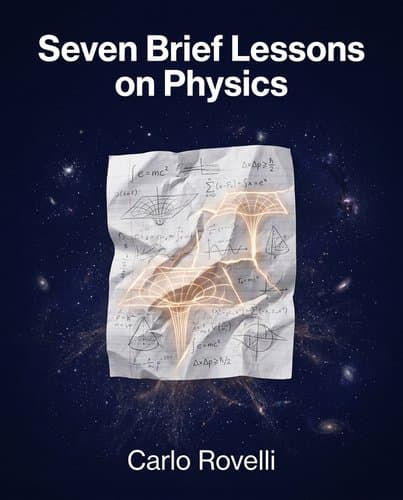
25734172_seven-brief-lessons-on-physics
by Carlo Rovelli
Carlo Rovelli distills a century of revolutionary physics into 79 pages, revealing how space curves, time dissolves, and matter vanishes into quantum…
In Brief
Seven Brief Lessons on Physics (2014) distills a century of modern physics — from general relativity and quantum mechanics to the nature of time and the structure of space — into seven concise, accessible chapters.
Key Ideas
Simple principle yields cosmic consequences
General relativity can be stated in half a line (space curves where there is mass), yet from that single equation fall black holes, the expanding universe, the Big Bang, and gravitational waves — the ratio of simplicity to consequence is unmatched in science
Quantum interpretation remains fundamentally unresolved
Quantum mechanics does not describe what a physical system IS, only how it affects other physical systems — after a century of use, physicists still disagree about what this means for the nature of reality
Truth transcends elegance in physics
The Standard Model of particle physics is our most accurate theory of matter and widely regarded by physicists as ugly and incomplete — elegance is not guaranteed to track truth, and the next layer of physics remains genuinely unknown
Time's arrow emerges from statistics
The arrow of time — past flowing into future — is not a fundamental law but a statistical phenomenon: in any process where heat is negligible, the laws of physics work equally well run in reverse
Spacetime emerges from quantum atoms
Loop quantum gravity suggests space itself is granular, made of discrete 'atoms' billions of times smaller than atomic nuclei, and that time does not exist at the elementary level — it emerges from relationships between quantum events
Cosmic abundance revealed through darkness
The Hubble Deep Field image — a patch of apparently black sky resolving into thousands of galaxies — implies thousands of billions of billions of billions of planets like Earth: the most useful single image for calibrating human scale
Science traces our stardust origins
Science is not campfire storytelling — it follows real traces toward something real, always ready to be wrong — and what it has found is that we are made of the same stardust as everything else in the universe
Who Should Read This
Science-curious readers interested in Physics and Neuroscience who want to go beyond the headlines.
Seven Brief Lessons on Physics
By Carlo Rovelli
14 min read
Why does it matter? Because the universe physics discovered is stranger than anything we imagined — and that strangeness is where we belong.
You probably think modern physics is something that happens to other people — in laboratories, behind equations, far from anything that matters. What Carlo Rovelli wants you to know is that physics has spent a century systematically destroying every assumption you hold about reality: that space is fixed, that time flows evenly forward, that matter is solid, that you are somehow separate from the rest of it. General relativity, quantum mechanics, thermodynamics — each hands you something stranger than what it took away. The astonishing thing, the thing that makes this slim book worth your full attention, is what's left when the comfortable picture is gone. Not emptiness. Not alienation. Something that feels, against all expectation, like coming home.
Einstein Spent a Year Loafing — and Rewrote the Universe
Picture a young man on a beach in Calabria, squinting through Mediterranean sunlight at a physics textbook whose corners have been chewed away by mice. Carlo Rovelli looks up from the equations, stares at the glittering sea, and for a moment feels he can actually see what the mathematics is describing — space itself bending, curving, alive. That experience of sudden vision is, he argues, exactly what Einstein's general theory of relativity deserves: not just comprehension, but the gut-level awe you feel standing in front of the Sistine Chapel.
The theory took a decade of anguish to produce. After publishing three landmark papers in 1905 — on the reality of atoms, the foundations of quantum theory, and special relativity — Einstein noticed a problem. His new understanding of space and time refused to fit with Newton's account of gravity. He spent the next ten years in what Rovelli calls frenzied study: wrong articles, brilliant dead ends, genuine confusion. The November 1915 solution, general relativity, emerged from that mess.
What Einstein had done was collapse a distinction everyone assumed was fixed. Newton's universe contained two separate things: space, a rigid invisible container through which matter moved, and gravity, a mysterious force that somehow reached across empty distance to pull objects together. Nobody could explain how this force worked. Einstein didn't explain it — he dissolved the question. The gravitational field and space are not two things. They are one thing. Space is the gravitational field. It curves, flexes, and warps wherever matter is present, and what we experience as gravity is simply the shape of that curvature.
The mathematical tool that made this writable was an unlikely inheritance. In the previous century, Bernhard Riemann had written a doctoral thesis generalizing how to measure curvature across spaces of any number of dimensions — work that struck everyone at the time as a beautiful solution to no known problem. Decades later, Einstein reached for it. Riemann's curvature, represented as R, gave him exactly the language he needed. His entire theory of gravity compresses into a single relation: R equals the energy of matter. Space curves where mass is. That is the whole idea, and it fits in half a line.
From that half-line fall consequences that read like a fever dream someone had the honesty to test. Light bends around the sun — confirmed by observation in 1919. Time runs fractionally faster at altitude than at sea level — confirmed by experiment. Massive dying stars can collapse so completely that they warp space into a sealed pocket with no exit, what we now call black holes, observed today in their hundreds. The universe itself must be expanding — verified in 1930.
All of that from one act of radical imagination: the willingness to look at two things everyone treated as separate and ask whether they might be the same thing.
Quantum Mechanics Works Perfectly and Nobody Understands It
Quantum mechanics is the most successful scientific theory ever written — and no one, including its inventors, has agreed on what it means.
The story of how we got here runs through three figures. In 1900, the German physicist Max Planck was calculating how heat energy behaves inside a closed box. To make the mathematics work, he treated energy as coming in discrete chunks rather than flowing continuously — a bookkeeping trick, he assumed, not a claim about nature. Einstein looked at the same trick five years later and said: no, the chunks are real. Light itself is made of individual packets. He opened his paper with the phrase 'it seems to me' — a hedge that Rovelli reads as the signature of genuine discovery. Darwin used the same instinct: in his notebook, before sketching the first branching diagram of the evolutionary tree, he wrote 'I think' — two words that turned out to contain biology's central idea. Einstein's colleagues were less impressed by the hesitation or the idea behind it; they treated the paper as the bright nonsense of an overconfident young man. It eventually won him the Nobel Prize.
What followed got stranger. The Danish physicist Niels Bohr showed that electrons inside atoms occupy fixed energy levels and jump between them by emitting or absorbing a single photon — never anything in between, never a smooth glide. In 1925, the young Werner Heisenberg wrote down the full equations of the new theory. His interpretation of what those equations described was radical enough to stop even Einstein cold.
Heisenberg's claim was not simply that we lack the instruments to track an electron's path. He argued that between interactions, an electron has no position at all — not an unknown position, but no position. It exists, in some meaningful sense, only at the moment it collides with something else. Reality, on this account, is not a collection of things sitting in definite locations; it is a web of interactions, and nothing sits anywhere between them.
Einstein recognized that Heisenberg had found something real, and nominated him for the Nobel Prize. He also spent the rest of his life insisting the picture couldn't be complete. He built elaborate thought experiments — the most famous involving a box filled with light — trying to expose a contradiction in Bohr's position. Bohr answered each one. The two men corresponded for decades, each shifting slightly, neither converting the other. Einstein conceded that the equations contained no internal contradiction. Bohr conceded that the interpretation was murkier than he'd first believed. Neither gave way on the central question: whether reality exists independently of observation.
When Bohr died, a photographer captured his study blackboard. Chalked on it was a diagram of Einstein's light-box experiment. The two greatest physicists of the century had argued the point to the last, and left it open. The equations of quantum mechanics run every transistor on the planet. What those equations are actually telling us about reality — after a century of argument, by the people best placed to settle it — remains genuinely unresolved.
Every Step Outward Makes Us Smaller — and the Sky More Crowded
Imagine looking at a patch of night sky so dark and empty that your thumbnail would cover it entirely. Now imagine pointing the Hubble telescope at that same thumbnail-sized void for days on end. What comes back is one of the most disorienting images in human history: thousands of faint dots, each one not a star but an entire galaxy containing a hundred billion suns — and most of those suns are circled by planets. Do the arithmetic and you arrive at a number so large the mind simply refuses it: thousands of billions of billions of billions of worlds like ours, in every direction we care to look.
Rovelli's point, though, is that we have had to discover this largeness in stages, and each stage required someone willing to throw out a picture that felt obviously true. More than two thousand years before Copernicus, a Greek thinker named Anaximander looked at the sun and moon wheeling overhead and asked a question no one had thought to ask: if everything revolves around us, what is the Earth actually sitting on? His answer was radical — nothing. The sky doesn't hang above us; it wraps all the way around. The Earth floats free, suspended in space with no support required. That single act of imagination, Rovelli argues, was the first genuine scientific revolution, arriving millennia before anyone had a telescope or an equation.
Every step since has followed the same pattern: a comfortable picture replaced by a stranger, larger, more vertiginous one. Earth at the center, then the sun at the center, then the sun as one unremarkable star among a hundred billion, then the galaxy as one speck among billions of galaxies. Science, as Rovelli frames it, is a sequence of harder and harder acts of seeing — and the honest reward for each one is the discovery that wherever you thought you were standing, you were standing somewhere considerably less important.
The Standard Model Explains Everything and Physicists Are Embarrassed by It
The Standard Model of particle physics — assembled over three decades and confirmed with extraordinary precision — is the theory physicists trust most and respect least.
Everything you can touch is made of fewer than ten types of elementary particles, all of them excitations of underlying fields rather than tiny marbles — blinking in and out of existence, swarming even in apparently empty space. The void seethes: reality at its deepest level is not a collection of stable objects but a continuous churn of fleeting events.
The theory that describes all of this — finalized in the 1970s and fully confirmed in 2013 with the discovery of the Higgs boson — works with almost embarrassing accuracy. It also looks, to anyone who cares about elegance, like a junk drawer. Certain fields interact through certain forces governed by certain constants, but no underlying principle explains why these fields, these forces, these precise values. The equations, applied directly, produce infinities — nonsensical results that physicists correct through a convoluted workaround called renormalization, imagining that the starting parameters are themselves infinite so the infinities cancel out. It produces the right answers. It satisfies no one who wants to understand why.
Paul Dirac understood this better than most. He was among the principal architects of quantum mechanics — one of the century's great theoretical physicists — and he spent the final years of his life returning, repeatedly, to the same verdict: 'we have not yet solved the problem.' Not a rival's critique. The builder's own assessment of his building.
Attempts to replace the Standard Model with something cleaner have run into the cruelty of experiment. One elegant candidate, the SU5 theory, unified the patchwork equations into a tighter structure and made a specific prediction: protons should occasionally decay, transforming into other particles. To test this, physicists surrounded thousands of tonnes of water with sensitive detectors and simply waited — years of watching for a single proton to come apart. None did. The theory died.
The uncomfortable question the Standard Model leaves behind is whether elegance is actually a guide to truth at all. Physicists keep reaching for beautiful alternatives. Reality keeps not cooperating.
Space Is Not Where Things Happen — Space Is What Things Are Made Of
What if the two greatest theories in all of physics simply cannot both be true?
That is the situation physics has been in for a century. A student who attends a morning lecture on general relativity and an afternoon lecture on quantum mechanics encounters two irreconcilable worlds. In the morning: a curved, continuous space-time in which everything flows smoothly. In the afternoon: a flat stage on which packets of energy leap between discrete levels, obeying equations where continuity has no role. Both theories are confirmed to extraordinary precision. Both are foundational to the technology around you. And they flatly contradict each other.
Rovelli's response is not despair but appetite. Physics has been here before. Einstein resolved the clash between electromagnetism and mechanics and came out with relativity. A contradiction between successful theories is not a failure; it is a forced opening. The current schism is one of those openings.
The most promising attempt to walk through it is called loop quantum gravity. Its argument runs like this: general relativity tells us that space is not an inert container but something dynamic, capable of flexing and warping. Quantum mechanics tells us that every dynamic field is granular — made of discrete quanta. Put those two lessons together and you cannot avoid the conclusion: space itself must be granular. Not infinitely divisible, but composed of irreducible chunks, roughly a billion billion times smaller than the nucleus of an atom. These are the loops — not objects sitting inside space, but the constituents of space itself, interlocked like links of chain mail into the fabric we move through.
The second consequence is harder to absorb. The equations of loop quantum gravity contain no variable for time. This doesn't mean nothing changes — change is everywhere. It means there is no single universal clock underneath events, ticking along while the universe happens to it. At the scale of these fundamental grains, each quantum process unfolds at its own pace, uncoordinated with its neighbors. What we experience as time — the felt sense of before and after, of a river flowing in one direction — is not a backdrop. It emerges from the relationships between quantum events, the way temperature emerges from the jostling of molecules rather than existing as a property of any one of them.
Consider a calm alpine lake. The surface looks glassy, continuous, still. Underneath, countless water molecules are moving rapidly in every direction. The stillness is real, but it is a coarse-grained average of something far more turbulent. Space and time are, on this account, the same kind of illusion — the smooth surface of something that, looked at closely enough, is a seething swarm of interactions with no container and no clock.
Physics has taken away our comfortable Earth at the center, our fixed stars, our absolute time. Now it is reaching for space itself.
The Arrow of Time Is Not a Law — It's a Statistical Accident
Why does time run in only one direction? You never see a scrambled egg reassemble itself, a shattered glass leap back together, a cold cup of tea warm spontaneously from the table beneath it. These reversals feel impossible — but are they?
Here is the unsettling answer: the laws of physics place no barrier against them. Run any physical process at the level of individual particles and the equations work equally well in both directions. Nothing in the fundamental mathematics forbids a cold teaspoon from drawing heat out of lukewarm tea and becoming colder still. The arrow of time is not a law. It is a statistical accident — and Ludwig Boltzmann paid his life to see this recognized.
Boltzmann's insight, worked out in the nineteenth century and met with derision, was that heat flows from hot to cold not because nature commands it but because it is overwhelmingly more probable. When a fast-moving molecule in hot tea collides with a slower one in a cold spoon, energy is far more likely to pass from fast to slow than the reverse. Across billions upon billions of such collisions, the improbable direction never wins. Temperature equalizes, always, because the mathematics of large numbers makes any other outcome fantastically unlikely — not impossible, just so improbable it will never happen in the lifetime of the universe. On September 5, 1906, in Duino near Trieste, Boltzmann died by suicide without ever witnessing the universal acceptance of this idea.
What this means for time is vertiginous. Past and future are distinguishable only where heat is involved. A frictionless pendulum swinging in a vacuum could, filmed and reversed, pass for normal footage — no law would object. The moment friction enters, the pendulum warms its support, loses energy, and slows. Now the film has an obvious direction. The arrow of time is thermodynamic, not mechanical. It emerges from the statistical behavior of vast numbers of particles, nowhere else.
Boltzmann's probability is tied to ignorance. We measure a balloon's pressure, volume, and temperature but remain blind to the precise position and velocity of each molecule inside. Our coarse grip on the world — the blurred view we actually have — is what makes some futures predictable and others open. A hypothetical being with full knowledge of every microstate (the exact position and speed of every particle) would see no arrow at all: past and future would look identical, two directions through a fixed landscape. The flow of time, our most visceral experience of reality, is what ignorance looks like from the inside.
Einstein, who had already shown through relativity that there is no single universal now, reached the same conclusion — and in a letter written after his closest friend Michele Besso died, he called the distinction between past, present, and future 'a persistent, stubborn illusion.' That phrase costs something to sit with. Not because it is pessimistic, but because it means our deepest sense of being alive — of moving through moments, of having a past and anticipating a future — is a feature of our limitations, not of the universe.
We Are Not Strangers in the Universe — We Are Made of It
The universe strips you of every comfortable illusion — fixed space, absolute time, a stable self at the center of things — and then, if you follow Rovelli all the way to the end, hands something back. Not consolation. Something more solid: the claim that physics has not revealed a world we are strangers in, but the world we are built from.
Spinoza is where this lands most precisely. We feel free, Rovelli argues, and we are right to feel it — but freedom doesn't mean some ghostly 'I' hovering above the neurons, occasionally overriding them. The self and the neurons are the same process. When the seventeenth-century Dutch philosopher Baruch Spinoza made this argument, it was heresy. Now it's neuroscience. You have roughly a hundred billion neurons — as many as there are stars in the Milky Way — linked by a number of possible connections so vast it defeats imagination. You are conscious of a fraction of what that network is doing at any moment. The intensity of your felt sense of freedom comes precisely from this gap: your self-image is a rough sketch, and the actual complexity churning beneath it is inexhaustible. We are amazed by ourselves because we barely know ourselves. The 'I' that decides is not separate from this process. It is the process.
Rovelli makes the same move on the largest scale: we are not observers watching nature from outside, we are a temporary expression of it. He says plainly that our species will almost certainly not last long — that the environmental damage we've set in motion is unlikely to spare us. The turtle has held its basic form for hundreds of millions of years. We have barely started, and already we are rewriting the climate that made us. This is not delivered as despair. It is delivered in the same register as everything else in the book: here is what the evidence shows, here is what it means, here is what it feels like to look at it honestly. Earlier civilizations — the Maya, the Cretans — collapsed too. Stars are born and die. So do species.
The strangeness physics has uncovered — granular space, timeless equations, a self that is a neural process rather than a soul — turns out to be the texture of the place we already live. Rovelli's last image is not alienation but homecoming: we are made of the same stardust as everything else, and the curiosity driving us to map the cosmos is itself part of the cosmos mapping itself.
The Strangest Discovery Physics Made Was That We Belong Here
Here is what physics leaves you with, if you follow it honestly to the end: not a cold ledger of forces and particles, but something closer to recognition. Every comfortable intuition got dismantled along the way — solid matter dissolved into fleeting interactions, space turned out to be elastic, time an emergent fiction, the self a neural storm that calls itself "I." That should feel like loss. Rovelli's quiet wager is that it doesn't — that when you learn the iron in your blood was forged in a dying star, that the atoms composing you have been composing other things for billions of years and will again, the response that rises isn't alienation but something older and harder to name. You were never separate from the universe, watching it from outside. The strangeness was always home.
Frequently Asked Questions
- What are the main topics covered in Seven Brief Lessons on Physics?
- Seven Brief Lessons on Physics distills a century of modern physics into seven concise chapters exploring general relativity, quantum mechanics, particle physics, the nature of time, space structure, and the scale of the universe. Theoretical physicist Carlo Rovelli presents discoveries that fundamentally challenge common sense: space curves around mass, quantum systems remain undefined until interaction occurs, the arrow of time is statistical rather than fundamental, and space itself may be granular at quantum scales. The book reveals how elegance doesn't guarantee truth in physics, and demonstrates that we're composed of cosmic stardust shared with everything in the universe.
- What does Carlo Rovelli explain about quantum mechanics?
- According to Rovelli, quantum mechanics fundamentally differs from our intuitive understanding of reality. "Quantum mechanics does not describe what a physical system IS, only how it affects other physical systems." After a century of use, physicists still disagree about what this means for the nature of reality at the quantum level. This uncertainty extends to the very foundation of quantum theory—we have a mathematically predictive framework that works extraordinarily well, yet the physical interpretation of what's actually happening remains contested among leading physicists.
- How does Carlo Rovelli describe the relationship between space and gravity?
- In Seven Brief Lessons on Physics, Rovelli explains that general relativity can be stated remarkably simply: space curves where there is mass. From this single elegant principle emerges an extraordinary cascade of phenomena: black holes, the expanding universe, the Big Bang, and gravitational waves. The ratio of simplicity to consequence is unmatched in science. This fundamental insight transforms our understanding of the cosmos from a fixed container in which objects move to a dynamic fabric that warps in response to matter and energy.
- Is Seven Brief Lessons on Physics worth reading?
- Seven Brief Lessons on Physics is worth reading for anyone wanting to understand what modern science has genuinely discovered about reality without technical jargon. Rovelli presents the universe as far stranger and more beautiful than common sense suggests, exploring topics from black holes to the granular nature of space itself. The book challenges assumptions about time, elegance in science, and human significance—using the Hubble Deep Field image to contextualize Earth as one of billions of billions of planets. It offers essential perspective on scientific methodology and our place in the cosmos.
Related Book Summaries

Read the full summary of 25734172_seven-brief-lessons-on-physics on InShort