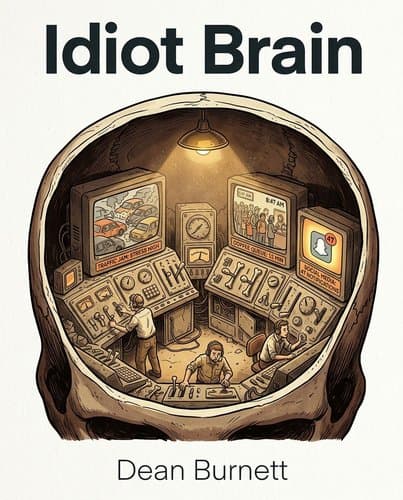
26530389_idiot-brain
by Dean Burnett
Your brain isn't malfunctioning when it makes you anxious, irrational, or forgetful—it's running million-year-old survival software in a world it was never…
In Brief
Idiot Brain (May ) explores why the human brain routinely undermines us — through false memories, irrational fears, poor decisions, and emotional misfires — by tracing each quirk to ancient survival programming mismatched with modern life.
Key Ideas
Unresolved physical tension perpetuates lingering anxiety
When the fight-or-flight response fires at something harmless — a noise in the dark, a social confrontation — the physical aftermath (tense muscles, residual adrenalin, cramps) is real and needs a physical outlet. The brain prepared your body for a sprint it never took; not releasing that tension is what causes lingering anxiety, not the original trigger.
Your brain rewrites history to star you
Before trusting a vivid memory, ask who benefits from it being accurate. Egocentric bias systematically inflates your own role in group decisions and group successes — not through lying, but through genuine rewriting. If you remember yourself as more central, your choice as wiser, or the outcome as more predictable than it felt at the time, your brain's publicist has been busy.
Extreme confidence often masks deep ignorance
Treat extreme confidence as a prompt for more scrutiny, not less. The Dunning-Kruger effect runs in both directions: the least informed are often the most assertive, while genuine expertise tends to produce calibrated uncertainty. In any high-stakes domain — medicine, finance, policy — the person hedging their answer may be the one who actually knows.
Pause before requests following prior agreements
Recognize the three main compliance techniques — foot-in-the-door (small yes primes larger yes), door-in-the-face (large rejected request makes smaller one feel like relief), and low-ball (agree to terms, terms change, you comply anyway). The antidote to all three is the same: a deliberate pause before any request that is framed as a natural follow-on to something you've already agreed to.
Early anger release prevents explosive breakdown
Anger is not purely destructive. Research shows it activates the brain's approach-motivation system, lowers cortisol, and produces more honest negotiations. The problem isn't feeling anger — it's accumulated anger with no viable outlet, which produces displacement: disproportionate explosions at undeserving targets. Finding a physical or direct release for minor anger early reduces the likelihood of a 'broken dam' event.
Depression is brain plasticity failure, not chemistry
Depression is more accurately understood as a plasticity failure than a serotonin shortage. The brain becomes 'stuck' — unable to form new connections in response to stress, unable to escape established negative loops. This reframe is clinically meaningful: the goal of treatment is restoring flexibility, not topping up a depleted chemical, which changes what recovery looks like.
Who Should Read This
Science-curious readers interested in Neuroscience and Behavioral Psychology who want to go beyond the headlines.
Idiot Brain
By Dean Burnett
9 min read
Why does it matter? Because almost every irrational, embarrassing, or baffling thing you do makes perfect sense — once you understand the million-year-old survival machine running it.
You probably think your brain is competent — sophisticated hardware that occasionally glitches under stress, or when you're tired, or when someone cuts in line at the coffee shop. You assume the peculiar stuff is the exception. The anxiety before the presentation, the road rage, the 2am regret spiral: these feel like departures from an otherwise steady baseline. Dean Burnett would like to correct that assumption, gently, and with considerable amusement.
The peculiar stuff is the system. What you call "glitches" — the irrational fears, the self-serving memories, the social anxieties, the inexplicable appetite for bad decisions — are the brain executing exactly the program it was built to run. That program was written millions of years ago, for a world where the things trying to kill you were visible and the things keeping you alive were scarce, and it has absolutely no idea it's been relocated to the twenty-first century. You didn't inherit a precision instrument. You inherited ancient survival firmware running in a world that has moved on without it, and once you understand that, almost everything confusing about human behavior starts to make a strange, uncomfortable kind of sense.
The Brain That Keeps You Alive Is Also the One Making You Throw Up on a Boat
Your brain is not on your side. The part of your brain that keeps you breathing and upright is ancient, blunt, and completely ill-equipped for a world it never evolved to handle. It will protect you. It will also, fairly regularly, make you vomit on a perfectly nice boat.
Motion sickness is almost too perfect an illustration. Humans are extraordinarily good at moving. We've covered every continent and made it to the moon, so clearly the locomotion system works. We even have nerve clusters in the spine that coordinate walking without conscious involvement. The system is robust.
Until you get in a car.
When traveling by vehicle, you're sitting still. Your proprioception, the body's system for tracking position and movement, reports nothing. Your eyes confirm you're not doing anything particularly athletic. But your inner ear, those fluid-filled canals that detect acceleration and balance, is screaming that you're hurtling through space at speed.
The primitive brain receives these signals simultaneously. On one side: stillness. On the other: rapid movement. It cannot resolve the contradiction. In the world this brain evolved for — one without cars or cruise ships — only one thing causes such internal confusion: poison. Something has entered the system. The only reasonable response is to evacuate the stomach immediately.
So it does.
Your neocortex knows perfectly well you're on the motorway, not dying. But the reptile brain, once committed to the poison theory, isn't interested in updates. It's the managerial equivalent of someone who's been doing the job for forty million years and has no interest in feedback from the new hire.
The comedian Spike Milligan got through the Second World War without catching seasickness once. Asked for his remedy, he gave three words: "Sit under a tree." The reasoning is sound: a stationary reference point reconciles what the eyes and inner ear are reporting, the poison diagnosis gets dropped, and the reptile brain stands down.
The physics is just where it starts. The brain is at least as confident, and at least as wrong, about the past.
Your Memory Isn't a Record of What Happened — It's a Publicist for Who You Were
In the summer of 1973, John Dean sat before a Senate committee and told investigators everything: the meetings, the planning sessions, the conversations that had built the Watergate cover-up from the inside. He spoke for hours. He was meticulous. He had total confidence in what he was saying.
The White House tapes told a different story.
When investigators compared Dean's account against the actual recordings, they found he'd gotten the broad shape of events roughly right — but the details of his own role were dramatically inflated. He'd described himself as a key architect. The tapes placed him at the margins, a minor participant at best. He hadn't lied. His brain had simply rewritten the record to give him a more flattering part.
This is egocentric bias, and the unsettling thing isn't that it happens. It's that it happens below the level of consciousness. Dean wasn't performing for the committee. He was reporting what he genuinely remembered. The modification had occurred quietly, at some point between the event and the recollection, in the ordinary course of the brain doing its housekeeping.
And the brain does this constantly. Every time a memory is retrieved, it's also slightly rewritten, which means the more you revisit something, the more opportunity there is to polish it. You made the call in the meeting, not someone else. You caught a respectable fish, not a minnow. You saw it coming before anyone else did. The memories aren't fabricated so much as edited. The original footage quietly replaced by a press release.
Why? Partly because decision-making requires confidence, and confidence requires a track record. If your brain let you dwell on every judgment call you got wrong, you'd be too paralyzed to cross the street. So it quietly adjusts the archive, not enough to invent new events but enough to shade existing ones toward competence and centrality.
You can be completely sincere and completely wrong about your own past. Not lying. Not misremembering in the fuzzy way of a half-forgotten dream. Wrong, with full conviction, because the source you're drawing on has been altered by the very act of being the person whose story it is.
Your memory isn't a recording. It's a publicist — one you hired without knowing, who's been quietly managing your reputation ever since.
You Don't Enjoy Horror Films Despite Being Scared — You Enjoy Them Because of It
Why do Stephen King and Dean Koontz have a combined readership in the hundreds of millions, when what they're selling is the experience of being frightened? Fear is supposed to be the brain's alarm system — a warning to flee or fight, not something to seek out on a Friday evening with popcorn.
The answer lies in what the reward system actually rewards. Deep in the brain, a reward circuit handles pleasure. One region detects whether something is good or bad; another — the nucleus accumbens — produces the appropriate signal. Eat something delicious: reward fires. Drink curdled milk: disgust fires. Straightforward enough. But here's what the brain designers apparently didn't anticipate: the reward pathway fires with particular intensity not when something good begins, but when something dangerous stops.
When the haunted house tour ends and you're back outside, the brain doesn't just feel relieved. It treats the experience as a genuine near-death escape, because as far as the threat-detection system was concerned, that's exactly what it was. The adrenalin already in your system from the fight-or-flight response amplifies everything. The reward hits harder than almost any benign pleasure can, because benign pleasures don't have thirty seconds of terror as a setup. The brain is rewarding its own false alarm. And it turns out that feels incredible.
The mechanism explains a detail that seems minor but isn't: why horror novels can terrify in ways that realistic video games cannot. A game responds to your inputs: you can pause it, restart it, steer the character away from danger. The brain registers this agency and quietly dials down the threat response, because genuine threats don't come with a pause button. A horror novel offers no such comfort. The story proceeds without you. You cannot stop what happens next. That loss of control is precisely the condition that keeps the threat response fully activated, which means the survival reward, when the last page finally closes, hits at full strength. King and Koontz are not just writers. They're engineers of controlled helplessness.
The Less You Know About Something, the More Certain You Are — and Your Brain Cannot Correct This
A man walked into a bank one afternoon with no mask, no disguise — just his face and quiet confidence. He'd taken a precaution, though. Before the robbery, he'd covered his features in lemon juice, because lemon juice can be used as invisible ink, and therefore, logically, his face wouldn't show up on camera.
He was arrested the same day, genuinely baffled.
When David Dunning and Justin Kruger at Cornell heard about this case, they recognized it as something more than a crime story. They ran experiments where participants completed tests and then estimated how well they'd done. The pattern was immediate and stark: people who performed worst almost always believed they'd done much better than they had, while people who performed well tended to assume they'd fallen short. The gap wasn't modest — poor performers didn't think they'd scored average. They thought they'd aced it.
The explanation Dunning and Kruger landed on is the part that sticks: recognizing your own incompetence requires the very competence you're missing. You can't perceive the limits of what you don't know, because that perception is itself a skill. The lemon-juice robber didn't choose his approach despite understanding how cameras work; he chose it because he didn't, and couldn't tell the difference. The same mechanism runs in far less dramatic situations: the confident opinion in an argument you haven't studied, the dismissal of an expert by someone who's never needed to be one.
Late in his life, Einstein reportedly told a colleague that the admiration his work received made him deeply uncomfortable, that he felt like an involuntary swindler who'd somehow gotten away with something. Not exactly a man with grounds for self-doubt. But the dynamic Dunning and Kruger identified runs in both directions. Intelligent people keep discovering how much they don't know. They're surrounded by peers who will immediately spot their mistakes. Every new thing they learn opens onto a larger territory of things they haven't learned yet. Confidence, under those conditions, becomes genuinely hard to sustain.
The brain isn't calibrated for accuracy — it's calibrated for confidence, and it applies that setting most forcibly to the people who most need correcting.
Your Brain Is Running a Background Program to Be Liked — and Anyone With a Script Can Exploit It
Think of your brain as a computer that, alongside whatever you're consciously doing, is running a permanent background process: one that monitors what nearby people think of you and adjusts your behavior to keep the approval rating high. You didn't install it. You can't close it. And anyone who knows it's there can exploit it without your conscious mind ever catching on.
The clearest evidence for this is how little sophistication is required to manipulate someone. Researchers tested two sequences for getting students to complete an arithmetic test. In the first condition, students were asked a small favor first, then a larger one — the classic foot-in-the-door approach. Six in ten complied. In the second condition, researchers opened with a large request, got turned down, then immediately scaled back to the test. Nine in ten agreed. Same students. Same test. Completely different compliance rates — from a single change in the order of asking. No charm, no persuasion, no particularly compelling argument for why arithmetic tests deserved their time.
The mechanism behind that second result is the background program doing its job. When someone makes a smaller request after you've refused a bigger one, the brain doesn't process this as "a request I didn't ask for." It registers the smaller ask as a concession — something that person did for you. Reciprocity fires. And underneath reciprocity is the deeper drive: you already said no once, which put a dent in their approval of you, and the path back to good standing is agreeing now. The brain resolves social tension at the expense of your rational self-interest, and it does this in milliseconds, well before conscious judgment gets a say.
What's striking is that the brain runs this program regardless of whether you know about it — the compliance study caught it from the outside, in behavior you couldn't quite explain afterward; neuroimaging caught it from the inside. When researchers scanned subjects trying to manage how others saw them, impression management generated no distinctive brain signal when people were trying to look good. The regions involved only lit up noticeably when subjects tried to seem bad. Looking good is simply what the brain does by default. Trying to scan for it is like trying to find one specific raindrop in a storm.
You're not being outmaneuvered by a clever opponent. You're being run by a program that was installed before you knew you were a person.
Mental Illness Isn't a Different Kind of Brain — It's the Same Systems, Pushed Past Their Limits
That reward circuit, the one behind every pleasure signal the brain generates, normally requires something useful first. Survive a threat. Find food. The reward follows because something worth reinforcing happened. Drugs skip this entirely, activating the pathway directly, the way a counterfeit key opens a lock: no credentials, full access. The brain, never having evolved to distinguish earned pleasure from a chemically induced facsimile, responds with the full signal.
What follows is the same-systems logic running to its conclusion. The brain compensates by downregulating, turning down pleasure's volume so the drug can't keep overwhelming it. The user escalates; the brain compensates again. Eventually the whole system is calibrated around the drug's presence. Remove it, and what remains isn't a brain at baseline. It's a brain tuned for tolerance, now running without what it was tuned for. This is why heroin withdrawal isn't a willpower problem. The pain-detection system, suppressed for months, had been amplified just to punch through the high. Take the drug away; the amplification stays. The agony isn't a side effect; it's the brain's own defenses, running unchecked.
Depression works from the opposite direction. SSRIs raise serotonin within hours, but clinical improvement takes weeks, which suggests the chemical-imbalance explanation misses something. The better candidate is neuroplasticity: the brain's capacity to form new connections under stress and reorganize in response to difficulty. In depression, that capacity is impaired. The brain becomes rigid, stuck in whatever pattern it was already running, unable to build its way out. Antidepressants may work not by correcting a deficit but by eventually restoring the ability to change.
PTSD comes from the flashbulb-memory system — the mechanism that locks in vivid, permanent records of dangerous events so you never repeat them. The right design, until the event is bad enough. Then the system doesn't just record it; it replays it, unbidden, indefinitely. The tool designed to prevent re-exposure becomes the re-exposure.
Mental illness is the same brain architecture from every earlier chapter, running past its limits — which means normal was already closer to the edge than most people assume.
Impressive, Isn't It? But Also, a Bit Stupid.
The lemon-juice bank robber, John Dean, and everyone who agreed to something absurd because the request came in the right order have one thing in common: a completely standard brain, doing exactly what it was built for. The architecture that produces motion sickness also produces curiosity. The memory that casts you as the hero keeps you moving after bad calls. And the circuits that tip into addiction or depression aren't a separate category of brain — they're just this one, pushed past its tolerances. Which means the line between "fine" and "not fine" was never as wide as the clinical labels suggest. You were already running closer to the edge than you knew. That doesn't fix anything. But it means you can stop layering shame on top of what the brain is already doing — and that, at minimum, clears some space.
Notable Quotes
“In the cortex, where it's processed further, the more analytical part of the brain looks at the information and wonders”
“while running for your life). When faced with a potential threat, both brain and body rapidly shift to a state of enhanced awareness and physical readiness to deal with it. But the problem with this is the”
“aspect. The fight-or-flight response kicks in before we know whether it's actually needed. Again, this makes logical sense; the primitive human who runs from something that might be a tiger was more likely to survive and reproduce than the one who said,”
Frequently Asked Questions
- What is Idiot Brain about?
- Idiot Brain explores why human brains undermine us through false memories, irrational fears, poor decisions, and emotional misfires. Dean Burnett traces these quirks to ancient survival programming mismatched with modern life. The book uses neuroscience to explain mental glitches—showing our brains evolved for a prehistoric environment where quick reflexes meant survival. Today, those neural patterns fire in counterproductive situations like anxiety at social gatherings. Burnett provides tools to recognize when your brain is "running millions-year-old code to their disadvantage," helping readers understand why evolution sabotages modern life.
- What should I understand about my memories according to Idiot Brain?
- Before trusting vivid memories, ask who benefits from accuracy. Dean Burnett explains that "egocentric bias systematically inflates your own role in group decisions and group successes — not through lying, but through genuine rewriting." Your brain rewrites your past to cast you favorably. If you remember yourself as more central to decisions, your choices as wiser, or outcomes as more predictable, "your brain's publicist has been busy." This reframing happens unconsciously and systematically, making self-perception increasingly distorted from reality. Understanding this mechanism helps you question autobiographical memories and catch where your brain has embellished your role.
- How does the fight-or-flight response create lingering anxiety according to Idiot Brain?
- The physical aftermath of fight-or-flight activation is real and requires a physical outlet. When triggered by harmless stimuli—like a noise in the dark or social interaction—"the physical aftermath (tense muscles, residual adrenalin, cramps) is real and needs a physical outlet." Your brain prepared your body for a sprint it never took, leaving activated muscles and hormones with nowhere to go. "Not releasing that tension is what causes lingering anxiety, not the original trigger." This explains why anxious people feel restless or compelled to move. Finding a physical outlet for tension is therefore crucial for managing anxiety.
- How does the Dunning-Kruger effect influence who we should trust according to Idiot Brain?
- Treat extreme confidence as a prompt for scrutiny, not less. Dean Burnett explains that "the Dunning-Kruger effect runs in both directions: the least informed are often the most assertive, while genuine expertise tends to produce calibrated uncertainty." In high-stakes domains like medicine, finance, or policy, the person hedging their answer may be the one who truly knows their subject. This counterintuitive insight suggests overconfidence often marks incomplete knowledge, while true expertise comes with awareness of complexity. Recognizing this pattern helps you identify trustworthy expertise versus charismatic overconfidence when making critical decisions.
Related Book Summaries


Read the full summary of 26530389_idiot-brain on InShort