23019289_ashley-s-war
by Gayle Tzemach Lemmon
Meet the women who fought America's shadow wars in Afghanistan—'attached, not assigned' to Ranger units so the military could skirt its own combat ban.
In Brief
Meet the women who fought America's shadow wars in Afghanistan—'attached, not assigned' to Ranger units so the military could skirt its own combat ban. Ashley White's story exposes how bureaucratic fiction collides with battlefield reality, and what it truly costs to ask someone to serve.
Key Ideas
Institutions absorb change through administrative stealth
Institutional change in the military rarely begins with policy — it begins with commanders leaving personnel fields blank, calling assignments 'support' instead of 'combat,' and creating programs built specifically to stay in legal shadows. The CST program is a case study in how large institutions absorb change they officially resist.
Tactical imperative overcame ideological institutional resistance
The strategic case for women in special operations wasn't ideological — it was tactical. Half of Afghanistan's population was completely inaccessible to male soldiers. The intelligence gap was real, measurable, and lethal. Amber's five-man count is the simplest proof: one woman's access to a group of frightened Afghan mothers saved a Ranger's life.
Integration demands asymmetrical burden of proof
The burden of proof in integration is rarely symmetrical. The CSTs had to prove themselves every night, knowing that a single failure would be attributed to all women, while a decade of successes would be credited to the program in aggregate. Scottie Marks's 'diamond among diamonds' insight names this specifically: being exceptional is not the same as being accepted.
Bureaucratic euphemisms obscure deadly human realities
Bureaucratic language ('attached not assigned,' 'enablers,' 'combat support') does real human damage when it obscures what people are actually doing and dying for. Bob White's question at Dover — 'if they are getting killed out there, what in the hell is the difference?' — is not rhetorical. It is the sound of a legal fiction meeting a father's grief.
Revoking meaningful work inflicts institutional harm
The cost of giving people access to meaningful, high-stakes work and then taking it away is its own kind of institutional harm. Kate's outburst — 'there is no place else for us to go' — is the grief of someone who has been shown what they're capable of and then sent back to a world that won't use it.
Who Should Read This
History readers interested in Military History and World History who want a deeper understanding of how we got here.
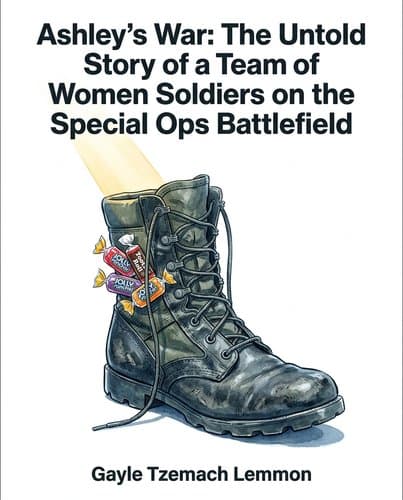
Ashley's War: The Untold Story of a Team of Women Soldiers on the Special Ops Battlefield
By Gayle Tzemach Lemmon
11 min read
Why does it matter? Because the question of whether women belong in combat was already answered on hundreds of night raids before Washington admitted it.
The debate over women in combat has been conducted almost entirely by people who weren't there. Congressional hearings, op-eds, think pieces — the argument raged for years among people with no way to resolve it. Meanwhile, in Kandahar's vineyards at two in the morning, in mountain villages in eastern Afghanistan, on the dark approach to compound after compound, the question was already being answered. Women carrying rifles and candy, searching Afghan women that male soldiers couldn't touch, counting armed men inside walls that Rangers were about to breach — they were deciding the argument in real time, on every mission, in a program so classified that their own families didn't know it existed. Ashley's War tells the story of those women: what they sacrificed to get there, what they found when they arrived, and what it cost the women who proved it to prove something the country wasn't yet ready to admit.
Before Anyone Admitted Women Were in Combat, They Already Were
Kandahar, August 2011, 2200 hours. A soldier methodically works through a gear checklist in a plywood-shelved ready room that smells of gun oil. Helmet and night-vision goggles. M4 rifle. M9 pistol. Ammunition. Eye protection. Tourniquets. And then, tucked in alongside the lifesaving equipment: Jolly Ranchers and Tootsie Rolls for village kids. Check, check, check, all the way down the list. The soldier joins dozens of Rangers — men with Purple Hearts and double-digit deployments — for a mission briefing, files onto a helicopter in the dark, runs off the bird into a swirling brownout, and marches in total silence through vineyards and dry riverbeds toward a target compound. Only when the radio crackles — "CST, get up here" — do you learn that the soldier carrying fifty pounds of gear through the Afghan night is Second Lieutenant Ashley White, and that the Cultural Support Team she leads exists precisely because male soldiers cannot do what she is about to do.
The policy debate over women in combat was, by this point, almost beside the point. In conservative Pashtun areas, an unwritten tribal code called Pashtunwali held that male soldiers could not interact with, search, or even glimpse a woman without causing a serious offense against family honor. Which meant that in any raided compound, every room where women might be hiding weapons, sheltering fighters, or simply holding information was effectively off-limits. A 2010 military journal article put a number on the result: American servicewomen had a higher chance of getting pregnant that year than of actually meeting an Afghan woman outside the wire. Half the country's population — and everything they knew — was invisible.
The Army Kept Inventing Workarounds Because the Mission Left No Other Choice
The Army didn't decide to integrate women into special operations because attitudes changed. It integrated because the mission kept running into a wall, and commanders on the ground kept quietly moving the wall. Long before the Cultural Support Team program existed, female officers were already filling roles the Army's own personnel system said they couldn't hold. Anne Jeremy became her combat engineer company's first female executive officer in Afghanistan while her colonel left the relevant field in her file blank — job done, paperwork corrected later. Tristan Marsden led an artillery platoon and then became her battery's first female XO, both positions officially coded male-only, because her commander read her file and decided she was the best person available. Nobody changed policy. They just stopped enforcing it against the people they couldn't afford to lose.
The CST program formalized that pattern. Admiral Olson's lawyers found that women could be "attached" rather than "assigned" to Ranger units — a distinction that preserved legal cover against the 1994 ground combat ban while putting women exactly where the mission required. The name was engineered with similar care: drop "female" to reduce friction with the men, add "support" to fend off accusations of a backdoor combat role, keep "cultural" to describe what the teams actually did. The architecture was designed to make the workaround survivable inside an institution still officially opposed to what it was already doing.
The attached-not-assigned language was just the formal version of what commanders like Jeremy's colonel had been doing informally for years — leaving fields blank, calling someone the best person available, fixing the paperwork later. The alternative was leaving half of Afghanistan permanently out of reach.
Being the Best Woman in the Room Is Not the Same as Being a Diamond Among Diamonds
That's the realization Sergeant Scottie Marks watched hit the CSTs during their pre-mission training week. Marks had trained Rangers for years after a blown knee ended his twelve-plus deployments to Iraq and Afghanistan. When he took on the task of readying the first female Ranger enablers, his colleagues ribbed him about babysitting girls. He designed the same combat-mindset course he ran for everyone else. By day three, he was telling a colleague these were the best soldiers he'd ever seen. By the final day, he'd figured out why so many of them were quietly miserable.
Every one of them, he told the assembled group, had spent her entire Army career as the standout woman in her unit. The unchallenged best. And now, for the first time, the person next to her was just as good — or better at something specific. He didn't call it perfectionism. He called it the shock of equality: you're not failing, you've simply found your actual peers for the first time. You're a diamond among diamonds now, he said. Stop being frustrated. Figure out who's beating you and why, then get better.
The line landed because it was precise. Kate Raimann had stayed with an injured soldier during a ruck march over an instructor's objections, then sat in her evaluation and heard herself described as average, middle of the pack at best — before the acceptance folder slid across the desk. She wasn't unaccustomed to excellence. She was unaccustomed to being surrounded by it. Marks saw that the adjustment wasn't physical. It was the harder work of learning what you're actually made of when the room finally matches you.
One Word — 'Liability' — and a Decade of Preparation Explodes
That argument about evaluation — about who gets trusted with what, and why — plays out most viscerally in a single classroom exercise at Fort Bragg.
Amber has spent a decade getting ready for this moment. Not this exact role-play, but for the argument itself. She walks to the front, lays out the case calmly: male soldiers can't reach half the Afghan population, the CSTs can, she has Farsi training that could cover Dari-speaking areas without pulling interpreter resources. The Special Forces role-player stares back like she's reading from a take-out menu. Then comes the word: she'd be a liability.
The word has a specific history for Amber. When she was nineteen, a private first class working as an intelligence analyst in Bosnia, she made the same pitch to special operations soldiers twice her age — let me come with you to capture war crimes suspects, I'll bring an interpreter, I'll talk to the women. They heard her out patiently and explained that she would just be a liability. They weren't wrong; she wasn't physically ready. But she heard it as a challenge and spent the next ten years answering it: marathon, sub-six-minute mile, CrossFit twice daily, a body and a mind she had systematically forged into something harder. She showed up to the CST program as the living refutation of that word.
To hear it again, after all that, is too much. She challenges the role-player to a PT test. She offers to start doing push-ups on the floor right now. She's on her feet, leaning forward, voice rising, and the room goes still. Kate, watching from a few rows back, has the sensation of seeing a car meet a wall in slow motion — half horrified, half relieved that someone finally stopped absorbing the insult and threw it back. Sarah, the MP who'd gotten closer to combat by giving up her medical school dreams, disagrees entirely — humility would win these men over, not a push-up challenge.
Lane passes Amber a note: "Way to go. That was for all of us."
The Intelligence That Only a Woman Could Get
The intelligence that justified the entire program arrived in the form of a number: five. Amber, scaling a steep wooded mountain in eastern Afghanistan with fifty pounds of gear and her interpreter gripping her sleeve, reached a valley village and spent the next hours with a group of women and children while Rangers cleared the compound's male occupants. The women told her who was home that night. Five men. She relayed it. The Rangers radioed back: check again. She checked. Still five. Check again, the Ranger leader said, urgency bleeding through the transmission. She confirmed it a third time — five men, six women, twelve children — and held her ground.
The Rangers had four men in front of them. The discrepancy meant one thing: someone was hiding inside, and in recent months that profile matched a pattern of barricaded shooters who waited until soldiers entered a room to open fire. A flash bang bought nothing. Then a trained military dog bounded through the doorway, and the fifth man started shooting. A Ranger caught a bullet beneath the ribs.
At the mission debrief, eating a microwaved s'more, Amber heard the Ranger who ran the brief acknowledge her work in the flattest possible terms: good job out there, you corroborated the fact that we were missing somebody. The women in that valley compound talked to Amber because she was a woman — removed her helmet, showed her combat braids, kept the men away, made a promise and kept it. No male soldier in that platoon could have gotten that count. The count itself may well have prevented a second Ranger from walking into an ambush unprepared.
Sarah's mission a few weeks later showed the same logic from a different angle. After twelve hours of surveillance, Rangers raided a compound where the insurgent Hamidullah had taken shelter. Inside, Sarah found a woman named Masuda surrounded by seven children in a carefully kept room hung with deep-colored tapestries. Masuda described how Hamidullah had arrived armed, threatened to detonate the door if her husband refused entry, forced his way in, demanded food, and refused to leave. The testimony exonerated her husband entirely — he was a government contractor who had been held hostage in his own home. Sarah brought that information back to the Rangers. The mission's target was confirmed. An innocent man avoided whatever fate misidentification would have brought him. When Hamidullah's radio crackled on the way out — his associates asking where he was — the Afghan interpreter couldn't help himself: don't worry about Hamidullah, he told them. We got your guy.
You Cannot Fight This War Without Also Paying Its Moral Costs
Kate is sprinting through an Afghan compound in the dark, a barefoot infant thrown over one shoulder and a small girl clutched against her side, when her boot catches in a hole invisible through night-vision goggles and the ground comes up fast. She tucks the baby against her body armor, goes into a full forward roll, releases the girl's hand just in time, and lands on her back staring up at stars with gunfire erupting thirty feet away and the infant gazing down at her, wide-eyed, completely silent. The thought she has in that moment: What the fuck is my job right now?
The book refuses to let that stay rhetorical. Kate — a Cultural Support Team soldier on a night raid of a Taliban fighter's compound — had just been told by the fighter's wife that no one was inside. Moments later, an explosion. The husband had been waiting in there. Two Afghan soldiers were hit. One would not survive the night.
After Kate moves the women and children to cover and the medevac arrives, the stretchers pass within feet of the woman who lied. An Afghan soldier turns on her: you didn't get Americans hurt, he says. You killed your own people. The woman's face registers what her mouth won't say — that her husband, the man who started the firefight, is almost certainly on one of those stretchers.
Kate replays the mission afterward, sitting with a question that has no clean answer: was there anything she could have done that would have kept those men alive? The book lets her sit there. The CST mandate required Kate to build trust with women who might be shielding fighters — which meant she could never treat every woman as a potential threat without destroying the thing that made her indispensable. The lie had cost a life. The program that put her in that compound was still worth having. Both things are true, and the book makes you hold them together.
When the Fiction That Women Weren't in Combat Finally Collapsed
Anne finds the DVD while inventorying Ashley's room — standard Army paperwork, uniform tops counted and written down, uniform bottoms, underwear, medical books, pairs of socks. Then, tucked among the rest of it, a white disc stamped in black cursive: 'Our Wedding Portraits.' The proof photos from Ashley's May wedding had just arrived. She had promised Anne she'd show them the next free day they had.
There is no next free day. Anne writes down the DVD on the inventory form and keeps going.
That is the fiction collapsing — not in policy language but in an Army form and a wedding disc that arrived too late. The entire architecture of the Cultural Support Team program — 'attached' rather than 'assigned,' 'enabler' rather than 'combatant,' 'cultural support' rather than 'combat' — had been designed to keep a clean institutional distance from exactly this outcome. The distance did not survive Dover Air Force Base.
Bob White, Ashley's father, had understood his daughter to be working at a hospital on a base, helping women and children. When a Ranger casualty officer tried to explain the distinction between a Ranger and an enabler — the careful legal term the Army used for what Ashley did — Bob stopped him. If women march with Rangers every night, he said. If they wear the uniform and carry weapons and go out on the raids. If they are getting killed out there. What, exactly, is the difference? The Ranger had no answer, because the question was genuinely unanswerable. The 'attached' distinction had been a bureaucratic solution to a political problem, and it worked beautifully right up until the moment a father was standing in a room at Dover asking where his daughter had been.
The program had kept the fiction alive partly by design and partly because the women themselves kept it alive. Ashley had told her parents she was setting up tents. She had thought about them first, as she always did, and protected them from worry. Ashley shouldn't have been the one doing the protecting.
The Policy Caught Up to Reality Just as the Women Who Proved It Were Sent Home
In January 2013, Secretary of Defense Leon Panetta lifted the formal ban on women in ground combat units. The policy had finally caught up to what Kandahar already knew. And the women who proved it were gone.
At Bagram, before the CSTs boarded their flights back to ordinary Army assignments, Kate stood in an auditorium and interrupted a general who had come to thank them. 'Sir, with all due respect, you don't understand,' she said. 'This is it for us. There is no place else for us to go. We have done nothing better and will do nothing better. And now we are being sent back to our units.' The ban on women in direct action roles meant the CST deployment was a ceiling as much as a door — one year, one cohort, then back to whatever came before. The general who had just thanked them had no answer.
The vindication, when it arrived, had this quality throughout: it came after. Ashley's name was etched into the Special Operations Command Memorial Wall alongside the Rangers she had served. A stranger approached Debbie White at the graveside and said she had brought her small daughter to the burial because she wanted her to know what a hero was — and that girls could be heroes too. A child's hand and a grave covered in red roses.
The CSTs who survived built their own memorial out of ordinary life: finishing each other's sentences, serving as career counselors and grief anchors for women from cohorts they'd never met but immediately recognized. The bond held because nothing else in the Army would ever match what they had done. The door opened in 2013. The women who pried it open were already somewhere else.
What the Coins on the Casket Actually Meant
The Ranger coins landed on Ashley's casket before anyone in Washington signed anything. The men who carried her onto the C-17 didn't consult the 1994 policy. They knew what she was. That's what the institution couldn't paper over, no matter how carefully it arranged the language — because the people inside it had already settled the question in the dark, in the vineyards, on the helicopters. What you're left with is the gap — between what institutions are willing to say and what soldiers already know — and the specific weight of living and dying inside it while the paperwork gets sorted out.
Notable Quotes
“Do you think they'll shut us down?”
“She was a great soldier,”
“It is important that we do recognize that what Ashley was doing is something that a very small number, a very select group of women have raised their arms for,”
Frequently Asked Questions
- What is Ashley's War about?
- Ashley's War chronicles the Cultural Support Teams, a program embedding women with special operations forces in Afghanistan to access female populations that male soldiers couldn't reach. Through Ashley White's story, author Gayle Tzemach Lemmon reveals how the military institutionalizes change it officially resists. The book demonstrates how commanders created programs functioning in legal shadows, with roles called "support" rather than "combat." It examines the toll when bureaucratic language obscures soldiers' actual work and danger, exposing the gap between military policy and operational reality where women proved tactical value.
- Why were women embedded with Army Rangers and Special Forces in Afghanistan?
- The strategic case for women in special operations was primarily tactical, not ideological: half of Afghanistan's population was completely inaccessible to male soldiers. This intelligence gap was real, measurable, and lethal. Women soldiers could access Afghan mothers and female civilians in ways men could not, gathering critical intelligence that saved lives. Lemmon documents how "one woman's access to a group of frightened Afghan mothers saved a Ranger's life." This concrete success proved women's tactical value through performance rather than policy arguments, demonstrating the CST program addressed a genuine operational intelligence problem.
- What does Ashley's War reveal about the challenges women faced in military integration?
- Ashley's War reveals that the burden of proof in military integration was asymmetrical. Women soldiers had to prove themselves every night, knowing a single failure would be attributed to all women, while a decade of successes would be credited to the program in aggregate. Scottie Marks articulated this reality with his "diamond among diamonds" insight, capturing how exceptional performance did not automatically lead to acceptance. The book demonstrates how the military institutionalizes change it officially resists—through blank personnel fields, ambiguous job titles like "enablers," and programs designed to stay in legal shadows. These systemic contradictions directly harmed soldiers.
- How did bureaucratic language harm soldiers in the Cultural Support Teams?
- Bureaucratic language did real human damage by obscuring what soldiers were actually doing and dying for. The military used terms like "attached not assigned," "enablers," and "combat support"—language designed to keep women outside official combat rules while deploying them in actual combat. Bob White's question at his daughter's funeral captured this contradiction: "if they are getting killed out there, what in the hell is the difference?" His question was not rhetorical—it represented legal fiction meeting a father's grief. Lemmon argues that when institutions use such language, they create contradictions that directly harm soldiers and their families by obscuring truth.
Related Book Summaries

Read the full summary of 23019289_ashley-s-war on InShort