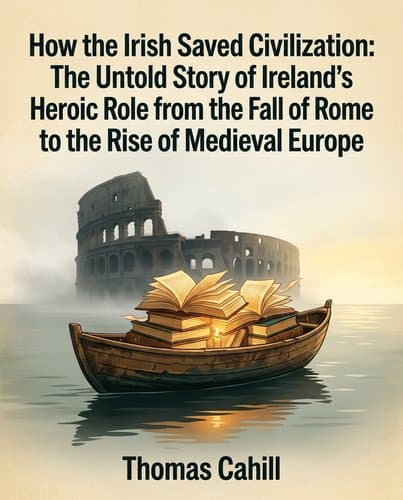
25669_how-the-irish-saved-civilization
by Thomas Cahill
When Rome fell and Europe plunged into darkness, it was Irish monks—improbable outsiders on civilization's fringe—who copied, carried, and ultimately returned…
In Brief
When Rome fell and Europe plunged into darkness, it was Irish monks—improbable outsiders on civilization's fringe—who copied, carried, and ultimately returned classical knowledge to a continent that had forgotten how to think. Cahill reveals how marginality, not power, is history's true preservation engine.
Key Ideas
Periphery Preserves What Centers Corrupt
Civilizations are not preserved by powerful centers but by peripheral outsiders who love the thing more freshly — the Irish had no stake in Roman bureaucratic prestige and so could carry Roman learning without Roman decay
Ask Whose Perspective Shapes History
The historian's bias isn't usually deliberate falsification: it's structural — when the lion always loses in the palace paintings, it's because men were the artists. Ask whose perspective is missing from the histories you've absorbed.
Patrick Transcended Empire Through Psychology
Patrick's radical innovation was going beyond the Roman Ecumene entirely — the first missionary to barbarians outside Roman law — and connecting Christianity not to social advancement but to the deepest psychological needs of the culture he entered
Wonder and Argument Preserve Thought
The specific texture of what was nearly lost matters: not just 'books' in the abstract, but the habits of mind that make thought possible — the capacity for wonder, the love of argument, the sense that all knowledge is fair game
Selective Transmission Abandons Original Intent
The Irish preserved Augustine's intellectual toolkit without inheriting his authoritarianism — a reminder that what gets transmitted in a cultural handoff is never the whole package, and the gaps matter as much as what survives
Rome's Pathologies Echo Through Eras
When a civilization is collapsing, the signs are recognizable: porous borders with unremarked demographic change, a self-perpetuating bureaucracy, the wealthy using a corrupt tax system to absorb the middle class, military service despised by elites, lip service to dead values — Rome's pathologies are not the property of any single era
Who Should Read This
History readers interested in World History and Cultural Studies who want a deeper understanding of how we got here.
How the Irish Saved Civilization: The Untold Story of Ireland's Heroic Role from the Fall of Rome to the Rise of Medieval Europe
By Thomas Cahill
12 min read
Why does it matter? Because the civilization you inherited was nearly lost — and saved by people history was designed to overlook.
Here's the uncomfortable truth about how civilization survived the fall of Rome: it wasn't preserved by the powerful. The great centers held nothing. Libraries burned, roads became gauntlets, the bureaucratic class ate itself alive trying to meet tax quotas while barbarian armies grazed through what had once been the known world. What survived — the texts, the habits of thought, the capacity to ask hard questions and write the answers down — was carried through the darkness by people Protestant Anglo-American historians had no framework to take seriously. A preliterate, Iron Age, cattle-raiding people on a rock in the Atlantic, only just discovering what books were, fell so completely in love with the written word that they copied everything, then sailed back into the wreckage of Europe to teach a continent how to read. This is that story.
The History You Were Taught Was Written by the Winners — and the Irish Always Lost
Imagine you commissioned a portrait of yourself, then hired your rival to paint it. The canvas would technically include you — but somehow you'd always be slightly off to the side, slightly smaller, slightly losing. This is roughly what happened to Irish history.
Think about who wrote the textbooks you absorbed. As Thomas Cahill points out, the history most of us encountered was largely the product of Protestant English and Anglo-Saxon American scholars — men working within a tradition that had decided, long before they sat down to write, exactly what counted as civilization and who possessed it. The Irish contribution was Celtic and Catholic: two strikes before the pen touched paper.
John Henry Newman captured the mechanism with a fable. A lion tours a palace hung with paintings and sculpture. He appears in many of them — he's not erased. But in every single depiction, without exception, the man wins and the lion goes down. At the end of the tour, the lion observes that things would have gone differently had lions been the artists.
That's the logic, and it doesn't require anyone to lie. Benjamin Disraeli — Queen Victoria's prime minister — described the Irish in terms that would embarrass a schoolboy today, but he wasn't being unusually cruel. He was stating what his world took as obvious. Princeton historian Anthony Grafton later admitted that Catholic culture was treated as the province of 'lesser breeds' in American universities until what he carefully called 'an uncomfortably recent date.'
So when you learned about the fall of Rome and the rise of medieval Europe, and the Irish weren't there — that absence wasn't an accident. The artists had simply painted what they expected to see.
Rome Didn't Fall — It Rotted From the Inside While Everyone Pretended Not to Notice
On the last day of December 406, the Rhine froze solid, and somewhere between a quarter million and half a million Germanic men, women, and children — Vandals, Alans, Sueves — walked across. The Roman legionnaires on the west bank watched them come and still believed, with full conviction, that they had the upper hand.
What's striking about Rome's collapse is that it wasn't primarily a military failure. It was the failure of a society that had quietly stopped caring about itself — and couldn't see that it had stopped.
Ausonius of Bordeaux tutored the son of an emperor, rose to consul — the highest civilian post in the empire — and spent a long career producing what Gibbon called poetry that 'condemns the taste of his age.' His verses were imitations of Virgil, elaborate word games, formula tributes to ancestors and former colleagues: technically accomplished, genuinely empty. His letters communicated nothing necessary. His emotions were almost entirely absent from the page. He was, Cahill suggests, the perfect expression of a civilization that had elevated the performance of doing things over the doing of them.
In his entire surviving body of work, exactly one person from outside the aristocratic class appears: Bissula, a German slave girl he won as war spoils, described in terms of what she could do for him. That's it. The suffering of anyone below his social level didn't register — not as cruelty, but as absence. Cahill calls this the complete extinction of Res Publica (the public thing, social concern, the sense that a civilization includes people you don't personally know).
The consequences were structural. The men tasked with collecting taxes — the curiales — were born into hereditary obligation to deliver fixed amounts to the imperial treasury, personally liable for any shortfall out of their own pockets. When inflation made the debts unpayable, they tried every exit: bribing their way into the Senate (which paid no taxes), buying army commissions, entering the priesthood. The emperor closed each route by legislation, trapping them into a hereditary caste of increasingly desperate men who preyed on anyone weaker than themselves. Small farmers lost their land to great lords. Skilled freemen became serfs. The middle class began its long disappearance. Medieval feudalism wasn't born from barbarian conquest. It was the internal logic of a tax system designed to protect the Ausonian class from consequences.
When Alaric of the Visigoths arrived at Rome's gates in 410, the city's envoys threatened him with 'innumerable ranks of warriors.' He replied that the thicker the grass, the easier it was to scythe. When they asked what he'd leave them after taking everything of value, he paused: 'Your lives.' In that pause, something ended — not because a barbarian said a clever thing, but because the Romans on the other side of the negotiation had spent a century making it true.
Pre-Christian Ireland Was Not Primitive Darkness — It Was a Fully Realized World That Rome Never Touched
The Ireland that existed before Christianity arrived was not a darkness waiting to be lit. It was a fully realized civilization — seminomadic, Iron Age, aristocratic, and intoxicated by the power of words — that had developed entirely outside the exhausting bureaucratic orbit of Rome.
The evidence arrives in the opening scene of the Táin Bó Cúailnge, the great Irish prose epic, where Queen Medb and King Ailil are lying in bed at the royal palace of Cruachan Ai, playfully arguing about who was wealthier when they married. The argument escalates with remarkable speed into a full inventory of everything they own: iron pots, thumb-rings, bolts of striped and yellow-brown cloth, then entire herds of sheep driven in from the meadows, matched animal for animal. Their pigs are counted. Their horses are brought in from the paddock. Everything comes out equal until Ailil produces his prize bull, Finnbennach the White Horned — who had originally belonged to Medb's herd but had refused, apparently on principle, to be led by a woman, and defected to the king's side. That single animal breaks the tie. Medb's spirits collapse as completely as if she hadn't owned a thing. By the next morning she has sent envoys north to Ulster to borrow the Brown Bull of Cuailnge, the only animal in Ireland that could match Finnbennach — and when that negotiation falls apart because her drunken messengers boast they could have taken the bull by force anyway, she shrugs and launches a full military campaign. One domestic argument over livestock tips into an epic war. Nothing in Virgil or Cicero prepares you for this.
What makes the scene startling isn't the comedy — it's the people. Medb is not a supporting character in someone else's story. She sets her own marriage terms, commands her own army, and when her son is killed in battle, responds to the news with something like dry impatience: this is what war costs, did you think otherwise? She is more present, more willful, more alive than Dido or Helen — neither of whom actually drives her story forward. Medb drives everything.
While the continent's warrior culture was being absorbed, Romanized, and gradually bureaucratized into exhaustion, Ireland stayed outside the current. The result was a people who still lived at the full pitch of the heroic age — frank, generous, physically confident, and constitutionally incapable of emotional concealment. That pitch was its own complete thing. It didn't need Rome to give it meaning, and Rome hadn't managed to take it away.
Patrick Didn't Bring Roman Christianity to Ireland — He Invented Something Rome Could Never Have Made
How did Christianity actually take hold in Ireland? The assumption that follows naturally from everything you know about how religions spread is that Patrick offered the Irish the same deal the faith offered everywhere else in the Roman world: become Christian and become civilized, join the winning side, climb the social ladder. The problem is that Patrick had none of that to offer. He wasn't Rome's ambassador. He was Rome's reject — a man his British contemporaries dismissed as an uneducated former slave, so awkward in Latin that his own Confession reads, as Cahill notes, like a man without a fully settled language. He couldn't give the Irish status. He had to find something deeper.
The something deeper was fear. Not Patrick's fear — his remarkable quality was its absence — but the terror that ran beneath the surface of Irish warrior culture like an underground river. The war goddess Nemain and her sister Badb once cried out at night over an Irish army camp, and a hundred men died of fright before morning. The storyteller reports this with compact understatement: 'It was a bad night for them.' That detail tells you everything about the psychological weather Patrick was walking into. These were people who drank themselves insensible before sleep, not from pleasure but because the darkness was genuinely threatening. Patrick slept soundly and soberly. In a society where no one slept soundly, that was itself an argument.
But the deepest fear was older than war goddesses. A body pulled from an English bog in 1984 — dug from the peat of Lindow Moss near Manchester — may be the most eloquent evidence we have of what Patrick was working against. Lindow Man had uncalloused hands and beautifully manicured nails: an aristocrat who had never fought. His body bore no battle scars. He wore nothing except a small armband of fox fur. His last meal was blackened hearthcake — a piece of scorched unleavened bread that served in Celtic communities as the mark of the chosen victim. Then came his death: three blows of an axe to the skull, a thrice-knotted cord around his throat, and finally his jugular opened — three wounds, three knots, because three was the sacred number. His face, preserved by the chemistry of the peat for two thousand years, is at peace. He went willingly. Archaeologists think he was an Irish druid prince who offered himself to the gods to stop the Roman advance.
Patrick looked at a culture built around this logic — you feed the god so the god won't eat you, you offer the unblemished victim so the monster looks away — and made a single argument: there is no more need for this. Someone already died, once, for everyone. The God of the Three Faces — the triple deity the Irish already knew — gave his own son. You can put the knife down.
For people living inside the Irish sacrificial imagination, that wasn't abstract theology. It was the answer to the oldest terror. And it came wrapped in something Rome could never have manufactured: a Christianity that didn't arrive with civilization as its bonus offer, but met the Irish exactly where they were — in a world already charged with the sacred, already pulsing with forces just beyond sight.
Patrick didn't replace Irish nature-mysticism. He baptized it.
The result was something Rome could never have made, because Rome was too embarrassed by the countryside to try.
While Europe Went Dark, Irish Monks Were Collecting Everything — and Then They Carried It Back
On the last morning of his life, Columcille — the exiled Irish prince who had founded sixty monasteries across Scotland and northern Britain — walked out to the monastery fields on Iona and said goodbye to each of his brothers working there. Then he went to find the old packhorse that carted the monks' milk, and said goodbye to it too. The animal, according to the account that survives, wept. Then Columcille sat down to copy a manuscript, as he had spent most of his life doing. He was writing out the thirty-fourth Psalm when he reached the line 'they that seek the Lord shall not want any thing that is good.' He set down his pen and whispered to his assistant: 'Let Baithene write the rest.' That night he rose for midnight prayers, was found before the altar in ecstasy, blessed his brothers, and died.
What makes this worth dwelling on isn't the sanctity — it's the specificity of what he was doing. Copying. To the end, copying. Because the Irish had grasped something the collapsing Roman world had not: a civilization only survives if someone keeps making copies of what it knows.
While Columcille was founding Iona in 563, the continental libraries were closing. The Roman empire's twenty-eight public libraries had become, in one historian's phrase, 'closed forever, like tombs.' The profession of copyist had vanished from Europe. Pope Gregory the Great — the most educated man in sixth-century Rome — couldn't read Greek. Ireland, by contrast, was furiously copying everything: the Bible, the church fathers, Virgil, Ovid, Greek philosophical texts, and its own oral literature, which the monks were the first to write down at all. They kept nothing out. The Irish had arrived at literacy as a form of play, and they saw no reason to decide which books were too much fun to preserve.
After Columcille, his spiritual heirs carried those books back to the continent. The monk Columbanus departed with twelve companions in 590 and founded — in twenty-five years — somewhere between sixty and a hundred monasteries across France, Switzerland, and Italy. The scattered Irish exiles who followed seeded what would become Würzburg, Saint Gall, Luxeuil, Bobbio. Historians estimate that more than half of all surviving biblical commentaries from the years 650 to 850 were written by Irishmen. By 870, the French scholar Heiric of Auxerre was complaining — with the particular exasperation of someone watching a trend he can't stop — that 'almost all of Ireland, despising the sea, is migrating to our shores with a herd of philosophers.'
Latin literature would almost certainly have been lost without them. Vernacular literatures across Europe would have had no model to build on — Irish was the first vernacular literature written down anywhere in the West. And when Islam expanded westward in the medieval period, it would have encountered not the intellectual civilization that was actually there, but scattered animist tribes with nothing to defend. The rescue was accomplished by people who treated books as sacred objects and cheerful adventures simultaneously — monks who tied manuscripts to their belts like trophies, who scribbled love poems in the margins of theological commentaries, who wrote one perfect poem — in the margin of a theology manuscript — about a cat named Pangur Ban. Unlikely saviors. The only kind that work.
The Custodians Were Peripheral Precisely Because the Center Had Run Out of Energy
The Irish succeeded not in spite of their distance from Rome but because of it. Centers run on momentum; the periphery runs on hunger. By the time the continental bishops were holding synods to police the Easter calendar, they had forgotten how to do anything else — men who tended the ghostly remnants of a lost society from behind well-plastered urban walls, never venturing into the rough mountain settlements where actual people lived. Columbanus, summoned to answer for his Irish irregularities, declined, and sent a letter addressed, pointedly, to brothers rather than lords. The bishops were furious. They were also, demonstrably, going nowhere.
The Irish freshness was the mechanism, not a charming side effect. They received literacy as play. They refused to self-censor the pagan classics. They built monasteries that admitted women as rulers, offered repeated confession as often as needed, and let abbots shrug off the whole apparatus of Roman uniformity with the casual observation that love has nothing to do with order. From this un-exhausted margin came the philosopher John Scotus Eriugena — arguably the first person capable of genuine systematic thought in three centuries — who declared that reason trumped ecclesiastical authority and that all of reality, God included, formed a single continuum. Pope Honorius III ordered his book burned nearly four hundred years after he wrote it. Some copies escaped.
History, the argument runs, divides into Romans, who believe scarcity is permanent and must be hoarded against, and catholics — lowercase, universal — who believe the family of humanity is one. The Irish were peripheral, marginal, un-Roman to their bones, and that is precisely why the books survived. The question left hanging is whether the thing that saved civilization then — some unhoarded, un-bureaucratic human willingness showing up somewhere unexpected — might be what we are waiting for now.
Who Is Copying the Manuscripts Now?
The monks who copied on Skellig Michael — a spike of rock eight miles off the Irish coast, battered by Atlantic weather — had no idea they were living through dark ages. They weren't heroic in the way we use that word now. They were stubborn, curious, and lucky enough to be ignored by whoever thought they were running things. That combination turned out to be enough. Cahill's real question isn't historical. It's this: right now, somewhere peripheral enough to escape the attention of whoever is busy performing civilization, someone is doing the quiet work that will matter in three hundred years. The danger isn't that they'll fail. It's that we'll be too busy writing the official history — the one where the lion always loses — to notice them at all.
Notable Quotes
“leeks from the garden, poultry, game, salmon and trout and bees.”
“It is hard to believe,”
“that for quite a long time—almost a hundred years—western Christianity survived by clinging to places like Skellig Michael, a pinnacle of rock eighteen miles from the Irish coast, rising seven hundred feet out of the sea.”
Frequently Asked Questions
- What is How the Irish Saved Civilization about?
- How the Irish Saved Civilization explains how Irish monks preserved classical and Christian manuscripts while Rome collapsed and Europe fell into illiteracy. Cahill argues that "civilizations are not preserved by powerful centers but by peripheral outsiders who love the thing more freshly"—in this case, the Irish had no stake in Roman bureaucratic prestige and could carry Roman learning without Roman decay. The book explores St. Patrick's radical innovation of going beyond the Roman Ecumene entirely, becoming "the first missionary to barbarians outside Roman law." Cahill draws parallels between Rome's decline and recurring patterns in later civilizations, suggesting that institutional collapse follows recognizable signs across history.
- What are the main takeaways from How the Irish Saved Civilization?
- Cahill's central argument is that civilizations are preserved by peripheral outsiders unburdened by institutional power. The Irish "preserved Augustine's intellectual toolkit without inheriting his authoritarianism," showing cultural transmission is selective. Patrick connected Christianity to the deepest psychological needs of his culture rather than social advancement. Cahill emphasizes that what nearly vanished wasn't abstract "books" but "the habits of mind that make thought possible — the capacity for wonder, the love of argument, the sense that all knowledge is fair game." He notes that in cultural handoffs, "the gaps matter as much as what survives." Finally, Cahill identifies recognizable collapse signs: porous borders, self-perpetuating bureaucracy, wealth concentration, and elite military disdain.
- Why is Cahill's perspective on historical bias important?
- Cahill identifies that the historian's bias isn't usually deliberate falsification—it's structural, shaped by who had access to document events and whose perspective was valued. He asks whose perspective is missing from the histories you've absorbed. This structural bias means historical understanding is inevitably incomplete, shaped by power dynamics of the time those histories were written. The book demonstrates this through the Irish example: peripheral monks preserved knowledge while Rome's institutional decline erased vast portions of Western learning. Recognizing this gap is crucial for understanding what was systematically excluded from conventional records. This insight prompts readers to question received historical narratives and examine whose voices remain silent in mainstream accounts.
- Is How the Irish Saved Civilization worth reading?
- Yes—this book is essential for understanding how civilizations preserve knowledge during institutional collapse. Cahill argues that civilization depends on peripheral outsiders rather than powerful centers, offering profound implications for cultural continuity. The work challenges readers to recognize hidden biases in their education. Most strikingly, Cahill identifies recognizable collapse signs: "porous borders with unremarked demographic change, a self-perpetuating bureaucracy, the wealthy using a corrupt tax system to absorb the middle class, military service despised by elites." He concludes that "Rome's pathologies are not the property of any single era," making his ancient analysis urgently relevant to understanding contemporary institutional decline.
Related Book Summaries
Read the full summary of 25669_how-the-irish-saved-civilization on InShort