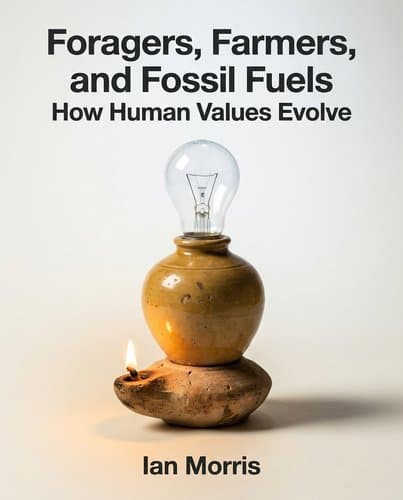
23528832_foragers-farmers-and-fossil-fuels
by Ian Morris
Your deepest moral convictions about fairness, gender, and violence aren't eternal truths—they're functional adaptations to whatever energy system feeds your…
In Brief
Your deepest moral convictions about fairness, gender, and violence aren't eternal truths—they're functional adaptations to whatever energy system feeds your society. Ian Morris's provocative thesis forces a reckoning: as fossil fuels give way to new energy regimes, your most sacred values will shift again, whether you choose it or not.
Key Ideas
Moral instincts reflect energy regime, not universal truth
Your instinctive moral reactions — discomfort at hierarchy, outrage at violence — are not universal truths but functional adaptations to the fossil-fuel energy regime you were born into. People in different energy regimes had equally strong instincts pointing the other way.
Forager equality and violence spring from same logic
Forager societies were simultaneously the most economically equal and the most personally violent human societies on record — both features explained by the same material logic, not by moral character.
Farming hierarchy emerged through rational individual decisions
The farming transition was not a choice. Once one family started cultivating, the payoffs from foraging declined for everyone nearby. Hierarchy and patriarchy 'crept up' on people through thousands of individually rational micro-decisions, not through a single moral capitulation.
Functional analysis distinct from moral judgment of societies
Morris's most controversial claim: the Taliban are not morally deficient but historically 'backward' — playing by the functional rules of an energy regime that is ending. Whether you accept this or not, it forces a distinction between functional analysis and moral judgment that most political discourse collapses.
Values lose power if reduced to energy capture
Korsgaard's transparency argument is a genuine unresolved problem for any sociological theory of values: if values only work because people believe they track real obligations (not energy efficiency), then a theory that reduces values to energy capture would, if believed, destroy the social fabric it describes.
Societal collapse reverts to forager behavior within hours
In collapse scenarios, societies don't step back one rung on the value ladder — they leap directly to forager-era behavior within 24 hours. The complexity that sustains fossil-fuel values is fragile in ways the energy system's apparent dominance conceals.
Who Should Read This
History readers interested in World History and Anthropology who want a deeper understanding of how we got here.
Foragers, Farmers, and Fossil Fuels: How Human Values Evolve
By Ian Morris & Richard Seaford & Jonathan D. Spence & Christine M. Korsgaard & Margaret Atwood & Stephen Macedo
12 min read
Why does it matter? Because the values you'd die defending may be as historically contingent as one man's donkey arrangement.
You think your values are yours — the product of reason, conscience, maybe hard experience. The conviction that women deserve equal standing, that violence is a last resort, that no one is naturally born to rule another: these feel like moral bedrock, arrived at through civilization's long labor toward the truth. Ian Morris's argument is that they're not bedrock at all. They're outputs — functional adaptations to the energy system that feeds your society, as surely as a polar bear's fur is an adaptation to cold. Foragers, farmers, and fossil-fuel societies each develop the values they need to make their particular arrangement work. Yours happen to match the current arrangement — which is the only reason they feel obvious. Change the energy, and the values follow — not because anyone chooses it, but because the societies that hold incompatible values tend to lose. That's a disturbing idea. This book makes it very hard to dismiss.
Mr. George's Donkey Explains 20,000 Years of Moral History
Picture a dusty village road in northern Greece, 1982. A young British archaeologist watches an old man ride past on a donkey, tapping it with a stick. Behind him, his wife walks bent double under a bulging sack. When someone from the dig team asks why she isn't riding, the old man — Mr. George — pauses, smiles, and gives an answer so obvious it barely needs saying: she doesn't have one — a donkey, obviously.
The students laughed. Or winced. Either way, their reaction was instant: something here was wrong. And that instinctive wrongness is exactly what Ian Morris wants to pry open, because it tells you less about Mr. George than it tells you about yourself.
Your discomfort at that scene is not a universal moral signal. It is a product of where and when you were born. Morris's argument, built across twenty thousand years of human history, is that moral sensibilities don't float free of the material world — they grow out of it. Specifically, they grow out of how a society captures energy. Foragers living off wild plants and animals develop one cluster of values. Farmers living off domesticated crops and livestock develop another. People powered by fossil fuels develop a third. Mr. George belonged to the second world; Morris and his students belonged to the third. The collision felt like a moral failure. It was actually a meeting of two different energy regimes.
The anthropologist Jonathan Haidt offers the hinge: we are born with the drive to be righteous, but we learn from our surroundings what to be righteous about. The content of that lesson, Morris argues, is largely determined by how your society keeps the lights on and the fields planted. Which means your confident sense that Mr. George's wife deserved that donkey seat — that certainty you'd stake an argument on — is something the Industrial Revolution quietly installed in you.
Forager Egalitarianism Wasn't a Value — It Was a Physics Problem
Forager egalitarianism was not a moral achievement. It was a physics problem.
Hunter-gatherers who lived in small, constantly mobile bands — typically two to eight people, covering territories so vast that population density rarely exceeded one person per square mile — faced an iron constraint: you cannot accumulate what you have to carry. Dragging possessions through the landscape makes hunting harder and gathering slower, and the incentive to stockpile anything evaporates when you abandon camp every few weeks anyway. When anthropologists calculated Gini coefficients for five foraging groups across Africa, South America, Indonesia, and Australia, the scores clustered around 0.25 — closer to the equality end of the scale than virtually any farming or industrial society. That number doesn't reflect a philosophy. It reflects the logistics of wild food capture.
The same constraint shaped politics. A single wrong decision about where to move, or when, could get a small band killed — which meant concentrating that decision in one person's hands was genuinely dangerous. So foragers didn't simply dislike hierarchy; they engineered its impossibility. When a researcher asked a !Kung San man in the Kalahari whether his group had any chiefs, the answer came back puzzled and definitive: of course they had headmen — every single one of them was a headman over himself. Half a world away in Tierra del Fuego, an Ona man offered the same arithmetic in different language: all the men were captains, the women were sailors. Two societies, no contact, identical conclusion — because they faced identical constraints.
When someone pushed against those constraints, the group pushed back. Forager communities had a repertoire for it: mockery first, then ostracism, then, when those failed, something harder to name.
The material world produced the moral world. The values followed the energy.
The Gentle People Had a Murder Rate Like Detroit During the Crack Epidemic
How can a society be the most economically equal we know of and the most personally violent at the same time? The same answer explains both.
Elizabeth Marshall Thomas spent time with the !Kung San of the Kalahari in the 1950s and left calling them "The Harmless People" — the title of her 1959 ethnography. She wasn't lying or naive. She simply hit the demographic wall that fooled a generation of anthropologists: a twelve-person band with a ten percent rate of violent death produces roughly one homicide every twenty-five years. Most fieldwork runs shorter than that. You hear stories about killing, you watch people express genuine fear of violence, but you don't see anyone die, so you write up the gentleness. What Thomas missed, and what researchers only pieced together in the 1990s, was that the !Kung murder rate matched Detroit at the worst of the crack cocaine epidemic. Among the Yanomami and Waorani of the upper Amazon, more than one man in four died violently.
The same material logic that flattened forager wealth inequality drove this violence upward. No centralized government, no monopoly on force — because concentrated authority is exactly what forager social engineering was designed to prevent. Mockery, ostracism, walking away: these tools work most of the time. But when someone is genuinely dangerous and none of them work, the only remaining option is a fist, a spear, or a community that quietly decides to look the other way when the upstart disappears. Thomas Hobbes (the political philosopher who gave us "nasty, brutish, and short") imagined a world without government as theoretical horror. Foragers actually lived it, and paid the price.
The egalitarianism and the violence aren't contradictions. They're the same coin, minted by the same economic press.
Farming Didn't Just Change What People Owned — It Changed What People Deserved
Think of a software company where everyone votes on major decisions, equity is split fairly evenly, and nobody calls anyone 'sir.' Scale that up: ten thousand employees, eventually a million. Hierarchy isn't imposed from outside — it emerges from the math.
Farming created that kind of math, fast. When you shift from chasing wild animals across open steppe to planting wheat and waiting for it to ripen, you need to stay put, coordinate with neighbors, and defend what you've built. Population densities jumped from fewer than one person per square mile to ten, fifty, eventually hundreds. The logistics alone required bosses, priests, soldiers, tax collectors — a whole apparatus of coordination that forager bands of eight people simply didn't need.
The inequality this generated staggers the eye. When the Roman businessman Gaius Caecilius Isidorus died in 8 BC, his estate included 3,600 pairs of working oxen, a quarter million other animals, more than four thousand enslaved people, and enough cash to feed half a million people for a year. He was near the top of a system in which the wealthiest tenth of the population extracted wealth from everyone else at roughly eighty percent of the theoretical maximum possible rate. Wealth Gini scores averaged around 0.25 for foraging societies. Among peasant farming communities they averaged 0.48. The same arc that took human energy capture from five thousand calories per person per day to thirty thousand also produced Isidorus and his two hundred fifty thousand animals.
The striking part isn't the inequality. It's that most people accepted it as correct. Hesiod, writing around 700 BC, described Zeus-favored lords as gifts to mankind — when good rulers gave straight judgments, their fields flourished and their women bore healthy children. The Chinese Classic of Rites, corroborating the pattern from the other side of the world, announced that under proper governance 'the worthy and able are selected to office' and 'the aged are cared for until the end of their lives.' The same contract, running across four continents: obey the hierarchy and the gods will hold up their end. Morris calls this the old deal, and it was not simply propaganda pumped downward by the powerful. It was the moral system that made sense when coordination at scale was the difference between society functioning and collapsing. The same material pressure that produced Isidorus's cattle also produced the conviction that his wealth reflected divine favor — and that the poor man's poverty reflected the same order of things.
The Taliban Are Not Evil — They're Playing by the Rules of a Dying Age
October 9, 2012. A man boards a school bus in northwest Pakistan, asks if Malala Yousafzai is on board, and shoots the sixteen-year-old in the face. The Taliban spokesman explained her crime without embarrassment: she was pro-Western, she spoke against them, she called President Obama her ideal leader.
Morris's response is the most unsettling sentence in the book. The Taliban, he writes, are not guilty of moral failings — they are guilty of backwardness. The distinction is everything. A moral failure means you knew better and chose wrong. Backwardness means you are operating faithfully by the logic of a system whose time is passing.
Farming societies rated political inequality, wealth inequality, and gender inequality as good — or at least correct, built into the divine order, necessary for a functioning world. For ten thousand years, violence was a legitimate tool for punishing people who defied that order. The Taliban who shot Malala weren't doing something alien to that tradition. They were doing something entirely consistent with it: a girl publicly defying divinely sanctioned authority over women and education was an affront requiring correction. In Agraria, that logic wasn't extreme. It was normal.
The discomfort this produces is the point. You want to call the Taliban evil because the alternative feels like excusing them. But Morris applies identical machinery to them as he did to Mr. George — the Greek farmer whose donkey arrangement struck British students as selfish and everyone in Assiros as self-evident. The Taliban's logic strikes the denizens of Princeton as monstrous; within the value system of farming-age societies, it was simply governance. Neither Mr. George nor the Taliban chose their moral software. They inherited it.
The same logic runs forward. When fossil fuels restructured who did economically valuable work — pulling women into factories and offices, making educated workers more productive than deferential ones — the moral software updated to match. Attitudes toward women's public roles didn't shift because people got kinder. The energy regime changed, and the values followed.
Morris's final verdict is colder than condemnation: the age that needed those values is dying. Every society that has stayed loyal to Agrarian values over the past two centuries has been slowly overwhelmed by societies organized around fossil fuels and the open, flat social architecture those fuels make possible. The remaining holdouts will follow. The WEIRD — Western, Educated, Industrialized, Rich, Democratic — shall inherit the earth, not because they are morally superior, but because the energy is on their side.
Morris's Entire Theory Has a Self-Destruct Button Built Into It
What happens to Morris's entire framework if it becomes widely believed? That question is Korsgaard's self-destruct device, and it's sharper than it first appears.
Morris argues that the values holding any society together — submission to godlike kings, acceptance of male dominance, tolerance for violence — exist because they sustain the social forms required by a particular energy regime. They are functional adaptations dressed up as moral truths. But functional adaptations only work on people who don't know that's what they are. Imagine a farming woman who understands, clearly and correctly, that her deference to her husband exists not because women are genuinely subordinate beings but because wheat agriculture required strict household divisions of labor and male control of surplus. Would she still accept it? Almost certainly not. The belief does its social work only because she mistakes it for a genuine moral truth. The moment she sees through it, the machinery stops.
Philosophers call this a transparency problem, and Korsgaard uses it as a lever against the whole enterprise. She draws on a point Hume and Hutcheson made against Mandeville, who claimed virtue was a political invention: if praise were really just a signal that you had served someone's interests, being called 'virtuous' would carry no more weight than being called 'useful.' The concept of virtue only motivates people because they believe it tracks something real — something beyond mere social convenience. Morris faces the same foundational problem: you can't build a moral system on premises that undermine moral systems. His theory describes values as adaptive fictions, but adaptive fictions can't generate the concept of genuine obligation in the first place. You can't derive 'this is truly wrong' from 'this is socially costly.'
Morris's response, when pushed, is essentially: it's functional adaptations all the way down, no real moral values anywhere, full stop. But that's less a rebuttal than a restatement of exactly what Korsgaard is questioning. She's pointing out that his theory, if true, would corrode the very beliefs it depends on to explain — which means either the theory is wrong, or it explains its own impossibility. The gap stays open. Which is exactly where it should stay.
The Framework That Claims to Explain Everything May Be a Product of the Thing It's Explaining
Richard Seaford lands the hardest punch in the book, and Morris never quite ducks it. The charge isn't that Morris got a fact wrong — it's that the whole framework might be a fossil-fuel product theorizing about itself, mistaking the assumptions of one energy regime for the neutral laws of history.
Seaford's specific list is damning: the four concepts that quietly organize Morris's entire theory — competition, quantifiability, consensus, and efficiency — happen to be the foundational concepts of capitalist enterprise. Morris never mentions capitalism, but his framework is saturated with it. Competition drives cultural evolution toward better values. Efficiency explains why ancient societies reorganized their economies. Quantifiability makes cross-cultural comparison possible in the first place. These aren't neutral analytical tools; they're the vocabulary of a particular economic order, absorbed so deeply that they appear to be common sense rather than ideology.
Morris's rebuttal is to separate fossil fuels from capitalism by running the growth numbers. The engine of modern growth, he argues, is fossil fuels — not markets, not mentality. Nazi Germany's economy expanded at 7.2 percent annually between 1933 and 1939 under a regime with no interest in free markets whatsoever. Capitalism was just the most effective organizational wrapper for that energy, not its source.
But this deflects the epistemological charge rather than answering it. Seaford isn't asking whether capitalism caused growth. He's asking whether a mind formed inside a fossil-fuel world can see past its own horizons. Mr. George, recall, couldn't see that his wife's deference was a product of her situation rather than her nature — he mistook the local for the universal. The question Seaford is really posing is whether Morris has done the same thing to the past: mistaking the arrangements that made sense within his world for the arrangements that simply make sense.
When Civilization Collapses, We Don't Go Back One Step — We Jump to the Beginning
The Seaford critique asks whether we can think outside our energy regime. Atwood asks what happens when the regime collapses.
Think of the world's values as a ratchet — each energy revolution clicking the dial one notch further, foragers to farmers to fossil fuels. It's a reassuring image. Then Margaret Atwood removes it.
Her intervention in the seminar is brief and blunt: if civilization collapses, we don't step back one notch. We jump straight to the beginning. The reason is practical rather than philosophical. Farming values require farmers — people with land to defend, borders to protect, a harvest to wait for. Strip away the electrical grid and the supply chains, and urban populations become something else entirely: nomads with nothing to grow and everything to scrounge. Atwood, whose fiction has mapped collapse scenarios for decades, puts a number on the transition. When the lights go off and the police network fails, the looting starts within twenty-four hours. Not a return to agrarian hierarchy — a direct leap to forager-mode resource competition, minus even the tight social bonds that kept forager violence in check.
The ratchet only clicks forward. It doesn't hold position on the way back down.
Morris's chart of values advancing steadily upward through history depends entirely on the infrastructure that makes the current energy regime work. Pull that infrastructure, and twenty thousand years of moral progress become a surface feature — a coat of paint over the forager wiring that never left. The violence rates and the flat hierarchies and the scavenging logic are still there, underneath, waiting.
Atwood ends on a note that's almost hopeful. The episodic memory systems in human brains evolved not to preserve the past but to navigate the future — which means that running the last twenty thousand years of values, energy, and collapse through your head isn't nostalgia or scholarship. It's the thing your mind was literally built to do: model what comes next. Whether that's reassuring depends on what you do with it.
The Question Mr. George's Donkey Never Answered
Here is what Morris leaves you with, though he never quite admits it: two different sentences in the same book, pulling in opposite directions. The Taliban are not evil, just historically out of sync. And yet — of course what they did to Malala was wrong. He means both. But you cannot mean both from the same chair. The first sentence is a sociologist's sentence; the second is a human being's. Morris has given you a remarkably clear map of how values get built: energy in, moral intuitions out. What the map cannot show you is whether anything survives the cartography. Whether, after you understand that your outrage is a fossil-fuel product, the outrage still counts. That question didn't exist before you started reading. It's yours now.
Notable Quotes
“Of course we have headmen! In fact, we're all headmen. . . . Each one of us is headman over himself!”
“Yes, señor, we, the Ona, have many chiefs. The men are all captains and the women are sailors.”
“One should assert one's authority only in ways that do not threaten the equality and autonomy of others.”
Frequently Asked Questions
- What is 'Foragers, Farmers, and Fossil Fuels' about?
- The book argues that human moral values — around equality, hierarchy, gender, and violence — are not timeless truths but functional adaptations to energy systems. Rather than being grounded in universal principles, our instinctive moral reactions reflect the fossil-fuel energy regime we were born into. The work shows how foraging, farming, and fossil fuels each generate distinct value systems shaped by material conditions. By examining history, philosophy, and anthropology, it demonstrates why our values have shifted dramatically across societies and energy regimes, and predicts they will continue evolving as our energy systems change.
- How can forager societies be both the most equal and most violent?
- The key takeaway is that forager societies were simultaneously the most economically equal and the most personally violent human societies on record — both features explained by the same material logic, not by moral character. The material conditions of foraging create both outcomes through economic necessity: the need to prevent resource accumulation drives equality, while low population density and weak centralized authority leave interpersonal violence unregulated. This demonstrates the book's core argument that values are functional adaptations rather than reflections of inherent morality or virtue in a society's members.
- What is the book's controversial claim about the Taliban?
- Morris argues the Taliban are not morally deficient but historically 'backward' — playing by the functional rules of an energy regime that is ending. Rather than condemning them as evil or uniquely immoral, the analysis treats their values as functional adaptations to a pre-industrial energy system. This claim forces a distinction between functional analysis and moral judgment that most political discourse collapses together. Whether or not readers accept this argument, it fundamentally challenges how we evaluate societies operating under different material conditions, separating descriptive analysis from moral evaluation.
- What is the transparency argument Korsgaard raises about the book's theory?
- Korsgaard raises the transparency argument: if values only work because people believe they track real obligations (not energy efficiency), then a theory that reduces values to energy capture would, if believed, destroy the social fabric it describes. The problem is that sociological explanations that explain values away as purely functional create a paradox—once people understand their values are only energy adaptations, those values may cease to function as social glue. This represents an unresolved philosophical tension at the heart of any materialist theory of morality.
Related Book Summaries


Read the full summary of 23528832_foragers-farmers-and-fossil-fuels on InShort