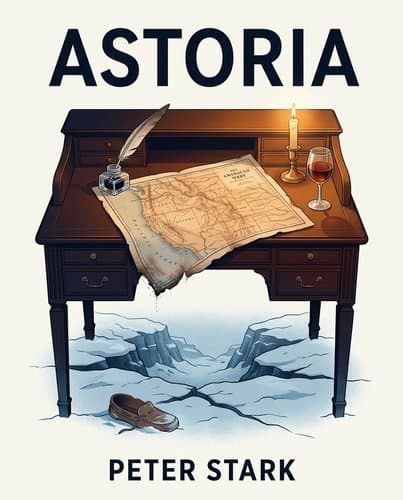
18085481_astoria
by Peter Stark
John Jacob Astor's vision of a Pacific empire was brilliant—his catastrophic failure to match the right people to the mission destroyed it.
In Brief
John Jacob Astor's vision of a Pacific empire was brilliant—his catastrophic failure to match the right people to the mission destroyed it. This gripping true adventure reveals how cultural arrogance, misplaced loyalty, and divided allegiances doomed America's first corporate conquest of the West.
Key Ideas
Competence Cannot Be Replaced by Loyalty Alone
Loyalty and competence are not the same qualification — Astor chose Hunt over Mackenzie for nationalist reasons, and the gap between their wilderness instincts nearly killed sixty people. When the stakes are high, the person you send is the decision.
Cultural Understanding Essential for Operational Success
Cultural contempt is operationally lethal: Thorn's destruction of the Tonquin didn't require malice, only a refusal to understand the trading culture of the people he was dealing with. Curiosity about the other side isn't just good manners — it's risk management.
Ground-Level Workers Hold Crucial Information
The people closest to execution will always know things the person at the top cannot: Astor's 19th-century communication lag was structural, but his emotional distance from his employees' reality was a choice. Every layer between a founder and the ground truth costs something.
Crisis Exposes Hidden Divided Loyalties
Agents with divided loyalties don't reveal themselves during good times — they reveal themselves when the environment makes defection cheap. Astor's Scottish partners maintained British allegiance throughout; the War of 1812 just gave them cover to act on it.
Failure Produces Unintended Lasting Legacy
Failure leaves infrastructure: the Astorians' chaotic retreat produced the South Pass and the Oregon Trail. The most durable things an ambitious enterprise leaves behind are often not what it intended to build.
Who Should Read This
History readers interested in World History and Business Strategy who want a deeper understanding of how we got here.
Astoria
By Peter Stark
13 min read
Why does it matter? Because the empire Astor built and lost accidentally created the road that opened the American West.
In 1810, most Americans had only the vaguest notion that a West Coast existed. Yet one immigrant — a German butcher's son who'd arrived in a frozen Chesapeake Bay with seven flutes and outsized ambitions — was already negotiating with a former president to plant a colony there and corner the entire Pacific trade. John Jacob Astor's plan was genuinely staggering in scope. What collapsed it wasn't geography or British warships or bad luck, though all three showed up. It was something more instructive: the catastrophic mismatch between a visionary's blueprint and the actual human beings he dispatched to execute it. A paranoid naval captain. A Scottish trader with older loyalties. A well-meaning merchant who'd never once spent a night in the wilderness. Astor sat in his Manhattan townhouse eating browned roasts while his men gnawed on moccasin leather in a canyon nobody had mapped. Their wreckage, it turns out, mattered far more than anything they meant to build.
A Private Citizen Tried to Colonize the Pacific Before the U.S. Government Knew It Wanted To
In 1808, before the United States had any mechanism to project power beyond the Rocky Mountains, a German immigrant fur merchant sat down at his writing desk on Lower Broadway, dipped his pen, and personally initiated the geopolitical colonization of the American West Coast. Not the government. Not the military. One man, John Jacob Astor, acting on a private vision that happened to perfectly overlap with Thomas Jefferson's most ambitious dream.
Jefferson had already stretched the country's borders with the Louisiana Purchase in 1803, but that enormous addition only reached the Rockies' spine. Beyond it lay a coastal no-man's-land nearly two thousand miles long — running from Russian fur posts in Alaska down to Spanish missions near San Francisco — that no Western power had convincingly claimed. Jefferson privately compared its scale to the entire Atlantic seaboard from Florida to Maine, sitting there for the taking. So when Astor's letter arrived proposing a privately funded West Coast colony backed by a global trading empire, Jefferson replied with the enthusiasm of a man who'd been waiting for exactly this offer. He pledged the full support of the executive branch and told Astor that his name would be remembered alongside Columbus and Raleigh.
What Astor had designed was a triangle trade of staggering ambition. His ships would carry cheap manufactured goods from New York around Cape Horn to the Northwest Coast, swap them with Native traders for sea otter pelts worth fortunes, sail those furs across the Pacific to sell in Canton at enormous markups, load the holds with Chinese silk and porcelain, and return to sell those luxuries to European and American markets hungry for them. The settlement at the Columbia River's mouth — Astoria — would be the hub through which the entire tradable wealth of western North America flowed, all of it passing through Astor's hands.
Jefferson's private goal was something else entirely: a democratic republic on the Pacific, a sister nation that looked toward Asia rather than Europe. Astor wanted a monopoly. Jefferson wanted a country. For one brief window, those two ambitions were perfectly aligned in the hands of a single immigrant with a fur shop and a very long game of Patience.
The Man You Send Is the Decision That Matters Most — and Astor Got It Wrong Immediately
The expedition nearly failed before a single canoe touched the water. The reason was a trade Astor made in his New York office: loyalty for competence. When the NWC merger collapsed, Astor lost access to the best-trained fur operators on the continent. To fill the leadership gap, he looked for men he could trust absolutely. That impulse is understandable. It also nearly got sixty people killed.
The clearest example is what he did to Donald Mackenzie. The Scotsman had spent a decade in the North West Company's wilderness network, learning the canoe routes, the portage systems, the tribal politics, and the physical demands of moving large parties through unmapped terrain. His fellow travelers called him "Perpetual Motion" — when he wasn't moving, he was planning the next move. Astor had originally made him co-leader of the Overland Party precisely because Hunt, his preferred man, had no wilderness experience whatsoever. But once the NWC merger failed and British-American tensions rose, the math changed in Astor's head: a Scottish former Nor'wester leading an American expedition toward contested Pacific territory felt like a security risk. So Astor demoted Mackenzie to equal partner and handed sole command to Wilson Price Hunt — a Trenton, New Jersey merchant who had never crossed a mountain range in his life.
What Hunt did instead of leading: he polled. Every major decision became a group consultation. When winter approached and the party was still a thousand miles short of schedule, Hunt lingered in St. Louis visiting old friends instead of pressing the pace. The Missouri froze shut in November with the party stranded far short of their target winter camp. The delays would compound every subsequent hardship — the Blackfeet, the desert crossings, the starvation. Astor had his loyal American. The bill for that decision would arrive in installments.
Captain Thorn's Rigid Discipline Was the Only Thing Keeping the Ship Afloat — and Also What Sank It
When the storm hit, everyone aboard the Tonquin survived because someone had already imposed the kind of iron order that lets sixty people function as a single organism in a crisis. The helmsman broke two ribs when a rogue wave flung him across the quarterdeck. The ship lost sails and took on water. They limped through it. The same rigidity that made Thorn despised in calm weather kept the vessel from going down in rough it.
The problem with a man whose only tool is force: he applies it equally in situations where force is exactly right and situations where judgment, restraint, or simply waiting would serve better. At the Falkland Islands, a clerk tied a goose's leg to a rock as a prank. Thorn fired twice at it, walked over to claim his kill, and discovered the joke. He did not laugh. He walked back to his boat, rowed to the Tonquin, and sailed away — leaving nine men, including the expedition's senior partners, standing on a barren beach six hundred miles from Antarctica.
They piled into a twenty-foot rowboat and chased the ship for six miles into the open South Atlantic. An oar snapped. The bailing bucket floated away. Falklands water is cold enough in summer to kill an unprotected swimmer inside two hours. The situation was resolved only when Robert Stuart — whose uncle David was one of the men in the sinking boat — walked up to Thorn on the quarterdeck, pointed two loaded pistols at him, and gave him a choice. Thorn later wrote to Astor that it was a change in the wind that turned the ship around.
The Columbia Bar — the most dangerous river mouth on the continent — was still ahead. And Thorn had not updated his approach by a single degree. The partners were about to find out what that meant on a shoreline with no room for error.
The Tonquin Didn't Explode Because of a Trade Dispute. It Exploded Because Thorn Never Tried to Understand Who He Was Trading With.
An elderly Clayoquot chief named Nookamis climbs aboard the Tonquin and holds up a roll of sea otter fur. He wants five blankets. Captain Thorn offers two. Nookamis haggles — because that is how trade has worked on this coast for centuries, a social ritual as formalized as a handshake. Thorn does not see a ritual. He sees insolence. He grabs the fur, grinds it into the old man's face, and kicks him off the ship.
That moment is usually read as a temper problem. It was something worse: a failure of basic curiosity. Thorn had never tried to understand who he was actually dealing with.
The Clayoquot of Vancouver Island were not primitive subsistence hunters. The Northwest Coast's annual salmon runs delivered roughly 1.8 billion pounds of protein to these communities — a reliable, staggering surplus that freed entire societies from the scramble for calories and let them build something genuinely complex. They had social classes, hereditary chiefs, and a slave caste of war captives who performed menial labor. Their ceremonial life centered on the potlatch — a feast in which families gained social prestige precisely by giving away or destroying their own wealth, the opposite of every assumption a New York merchant would carry onto a trading deck. These were people whose economy ran on signals that Thorn, a navy man fluent only in commands and force, could not begin to read.
Astor had actually warned him. Having spent his early career trading with Iroquois communities in upstate New York, Astor understood — at least abstractly — that Native economics operated on respect, reciprocity, and memory. His written instructions told Thorn to be kind and exercise forbearance. He might as well have written them in Chinook.
The Clayoquot returned the next morning with their anger hidden beneath fur mantles. By the time Thorn noticed how many warriors had climbed aboard, it was already over. The war clubs came out — polished whalebone and stone weapons designed for skull fractures in close quarters — and the ship's ten cannons, aimed uselessly seaward, and its nine thousand pounds of powder locked in the hold, were exactly as effective as furniture. The men who survived barricaded themselves below. Four escaped by longboat and were later captured and tortured to death on shore. One wounded man stayed behind. He waited until hundreds of Clayoquot had swarmed aboard to loot the hold, then lit the powder magazine. The explosion scattered bodies across the cove for days. Roughly two hundred people died.
The Clayoquot didn't fight Thorn's battle; they chose their own ground — a crowded deck, hand-to-hand, where his cannons were ornaments. He'd sailed ten thousand miles with a warship and entered a negotiation without the first thing he needed, which was the willingness to learn anything about the person sitting across from him.
The Wilderness Doesn't Care About Your Letter of Credit
A man named John Colter walked up to the riverbank as Hunt's boats labored upstream and held them spellbound for an afternoon. Colter had survived something recent and specific: the Blackfeet had stripped him naked, set a few hundred armed warriors behind him, and told him to run. Six miles, barefoot, over prickly pear cactus. By mile three, blood was pouring from his nose and mouth — the capillaries in his lungs bursting from the exertion. He outran every warrior but one, stopped, spread his blood-drenched arms wide to shock the man, caught the spear when the warrior tripped and broke it, drove the blade through the man's body, and walked out of Blackfeet territory alone. That was 1808. The Blackfeet hadn't changed their opinion of white trappers since.
Hunt listened, thanked Colter for his time, and made a decision that felt cautious and reasonable: he would avoid Blackfeet territory entirely, leave the Missouri River at the Arikara villages, and strike west overland on an untested route through the Rockies. Safer, surely, than Colter's experience. And here is where the compounding begins.
That single choice — sensible, even prudent — required abandoning the expedition's heavy riverboats, the ones equipped with swivel guns that had already convinced six hundred Sioux warriors to stand down. It meant the party of sixty would travel on foot and horseback through terrain no map described, guided by three Kentucky trappers whose confidence outran their cartographic knowledge. It meant swapping certainty for speed, and armament for faith in a headwater stream they'd never seen.
They found the stream in October 1811 — the Snake River, though they called it the Mad River — and the voyageurs were so relieved to be off horses and into canoes that they pushed off singing. Six days later, a veteran steersman named Antoine Clappine was dead. His canoe, hewn from cottonwood because the right birch trees didn't grow at this altitude, was heavier and slower to respond than anything he'd paddled before. When it struck a basalt boulder midcanyon, the hull split clean down its length. Clappine clung to the stern as it washed downstream and disappeared into the next set of rapids.
After that, the canyon walls closed in, portages accomplished nothing, and the party ran out of river and out of food at roughly the same moment. Hunt had left 120 horses in a high valley, after the usual round of consultation convinced him that canoes were the faster route to the Pacific. Now he was on foot in a gorge half again as deep as the Grand Canyon with five and a quarter pounds of meat per person and a pregnant woman among his twenty.
When he finally spotted Ramsay Crooks on the opposite bank in December, walking the wrong direction, his partner had been surviving on moccasin soles and the shared organs of a single dog. Hunt was carrying a letter of credit from Astor that could purchase warehouses of grain. In Hells Canyon it was less useful than a beaver skin. Every choice had been defensible. The river didn't care.
While His Men Drank Their Own Urine, Astor Wrote Jefferson That Everything Was Going Splendidly
Think of a ship's captain on a long ocean voyage before radio existed. He can see his own deck, feel the wind, read the water immediately around him — but his home port is a fantasy he maintains in his head, populated by whatever news he received at his last stop. The fantasy and the reality drift apart over months, and he has no mechanism to know it. John Jacob Astor, sitting at 223 Broadway in December 1811, was that captain, except he wasn't on the ship at all.
That Christmas, Astor was in genuine high spirits. He wrote a long letter to Thomas Jefferson — reporting in to his mentor-in-empire like a capable subordinate with good news — explaining that his Overland Party leader, a Trenton merchant named Wilson Price Hunt, had almost certainly found a better route to the Pacific than Lewis and Clark. The group had 'no doubt' met the sea party by October, Astor told Jefferson. He would have written this in warmth, over a good dinner, in a house with fireplaces in every room and best silver on the table and casks of Madeira wine his own ships had ocean-aged to a perfect mellowness.
At the moment he was writing, Hunt's party was in Hells Canyon in a whiteout, having eaten through every emergency ration. The guide's wife, Marie Dorion, was eight months pregnant and moving on foot. Men were slicing up moccasin soles and eating the leather.
That gap — Astor's confident letter versus the actual physical condition of the people it was about — is not a character flaw. It is a structural fact about how a 19th-century continental enterprise necessarily worked. News traveled at the speed of a horse or a ship, which meant Astor was always operating on information three to six months old, always managing a fantasy that the ground had already contradicted. He knew this. He accounted for it. He told Jefferson plainly that long delays were expected. His coolness in the face of no news was not denial — it was calibrated rationality.
Which makes the moment the calibration breaks down all the more revealing. In May 1812, Astor read in his morning newspaper that the Tonquin had been destroyed with its crew. That evening, he went to the theater — a detail worth holding onto. The enterprise remained grand. The math on the Enterprise returns still worked: cheap trinkets in New York fetching four hundred percent in Canton, four hundred percent more in Chinese silks sold back in New York. The triangle trade was proven. One ship was a tolerable loss.
The Empire Collapsed Because Astor's Agents Were Never Really His Agents
The enterprise didn't fail because the wilderness was too harsh or the war too sudden. It failed because the men running Astoria had never fully switched sides.
Before the Tonquin even left New York Harbor, the Scottish partners Astor had hired — former employees of the rival North West Company — quietly visited the British consul and asked a simple question: if war breaks out, what happens to us? The consul's answer was plain. He couldn't speak to their commercial interests, but as British subjects, they would be protected. They shook hands and said nothing to Astor. On paper they were partners in an American enterprise. In practice they had already chosen their exit.
You can watch this dual allegiance curdle in real time once the war arrives. In the winter of 1813, with Astoria low on food, scurvy spreading through the men, and the Tonquin long confirmed dead, a North West Company representative shows up and hands McDougall a copy of Madison's war declaration along with a pointed reminder: an armed British ship is reportedly headed for the Columbia's mouth. McDougall, who had been posturing as king of the Northwest just two years earlier — holding fake smallpox in a bottle to bluff the surrounding tribes into compliance — now collapses completely. He and Mackenzie call a vote. They decide to abandon the entire venture. Then McDougall sells Astor's warehouses, furs, and trading network to the North West Company for a fraction of their value, and promptly joins that same company himself.
The British warship, when it finally arrived, found nothing left to seize. The sale had already accomplished what a naval bombardment couldn't: it erased the American claim peacefully, with the cooperation of Astor's own men. The wilderness and the war get the credit in most retellings. The real story is that some of the people Astor trusted most were simply waiting for a respectable reason to go home. What no one counted on — least of all Astor — was that the wreckage they left behind would eventually point the way for everyone else.
The Failure That Built the Oregon Trail
What did Astor's failure actually buy? On October 22, 1812, a small, starving party of Astorian survivors — carrying messages east for a man whose empire was already crumbling — walked across a gentle saddle of high country in what is now southwestern Wyoming and realized they had just strolled across the Continental Divide. Robert Stuart, leading this retreat, had stumbled onto South Pass: the one place along the entire Rocky Mountain chain where a fully loaded wagon could cross from one watershed to the other without being destroyed by the terrain. The discovery happened backward, accidentally, during a withdrawal from catastrophe rather than an advance toward one.
That pass sat largely forgotten for three decades. Then the reports came back from the Willamette Valley — impossibly green, astonishingly fertile, the kind of land that turns farmers into zealots — and suddenly the route the Astorians had bled across became the most consequential highway in American history. Up the Platte River, through South Pass, along the Snake River plain, over the Blue Mountains, down to the Columbia. Half a million settlers followed it between 1843 and the 1860s, dragging their pianos and plows west along a track that Hunt's exhausted, moccasin-eating party had carved into the geography of the continent while trying simply to survive.
The Astorians didn't set out to find the Oregon Trail. They set out to build a commercial empire for one wealthy man and ended up doing something larger than either they or Astor could see from where they were standing. The wreckage of the enterprise — the dead, the betrayals, the sold-out colony, the men who ate leather and drank their own urine in the bottom of Hells Canyon — turned out to be the seedbed for the actual American West.
Which leaves an uncomfortable question the history won't quite release: if sixty-one men died building the foundation, and that foundation carried half a million settlers west, whose story is the Oregon Trail actually telling — theirs, or the people who walked it after them?
The Question Astor Never Had to Answer
Astor called himself the architect of a Pacific empire, and the historical record doesn't entirely argue. But here is what should stay with you: he never once slept in wet clothes in below-freezing temperatures, never rationed a moccasin sole across four days, never held his breath under a logjam while people above tried to kill him. His risk was denominated in dollars, which meant it was also recoverable. The men he blamed for lacking his spirit — his drive, his vision, his willingness to see the thing through — were the ones who paid for that vision in frostbite and starvation and slow deaths in a canyon no map had ever named. So yes, Astor founded something. But founding turns out to be a word capacious enough to cover an enormous distance between the person who imagines the thing and the people who actually bleed for it. That distance deserves a name of its own.
Notable Quotes
“to my astonishment and distress I saw Mr. Crooks and his people on the other side of the river.”
“It was impossible for men in their condition to get through,”
“They said that we would all die from starvation,”
Frequently Asked Questions
- What is Astoria by Peter Stark about?
- Peter Stark's Astoria chronicles John Jacob Astor's ambitious attempt to build a Pacific fur-trading empire through founding Astoria, Oregon, and its catastrophic collapse. The book uses meticulous historical research to examine how poor leadership selection, cultural arrogance, and divided loyalties doomed a strategically sound venture. Stark reveals that beyond dramatic frontier narratives, the failure stemmed from fundamental business decisions: choosing the wrong people for critical roles, failing to understand trading cultures, and maintaining emotional distance from ground-level realities. The work offers clear lessons on delegation, execution, and the persistent gap between vision and operational reality.
- What was wrong with John Jacob Astor's leadership selection in the Astoria venture?
- Astor's fateful decision reveals why loyalty and competence are not the same qualification. He chose Hunt over Mackenzie for nationalist reasons rather than wilderness competence, creating a gap in leadership instincts that nearly killed sixty people. Astor prioritized ideological alignment with American expansion over proven capability in frontier conditions. When the stakes are high, the person you send is the decision itself—their competence, judgment, and experience determine outcomes more than strategic planning. This demonstrates that even visionary entrepreneurs can fatally underestimate how much execution depends on selecting individuals with demonstrated capability in the specific domain.
- How did cultural misunderstanding destroy the Astoria mission?
- Cultural contempt is operationally lethal to Astor's enterprise. Thorn's destruction of the Tonquin didn't require malice, only a refusal to understand the trading culture of the people he was dealing with. This wasn't merely a diplomatic failure—it was a risk management failure. Curiosity about the other side isn't just good manners—it's risk management. The Tonquin disaster exemplifies how contempt for unfamiliar trading practices and customs created catastrophic consequences. Stark shows that understanding different cultures is not a soft skill but a hard business necessity that determines operational success across cultural boundaries.
- What does Astoria reveal about the distance between leadership and ground truth?
- The people closest to execution will always know things the person at the top cannot—a reality Astor failed to bridge. While 19th-century communication lag was structural, his emotional distance from his employees' reality was a choice. Every layer between a founder and ground truth costs something. Additionally, agents with divided loyalties don't reveal themselves during good times—they emerge when the environment makes defection cheap. Astor's Scottish partners maintained British allegiance throughout; the War of 1812 just gave them cover to act on it. Proximity to execution and loyalty alignment prove critical to venture success.
Related Book Summaries
Read the full summary of 18085481_astoria on InShort