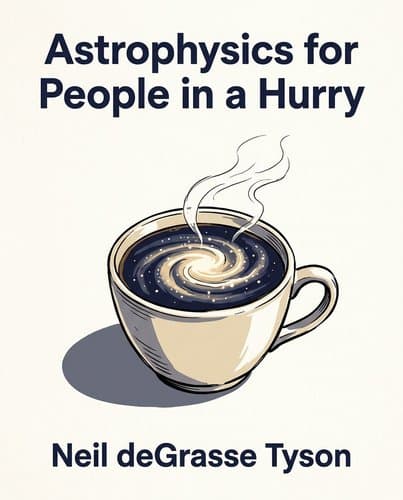
32191710_astrophysics-for-people-in-a-hurry
by Neil deGrasse Tyson
You are literally made of stardust — and we still can't explain 95% of the universe around you. Tyson distills 13.8 billion years of cosmic physics into an…
In Brief
You are literally made of stardust — and we still can't explain 95% of the universe around you. Tyson distills 13.8 billion years of cosmic physics into an afternoon read that permanently shrinks your ego and expands your sense of wonder.
Key Ideas
Matter's Tiny Surplus Birthed The Universe
The entire material universe exists because matter outnumbered antimatter by one part in a billion — a fractional surplus that is the literal origin of every galaxy, star, planet, and person. Without it, the cosmos would be pure light with no observers.
Physics Laws Are Universe's Sole Language
The laws of physics are universal and pre-human: the same equations govern a falling apple and a galaxy cluster 300 million light-years away, verified unchanged across 13.8 billion years. Science isn't a cultural product — it's the only language the universe speaks.
Ninety-Five Percent Remains Fundamentally Unknown
We understand only 5% of the universe's total mass-energy. Dark matter and dark energy aren't gaps in a nearly-complete picture — they are 95% of the territory itself, and the best theoretical estimate for dark energy is wrong by a factor of 10^120.
Your Atoms Were Forged In Stars
Every heavy atom in your body was forged in a stellar core and scattered by a supernova. 'We are stardust brought to life' is not a metaphor; it is the precise account of where your iron, calcium, and carbon came from.
Earth Broadcasts Civilization To The Stars
Earth is cosmically conspicuous — blazing in radio waves from our own technology. The atmospheric fingerprints of our civilization (free oxygen, methane, smog acids) would read to any sufficiently advanced alien observer as strong evidence against intelligent life.
Cosmic Scale Corrects Human Self-Perception
The feeling of cosmic smallness is not depression — it is a correction. The ego was inflated by the cultural assumption that humanity occupies a special place in the cosmos. Getting your size right is the prerequisite for getting your conflicts right.
Who Should Read This
Science-curious readers interested in Physics and Learning who want to go beyond the headlines.
Astrophysics for People in a Hurry
By Neil deGrasse Tyson
10 min read
Why does it matter? Because the universe is the only context wide enough to make human conflicts look as small as they are.
Most people file astrophysics under "enriching but optional" — something you get to after the mortgage, the inbox, and the evening news. That assumption turns out to be exactly backward. The cosmic view isn't a luxury for people with leisure time; it's probably the most effective corrective available to a species that still draws borders in the dirt and kills over which side of them you were born on. Neil deGrasse Tyson covers 13.8 billion years in twelve brisk chapters, and the cumulative effect isn't wonder or depression — it's calibration. Once you actually absorb the scale, the age, the sheer indifference of the universe to your nationality or your grievances, you can't quite unsee it. This book is the prescription.
Everything You Are Was Decided in the Universe's First Two Minutes
The narrowest escape in cosmic history happened in the first trillionth of a second after the Big Bang. The young universe was a dense, furious cauldron of quarks and their antimatter counterparts, continuously forming and annihilating each other. Every particle of matter that flickered into existence was paired with a particle of antimatter, and the two destroyed each other on contact, converting their mass back to energy, which spawned new pairs, which annihilated again. The universe was a self-canceling machine running at a billion degrees.
Except physics had placed a thumb on the scale. For reasons still not understood, matter particles outnumbered antimatter by exactly one in a billion. As the universe expanded and cooled, new pairs could no longer form. The annihilations ran to completion: a billion pairs destroyed each other, leaving a billion photons in their wake. And one unpaired particle of matter was left standing.
Those orphaned particles are the source of everything with mass in the observable universe. Every proton in your body, every atom in every galaxy, every speck of dust in every sunbeam descends from that fractional surplus. Without it, every particle would have found its match, and the cosmos would be nothing but photons: pure light with no observers, no matter, no story.
From those one-in-a-billion survivors, the rest of history falls into place fast. Within two minutes, protons fuse into hydrogen and helium. After 380,000 years, electrons settle onto nuclei and the universe goes transparent for the first time, releasing a bath of light we can still detect today. Over billions of years, gravity builds galaxies; massive stars forge heavier elements in their cores and scatter them across space when they explode. The Sun formed from that enriched debris. So did Earth. So, eventually, did you.
The atoms in your body are survivors of an almost-total annihilation. One in a billion made it. That fraction is the only reason anything in the cosmos exists at all.
The Same Equation That Drops an Apple Also Governs a Galaxy 300 Million Light-Years Away
The laws of physics are the universe's standing orders, identical in a Pasadena lab and a galaxy a billion light-years away. Newton cracked this open when he showed that the force pulling a ripe apple off a branch and the force holding the Moon in orbit obeyed the same equation. One set of rules, everywhere.
That turned out to be just the opening move.
When Gustav Kirchhoff aimed a glass prism at sunlight in the 1850s — splitting white light into its constituent colors — he found dark lines sitting exactly where hydrogen, iron, and oxygen leave their fingerprints in Earth labs. Ninety-three million miles away, the same physics.
Then spectral analysis turned up something with no counterpart on Earth: a pattern of lines that matched nothing in the Periodic Table. Astronomers named the mystery substance after the Sun itself — from the Greek helios — and called it helium. Thirty years passed before anyone isolated it in a terrestrial laboratory. Helium remains the only element in chemistry's catalog discovered somewhere other than Earth first, and it had been sitting in sunlight the entire time, waiting.
Scientists Can Describe 5% of the Universe. The Other 95% Has a Name and Almost Nothing Else.
If the same physics governs every corner of the observable universe, does that mean we've largely mapped what's out there?
We haven't. Every star, planet, atom, and force we've ever measured accounts for roughly 5% of the total mass-energy in the cosmos. The remaining 95% goes by two names: dark matter and dark energy. Both are real, both dominate, and for neither do we have an explanation.
Dark matter makes itself known only through gravity: galaxy clusters contain far too little visible mass to hold themselves together at the speeds their galaxies are moving, yet they persist, billions of years old, when the math says they should have scattered long ago. Something unseen provides the gravitational glue. That something exerts six times the pull of all visible matter combined, and we have no idea what it is.
Dark energy is a stranger story and a bigger one.
In 1916, Einstein's equations for general relativity included a term he called lambda — a repulsive pressure inherent to the vacuum of space itself, inserted to prevent his theoretical universe from collapsing under its own gravity. When Hubble proved in 1929 that the universe was expanding rather than static, Einstein deleted lambda and called it his greatest blunder. A mathematical convenience with no physical reality, he decided.
Sixty-nine years later, two competing teams of astrophysicists measuring the most distant supernovae ever observed found something wrong. A particular class of supernovae makes reliable cosmic yardsticks: each one ignites the same fuel mass and peaks at the same brightness, so brightness gives distance directly. When they compared those distances against what galactic recession speed predicted, the numbers didn't match: the supernovae were farther away than expected. The universe wasn't just expanding. It was accelerating. Nothing in Einstein's equations could account for this except the constant he had thrown out. Lambda came back. It was renamed dark energy, and it now accounts for 68% of all mass-energy in the universe. Dark matter is 27%. The ordinary matter underlying every triumph of physics: 5%.
The best theoretical candidate for dark energy is quantum vacuum pressure — particle-antiparticle pairs briefly flickering into existence and annihilating, each exerting a tiny outward push on space. When physicists calculate the expected magnitude of this pressure, they get a number 10^120 times larger than what's measured. A 1 followed by 120 zeros. The largest disagreement between theory and observation in the history of science.
Which means Einstein's real mistake was throwing lambda away.
Every Atom in Your Body Spent Billions of Years Inside a Dying Star
Think of the iron in your blood not as a nutrient but as material with a past. Every atom of it was forged in the core of a massive star that no longer exists — a star that lived and died before the Sun was born.
Here's how that works. Massive stars spend their lives as fusion engines, building progressively heavier elements in their cores: hydrogen to helium, helium to carbon, carbon to oxygen, all the way up the periodic table. Then they reach iron, and the engine stops. Iron has the lowest total energy per nuclear particle of any element. Fusing it doesn't release energy — it absorbs it. Splitting it doesn't either. Every reaction involving iron is a drain on the star's reserves. When a massive star accumulates an iron core, it can no longer fight gravity. The core collapses in an instant and explodes outward as a supernova. For a few weeks, a single dying star blazes as bright as every other star in its galaxy combined. Then the light fades, and everything the star spent millions of years building gets scattered across surrounding space.
Do that for nine billion years across the Milky Way, and you get an interstellar medium rich in carbon, oxygen, nitrogen, iron, and dozens of other elements. The gas cloud that condensed into the Sun (and the rocky planets orbiting it) was built from this enriched debris. Everything heavier than helium in your body was manufactured in a stellar core and then violently dispersed. Your iron came from one explosion. Your carbon came from another. The calcium in your teeth, the oxygen in your lungs: each has a provenance stretching back billions of years to a star that burned out before ours ever lit.
"We are stardust" is usually offered as poetry. It works better as a chemistry invoice. The elements in your body passed through the hearts of dying stars before they ever passed through you.
Aliens Would Detect Us Easily. What Our Atmosphere Would Tell Them Is the Punchline.
Picture the telescope pointed the other way. For most of astronomical history, Earth is the platform, the ground from which we squint at faint signals arriving from distant worlds. But what if you were the signal? What would a civilization a few dozen light-years away detect when they aimed their equivalent of a radio telescope at our solar system?
The answer has two parts, and the second part is humbling.
They'd hear us long before they saw us. Small, rocky planets in their natural state emit almost no radio waves. Earth is the exception. Mobile phones, broadcast television, military radar, microwave ovens, communications satellites — together they make our planet one of the most anomalously luminous radio sources in the sky. An alien civilization with a dish the size of China's 500-meter telescope would have no trouble picking up the signal. The challenge would be distinguishing Earth's blaze from Jupiter's radio emissions or the Sun's. The signal is unmistakable; the origin is the puzzle.
The atmosphere tells an even stranger story. A spectrometer aimed through Earth's atmosphere as we transit the Sun would read our chemical fingerprint (every molecule has one). Free oxygen covers a fifth of our atmosphere. Oxygen is reactive; it bonds with nearly everything and disappears unless something keeps replenishing it. That something, on Earth, is photosynthesis. Any alien cosmochemist would read "life" in that single line on the spectrum.
But keep reading the fingerprint. Methane is there too — two-thirds of it produced by human activities: oil extraction, rice cultivation, sewage systems, and the collective digestive output of billions of livestock. Sulfuric, carbonic, and nitric acids show up as well, the byproducts of burning fossil fuels at industrial scale. The oxygen says biology. The smog says technology. Any civilization sophisticated enough to decode those markers would, in all likelihood, interpret the acid and methane signatures as convincing evidence for the absence of intelligent life on Earth.
We blazed in radio across the galaxy. Our atmosphere filed a detailed report. The telescope, turned around, points straight back.
The Cosmic View Doesn't Make You Insignificant — It Corrects an Ego That Was Already Too Large
A month after the Hayden Planetarium reopened in 2000 with a new show called Passport to the Universe, Tyson got a letter from an Ivy League psychology professor. The man's specialty was studying things that made people feel insignificant (a real academic niche), and the show, which zoomed visitors from the planetarium out to the edge of the observable cosmos, had produced in him the most crushing sense of smallness he'd ever felt. He wanted to survey visitors before and after to measure the depth of their depression.
He never replied. But the instinct that stopped him is the book's whole argument: the professor had it exactly backward. His ego was inflated far beyond what the evidence could justify, and the cosmic view hadn't injured him — it had corrected him. The show didn't shrink the professor; it finally scaled him accurately.
The same inflation runs through nearly every conflict humanity has ever staged. Peel back any war fought over territory, religion, or national honor, and underneath is a belief, shared by individuals and civilizations alike, that the world revolves around us. We treat this as adulthood, but it's closer to the toddler stage, where spilled milk registers as catastrophe because the child has no framework for comparison.
The molecule arithmetic makes the correction personal. There are more water molecules in a standard glass than there are glasses of water in every ocean on Earth — so some of what you drank today passed through the kidneys of Genghis Khan, Socrates, and Joan of Arc. Draw a breath: the air molecules entering your lungs right now are so numerous that some were exhaled by Napoleon, Beethoven, Lincoln, and Billy the Kid. You are already in circulation with every human being who ever lived.
What the professor felt (smallness, depression) was a story about human centrality being corrected. The actual experience of it is the opposite: not smallness, but connection. The brain you're using to read this is what mapped our address in a cosmos of hundreds of billions of galaxies. When the people in charge of things carry an accurate picture of where humanity actually sits, not above nature but woven into it, traded molecule by molecule with the dead, the things we kill each other over start to look like what they've always been.
The cosmic view is corrective. It's the one perspective wide enough to give everything its actual scale.
The Universe Gave You the Capacity to Grasp Your Own Insignificance — That's the Remarkable Part
The brain doing the reading right now weighs about three pounds. It runs on roughly 20 watts — less than a dim bulb. And as far as we can determine, after 13.8 billion years of cosmic history, it is the most complex information-processing structure the universe has ever produced. The cosmos had no obligation to generate anything capable of noticing it — most of what exists, from dark matter halos to stellar remnants, proceeds in complete indifference to its own existence. But something in the physics of carbon and chemistry and deep time turned around and looked. That something is you. Which means the cosmic perspective isn't a humiliation — it's a reorientation. And it raises the only question that actually matters: if this is what 13.8 billion years of universe-building produced, why are we burning it on the arguments we keep having?
Notable Quotes
“into existence. As the cosmos continues to cool—dropping below a hundred million degrees—protons fuse with protons as well as with neutrons, forming atomic nuclei and hatching a universe in which ninety percent of these nuclei are hydrogen and ten percent are helium, along with trace amounts of deuterium (”
“Predicting that the background existed and then getting its temperature correct to within a factor of 2, was like predicting that a flying saucer 50 feet wide would land on the White House lawn, but instead, a flying saucer 27 feet wide actually showed up.”
“red light, a brand-new part of the spectrum found just”
Frequently Asked Questions
- What is Astrophysics for People in a Hurry about?
- This book distills modern astrophysics from the Big Bang and dark matter to the stellar origins of every atom in your body into brief, precise chapters. It gives readers a working grasp of how the universe is structured and governed, showing how understanding cosmic scale reframes human conflict and ego. The author covers fundamental topics including the laws of physics, the composition of the universe, and humanity's place within it—all in short chapters designed for readers with limited time.
- What does Astrophysics for People in a Hurry explain about the origin of the universe?
- The book reveals that the entire material universe exists because matter outnumbered antimatter by one part in a billion—a fractional surplus that is the literal origin of every galaxy, star, planet, and person. Without this tiny imbalance, the cosmos would be pure light with no observers. This asymmetry in the Big Bang is fundamental to understanding why the universe contains anything at all, representing the most consequential fact in cosmic history. It explains the very existence of matter itself.
- Are we really made of stardust according to Astrophysics for People in a Hurry?
- Yes. Tyson explains that every heavy atom in your body was forged in a stellar core and scattered by a supernova. The book states: "We are stardust brought to life" is not a metaphor; it is the precise account of where your iron, calcium, and carbon came from. This isn't poetic language but literal chemistry—a direct physical connection between your body and the stellar furnaces of the universe. Your atoms were created billions of years ago in distant stars.
- How does Astrophysics for People in a Hurry characterize Earth's place in the universe?
- The book presents a paradoxical view: Earth is cosmically conspicuous—blazing in radio waves from technology and carrying atmospheric signatures visible to advanced observers. Yet the broader perspective is humbling: cosmic smallness isn't depression but a necessary correction to human perspective. The ego was inflated by the assumption that humanity occupies a special place in the cosmos. Understanding our true cosmic scale is the prerequisite for addressing human conflicts and ego properly. This reframing is essential for personal and collective wisdom.
Related Book Summaries


Read the full summary of 32191710_astrophysics-for-people-in-a-hurry on InShort