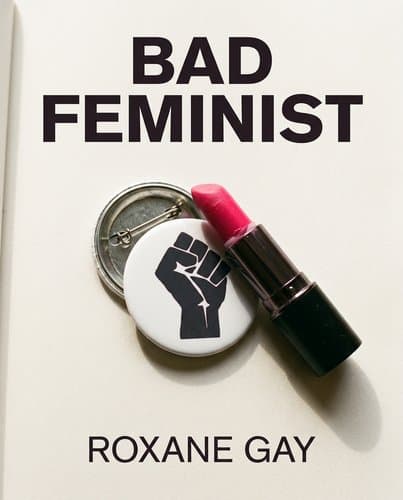
18813642_bad-feminist
by Roxane Gay
Roxane Gay dismantles the myth of the 'perfect feminist' by owning her contradictions—loving hip-hop, hating racism, craving bad TV, demanding equality—and…
In Brief
Bad Feminist (Augu) collects Roxane Gay's essays on feminism, race, and pop culture to argue that political commitment doesn't require personal perfection.
Key Ideas
Caricatures Are Tools to Discredit Movements
The 'angry man-hating humorless feminist' caricature was designed by people who fear the movement — recognizing it as a caricature is the first step to stopping it from working on you
Acknowledging Privilege Doesn't Erase Personal Pain
Acknowledging your privilege is not a denial of your own suffering; it's an accurate map of the terrain — you can hold both truths simultaneously without either one canceling the other
Impostor Syndrome Reflects Systemic Exclusion, Not Failure
Impostor syndrome in women, especially women of color, is not a personal failing — it's the predictable result of being told, repeatedly and in concrete ways, that you don't fully belong; excelling harder is not the cure
Likability Demands Require Female Silence
The demand that female characters be likable is a demand that they be silent — the most alive characters, like the most alive people, refuse to perform social acceptability for an audience
Entertainment Teaches Bodies as Public Property
Pop culture and reproductive legislation are not separate conversations; the jokes, songs, and TV shows that teach women their bodies are public property create the cultural conditions that make restrictive laws possible
Respectability Cannot Shield Against Systemic Racism
Respectability is not a shield against racism — Oprah Winfrey being told a purse is too expensive for her is the same system that put Trayvon Martin on trial for his own murder
Imperfect Activism Outweighs Perfect Theory
You don't have to resolve every contradiction to hold a political commitment — the bad feminist who dances to misogynist rap and still shows up for reproductive rights is more useful to the movement than the perfect feminist who exists only in theory
Who Should Read This
Readers who connect with first-person stories about Social Issues and Cultural Studies and want to see the world through someone else's eyes.
Bad Feminist
By Roxane Gay
12 min read
Why does it matter? Because the feminism you've been avoiding might be the only kind that actually works.
At some point, most women have done it — quietly dropped the word, softened it, prefaced it with
The Pedestal Is a Trap: Why Demanding Perfect Feminists Destroys Feminism
The feminist label is a trap — not because feminism itself is dangerous, but because the version circulating in popular culture was built by people who wanted the movement to fail. Roxane Gay makes this case with a confession that is almost too honest to be strategic: she spent years distancing herself from feminism because she assumed it was incompatible with her own sexuality. The image she had absorbed — the angry, sex-hating, man-hating ideologue — was never an accurate portrait of the movement. It was a caricature assembled and distributed by the people who had the most to lose if feminism actually succeeded.
The genius of the caricature is that it doesn't just repel outsiders; it polices insiders. Gay calls this the Feminist Pedestal problem. The movement elevates visible figureheads, demands they perform perfect ideology, then discards them the moment they fall short of an impossible standard. Gloria Steinem got it in the 1990s when younger feminists declared her too accommodating to men; the specific charge changed but the mechanism was always the same. The pedestal guarantees failure. Gay's answer is to step off it preemptively — to claim the bad feminist label before anyone can use it against her, which makes the threat useless.
What she puts in its place is both simpler and harder: being yourself while still showing up for the fight. She blasts the Ying Yang Twins on her morning commute — 'Bitch you gotta shake it till your camel starts to hurt' — and she is mortified by this, and she does it anyway. That contradiction is the point. The standard that says you must only consume culture that affirms your politics is the same standard that says you must never want to be taken care of, never love the color pink, never be afraid of being alone. It sets a bar no real human being clears, and its primary function is to convince women that feminism is not for someone like them.
So Gay claims the bad feminist label herself, openly, before anyone else can get there first. That's not a concession. That's the only move that actually works.
What Internalized Messages Actually Cost: The Girl Who Had to Prove She Deserved to Be There
She was walking down the hallway of her graduate school building, past a classmate's open office door, when she heard her own name used as an object lesson in who didn't belong there. The classmate was holding court with a small group of their peers, and the verdict was clean and confident: Gay was the affirmative-action student. Gay made it to her own office before she fell apart.
That moment becomes the key that unlocks something she has been carrying through her entire career. She responds the way a certain kind of high-achiever always does — not by confronting it, not by processing it, but by producing. She stops joking about being a slacker. She triples her project load, submits conference proposals, publishes, and designs a dissertation scope ambitious enough to make her want to disappear. Her peers, by the way, said nothing in her defense. They didn't disagree. The machine ran smoothly, and she fed it.
The cruel irony Gay identifies is that none of it works as a cure. Years later, established in a tenure-track position she earned on the first try, with funded degrees and a publication record, she still hears that classmate's voice when she pulls into the faculty parking lot. Strangers actually question whether she belongs there — physically challenge her right to be in that space. The hyperproductivity that was supposed to silence the accusation has instead become the permanent condition under which she operates. She has to keep proving it. There is no finish line.
Gay's point is this: the impostor feeling isn't a personal sensitivity that therapy might fix. It's the logical outcome of a culture that has spent decades telling certain people their seat at the table is provisional. When you absorb that message young enough and thoroughly enough, excelling harder doesn't erase it. It just turns the fear into fuel, and you burn and burn and still wake up wondering if today is the day everyone figures out what that hallway conversation already decided. The cost of that arrangement is paid not in failure but in the grinding, irrational, utterly exhausting labor of having to justify your own existence from the inside.
Surviving Something Does Not Make You Strong: On Trauma, Bodies, and the Stories We Tell to Stay Alive
A middle-school girl rides her bike into the woods with a boy she believes is her boyfriend. An abandoned hunting cabin sits about a mile in — dirt floor, broken windows, the litter of older teenagers' secrets. When she realizes what is about to happen, she tries to leave. She screams. Nobody hears her. She whispers the Our Father because it's the only prayer she knows by heart. God doesn't answer either. The boys keep her there for hours. Afterward, she walks her bike home alone, goes to her room, and reassembles herself into the girl her parents expected to see at dinner. The next day at school, the boy sits behind her in French class and calls her a slut loud enough for the whole room to hear. That becomes her name for the rest of the year.
Roxane Gay tells this story in the middle of an essay about The Hunger Games, which is either a strange choice or a completely logical one, depending on what you think stories are for. She gets there by way of Katniss Everdeen — a heroine she loves precisely because the books refuse to let her be undamaged. But before she can explain what that refusal means to her, she has to explain why she needs it. And that requires the cabin.
The line she arrives at is this: just because you survive something does not mean you are strong.
This is not a subtle point, but it lands with the force of something that needed saying. The culture surrounding trauma has developed a very specific grammar — the survivor narrative, the overcomer arc, the woman who turned her worst experience into her greatest strength. Gay's account refuses every beat of that structure. She doesn't emerge from the woods transformed into someone harder and wiser. She emerges and hides. She becomes a better student, a more obedient daughter, a more invisible person. And separately — the detail that connects this chapter to the previous one — she starts eating. Filling space. Making her body larger on purpose, operating on the logic that bad things could not happen to a body that took up enough room.
That is not strength. That is a child inventing whatever survival technology is available to her. The demand that she have processed it into something redemptive is just another thing being asked of her body without her consent.
Fiction, at its most honest, isn't there to sanitize the world for young readers or model clean recoveries — it's there to mirror back the truth that some of the people reading are already living inside. Not to sanitize the world for young readers, not to model clean recoveries, but to mirror back the truth that some of the people reading are already living inside.
Culture Is the Operating System: Why a Pop Song and a Rape Joke Are Never Just Entertainment
Culture runs on an operating system, and it is not installed by lawyers or legislators. It is installed by pop songs, punchlines, and the way a national newspaper chooses to frame a crime. Once you see this, you cannot watch the soft stuff — the music, the jokes, the entertainment — without recognizing what it is actually doing.
Consider what the New York Times did with a story that should have required no editorial skill at all: an eleven-year-old girl in Cleveland, Texas was raped by eighteen men, ranging in age from middle schoolers to a twenty-seven-year-old. The headline the paper ran was 'Vicious Assault Shakes Texas Town,' as if the town were the victim. The reporter focused on how the perpetrators' lives would be derailed, whether the child had dressed too provocatively, and where her mother had been. The father's whereabouts went unexamined. The word 'rape' appeared twice in the piece, neither time in direct connection to the girl's body. The preferred phrasing was 'forced to have sex' — a construction that describes the crime while insulating the reader from it. Gay's response is clean and devastating: it was an eleven-year-old girl's body that was destroyed, not a town. The paper's framing was not an aberration or a single journalist's bad call. It was the natural output of a culture that has been rehearsing this language for decades — through television dramas that use sexual assault as a ratings device, through comedians who treat it as punchline material, through the casual appropriation of rape as a synonym for minor inconvenience. When you marinate long enough in representations that smooth the edges off sexual violence, you eventually produce journalism that asks us to mourn the perpetrators.
Gay calls this 'trickle-down misogyny,' and the mechanism is worth understanding. Robin Thicke singing that he knows what a woman really wants even when she says otherwise, and Texas legislators rewriting abortion access, are not separate conversations happening in separate rooms. The pop song normalizes the assumption that women's bodies are subject to other people's interpretations. The legislation codifies it. Each one makes the next one easier to pass off as unremarkable. None of it is entertainment. It is instruction.
The Demand for Likability Is a Demand for Silence
Why do critics accept Humbert Humbert — a pedophile, a predator, a man who rapes a child across two continents — but lose patience with a bitter middle-aged woman who is angry about what her life has become? When a Publishers Weekly interviewer told Claire Messud she wouldn't want to be friends with Nora, the protagonist of The Woman Upstairs, Messud answered with a list: Hamlet, Raskolnikov, Oedipus, every character in Infinite Jest. Nobody asks whether you'd want to grab coffee with them. The demand for friendship — for warmth, for palatability — gets applied to women in fiction with a consistency that is never applied to men, and Gay's argument is that this asymmetry is not a quirk of taste. It is a mechanism for disappearing female characters who refuse to behave.
Gillian Flynn understood this, and Gone Girl is partly about understanding it. Amy delivers a speech about what she calls the Cool Girl — the woman who loves football and cheap beer and dirty jokes and never, ever complains, who exists only to reflect a man's preferences back at him at a size 2. Amy's point, which Gay takes seriously, is that this creature is a performance, and millions of actual women have accepted the labor of performing her. The Cool Girl is likability made flesh. She is what the culture rewards. And the reason Amy is so unsettling — the reason critics reached for words like 'psychotic' when the novel came out — is that she stops performing. She sees the demand clearly, names it, and refuses it. That refusal is treated as pathology rather than clarity.
Unlikable female characters are not failures of craft. They are characters who won't pretend, and the discomfort they produce is the discomfort of recognition. The question worth asking about a character is not whether you'd want to be her friend but whether she is alive. The characters who are most alive are almost always the ones making readers squirm — because they are doing the thing the reader cannot quite bring themselves to do. Which raises the question of what happens when that refusal moves off the page and onto the screen, and whether television has any better idea of what to do with women who won't perform.
Representation Is Not the Same as Recognition: What We See When We Turn On the Television
Imagine a mirror that only shows your left side. You can see yourself, technically — it's your face, your body, your life reflected back. But the image is incomplete in ways that compound over time, and the longer you rely on it, the more the missing half feels like it might not exist at all. That is what representation without recognition does. The difference between the two, Gay argues, is the difference between being visible and being seen.
The clearest demonstration comes from her dissection of The Help, a film beloved enough to sell millions of books and pack theaters with women clutching their dog-eared copies. The movie contains Black women, and the actresses playing them — Viola Davis, Octavia Spencer — are formidably talented. By the standard of mere presence, The Help should count as progress. Gay refuses that accounting. What the film actually offers, she argues, is a full inventory of magical negroes: Black characters whose wisdom, suffering, and emotional labor exist to complete someone else's story. Aibileen, the grieving maid at the center of the film, has a signature gesture — she tells a neglected white child, over and over, that she is kind, smart, and important. She performs this service even after being fired for a crime she never committed. The camera lingers on the gift she gives the child. It has almost nothing to say about what it costs her to give it. That asymmetry is the point. Recognition would require the camera to care about Aibileen's inner life for its own sake. Representation, in The Help's version, only requires that she be visible while serving someone else's — and when there are so few films where Black women's inner lives are the point, audiences have no other mirror to hold up against it.
The Political Stakes Are Not Abstract: What Happens When Culture Becomes Law
On June 25, 2013, Texas state senator Wendy Davis put on a pair of pink running shoes and stood at her Senate desk for thirteen hours straight — no food, no water, no leaning, no bathroom breaks — to block a bill that would have closed thirty-seven of Texas's forty-two abortion clinics. More than 180,000 people watched on a YouTube livestream from the Texas Tribune. Not one major cable network covered the final hours. When CNN anchor Chris Cuomo eventually weighed in, he called it 'odd politics' and wondered aloud why the activists hadn't simply compromised on reproductive freedom, as if the right to control your own body is something reasonable people split down the middle.
Gay learned about the filibuster the way most people did: not from a newsroom, but from a single activist on Twitter named Jessica Luther, who had been sounding the alarm about the bill for weeks. Gay admits she almost tuned it out. She didn't have the energy, she thought, to care about Texas. Luther's relentless, specific, furious posts made that indifference unsustainable. That's the point: the path from a pop song that tells women their bodies aren't really their own to a bill that makes that premise into law runs straight through the culture's capacity to look away. Luther forced Gay to keep looking. The news networks didn't.
The same year Davis stood in her pink sneakers, a parade of American legislators were publicly inventing new categories of rape — legitimate rape, honest rape, God-intended rape, emergency rape — each formulation designed to carve out circumstances where a woman's violation either didn't count or was somehow providential. These weren't fringe voices. They were candidates for Senate, sitting representatives, men running on party tickets. Gay's point, laid alongside journalist Hanna Rosin's then-fashionable book arguing women were finally winning, is withering: women may be gaining ground in pharmacy schools and corporate org charts while simultaneously watching elected officials compete to redefine assault as natural law. The cultural messaging that taught those legislators women's bodies were interpretable — the music, the jokes, the journalism that mourned rapists' futures — didn't stay in the entertainment column. It got sworn in.
Racism Doesn't Care How Respectable You Are
Racism is a structural condition, not a personal failing, and no amount of correct behavior will protect you from it. The politics of respectability — the idea that marginalized people can earn their way out of oppression by acting sufficiently dignified — places the entire burden of change on the people being harmed. Gay demolishes this logic with a single image: Oprah Winfrey, one of the wealthiest human beings alive, standing in a Zurich boutique and being told by a clerk that the handbag she wanted to examine was beyond her means. Not explained. Not shown. Assessed as unworthy by a stranger operating on reflex. Gay's point isn't that Oprah deserves our sympathy — it's that if extraordinary wealth, global fame, and decades of unimpeachable public behavior can't protect a woman from that particular reflex, then no amount of pulled-up pants or avoided litter ever will. The respectability formula assumes there's a threshold of acceptability you can cross, after which racism loses its grip. There isn't one.
Don Lemon's five-point plan for Black America — stay in school, stop littering, pull up your pants — runs on the same false logic. So does Bill Cosby's suggestion that apathy is the Black community's primary obstacle. Gay acknowledges these figures aren't coming from a cynical place. But what they're doing, she argues, is presenting their own trajectories as proof the path is open to anyone disciplined enough to take it, while remaining studiously uninterested in the institutional machinery that makes individual discipline irrelevant for so many people. Obama's 2013 speech on race pointed somewhere else: end racial profiling, reexamine the laws that let Trayvon Martin's killer walk free, build policy that supports rather than surveils. Gay finds the proposals vague. She also notes that Black girls disappear from the conversation entirely — and not incidentally, since the same week Martin's death dominated the national conscience, several Black girls had gone missing and no one said much about that at all. But at least the responsibility lands where it belongs: on the victims of those systems having to perform their own safety.
You Don't Have to Be a Good Feminist to Be a Feminist
Think of it like a gym membership. You don't have to show up every day in perfect form to legitimately call yourself a member. You can skip a week, complain about leg day, and eat a cheeseburger on the way home from your Saturday morning spin class. The membership is still yours. You just have to actually want to go.
Gay's version of this is weirder and more honest. She reads Vogue without irony. She loves pink. She shaves her legs. By the standard of Essential Feminism — the caricature that demands militancy, self-sufficiency, and the rejection of anything touched by the male gaze — she fails every morning before she reaches the office. She knows this. She catalogs these failures without flinching and then keeps going anyway. This is the whole argument.
The mistake is treating consistency as the measure of commitment. That standard describes no human being who actually exists, which means its primary function is to convince women that feminism isn't for someone like them.
The same year Gay was compiling her list of feminist failures, a Missouri Senate candidate named Todd Akin was assuring voters that in cases of what he called "legitimate rape," a woman's body has biological mechanisms to prevent pregnancy — and therefore abortion access was unnecessary. He said this out loud, into a microphone, as a sitting congressman running for Senate. Gay holds that political reality in one hand and her subscription to Vogue in the other without flinching. You don't get to walk away from Todd Akin because you also shave your legs.
She would rather be a bad feminist — contradictory, embarrassing, human — than no feminist at all. Stay in the fight anyway. That's what's actually available to any of us, and it turns out it's enough.
The Contradiction Is the Point
The tension never resolves — that's the whole point. Gay never arrives at a morning where she loves the right songs, holds the right opinions, and steps into the world without contradiction. Neither will you. The question isn't whether you'll fail your values sometimes; it's whether you'll let that failure become the reason you stop showing up. The bad feminist — dancing to something she shouldn't, still furious about what actually matters — is more useful to the world than the perfect one who exists only as a standard designed to exclude. Because the girl in the woods, the woman alone in the parking lot, the one still trying to explain something no one around her will name — she doesn't need you resolved. She needs you there. Show up embarrassed. That's the only way anyone ever actually does.
Notable Quotes
“You are an angry, sex-hating, man-hating victim lady person.”
“Don’t you raise your voice to me,”
“You’re some kind of feminist, aren’t you?”
Frequently Asked Questions
- What is Bad Feminist about?
- Bad Feminist is a collection of essays by Roxane Gay that argues political commitment doesn't require personal perfection. The book demonstrates that contradictions in a feminist's own life aren't failures but proof the movement must make room for flawed, fully human people. Through essays on feminism, race, and pop culture, Gay provides readers with a framework for holding strong convictions without demanding ideological purity from themselves or others, showing how personal contradictions can coexist with genuine political commitment.
- What does Roxane Gay mean by being a 'bad feminist'?
- Being a "bad feminist" means you can hold political commitments while maintaining personal contradictions—you don't have to be ideologically pure. Gay illustrates this through the example of someone who dances to misogynist rap while supporting reproductive rights. This "bad feminist" is more valuable to the movement than a theoretically perfect feminist who exists only in ideology. The concept challenges the false choice between complete ideological consistency and political engagement, suggesting that real change comes from imperfect people taking action, not from those demanding purity before participation.
- What are the key takeaways from Bad Feminist?
- Bad Feminist offers several central insights about feminism and culture. Recognizing the "angry man-hating humorless feminist" as a caricature designed to undermine the movement helps immunize readers against it. The book emphasizes holding multiple truths simultaneously—acknowledging privilege doesn't negate personal suffering. Gay challenges the culture of likability, noting that demanding female characters be likable is demanding silence. She connects pop culture and reproductive legislation, arguing that cultural messages teaching women their bodies are public property enable restrictive laws. Respectability offers no shield against racism.
- Is Bad Feminist worth reading?
- Bad Feminist is worth reading for anyone seeking a framework for political engagement without ideological perfectionism. Gay's essays are intellectually rigorous yet accessible, blending personal narrative with cultural analysis to make complex ideas relatable. The book addresses urgent topics—reproductive rights, racism, pop culture, and gender—with nuance that avoids both cynicism and purity culture. Whether you identify as feminist or not, Gay's work offers valuable tools for holding convictions while accepting human contradiction, making it both practical and transformative.
Related Book Summaries


Read the full summary of 18813642_bad-feminist on InShort