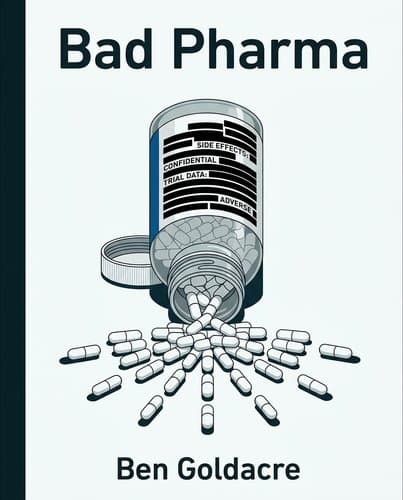
15795155_bad-pharma
by Ben Goldacre
Half of all clinical trial results are never published—and the missing data is almost always negative. Ben Goldacre exposes how a broken evidence system lets…
In Brief
Half of all clinical trial results are never published—and the missing data is almost always negative. Ben Goldacre exposes how a broken evidence system lets ineffective and harmful drugs reach patients while doctors, regulators, and patients remain blind to the truth.
Key Ideas
Question drug trials before accepting prescriptions
When your doctor prescribes a drug, ask whether there is a systematic review of all trials — not just the published ones — and whether the drug was tested against the best existing treatment rather than a placebo.
Published trials hide unpublished negative results
A positive clinical trial result is not evidence that a drug works; it is evidence that the trials its manufacturer chose to publish showed it worked. The unpublished trials may tell a different story.
Surrogate markers mislead about actual health benefits
Surrogate outcomes (blood pressure, cholesterol numbers, arrhythmia suppression) are not the same as real outcomes (death, heart attack, stroke). The CAST disaster killed an estimated 100,000 people who were being successfully treated by the wrong measure.
Trial registration prevents outcome-switching deception
Trial registration — publicly declaring what a trial will measure before it starts — is the single most important structural safeguard against outcome-switching. You can check whether a trial was registered and whether the published outcomes match the registered ones.
Industry-funded education shifts prescribing patterns reliably
Continuing medical education funded by pharmaceutical companies is not neutral education. Studies show it reliably shifts prescribing toward the sponsor's drug regardless of clinical merit. The conflict of interest is structural, not personal.
Verify patient advocacy group funding sources
Patient advocacy groups that receive industry funding should be treated with the same skepticism as industry-funded trials. Check funding sources before relying on a patient group's guidance on treatment options.
Reform tools exist; enforcement remains lacking
The reform tools already exist: mandatory trial registration, disclosure of all Clinical Study Reports to regulators and researchers, Sunshine Act-style payment databases, and pragmatic trials embedded in routine care. The deficit is enforcement, not invention.
Who Should Read This
Science-curious readers interested in Social Issues and Policy who want to go beyond the headlines.
Bad Pharma
By Ben Goldacre
12 min read
Why does it matter? Because the published evidence your doctor reads has been quietly edited by the people who profit from it.
You probably assume medicine is self-correcting. A trial gets published, peers scrutinize it, regulators weigh it, and bad evidence eventually gets filtered out. That assumption is universally held, and almost entirely wrong. The filtering system — peer review, regulatory oversight, academic publishing — has been quietly colonized by the industry it was supposed to police. Not through conspiracy, but through something more mundane and therefore harder to fight: the architecture of trust itself has been compromised, reshaped so that what reaches doctors, regulators, and patients has already been curated by the people with the most to lose from full disclosure. A doctor can read every published paper on a drug, follow every guideline, do everything right, and still harm patients — because the information system of modern medicine has been systematically shaped to hide exactly what a careful doctor most needs to know. This book is about how that happened, who benefits, and what an honest system would actually require.
A Doctor Who Did Everything Right Still Harmed His Patient
A doctor sits down to prescribe an antidepressant. His patient hasn't responded to anything else, so he reaches for something newer: reboxetine. Before writing the prescription, he does what a careful clinician is supposed to do — reads the trials, weighs the evidence, finds well-designed studies showing the drug outperforms placebo and holds its own against rival antidepressants. He signs the prescription. He has done everything right.
He is Ben Goldacre, and years later he would discover that he had harmed his patient.
In 2010, researchers finally assembled every trial ever conducted on reboxetine — not just what had appeared in journals, but what companies had run and quietly shelved. The picture that emerged was almost the reverse of what the published literature showed. Seven trials had compared reboxetine against a placebo. One, involving 254 patients, produced a clean positive result and was published. The other six, involving roughly ten times as many patients combined, found the drug was no better than a sugar pill — and none appeared in any journal. The comparisons against rival antidepressants told the same story: the small studies showing reboxetine held its own were published; the larger body of unpublished data, drawn from more than 1,600 patients, showed that people on reboxetine actually did worse. The side-effect data, buried alongside everything else, revealed higher rates of adverse events and more patients dropping out.
Goldacre had read the available evidence. He had appraised it critically, discussed it with his patient, and made a shared, informed decision. Every step was textbook. And the textbook had been written using only the chapters the manufacturer chose to release.
That is how industry-funded trials end up roughly four times more likely to report positive results than independently funded ones. Not through fabrication — through selection. Researchers run multiple trials, and the ones that flatter the drug get published while the others disappear. Doctors reading the literature believe they are seeing science when they are seeing a highlights reel. The reboxetine case makes this personal: a conscientious physician, a real patient, a treatment the full evidence would have ruled out entirely. No law was broken. The drug is still on the market.
The Rules Allow Companies to Bury Any Evidence They Don't Like — Legally
The selective disappearance of unflattering trials is not an ethical lapse among a few bad actors. It is the default operating mode of pharmaceutical research, and it is entirely legal.
The machinery works like this: a company runs ten trials on a drug. Three produce the hoped-for result. Seven do not. The three get written up and submitted to journals, where they join the permanent scientific record. The seven go into storage — old disk drives, paper archives, a warehouse somewhere. Doctors searching the literature find a drug that looks impressively effective. They have no way of knowing the search should have returned ten results but only delivered three. The system contains no alarm for missing evidence.
A 2010 review of over five hundred trials across five major drug classes found that 85 percent of industry-funded studies reported positive results, compared to 50 percent of government-funded trials on the same drugs. Then consider a 2004 study of trials presented at a major rheumatology conference — every one of which declared industry sponsorship — where all 45 out of 45 favored the sponsor's drug. Not 44. Not 43. Every one. The researchers needed only one sentence to report this finding.
The Tamiflu story shows what this costs in practice. Governments around the world, including the UK, spent hundreds of millions stockpiling the antiviral on the basis that it reduced serious complications from flu — pneumonia, hospitalizations, death. When researchers from the Cochrane Collaboration tried to verify that claim, they traced it back to a single industry-funded analysis drawing on ten trials, eight of which had never been published. The underlying data — detailed clinical study reports running to thousands of pages — sat with the manufacturer, Roche. When Cochrane asked for them, Roche offered access only if researchers signed a confidentiality agreement that would prevent them from discussing the terms of the agreement, or even acknowledging it existed. They refused. Roche then spent the better part of three years deploying one implausible excuse after another: another group already had the data, patient privacy was at risk, the trial design itself was commercially sensitive. All of this, to protect evidence about a drug governments were buying with public money to protect public health.
What makes this structurally different from ordinary wrongdoing is that no law compelled Roche to behave otherwise. The whole edifice — selectively published trials, inaccessible study reports, regulators with data they won't share — is the system working as designed. Doctors reading the literature believe they're reading science. They're reading what made it through.
The People Approving Your Drugs Work for the Industry Four Days Later
Imagine a food safety inspector who, each morning, checks your local restaurant for hygiene violations — then, each evening, consults for the same restaurant chain on how to pass inspections. You would not call that independence. You would call it the restaurant regulating itself with extra steps. Sit with that image for a moment. That is the structural reality of drug regulation.
In December 2010, the head of the European Medicines Agency — the body responsible for approving every drug sold across Europe — stepped down from his post. Four days later, he began consulting for the pharmaceutical industry. His name was Thomas Lonngren, and when he sent the EMA's management board a letter explaining his plans on December 28th, the chairman wrote back after ten days to say everything looked fine. No restrictions were imposed. Nobody even asked what work he planned to do. His assurance that no conflict of interest existed was, apparently, enough.
The story is less about Lonngren than about what his agency considered normal. A man who spent years deciding which drugs could be sold across a continent of half a billion people was, four days into retirement, advising companies on how to get their drugs approved — and the institution he had led saw nothing worth questioning. The Corporate Europe Observatory found fifteen other senior EU officials who had made the same journey.
Lonngren was not an aberration. He was a data point in a system built to produce exactly that outcome. Regulators in both the US and Europe are funded almost entirely by fees paid by the drug companies seeking approval — a structure introduced specifically to speed up the approval process for industry. The companies became, in a meaningful sense, the customer. When your salary depends on processing applications and your next job may come from the applicants, the incentive to set a high bar quietly erodes.
And the bar regulators do set is startlingly low. Here is where I find it hardest to stay calm. A company generally needs to show only that its drug beats a dummy placebo — not that it beats the best treatment patients are already taking. A 2011 review of 197 drugs approved by the FDA over a decade found that a full third had no head-to-head data against existing alternatives at all. What doctors and patients actually need to know — is this better than what we already have? — was simply never tested. Regulators accepted 'better than nothing' as a sufficient answer to a question nobody was actually asking.
Clinical Trials Are Designed to Win, Not to Find the Truth
What if a clinical trial is run not to find out whether a drug works, but to produce evidence that it does? The assumption most of us carry — that trials may have flaws but at least aim at truth — turns out to be naive. The design of a trial is itself a variable that can be tuned to generate the desired answer.
Consider how a trial measures success. Before it begins, researchers write a protocol naming the outcomes they intend to measure — their primary targets. This matters because statistics have a quirk: if you measure twenty things, one or two will probably show improvement by chance alone, even if the drug is inert. The pre-specified primary outcome protects against that. Everyone knows this.
And yet, in the paroxetine Trial 329, it made no difference. The original protocol listed two primary outcomes and six secondary ones. When the trial ended, none of those eight showed any advantage for paroxetine over placebo — not one. Researchers then sifted through nineteen additional outcomes they had also collected, found four that happened to favor the drug, and published those as the main findings. Systematic reviews were still describing Trial 329 as a positive result in 2007, nearly a decade later. Doctors reading those reviews would have had no idea they were reading a story assembled after the answer turned out wrong.
The same logic governs when a trial stops. The celecoxib CLASS trial measured gastrointestinal complications over a year. At the six-month mark, the drug looked good. Researchers published that cut of the data. When the full twelve-month results eventually became visible, the benefit had disappeared entirely — but by then the favorable summary was already in the literature, already shaping prescribing habits.
Or consider who the drug gets compared against. Test a new antidepressant against an old one given at a dose that causes heavy daytime drowsiness, and the new drug will look cleaner. Test a new antipsychotic against haloperidol at a dose high enough to produce significant side effects, and the new drug will look kinder. Neither comparison requires fabricating a single number. The design itself does the work — and that, more than any of it, is what should make you angry. You don't need to understand outcome-switching or interim analyses to feel what's wrong with deliberately sedating the competition. It's just cheating, stated plainly, with a trial number attached.
The Scale Is Not a Scandal. It's the Normal Business Model.
In 2012, GlaxoSmithKline paid $3 billion to settle what was then the largest criminal fraud case in US history. What the settlement covered will feel familiar by now: bribing physicians with gifts and luxury hospitality, running 'independent' education programmes that were actually sales operations, promoting drugs for unapproved uses, and withholding safety data on the antidepressant paroxetine and the diabetes drug rosiglitazone from regulators for years. The conduct spanned at least 2001 to 2007. Rosiglitazone, the drug being mis-sold during much of that period, wasn't pulled from the market until 2010.
The industry's response was to call it history. A spokesperson for the British pharmaceutical trade body said the sector had 'fundamentally changed' — mistakes from a different era. To check that claim, you only need to trace where the people in charge at the time ended up. The GSK executive named in the court ruling became chief executive of Sanofi. GSK's chief executive during the fraud years became chairman of a Swiss pharmaceutical company. The head of GlaxoWellcome during the years these practices became embedded went on to chair both Imperial College Healthcare NHS Trust and the Royal Institution — the UK's oldest science communication body. This is what reputation laundering looks like in practice: the same people, trailing the same history, reappear inside the institutions the public trusts to be independent. No caveats required. No reckoning. Just a smooth transition to the next prestigious title. And in the same year the fine was handed down, the British Medical Association, the Lancet, the Department of Health, and the Royal Colleges jointly signed a guidance document stating that industry plays a 'valid and important role in the provision of medical education.' No acknowledgment of the systematic evidence to the contrary.
The fine itself, presented as a reckoning, was a parking ticket. Rosiglitazone alone generated $10 billion in sales during the period covered by the settlement. Paroxetine brought in $12 billion. The $3 billion penalty wasn't a deterrent; it was a line item. GSK's share price moved negligibly. The same companies, led by many of the same people, continued operating under the same incentive structures — because those structures remain unchanged.
Most of the Doctors Doing This Believe They're Helping
Imagine a compass that always points slightly west of north — not broken, not tampered with, just miscalibrated in a way no individual user caused or can detect. Every navigator who picks it up makes honest, careful decisions. Every one of them drifts off course.
That is roughly the situation facing a doctor who learns about new drugs the way most doctors do. Continuing medical education — the ongoing training that qualified physicians are legally required to complete throughout their careers — is expensive. Governments have generally declined to pay for it. So industry does. The result is a system where the people deciding which drugs to prescribe are taught, at no personal cost, by the companies selling those drugs.
The content is predictably tilted. When researchers sent observers to two industry-sponsored courses on a class of blood-pressure medication — one funded by each of two competing companies — the sponsor's drug received three times as many favorable mentions as negative ones on each course. The rival drug was consistently framed as the weaker option. When those same researchers tracked doctors' prescribing after the course, the sponsor's drug went up. Not because the doctors were corrupt. Because that is what attending any confident, well-produced, free lecture from an enthusiastic expert does to what you reach for afterward.
The expert giving the lecture likely believes what they're saying. The key opinion leaders who present at these events are generally chosen because they already favor the drug — they're not paid to change their minds, just to speak them. Their slides are polished, their conference travel is covered, and their evenings at industry events put them drinking with the people who write clinical guidelines. Nobody in that room necessarily thinks anything improper is happening. And yet the cumulative effect — across thousands of lectures, hundreds of conferences, an entire professional lifetime of subsidized training — is a prescribing population whose instincts have been quietly oriented by the companies whose products they prescribe.
This is more unsettling than a boardroom conspiracy: the system doesn't need anyone to behave badly. It just needs good people using a compass that points slightly the wrong way. The saddest part is that the doctors it produces are, by any reasonable measure, trying their best — and their best is exactly what the system was designed to use.
The Fix Is Technically Simple. The Obstacle Is Political Will.
What would actually fix this? The answer is uncomfortable precisely because it isn't complicated. The technical solutions have been sitting on the table for years. Trial registration before a single patient is enrolled. Mandatory publication of all results within twelve months. Full disclosure of every hidden trial going back to the 1970s — retrieved from the dry-storage archives and aging hard drives where they currently sit — combined with a public accounting of which academic papers were written by hired commercial writers and signed off by researchers who contributed little more than their institutional prestige. None of this requires new science. It requires enforcement, and enforcement requires someone with both the authority and the incentive to use it.
That's the problem. The people with authority — regulators, professional bodies, government departments — have spent years demonstrating that they prefer not to use it. When the FDA passed a law in 2007 requiring trial results to be posted within a year, complete with fines of ten thousand dollars per day for violations, independent researchers later found that fewer than one in five trials complied. No fine has ever been collected. The British Medical Association, the Lancet, the Royal Colleges, and the Department of Health jointly signed a document in 2012 declaring that industry plays a 'valid and important role in the provision of medical education' — no caveats, no acknowledgment of the systematic evidence showing that role is systematically biased. These are not oversights. They are positions taken by institutions that are, in various ways, enmeshed with the industry they are supposed to scrutinize.
Which leaves the one source of pressure that doesn't have a financial stake in the status quo: patients and the public. Patient organizations can monitor trial registries, identify studies that completed without publishing, and write to researchers by name — because named accountability changes behavior in ways that vague institutional concern does not. The force that could embed a randomization button into every GP's prescribing software tomorrow is not a new regulation waiting to be written. It is the cumulative weight of enough people deciding they understand what's happening and won't quietly accept it anymore.
The Information You're Not Allowed to See
Goldacre wrote that reboxetine prescription believing, as his patients believed, that the drug worked. The evidence said so. What the evidence didn't say — couldn't say, because it had never been published — was that the majority of the trial data pointed the other way. We don't know what happened to his patient. That's not an oversight in the telling. That's the system working exactly as it was designed: harms that leave no record, outcomes that were never reported, patients who never appear in any dataset because the dataset was never released. You cannot grieve what you cannot see.
The fixes aren't complicated. Register every trial before it starts. Require full publication of results. Make the underlying data available to independent scrutiny. None of that waits on a scientific breakthrough. It waits on enough people deciding the current arrangement is unacceptable.
The patient Goldacre prescribed reboxetine to — we don't learn their name, or whether they got better, or what happened when the drug didn't work the way the published record said it would. That absence is the whole argument. Not a scandal, not a conspiracy, just a gap in the record where a person used to be.
Frequently Asked Questions
- What is Bad Pharma about?
- Bad Pharma exposes fundamental problems in the pharmaceutical industry's information ecosystem that undermines medicine's evidence base. The book reveals how hidden trial data, reliance on surrogate outcomes instead of real health improvements, and industry-funded medical education create structural conflicts of interest that distort drug development and prescribing. By documenting these systemic failures, Goldacre equips readers to critically evaluate drug claims, understand how pharmaceutical companies shape what doctors know, and recognize that the problem isn't individual corruption but broken institutional structures that need reform.
- What are the key takeaways from Bad Pharma about evaluating drug claims?
- Bad Pharma teaches readers to demand high standards of evidence before accepting drug claims. Ask whether a systematic review covering all trials—not just published ones—exists, and whether the drug was tested against the best existing treatment rather than placebo. The book emphasizes that positive trial results only prove published trials showed effectiveness; unpublished negative trials may exist. Most critically, distinguish between surrogate outcomes (blood pressure, cholesterol) and real outcomes (death, heart attacks). The CAST study killed an estimated 100,000 people treated by the wrong measure, illustrating this distinction's life-or-death importance.
- How does industry funding affect medical education and patient advocacy according to Bad Pharma?
- Bad Pharma reveals that industry-funded continuing medical education reliably shifts prescribing patterns toward sponsor drugs regardless of clinical merit. "Continuing medical education funded by pharmaceutical companies is not neutral education. Studies show it reliably shifts prescribing toward the sponsor's drug regardless of clinical merit. The conflict of interest is structural, not personal." Similarly, patient advocacy groups receiving industry funding deserve skepticism equal to industry-funded trials. Check funding sources before trusting a patient group's treatment recommendations. These conflicts stem from institutional structures, not individual corruption.
- What solutions does Bad Pharma propose for fixing the pharmaceutical industry?
- Bad Pharma argues that effective reforms already exist but lack enforcement rather than invention. These include mandatory trial registration (publicly declaring what trials will measure beforehand), disclosure of all Clinical Study Reports to regulators and researchers, Sunshine Act-style payment transparency databases, and pragmatic trials embedded in routine care. Trial registration is the most important safeguard against outcome-switching—you can verify whether trials were registered and whether published outcomes match registered ones. The deficit is enforcement and political will, not absent solutions.
Related Book Summaries



Read the full summary of 15795155_bad-pharma on InShort