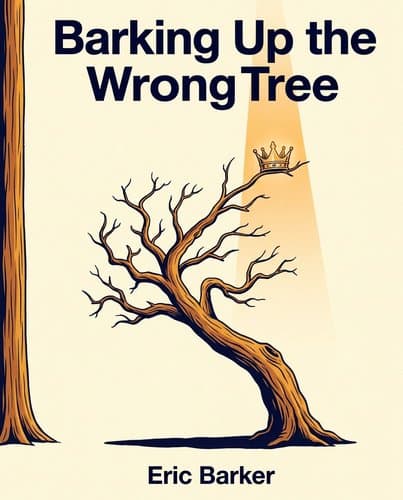
31751591_barking-up-the-wrong-tree
by Eric Barker
The traits you've spent years trying to fix—obsessiveness, defiance, relentless stubbornness—may be your greatest weapons, just aimed at the wrong arena.
In Brief
Barking Up the Wrong Tree (May ) uses social science research to challenge conventional success advice.
Key Ideas
Reframe weaknesses as contextual strengths
Before trying to fix a weakness, ask whether it might be an intensifier — a trait that's destructive in most contexts but a competitive weapon in the right one. If so, the work is finding the right context, not engineering a cure.
Cooperation beats competition long-term
Cooperation is the mathematically dominant long-term strategy in any repeated interaction. Start by cooperating, retaliate once when betrayed, forgive occasionally to prevent death spirals, and make your contributions visible. That's the formula two lines of code used to beat 14 complex algorithms — twice.
Reframe obstacles as winnable short-term games
When you hit an obstacle, reframe the struggle as a game with short-term, winnable goals and immediate feedback. The goal isn't to feel motivated — it's to manufacture the conditions where motivation becomes automatic, the way Joe Simpson turned a six-mile crawl on a shattered leg into a series of 20-minute sprints.
WOOP reveals when to pivot
Use WOOP (Wish, Outcome, Obstacle, Plan) before committing to a major goal. If you can't construct a credible path through the primary obstacle, that's not pessimism — it's the signal to redirect. Pure positive fantasy actively hurts goal pursuit; mental contrasting tells you when to push and when to pivot.
Self-compassion over self-esteem builds resilience
Replace self-esteem with self-compassion. Self-esteem requires either delusion or constant performance to maintain. Self-compassion — treating your failures the way a wise friend would — produces the same resilience and motivation with none of the narcissism, denial, or Kasparov-style collapse when reality intrudes.
Balance four life metrics simultaneously
Track your life across four metrics simultaneously: Happiness (enjoying the process), Achievement (winning), Significance (mattering to people who matter to you), and Legacy (extending your impact beyond your presence). Success in one without the others is a contract you signed without reading — Einstein's wife signed it; so did Ted Williams's children.
Relationships predict success more than performance
Your relationships are not a reward for success — they are its most reliable predictor. The Harvard Grant Study found that relationship quality at 47 predicted career earnings better than almost anything else measured. Build the skills of connection — cooperation, gratitude, conflict resolution — with the same seriousness you bring to domain expertise.
Who Should Read This
People working on personal growth in Behavioral Psychology and Positive Psychology, especially those tired of generic motivational advice.
Barking Up the Wrong Tree
By Eric Barker
10 min read
Why does it matter? Because the traits society told you to fix might be exactly what makes you exceptional.
A man wins the world's most brutal endurance race five times. Scientists test him every way they can and find nothing exceptional — no freakish physiology, no elite methodology. What they do find: he picks fights with mailboxes and terrifies his own crew badly enough that they lock the car doors when he approaches. His edge is that he's clinically unhinged.
Eric Barker spent years interviewing researchers, criminals, CEOs, and military strategists to answer one genuinely unsettling question: what actually produces success? Not what we're told produces it. The answer keeps landing in the same uncomfortable place — the qualities we spend our lives apologizing for might be exactly what we should be doubling down on. Just not everywhere. The game you're playing, and the arena you've chosen, matter more than almost anything you've been trying to build or fix.
Your Weirdest Quality Might Be Your Only Real Competitive Edge
Day four of the Race Across America, and Jure Robič is half a day ahead of the next rider. This is not a metaphor. In a race where cyclists cover three thousand miles without stopping — San Diego to Atlantic City, sleeping maybe three hours a night — being a half-day ahead means something almost incomprehensible. His nearest competitor would cross the finish line while Robič was already celebrating.
When researchers tested him, they found nothing exceptional. Physically, he was a typical elite ultra-endurance athlete: no unusual lung capacity, no freakish oxygen efficiency. And his coach? He didn't have one, really. Friends described him as "completely uncoachable."
What Robič had was a kind of insanity, and that's not colorful language. As journalist Dan Coyle documented, when Robič rode hard enough and long enough, he would genuinely lose his mind. He had tearful paranoid collapses so severe that his wife locked herself in the team trailer. Scientists had noted since the 1800s that mental instability can allow athletes to override the body's built-in pain limits, the conservative internal signals that tell you to stop before you break yourself. Robič described his condition as "awkward and embarrassing but impossible to live without." He won the RAAM five times.
Here's what's worth sitting with: the quality that made Robič the greatest ever in his sport was not, by anyone's definition, a positive trait. It was a liability in every other domain of his life. His own crew was afraid of him. His marriage suffered. He was, by measurable standard, mentally unsound. And yet in a race designed to break you, where you must push past every signal your body sends, his particular brand of broken was an unbeatable advantage.
Gautam Mukunda has a name for this: "intensifiers." Traits that damage you on average but, in the right environment, operate like rocket fuel. Not weaknesses you've managed to spin positive; genuinely problematic characteristics that happen to be exactly what a specific context rewards.
The uncomfortable implication is that you've probably been trying to fix something you should have been trying to place. The traits you've spent years apologizing for, moderating, working around are not necessarily problems to solve. They may be signals about where you belong. Robič didn't beat his insanity into submission. He found the one place on earth where insanity was a competitive advantage, and he went there, again and again, until no one could touch him.
Nice Guys Finish Last. And First. Jerks Are Stuck in Between.
Nice people cluster at both the bottom and the top of every success metric anyone has bothered to measure. Not in the middle. At the extremes. The jerks land in between.
That result, from Wharton professor Adam Grant's studies of engineers, medical students, and salespeople, sounds like a paradox until you understand what determines which end you land on. And to understand that, you need to know about a computer tournament run in the early 1980s.
Political scientist Robert Axelrod invited researchers from across disciplines to submit algorithms for a Prisoner's Dilemma competition (each player can either cooperate or betray — betrayal pays off short-term, but mutual cooperation pays more over time). Fourteen sophisticated strategies arrived, including a program that always betrayed and a program that always forgave. Axelrod ran them against each other for hundreds of rounds.
The winner barely qualified as code: cooperate first, then mirror whatever your opponent did last. Cooperate back after cooperation. Retaliate after betrayal. Two lines. Tit-for-tat won decisively enough that Axelrod ran the whole tournament again with 62 entries, including algorithms designed specifically to exploit its predictability. It won again.
Here's the counterintuitive part: tit-for-tat never beat its opponent in any single game. Not once. What it did was generate enormous mutual gains whenever it encountered a cooperative program, while converting borderline programs by making retaliation certain and forgiveness available. Devious programs that couldn't forgive got trapped in retaliation spirals and lost to everyone.
When researchers tried to build something better, more forgiveness, not more cunning, was the only upgrade that worked. Occasionally cooperating after a betrayal, rather than always punishing, rescued programs that might have cooperated and turned them into partners.
The formula this produces: cooperate first, retaliate when betrayed, forgive enough to avoid spirals, and never be a pushover. The nice people at the bottom of Grant's rankings (he calls them Martyrs) cooperate without ever pushing back, which signals to opportunists that exploitation is free. His elite Givers do the same cooperation but protect themselves, earning allies and screening out predators. The jerks take the short-term gains from defecting and miss the compounding returns that come from a reputation everyone actually wants to deal with.
Grit Is a Story You Tell Yourself — Which Means You Can Engineer It
Joe Simpson is at the bottom of a dark crevasse on a Peruvian mountain, alone. His shin has been driven up through his knee joint. His climbing partner cut the rope and left him for dead. He has six miles of ice and rock between him and base camp, frostbitten fingers, and no rational reason to believe he'll make it. What he does next is the strange part: he turns it into a game.
Can I reach that rock in twenty minutes? He sets the target, checks his watch, drags his ruined body forward. If he makes it, he's ecstatic. If he misses, he's frustrated — but the frustration pulls him to the next marker rather than stopping him. The game has its own gravity. Hours later, crawling delirious through a latrine, he hears voices. His partner is still there. He wins.
The obvious reading is that Simpson was extraordinarily tough. The more useful reading is that he was crafty about how he structured his attention. What we call grit isn't a reserve to draw from. Simpson built a winnable game, with clear goals and immediate feedback, and the game did the motivational work his body couldn't.
Research on what makes games compelling explains why. We fail at them roughly 80 percent of the time and stay hooked anyway, because failure in a well-designed game reads as information rather than verdict. The same failure in an unstructured setting reads as a reason to stop. The difference isn't difficulty. It's the frame. Simpson's twenty-minute windows converted an unsurvivable situation into a sequence of winnable ones.
Martin Seligman's dogs couldn't do this. Shocked randomly with no detectable pattern, they eventually stopped trying to escape even after escape became easy; they'd learned their actions didn't matter. One in three humans in equivalent studies never reached that conclusion. They kept treating failures as anomalies. The difference wasn't pain tolerance. It was the story they told about what failure meant.
Which is where WOOP comes in, the one tool that works in both directions — it fuels you when the goal is real, and tells you to quit when it isn't. Psychologist Gabriele Oettingen found that pure positive visualization actively hurts performance: women who spent time imagining their thinner future selves lost twenty-four fewer pounds than women who didn't visualize. The brain treats fantasy as partial completion and relaxes. WOOP replaces that fantasy with a four-step sequence: name your Wish, visualize the Outcome, identify the Obstacle, make a Plan. That last step is where intention becomes behavior: you pair each obstacle to a specific if/then response, deciding in advance what you'll do when it shows up. WOOP only energizes you when the goal is reachable; if you can't construct a credible path through the obstacle, you feel flat. That's information, not weakness. The system is telling you this game isn't winnable. Quit it and find one that is.
Fake Confidence Until You Start Believing It — Then You're in Real Trouble
Confidence works — but "fake it till you make it" has a ceiling, and when you hit it, you lose to a software bug.
In 1997, Garry Kasparov, world chess champion for twelve years and the most dominant player of his generation, was facing IBM's supercomputer Deep Blue when the machine made a move he couldn't explain. Game one, forty-fourth move: rook from D5 to D1, no visible purpose. Kasparov studied it, couldn't crack it, and drew a dangerous conclusion: the machine must be seeing things he wasn't. Maybe it was smarter than he'd assumed.
It wasn't. The move was a random glitch, a failsafe coded in for when the machine got stuck. Meaningless noise. But Kasparov read it as signal, as hidden genius, and his confidence quietly broke. He resigned game two from a position commentators later proved was drawable. He turned defensive. In game six, he fell into a trap a beginner would recognize. He lost the match to a hiccup.
That's confidence working exactly backwards. The appearance of certainty, even accidental, even fake, moved the outcome. What Deep Blue "projected" through sheer inscrutability was read as mastery, and that reading was enough to destroy a grandmaster.
The same dynamic runs in reverse: fake confidence doesn't just fool other people, it fools the faker. Dan Ariely nails the mechanism: students who cheated on tests predicted they'd outperform on the next one, attributing their success to intelligence rather than deception. The liar convinces himself first.
The exit isn't to swing to self-doubt. Kristin Neff's research points to a third option: self-compassion. Not a pep talk, not a performance, just treating your own failures the way a reasonable friend would. The data is striking: self-compassion produces all the motivational benefits of high confidence — resilience, persistence, happiness — without the narcissism. One study found self-compassion correlates with zero narcissism while self-esteem correlates significantly; under fMRI, self-forgiving people activate the same brain regions as when caring for others. You still push hard. You just don't need to construct a fiction to do it.
Kasparov lost because he believed in someone else's projected certainty. Self-compassion means you don't need to read the board through the lens of someone else's performance, or your own.
Every Obsessive Success Story Has a Second Chapter Nobody Wants to Read
Think of deep mastery as a wildfire: it doesn't discriminate between what it needs to burn and what it merely can. The people who achieve historic greatness (not good, not excellent, but historic) almost always got there by feeding the fire everything. The question worth asking before you admire the blaze is what exactly burned.
Einstein is the obvious case, but not for the reasons usually cited. He produced more paradigm-shifting work in a single year (1905, age 26) than most scientists manage in careers. What gets left out of the hagiography is the document he drafted for Mileva, his first wife, when the marriage was falling apart. He laid out his demands: meals delivered to his study, no intimacy, conversation stopped the moment he wanted it. She agreed to all of it. The marriage collapsed anyway. His son Eduard died in a psychiatric hospital; Einstein hadn't visited in over thirty years. Hans Albert, his other son, put it plainly: "Probably the only project he ever gave up on was me."
The pattern holds. Ted Williams, arguably the greatest hitter who ever lived, practiced until his hands bled and told a woman who wanted to come first: "Baseball, fishing, then you — in that order." His own verdict on fatherhood: "I struck out." Same fire, same ash.
Creativity and emotional availability draw from the same reservoir. People high in perfectionism are a third less likely to have satisfying relationships, not because they don't care, but because there's only one tank and it runs hot. The time they spend with family isn't just less; it's measurably lower quality.
Stanford research found that past fifty-five working hours a week, additional hours produce nothing measurable. The obsession wasn't even buying what it advertised.
The cost isn't inevitable — it's structural. The people who sustain greatness without burning everything around them aren't less passionate. They're more honest from the start about what they're actually optimizing for. That honesty is the hard turn the book makes next.
The Only Metric That Compounds Over a Lifetime Is Other People
Carl was just a regular guy, not a doctor or philosopher, who found out years earlier that he was a tissue match for his seriously ill friend Spencer Glendon. He didn't announce it. He started eating differently, exercising, keeping himself in peak condition. Quietly. For years. When Spencer's condition finally declined to the point that doctors had run out of options, Carl was ready. The transplant happened. Both men are healthy today.
Carl's story points to what every other framework in this book is actually pointing toward — and what you miss when you treat them as ends rather than means.
The book has walked you through a sequence: figuring out where you're naturally strong so you can place yourself rather than grind yourself into shape; finding people who cooperate rather than exploit, because your environment determines more than your discipline; setting goals that energize when a path is actually real; and staying in the game when it gets hard without turning every stumble into evidence against yourself. Each step assumes you're building toward something. But none of them tells you what. Master all of it without answering that question and you've become very efficient at something you haven't examined.
George Vaillant spent decades following a group of Harvard men from college until their deaths, tracking every metric that might predict a good life. What his data came back to, again and again, wasn't income or achievement or professional success. It was the quality of their relationships. His team scored each man on relationship quality at forty-seven: how long they'd been married, how close they were to their children, how many friends they had. That single score nearly predicted career earnings. Men at the top earned more than twice those at the bottom. The most empathic earned two and a half times what the most narcissistic did. Vaillant's summary, after four decades of data: what matters most in a life is the people in it.
The causal arrow runs in a direction most people don't expect. Relationships compound first, and the success follows. The people around you are the actual infrastructure of everything you build.
Carl trained his body for years for one reason: Spencer was his friend. That's the whole argument.
The Pond Changes the Fish
Martin Pistorius, a South African man who spent years fully conscious but unable to move or speak, written off by everyone around him, didn't escape by reengineering himself. He found conditions where who he already was could finally land. That's the thread the book keeps returning to: the question isn't what to fix, it's where to stand. Every framework here — intensifiers, tit-for-tat, WOOP, self-compassion — only delivers what it promises once you're honest about what you're actually optimizing for. Because you can apply all of them correctly and still end up like Einstein's son, standing outside a closed door. The tools sharpen whatever goal you hand them. Which means the hardest work isn't learning the tools. It's sitting with the question they all assume you've already answered: what, exactly, am I building — and who gets to be inside it when it's done?
Notable Quotes
“One reporter wrote that I traveled with a suitcase full of pills. Actually, they barely fill a briefcase.”
“I don't go to concerts, sometimes not even my own.”
“among his friends. He once commented,”
Frequently Asked Questions
- What is Barking Up the Wrong Tree about?
- Barking Up the Wrong Tree uses social science research to challenge conventional success advice and reframe how we think about achievement. The book argues that traits often labeled as flaws—rule-breaking, obsessiveness, contrarianism—can be competitive advantages in the right context. It equips readers with evidence-based frameworks for choosing environments, building cooperation strategies, sustaining motivation, and measuring success. Rather than fixing weaknesses, the work shows readers how to find contexts where their supposed flaws become strengths and how to build a fulfilling life based on multiple dimensions of success.
- What cooperation strategy does Barking Up the Wrong Tree recommend for long-term success?
- Cooperation is the mathematically dominant long-term strategy in any repeated interaction. Barking Up the Wrong Tree recommends starting by cooperating, retaliating once when betrayed, and forgiving occasionally to prevent death spirals, while making contributions visible. This formula—just two lines of code—beat 14 complex algorithms twice in competition. The book positions cooperation not as a moral choice but as mathematically optimal for building sustainable relationships. It emphasizes that relationships predict success: the Harvard Grant Study found that relationship quality at 47 predicted career earnings better than almost anything else measured.
- What four success metrics does Barking Up the Wrong Tree recommend tracking?
- The book recommends tracking your life across four metrics simultaneously: Happiness (enjoying the process), Achievement (winning), Significance (mattering to people who matter to you), and Legacy (extending your impact beyond your presence). Success in one metric without the others is incomplete. Examples include Einstein's wife and Ted Williams's children—both achieved in certain dimensions without fulfilling others. This framework challenges the assumption that achievement alone defines success and equips readers to measure progress toward genuine fulfillment rather than pursuing a narrow definition that neglects crucial life domains.
- Why are relationships the most reliable predictor of success according to Barking Up the Wrong Tree?
- The Harvard Grant Study found that relationship quality at 47 predicted career earnings better than almost anything else measured. Barking Up the Wrong Tree argues that relationships are not a reward for success but its most reliable predictor. The book emphasizes building connection skills—cooperation, gratitude, conflict resolution—with the same seriousness as domain expertise. Unlike conventional wisdom that prioritizes achievement first, this work reframes relationships as foundational to success. By treating interpersonal skills as non-negotiable investments, readers can create the social foundations that make professional success more likely and sustainable.
Related Book Summaries
Read the full summary of 31751591_barking-up-the-wrong-tree on InShort