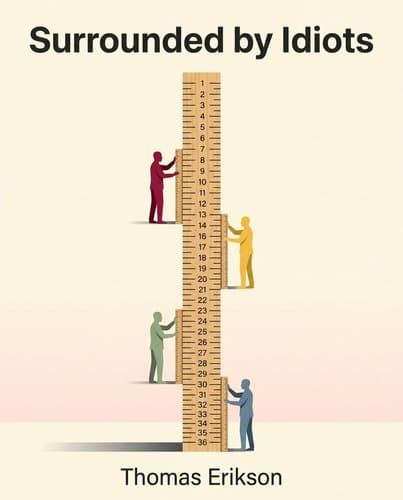
39101777_surrounded-by-idiots
by Thomas Erikson
Everyone you find maddening is simply wired differently—and once you decode their behavioral type (Red, Yellow, Green, or Blue), you gain a precise playbook…
In Brief
Surrounded by Idiots (2014) introduces a four-type behavioral model — Red, Yellow, Green, and Blue — to explain why people think, communicate, and react so differently. It gives you a practical framework for reading those around you and adapting your own style so you can work, lead, and connect more effectively with anyone.
Key Ideas
Pause judgment, assess what situation needs
When someone frustrates you, pause before labeling them difficult — ask instead: am I judging this person against my default, or against what the situation actually needs from them?
Lead with bottom line for Reds
With Reds: lead with the bottom line (they're waiting for the last slide anyway), skip the small talk, and hold your ground under fire — back down once and you lose their respect permanently.
Yellows prioritize feeling over spreadsheets
With Yellows: strip away data and details entirely, ask 'how does this feel?' rather than showing spreadsheets, and deliver any critical feedback in private — they're far more fragile to public criticism than they appear.
Greens need explicit direction and patience
With Greens: spell out every step explicitly because they won't take initiative without a clear invitation, break change into small pieces delivered over weeks, and watch for the barrel filling — if a Green has been quiet for a long time, create a private space for them to speak before the flood arrives.
Blues require precision and detailed analysis
With Blues: say '$9.73' not 'about $10,' verify every number before the meeting, and don't mistake their need to evaluate everything for indecision — the process of analysis is often the point, not the obstacle.
Your strength reveals your shadow side
Your own behavioral type has a shadow side that others experience as a failure mode. The same trait that makes you effective is the same trait that will eventually frustrate the people around you — knowing this is the beginning of actually doing something about it.
Types complement each other's blind spots
Diverse teams outperform homogeneous ones not because of values but because of mechanics: each type's blind spot is another type's default strength, and without that coverage, excellence in one dimension produces catastrophic failure in another.
Who Should Read This
Curious readers interested in Behavioral Psychology and Social Psychology and the science of how the mind actually works.
Surrounded by Idiots
By Thomas Erikson
10 min read
Why does it matter? Because the "idiot" in every frustrating interaction might be you.
Think about the most frustrating person in your life right now. The colleague who hijacks every meeting. The manager who buries feedback in seventeen pages of documentation. The friend who agrees enthusiastically and then does whatever they were going to do anyway. Your frustration feels completely earned — because it is. But here's the uncomfortable part: there's a decent chance you appear on someone else's identical list for exactly the same reasons.
Thomas Erikson spent twenty years studying why — and his answer isn't that people are broken, oblivious, or quietly hostile. They're operating from a completely different set of defaults. One that's just as internally coherent as yours, just as invisible to them. Once you know what to look for, it becomes far more legible than you'd expect. The frustrating ones don't need fixing. They need translating.
The Man Who Used Himself as the Measuring Stick for Everyone Else
Thomas Erikson was twenty-five when he sat down with Sture, a self-made entrepreneur in his sixties, to discuss how things were running at his company. Sture's opening observation: he was surrounded by idiots. Department A: complete idiots, every one. Department B: fools who understood nothing. Department C, the worst of all, so strange that Sture couldn't figure out how they made it to work each morning. He wasn't joking.
The warning light at one of Sture's offices tells the whole story. Someone had mounted it quietly above the reception desk — red when Sture was in the building, green when he was gone. Employees checked it before going in. Clients checked it before crossing the threshold. On red days, some simply turned around and came back later.
Erikson eventually asked the question the situation demanded: "Who hired all these idiots?" Sture threw him out. (Reportedly, he had to be talked down from escalating things considerably.)
What Erikson understood afterward, sitting in his car with a lump in his stomach after a particularly ruinous meeting, was simpler and more damning than cruelty: Sture had only one measuring stick, and it was himself. Anyone who didn't think, move, or decide the way he did was, by definition, broken. He had a full vocabulary for it: "arrogant windbags," "red-tape jackasses," "tedious blockheads." Not random insults. Categories. A taxonomy built around a single fixed reference point. Erikson recognized that vocabulary; he'd used versions of it himself, quietly, about people who baffled or frustrated him.
The same logic, the same center of gravity: one reference point, quietly elevated to the standard, and everyone else measured against it. Most people never notice they're doing it. Erikson caught himself. Sture never did.
That's the trap the book is built around. Calling someone an idiot forecloses curiosity: it answers the question before you've asked it. If Sture had wondered why Department C operated the way it did, what drove those people, how they approached problems, he might have found capable colleagues. Instead he accumulated confirmation that everyone else was the problem, and his entire organization quietly reorganized itself around managing his moods.
The measuring stick was always the issue. Sture had only ever owned one — and if you've ever mentally filed a colleague under "impossible to deal with," odds are you were gripping the same one.
They're Not Broken. They're Running a Different Program.
Picture two people trying to navigate an unfamiliar city. One sits down with a map — traces the route, notes the landmarks, checks the backup options. The other opens the front door and figures it out as they walk. Neither is confused. They have different answers to what "finding your way" means — which only looks like a problem if you've already decided one answer is correct.
That's the frame Erikson is working with. His four colors — Red, Yellow, Green, Blue — aren't personality intensities on a single dial. Each one is a complete internal logic, with its own answer to the most basic professional questions: What counts as a decision well made? What does helping someone look like? What does a good conversation accomplish?
The sharpest proof is a Blue CEO Erikson once tried to sell a leadership training program to. The first meeting was booked for fifty minutes exactly — not an hour. Lunch was eight minutes from the office, the bathroom two, which left precisely fifty minutes. When Erikson submitted a 35-page proposal, the CEO called back: was there any more material? Erikson expanded it to 85 pages. More material? He sent a 300-page binder, covering every 15-minute training session, every coffee break, the room setup. More material?
There was none. The CEO never placed an order.
The obvious read: he was stalling, indecisive, impossible. The actual read: he was never going to decide, because the decision wasn't the point. For a Blue, examining a problem with complete precision (every variable mapped, every contingency covered) is what doing a good job looks like. The decision is almost secondary. That's not obstruction; that's the operating logic. The fifty-minute meeting wasn't a quirk; it was a man who had optimized his day down to the minute and saw no reason not to apply that same standard everywhere.
The other three colors run the same way, and most readers will recognize their own before they recognize anyone else's. Reds are the ones who sound completely certain about things they've barely confirmed, not because they're dishonest but because conviction precedes fact-checking for them, always. Yellows are the ones who crashed a car into a lamppost and reported it as fine because they got out the other door. Not shallow; genuinely unable to dwell. Their default is forward. Greens are the ones who called you with an urgent need and spent fifteen minutes asking about your situation first, because directly asking for help would mean putting themselves ahead of someone else, and that calculus doesn't compute.
When behavior looks wrong, the question isn't what's the matter with that person — it's what program are they running? Behavior that makes no sense from outside almost always makes complete sense from inside; the person is doing exactly what their logic says a reasonable person should do. You might look at that logic and wince in recognition. Or you might feel the flicker of irritation that means it's the logic someone else runs, and that you've been mistaking for broken ever since.
Every Strength Has Its Failure Mode Built In
What if the habit you'd least recognize as a problem is the one that's already got its hooks in your career? That's Erikson's uncomfortable argument: your strengths and your failure modes aren't two separate columns. They're the same thing.
Take the woman at one of Erikson's training sessions who was furious that her behavioral profile had labeled her a perfectionist — completely wrong, she announced, the whole tool was useless. Erikson, careful not to argue with a Blue, asked her to demonstrate she wasn't one. She had plenty of evidence. When she came home in the evenings, children's shoes were piled at the front door, so she sorted them: smallest near the door, largest at the back, because those kids always left last. Then twenty minutes sanitizing the kitchen before she could sit down. Her colleagues were in stitches before she'd finished the second sentence. She looked around, confused — her house was such a mess, that was her point.
Years later, she found the profile in her purse. She'd been carrying it around and checking off behaviors whenever she caught herself doing them. Every single one, ticked. She tracked Erikson down: the profile was 100% correct. An amazing tool, actually.
The story lands something precise. The same capacity making her exceptional, the refusal to call something finished until it genuinely is, ran so deep that she couldn't observe it from outside. The shoe arrangement wasn't neurosis; size 10 at the back because those kids leave last is just correct. Obvious, even. But that same logic is why a Blue recalculates an Excel formula with a pocket calculator before sending it upstairs — just to be certain. The strength and the failure mode draw from the same well.
The same pattern runs through every color. The Red's decisiveness — what makes them effective — is the same trait that drives one colleague to pay a monthly bus-lane fine on top of a permit fee because the time savings pencil out and rules are just transactions. The Yellow's verbal fluency, what makes them riveting in any room, is what let one sales manager eat up roughly two-thirds of a meeting's talk time while holding maybe a tenth of its agenda. Erikson clocked it with a new stopwatch. The Green's deep capacity for accommodation, what makes them the person everyone wants in their corner, is what fills the fifty-gallon barrel of silent grievances until it tips, and the flood arrives with an itemized invoice stretching back to 1997.
The mirror is uncomfortable for a specific reason: you're not looking at someone else's flaw. You're looking at your own strength, extended slightly past its welcome.
When Everyone Thinks the Same Way, Everything Breaks in the Same Way
Erikson wanted to see what happened when you took the mixing out of the equation.
The Red group arrived thirty minutes early, grinning like they'd just won a race — which, in their minds, they had. They congratulated each other. Their presentation was organized, structured, properly thought through. About thirty seconds in, it became clear they had solved an entirely different problem than the one assigned. Erikson asked if they'd read the instructions. An argument broke out. One man stated confidently that they'd adapted the task to reality. Brilliant work, really. He waited for applause. When the standing ovation didn't arrive, the group shrugged and sat down. A woman immediately started texting.
Twenty managers from a telecom company, all high-performers with strong credentials. Erikson had divided them into four groups, each composed entirely of people who shared the same behavioral profile, and given them one task and one hour. The Red group wasn't the exception. They were the illustration.
They hadn't been careless. They'd simply done what Reds do: started before the instructions were finished and moved with such certainty that checking whether they'd understood the problem felt redundant. Confidence preceded accuracy, as it always does. Their speed was their strength. Their speed was also why they failed.
Every other group failed too, each in its own signature way. The Yellows gave a highly entertaining presentation about what an inspirational exercise the whole thing had been. They got the most applause. The Green spokesperson faced the whiteboard, spoke too softly for the message to land, and when Erikson asked if the group agreed, four of six had crossed arms and grim faces. All six nodded yes. The Blue group came with an agenda, opened with a correction that both "adviser" and "advisor" are technically acceptable, cataloged grammatical errors on page one, and never got to the solution.
Twenty high-performers, every one of them screened for competence. Collectively, none did the thing asked. Competence wasn't the problem — homogeneity was. When everyone in the room shares the same strengths, they share the same blind spots, and nobody's left to cover what the profile leaves exposed. The Red needs someone who will read the instructions. The Blue needs someone who will stop correcting them and start. Diversity in a team isn't a cultural value; it's the load-bearing structure.
The Only Lever You Actually Have Is Your Own Communication
Adam, a successful Yellow entrepreneur dragged to one of Erikson's behavioral training workshops, erupted partway through the afternoon. He didn't want to categorize people. He didn't want to adapt. What worried him wasn't that the system would fail. It was that it would work, and if everyone deliberately adjusted to everyone else, no one would be themselves anymore. For a Yellow, this wasn't abstract. Spontaneity is what they believe actually works: the unfiltered, improvisational quality that makes them magnetic. Performing for someone else's comfort feels like trading that engine for a quieter one.
Erikson let him finish. Then he handed Adam a behavioral assessment: specific, accurate, slightly uncomfortable. His patterns, his blind spots, the things everyone around him already knew. Adam went very quiet. When they talked it through, he understood. The tool wasn't dissolving him into someone else. It was showing him what he already was, and what others had been navigating around every time he walked into a room. The only thing you can change in any conversation is what you bring to it. Not the other person's temperament, not their default speed. Yours. Which word you lead with. How much you strip away before you open your mouth. That's not performing a different self. It's sending a signal on a frequency someone can actually receive.
That's the reframe. Adaptation isn't a personality transplant. A Red doesn't change their mind when you challenge them emotionally — they dig in. Appeal to the consequence that threatens their goal, speak in outcomes not feelings, and the same information lands. When Erikson worked with a Red sales director whose twenty reps described him as boorish and insensitive, he never once said your team feels hurt. He said: your team arrives Monday exhausted, and exhausted people don't close deals, and that's your number on the line. The director still cursed, still threatened, still crossed one item off the agreed list just to claim a win. But he heard it. The message arrived.
What the framework gives you isn't leverage over other people (you don't get that). It's the ability to stop sending signals into the wrong frequency and wondering why nobody's receiving. You can read a Red's impatience as hostility, or you can lead with the bottom line and skip to the part they were waiting for anyway. You can hear a Green's silence as indifference, or you can understand that criticism delivered publicly just shut them down for the rest of the day. The behavior hasn't changed. Your interpretation of it has — and with it, your next move.
The Question Sture Never Thought to Ask
Sture never once wondered what it felt like to show up at an office with a warning light above the door. Not because he was callous (he wasn't, particularly) but because the question never occurred to him. He had one measuring stick, it was himself, and the curiosity required to set down that measuring stick simply wasn't there. That absence is what this book is really about. The framework gives you a specific tool for filling it: before you reach for a label, ask what this person's behavior would look like if it were completely rational — just aimed at different things than yours. The Red who cuts you off mid-sentence, the Blue who needs one more week, the Green who won't say what's wrong — none of them are broken. They're running a different program. You can read it now. That changes what you do next.
Notable Quotes
“This is wrong! How could I categorize people like that? Put people into a theoretical grid system?”
“YOU DON'T ACTUALLY KNOW? THEN WHY AM I WASTING MY TIME WITH YOU?”
“I don't really know what to say”
Frequently Asked Questions
- What is the behavioral model in Surrounded by Idiots?
- Surrounded by Idiots introduces a four-type behavioral model — Red, Yellow, Green, and Blue — to explain why people think, communicate, and react so differently. The model provides a practical framework for understanding personality differences at work and in daily life. By identifying which type you and others belong to, you gain insight into communication preferences, decision-making styles, and stress responses. This framework helps you adapt your own behavior to connect more effectively with different personality types, ultimately improving relationships and collaboration in any setting. The model is built on observable behavioral patterns rather than abstract psychology.
- How should you communicate with each personality type according to Surrounded by Idiots?
- Surrounded by Idiots provides specific communication strategies for each type. With Reds: lead with the bottom line (they're waiting for the last slide anyway), skip the small talk, and hold your ground under fire. With Yellows: strip away data and details entirely, ask 'how does this feel?' rather than showing spreadsheets, and deliver any critical feedback in private. With Greens: spell out every step explicitly because they won't take initiative without a clear invitation. With Blues: say '$9.73' not 'about $10,' verify every number before the meeting, and recognize that their analysis is their decision-making process, not an obstacle.
- What does Surrounded by Idiots reveal about your own behavioral type?
- Erikson argues that your own behavioral type has a shadow side that others experience as a failure mode. The same trait that makes you effective is the same trait that will eventually frustrate the people around you — knowing this is the beginning of actually doing something about it. This insight is crucial for self-awareness: your greatest strength is inextricably linked to your potential weakness. Understanding this duality allows you to recognize when your default style is creating friction and consciously adjust your approach. The book frames self-knowledge not as a destination but as the first step toward meaningful change.
- Why do diverse teams outperform homogeneous teams according to Surrounded by Idiots?
- Surrounded by Idiots argues that diverse teams outperform because each type's blind spot is another type's default strength, and without that coverage, excellence in one dimension produces catastrophic failure in another. Rather than valuing diversity for cultural or moral reasons, Erikson grounds the advantage in mechanics: personality types have complementary strengths. A team of all Reds might excel at decisive action but miss critical details; a team of all Blues might paralyze themselves analyzing. The book emphasizes that type diversity creates natural checks and balances, ensuring broader organizational effectiveness and resilience.
Related Book Summaries



Read the full summary of 39101777_surrounded-by-idiots on InShort