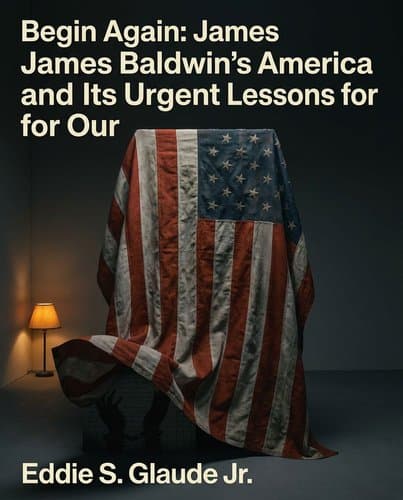
45754985_begin-again
by Eddie S. Glaude Jr.
America's racial hierarchy isn't a flaw to be corrected—it's the foundation. Through James Baldwin's unflinching late-career witness, Eddie Glaude reveals how…
In Brief
America's racial hierarchy isn't a flaw to be corrected—it's the foundation. Through James Baldwin's unflinching late-career witness, Eddie Glaude reveals how to name the lie at the heart of American identity and still find the courage to begin again without illusion or surrender.
Key Ideas
Exceptionalism treats symptoms, ignores structural disease
Calling Trump 'exceptional' is itself a form of the lie — it treats the symptom as the disease and leaves the foundational structure (the value gap) intact. The question is not what went wrong with American democracy; it's whether American democracy has ever been what we said it was.
Value gap reveals structural racism, not prejudice
The 'value gap' is a precise analytical tool: not individual prejudice but the foundational assumption embedded in American law, policy, and culture that white lives matter more. Using this term separates structural diagnosis from interpersonal blame — which is why it matters.
Bearing witness preserves truth against narratives
Bearing witness is distinct from activism. It means refusing, over time, to let the country's self-flattering narratives substitute for what actually happened — including when your own memory breaks under the weight of what you've seen. 'My memory stammers. But my soul is a witness.'
Monument timing exposes history as political weapon
Confederate monuments weren't built contemporaneously with the Civil War — most were erected in the 1890s and 1950s, at moments of rising Black political power. The history America tells about itself is not neutral retrospection; it is an active political weapon. Knowing the timing is knowing the argument.
Margin enables honest external societal vision
Creating 'elsewhere' — physical distance, communities at the margin, or any practice that lets you see your society from outside its own story — is not escape. It is a precondition for honest vision. Baldwin needed Istanbul to see America clearly. The margin is available without leaving.
Begin again without national innocence
'Begin again' is not a call for hope. It means going back to where the lie was seeded, telling a different history without national innocence as a crutch, and building communities of love that function regardless of whether white America is ready to change.
Who Should Read This
History readers interested in Social Issues and Cultural Studies who want a deeper understanding of how we got here.
Begin Again: James Baldwin's America and Its Urgent Lessons for Our Own
By Eddie S. Glaude Jr.
9 min read
Why does it matter? Because the America you thought you knew was always a story told to avoid a harder truth.
The comfortable story goes like this: America has a racial problem, always has, but we're working on it — slowly, messily, with backsliding, but generally trending better. Each crisis is a failure to live up to ideals we actually hold. Then Trump arrives and that story cracks. Eddie Glaude went to James Baldwin after 2016, looking for something that could hold — specifically to the difficult, post-King-assassination Baldwin that the comfortable reader usually stops before. What he found wasn't comfort. It was a diagnosis: the ugliness isn't a deviation from American values. It's what those values produce, on schedule, every generation. The lie at the country's foundation, that white lives are worth more, isn't a bug in the system. It is the system. Baldwin knew this in his darkest years. Glaude built a book from that knowledge. It's harder than consolation. It's also more useful.
America Hasn't Failed Its Founding Ideals — The Ideals Included the Lie From the Start
The ugliness you want to vote out of the White House isn't an intrusion into American democracy. It's democracy's original content.
Glaude builds this through Baldwin — specifically the late, post-King-assassination Baldwin that the comfortable reader usually stops before — and it cuts at something most people would rather not touch. We tell ourselves the story in its comforting form: America has a founding creed and a recurring problem with living up to it. The creed is good; the failures are correctable. Progress is the gap slowly closing.
Baldwin refused that story. In a 1964 essay called "The White Problem," he traced what Glaude calls "the lie" to its origin: the moment when the country's founders, who could plainly see that enslaved people were human beings, chose to declare them otherwise, because the only alternative was admitting they had committed a crime. The lie wasn't a departure from the founding. It was the founding's enabling move. The ideology of Black inferiority, the mythology of American innocence, the habit of treating each atrocity as a regrettable exception: all descended from that first act of self-deception. Baldwin called it the source of every problem that followed.
What the lie produces, Glaude argues, is a "value gap": the operating assumption, woven so thoroughly into American life that most people never examine it, that white lives carry more worth than others. Between 2008 and 2012, Black families lost their homes to foreclosure at roughly double the rate of white families. It shows up in how slavery gets framed in national memory: not as a defining institution built on systematic cruelty, but as a mistake the country eventually corrected. It shows up most seductively in the story Obama's election invited everyone to tell in 2008: that what King began in Montgomery, Obama finished at Grant Park, and the arc had finally bent. That version felt so good that Obama himself didn't discourage it.
Each of these — the sanitized history, the Obama-as-ending story — is the lie reshaping reality to protect the country's sense of its own innocence. Trump didn't introduce that mechanism. He's the third time it's cycled back after a moment when genuine change looked possible: Reconstruction ended it first, the civil rights era second. Treating this as aberration is itself part of how it survives.
Bearing Witness Means Refusing to Let the Country Forget What It Did — Even When Memory Breaks
On September 4, 1957, fifteen-year-old Dorothy Counts walked toward Harding High School in Charlotte, North Carolina, in a red-and-yellow dress her grandmother had sewn. The white students waiting for her threw ice and sticks, screamed slurs, and spat on her. Charlotte police stood at the far end of the street and watched. A photographer named Don Sturkey caught it all — her head up, her face holding something between dignity and horror — and the images went around the world.
James Baldwin later wrote that he saw those photos at a conference in Paris, and that they drove him to leave France and return to the United States. The images hit him like a demand: everyone else was paying their dues, and it was time he paid his.
Glaude traces the timeline and finds a problem. The conference Baldwin describes took place in 1956. The Counts incident happened in the fall of 1957. The article Baldwin filed from that conference mentions a Parisian evening, crowds, bakeries — not a photograph that changed his life. He got the facts wrong.
Glaude doesn't use this to discredit him. He uses it to ask what bearing witness actually requires. By the time Baldwin wrote No Name in the Street in 1972, he had watched Medgar Evers, Malcolm X, and Martin Luther King Jr. be murdered. He had seen the movement he'd risked himself for get crushed and absorbed into the Nixon backlash. Sixteen years of collective trauma had fractured how he held the sequence of events. The photo of Dot Counts — a child walking into a wall of hatred with her chin up — had become, in his memory, the moment that demanded his return, because in every essential sense it was. Not the chronological trigger, but the distilled truth of what he'd spent those years inside.
"My memory stammers," Baldwin wrote. "But my soul is a witness."
Traumatic memory doesn't preserve events in order. It preserves what mattered — what the events meant, what they cost, what they proved. That kind of truth is harder to discount than a timestamp.
The Cycle of Betrayal Doesn't Just Disappoint — It Manufactures Permanent Enemies
In the summer of 1964, a twelve-year-old named Ben Chaney bent over his brother's casket in Mississippi and wept so hard his whole body shook. A photographer caught it. The image went around the world. James Chaney, the only Black man among the three civil rights workers murdered near Philadelphia, Mississippi that year, had been beaten so savagely that a forensic pathologist testified he had never, in twenty-five years of practice, seen bones so completely shattered.
After the funeral, the family couldn't stay. Death threats came by phone. Someone fired shots at the house. Ben's mother finally packed them up and moved to Harlem.
There, Ben received a scholarship (named for Andrew Goodman, one of the white workers killed alongside his brother) to a progressive private school on the Upper West Side of Manhattan. He was one of twenty-five Black students among roughly eight hundred. He described it as landing in a foreign country. By 1969, he had dropped out, joined a coalition fighting for Black history in schools, and was moving, as his friends put it, away from the civil rights movement toward the Black Panthers and Malcolm X. In April 1970, a friend asked him to drive to Florida. It turned out to be a gun run for a Black nationalist underground that had decided, having watched the movement get crushed, to wage actual war. Four people were killed on the road between Florida and the Carolinas — by others in the group, Chaney said; he only drove the car. He was sentenced to life in prison at eighteen. He served thirteen years. When he returned to Mississippi, he found his brother's grave shot through with bullet holes.
James Chaney had been a CORE field organizer working under Dave Dennis, who led CORE (the Congress of Racial Equality) in Mississippi during the 1964 Freedom Summer voter-registration campaign. Dennis told Baldwin directly: what the country did was manufacture permanent enemies.
That's the mechanism Glaude is tracking. The betrayal doesn't leave people disappointed — it produces the radicalization the country then uses to justify its next round of repression. Ben Chaney believed in the system. The system watched his brother's murder go unanswered, relocated his family under threat of death, handed him a scholarship to a place where he didn't belong, and offered nothing resembling justice. None of it was irrational. It was the entirely predictable result of telling a twelve-year-old that his brother's life didn't matter, then acting surprised when he stopped believing lives matter. The country created Ben Chaney's rage and punished him for it. Baldwin and Dennis both understood: the civil rights movement was one more iteration of a pattern running since Reconstruction, a moment when the country was offered the chance to break it, chose not to, and arranged to forget.
Baldwin's Most Radical Move Was Returning the Problem to Its Actual Owner
What if the race problem isn't a problem of Black people at all?
For most of American history, the question has been asked in only one direction: What's wrong with Black communities? What failure of culture, family, or discipline produces poverty and incarceration? The frame assumes Black life is where the pathology lives, and the task is to diagnose it.
Baldwin turned the whole thing over. The pathology lives in white American psychology — the desperate need to maintain a self-image the facts don't support. The category of "the nigger" isn't a description of anyone. It's a projection: all the danger, sexuality, and criminality that white Americans refused to locate in themselves, deposited onto Black people as a useful contrast. The problem belongs entirely to those who invented it.
Eldridge Cleaver's 1966 attack on Baldwin in Ramparts, the Bay Area radical magazine, accused him of secretly loving white men, of hating Black people. From this angle, it looks like a strange confirmation. Cleaver's whole politics were organized around virile Black manhood reclaiming patriarchal standing from white men, which means his revolution was still structured entirely by the terms white men set.
Baldwin's formulation makes this precise. By the time he was seventeen, he wrote, he understood that whatever the country was describing when it deployed that word had nothing to do with him. Something had to be invented to carry what white Americans feared. So they invented it and invested him with it. "I've always known that I am not a nigger," he said. "You're the nigger, baby, it isn't me." Glaude calls this Baldwin's revolutionary act — not defiance but a philosophical handoff. The invention reveals the inventors. Whatever that category contains is what white America needed to disown; returning it means white Americans have to look at what they've been carrying.
You Cannot See America Clearly While Living Inside Its Story of Itself
Try standing close enough to a painting that your nose nearly touches the canvas. You see brushstrokes, individual flecks of paint. What you can't see is what the painting is of. Distance isn't abandonment — it's the condition of vision.
Baldwin understood this by 1961, when he showed up at the Istanbul apartment of Turkish actor Engin Cezzar, penniless and sick, and said, "I need your help." He'd been failing to finish Another Country for years. He finished it in Istanbul.
Photographer Sedat Pakay captured him there in 1970, near the end of his time in the city. One image lands: Baldwin at a bedroom window in his underwear, and in the Bosphorus outside, unmistakably, an American warship. The image makes the argument on its own. There is no escaping American power. What Istanbul gave Baldwin wasn't escape — it was angle. "One sees it better from a distance," he said in voice-over. "From another place, from another country."
Glaude is precise about what this means. Baldwin never learned Turkish. He moved through the city in silence, which let him hear his own language differently, see the country's shape from outside its gravitational pull. Black Americans, Glaude argues, were already what he calls "natally exiled": cut off by law and practice from the ancestral community and social standing that ground a person's identity. Choosing to leave was a second layer of exile on top of the one that already existed.
Which is why "elsewhere" isn't a geography. It's a condition for honest vision, and Glaude argues you can cultivate it without leaving. The Confederate monuments show what happens without it: historians established that most were built in two later waves (the 1890s and the 1950s), each coinciding with rising Black political power. Du Bois documented this dynamic in Black Reconstruction in 1935. The country spent eighty more years not seeing it. That isn't stupidity. It's immersion. You need somewhere to stand outside the story to see what the story is doing. The harder question is what you look at once you're there.
Begin Again Is Not Optimism — It's the Discipline of Going Back to Where the Lie Was Seeded
On a summer day, Glaude and Carole Weinstein drove to Ferncliff Cemetery in Hartsdale, New York, to find James Baldwin's grave. Carole had been to the funeral and remembered the landmarks. They walked the Hillcrest section, past Hillcrest Garden, Hillcrest Terrace, Willow, Knollwood, and couldn't find him. A cluster of young men (Black, white, Latino) near a mausoleum suggested Baldwin might be buried near Malcolm X. He wasn't. Carole moved toward a tree she remembered from the funeral. There was Jimmy. "He is right there?" one of the young men said. Hidden in plain sight.
That's what begin again looks like: not a discovery of something new, but a recovery of what was always there, waiting.
The phrase comes from Baldwin's last novel, Just Above My Head (1979), and connects to something older: Revelation 2:5, "do your first works over." Glaude reads this not as nostalgia but as a demand to go back further than anyone wants to: not to the civil rights movement, not to the New Deal, but to the founding, where the lie was first made. The founders knew they were enslaving human beings and built the architecture to sustain it. The value gap, the incarceration machine, the suppressions of Black political power: all of it descended from that choice to protect their self-image over the truth. Begin again means going further back. Not to Selma.
The moderate offer of "normalcy" (restoring pre-Trump institutional life) doesn't solve anything. King named it in his Selma address: normalcy was precisely what killed Jimmy Lee Jackson, what led police to charge peaceful marchers on a bridge. Returning to it doesn't undo the lie; it makes the lie quieter and easier to carry.
The concrete demands: a national story that starts in 1619, with the arrival of the first enslaved Africans, rather than Plymouth Rock; a reparations commission (H.R. 40, in Congress every session for three decades without a vote) that treats racial harm as structural. Not charity. Dismantling. And beneath all of it, the thing Baldwin kept returning to: communities of love that don't require white validation to be real, capable of witnessing this history together.
Glaude kneeled at the grave and said "Thank you." He'd been reading Baldwin for thirty years. Baldwin had been waiting the whole time — to see what this history, once passed through, had made of all of us.
He Was Right Here All Along
That it took an hour to find something that had never moved is the book's whole argument. The evidence has been in the record the whole time: in the timing of the monuments, in the dates of the betrayals, in the forensic pathologist's testimony about James Chaney's bones. The difficulty was never the finding. It was deciding to look.
Glaude kneeled and said thank you. What Baldwin has been waiting for isn't vindication — it's company. Someone willing to go back further than the civil rights movement, further than the New Deal, all the way to where the lie was first chosen and the country built itself around protecting that choice. Begin again doesn't ask whether you're ready. It asks whether you're willing to stop pretending the grave was hard to find.
Notable Quotes
“all men are created equal”
“Ignorance allied with power is the most ferocious enemy of justice.”
“Black bodies swinging in the southern breeze,”
Frequently Asked Questions
- What is Begin Again: James Baldwin's America and Its Urgent Lessons for Our Own about?
- Begin Again uses James Baldwin's late career as a lens to examine America's foundational "value gap" — the structural assumption that white lives matter more. Published in 2020, Eddie Glaude Jr.'s work provides readers a framework for honest historical reckoning, bearing witness, and rebuilding without false hope. Glaude argues that focusing on exceptional figures misses the core problem; the question is not what went wrong with American democracy, but whether American democracy has ever been what we said it was. Understanding this demands confronting deep structural inequality.
- What is the "value gap" concept and how does it differ from individual prejudice?
- The 'value gap' is a precise analytical tool: not individual prejudice but the foundational assumption embedded in American law, policy, and culture that white lives matter more. This distinction is crucial because it separates structural diagnosis from interpersonal blame. Glaude emphasizes that calling Trump 'exceptional' is itself a form of the lie — it treats the symptom as the disease and leaves the foundational structure intact. The value gap represents the core disease of American society. Understanding this reframes conversations about American injustice from interpersonal to systemic.
- What does Glaude mean by "bearing witness" in this work?
- Bearing witness is distinct from activism. It means refusing, over time, to let the country's self-flattering narratives substitute for what actually happened — including when your own memory breaks under the weight of what you've seen. As Glaude explains, 'My memory stammers. But my soul is a witness.' This practice requires confronting uncomfortable historical truths even when they challenge national identity. Bearing witness is the ongoing work of maintaining moral clarity despite collective narratives that obscure reality, foundational to the honest reckoning Glaude calls for.
- What is the significance of "elsewhere" in Glaude's analysis of Baldwin?
- Creating 'elsewhere' — physical distance, communities at the margin, or any practice that lets you see your society from outside its own story — is not escape. It is a precondition for honest vision. Baldwin needed Istanbul to see America clearly. The margin is available without leaving. Glaude uses this concept to explain how critical distance from dominant narratives enables accurate diagnosis of structural problems. Physical displacement is one option, but communities and practices at society's margins also provide the vantage point necessary for truth-telling.
Related Book Summaries



Read the full summary of 45754985_begin-again on InShort