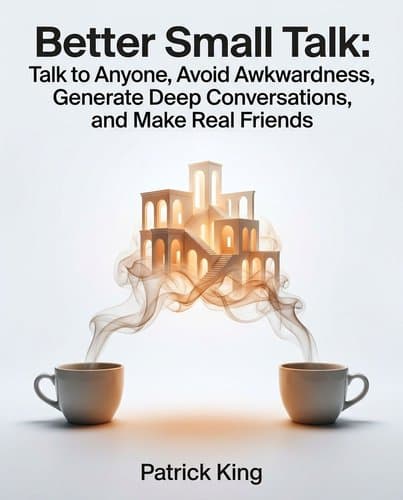
53512231_better-small-talk
by Patrick King
Social ease isn't a personality trait—it's a warm-up state you can engineer. Master the staged escalation, story formulas, and pre-built conversation inventory…
In Brief
Better Small Talk: Talk to Anyone, Avoid Awkwardness, Generate Deep Conversations, and Make Real Friends (2020) argues that social ease is a skill built on preparation and technique, not personality.
Key Ideas
Build biweekly inventory of stories
Build a conversation résumé — a pre-written inventory of your best stories, recent events, opinions, and notable experiences — and update it every two weeks. Preparation in calm conditions prevents going blank under social pressure.
Escalate conversations gradually with reciprocity
Move through conversational stages in order: small talk → fact disclosure → opinion disclosure → emotion disclosure. Escalation is conditional on reciprocity. Skipping stages doesn't save time — it collapses the connection.
Social ease as practiced state
Warm up socially before high-stakes events with ten-second interactions (a greeting to a cashier, a comment to a commuter). Social ease is a physical warm-up state, not a personality trait — and it degrades without use.
Launch conversations with single emotion
Use the 1:1:1 method for any story: one action, compressible to one sentence, evoking one named emotion. Stop after that sentence and let the listener guide what emerges. The story's job is to launch the conversation, not replace it.
Elicit engagement through strategic incompleteness
When someone won't engage, try elicitation: state something slightly wrong (they'll correct it), complain first to signal a judgment-free zone, act almost-but-not-quite-there on their area of expertise, or assume they answered your question and elaborate until they intervene.
Free-associate to sustain momentum
When stuck mid-conversation, free-associate from any word just said — each association is a ready-made question or pivot. Then chain HPM (History, Philosophy, Metaphor), SBR (Specific, Broad, Related), or EDR (Emotion, Detail, Restatements) to stay in motion across any topic.
Request stories instead of surface answers
Ask for stories, not answers. 'What was the most interesting part of your weekend — I know you didn't just watch a movie at home!' beats 'How was your weekend?' because it provides context, emotional direction, and hints that make a one-word answer structurally impossible.
Praise choices, not innate traits
Compliment conscious choices — a distinctive style decision, an unusual habit, a deliberate deviation from the norm — not innate traits. Choice-based compliments validate identity and judgment; trait-based compliments validate genetics.
Build meaningful life for authenticity
Pursue active interests outside work and passive consumption. The conversation résumé only works if there's something worth putting in it. The person you're building matters more than any move you've memorized.
Who Should Read This
People working on personal growth in Networking and Relationships, especially those tired of generic motivational advice.
Better Small Talk: Talk to Anyone, Avoid Awkwardness, Generate Deep Conversations, and Make Real Friends
By Patrick King
10 min read
Why does it matter? Because the people who effortlessly click with strangers aren't more charming — they're more prepared.
Some people just have it — that ease with strangers, the way they turn a five-minute wait into something worth remembering. You've watched them work a room and assumed it was personality, genetics, some talent distributed unfairly at birth.
It isn't. What looks like natural charm is a set of learnable systems running quietly in the background. The person who seems effortlessly magnetic pre-loaded material before the party. They warmed up their social muscles on the barista. They learned to ask questions that pull stories out of reluctant people, and to manufacture inside jokes in real time. The ease is genuine — and entirely built.
None of this is reserved for extroverts. It's preparation dressed up as spontaneity, and once you see it, you can't unsee it.
Your Discomfort With Small Talk Is Scientifically Justified — and That's Exactly the Problem
Small talk doesn't just feel like a waste of time — it is. That's not your inner introvert talking. It's data.
In 2010, psychologist Matthias Mehl had participants wear audio recorders for three days, capturing snippets of their daily conversations. Researchers sorted what they heard into two categories: casual small talk and substantive exchanges, then measured each participant's happiness and well-being. The result was clear. More small talk correlated with lower well-being. More substantive conversation correlated with higher happiness. Not vaguely. Cleanly.
This reframes the problem. Your discomfort with small talk isn't a personality quirk or social anxiety to be managed. It's an accurate signal. You've been picking up on something real.
A separate line of research shows what happens when you go the other direction. In 1997, psychologist Arthur Aron paired complete strangers and gave them a list of personal questions to work through — things like "What is your most terrible memory?" and "Do you have a secret hunch about how you will die?" These weren't intrusive. They were just specific. After one session, strangers reported feeling genuinely close to each other. Later versions of the study became known as "How to fall in love with 36 questions."
The implication: depth isn't a byproduct of long familiarity or natural chemistry between compatible people. It can be built deliberately, between two people who didn't know each other an hour before.
Wanting Deep Connection While Hating Small Talk Is Like Wanting Marriage While Hating Dating
Think of someone who wants to get married but finds dating tedious: the small talk, the getting-to-know-you dinners, the gradual revealing of who you are to a stranger. They'd rather skip straight to the committed partnership. The problem is obvious: you can't get there from here without the steps in between. Dating isn't the obstacle to marriage. It's the mechanism.
Small talk works the same way. Hating it while wanting deep connection isn't a preference. It's a contradiction. Closeness between people is built in sequence, not by mutual agreement to skip ahead.
The sequence starts with a low-stakes opener — weather, something happening nearby, whatever anyone can comment on. The goal isn't to reveal yourself; it's to make comfortable contact. If that lands, the conversation tips toward facts: where you live, what you do, what you're interested in. Share a detail, get one back, and something loosens. If you don't get one back, you don't push forward. You stay there. Once facts are on the table, opinions feel natural rather than presumptuous. You've found common ground: a city you've both lived in, a subject you both studied, a habit you share. That's what holds the final stage, where the real stuff gets said: something you're anxious about, a private opinion, a genuine compliment.
Skip stage one and stage four is unavailable. There's no shortcut — just the sequence.
The People Who 'Click' With Strangers Were Already Warmed Up Before You Met Them
Marcus arrives at the networking event and within ten minutes is holding court: three people laughing, one asking for his card. You know this person. They're at every party, every conference, always seeming to know exactly what to say. You've assumed it's personality. It isn't.
What Marcus did before walking in: spent eight minutes talking with the cab driver, said something to the doorman, joked for ninety seconds with the bartender. By the time he entered the room, his vocal cords were loose, his mind was already scanning for things worth saying, and he'd collected two small social wins. He didn't arrive cold. He arrived warm.
Most people do the opposite. They commute in silence, headphones in, walk into the room stiff, and then wonder why the first few conversations feel awkward and flat. Social ease degrades without use — like a runner's legs on a cold morning. The people who seem naturally charming often just started stretching earlier.
Service workers are perfect practice partners. Baristas, cashiers, valets: their job requires them to be courteous regardless of how your opener lands. They're often stationary and bored. They won't punish awkwardness. You can try a new story, test a greeting, watch what actually gets a real reaction, and if you flop, they smile anyway and the moment disappears. Land something, and you carry that small win into the next conversation.
One ten-second interaction per day, on the commute or at the coffee counter, is enough to change how you arrive at the moments that actually matter.
Effortlessly Witty People Don't Think Faster — They Prepared When You Didn't
Warmed-up social muscles still need something to work with.
The job interview analogy makes this visible. Think about the worst interview you've had. Someone asks "What's your biggest flaw?" and your mind empties. You scramble, produce something generic, and watch the interviewer nod politely. Now think about the best candidate in that room, the one who leans forward and says "I tend to be too dedicated, and I don't always know when to stop." Same question. Completely different result. The difference isn't intelligence. The second person answered that question before the interview, in a coffee shop, when nothing was on the line.
Conversation runs on the same dynamic. "What did you do last weekend?" The unprepared person says "Oh, not much. Some TV. You?" The prepared person has a story. They found it earlier, when there was no pressure to find it.
A conversation résumé is a private inventory of who you are, not something you hand to anyone. Your best stories, notable experiences, opinions on current events, whatever makes you specifically interesting. Four sections, updated every couple of weeks: daily life (anything worth telling from the week); personal (hobbies, where you're from, how you landed here); notable (five unique experiences, five real accomplishments, ten things you're genuinely above average at — the bar is deliberately low; learning to parallel park counts, so does having read every novel by a single author); staying current (five news events you've formed opinions on; four funny situations from the past week you could tell as a brief story).
You don't use it by reciting it. You use it by having loaded it into memory before the conversation starts. When a question hits and your mind would normally blank, it doesn't — the material is already there. The person across from you thinks you're quick. You're not. You're organized.
Most people discover the hard part isn't generating stories. They've never stopped to ask: what's actually interesting about me? The résumé forces the question. Usually the answer is more than they expected.
A Story Doesn't Need to Be Long — It Needs to Be Short Enough to Start a Conversation
The story you're about to tell is already too long.
Most people assume good storytelling means setup, context, background, and then — eventually — the point. That assumption is the problem. In conversation, a long story doesn't deepen connection. It uses up air.
Consider two versions of the same person answering "so what do you do?" Version one: "I'm a marketing executive." The other person is already scanning the room. Version two: "I'm a marketing executive — just last week a client threatened to send his bodyguards to our office." That earns "wait, WHAT?" Same job title, three extra sentences, completely different outcome. The story didn't need buildup. It needed one specific incident that made the listener lean forward.
Patrick King calls this a mini-story: one event, told with enough specificity to trigger a reaction. His method for building one is 1:1:1 — one action, compressed into one sentence, aimed at landing one specific reaction in the listener. No hero's journey, no dramatic arc. Just a premise tight enough to launch a conversation.
The long version of that same marketing executive story would sound like this: "I've been in the industry about twelve years, mostly B2B. It's interesting work, though client relationships can get complicated — there was actually a difficult situation last week with one of our bigger accounts, some tension over a campaign that underperformed..." By the time the actual incident arrives, the listener has already checked out. The short version leads with the bodyguards. The incident is identical in both. What changes is how much attention gets used up before you get there.
The practical version of this is preparation. Most predictable small-talk questions — what do you do, how was your week, where are you from — can be preloaded with a one-sentence story ready before you walk in. Not a polished speech. Just the one incident from your week that made you laugh, or wince, or call someone to tell them about it. The story doesn't replace the conversation. It starts one.
When Someone Won't Open Up, the FBI Has Already Solved Your Problem
Sarah has done everything right. She smiled first, asked a question, found what she thought was a hook — and got back a three-word answer. She tried again. Same result. The conversation feels like throwing tennis balls at a cement wall. She assumes this person just doesn't want to talk.
She's probably wrong. And even if she isn't, she has more moves.
The FBI developed a questioning technique called elicitation — not to extract confessions, but to get people to volunteer information without realizing they're doing it. It works by triggering instincts that override reluctance. Corporate intelligence operatives picked it up next. Patrick King argues it works just as well at a party.
The most reusable trigger is Correction. State something wrong about a topic the other person knows or cares about, and watch the instinct to set the record straight override their silence. King calls this "the backbone of any internet argument." The ego cannot let an error stand, especially about something the person considers their territory. You don't need them to want to talk to you. You just need to be slightly, obviously wrong about something they know.
King's own variation takes it further. Instead of waiting for them to answer a question, assume they already did and start elaborating on your invented answer. If someone at the party mentions they run, say "You must be training for a marathon then." They'll correct you, confirm it, or explain themselves — but they'll engage. The person who gave you a three-word answer is now telling you what they actually run for, because the alternative is letting a wrong version sit unchallenged.
Of course, the problem isn't always the other person. For someone willing but guarded, the issue is usually surface area. Answer "how was your week?" with "pretty busy" and you've handed your conversation partner almost nothing. The skiing trip with your brothers where you nearly broke your foot gives them four hooks instead of one. Their reticence isn't the bottleneck. Your withholding is.
You're Not Stuck Because Your Mind Is Blank — You're Searching in the Wrong Direction
What are you actually searching for when conversation dries up and your mind goes blank?
Usually, personal experience. Someone mentions car racing, and you scan your memory: have you ever watched a race, read about one, been to one? You find nothing, the silence grows, and you assume the problem is ignorance. That diagnosis is wrong. The search itself is the problem.
King's car racing example makes this concrete. Instead of scanning your past, let the word loose: what does it connect to? His list: NASCAR, gas mileage, tires, The Fast and the Furious films, Japan, Mustangs. None require having watched a single race. Every association is already a conversation move. "Is that like NASCAR, or more street racing?" "I always wondered what kind of gas mileage those cars get." "Do they use specialized tires?" Six mental images, six ready-made questions. The associations aren't preparation for the response — they are the response.
King names nine response types in three groups. The first draws on your inner world: your history with a topic, your opinion, or what it reminds you of. The second works the topic itself: specific details, broader context, or adjacent subjects. The third focuses on the other person: naming what they seem to feel, asking the journalistic five Ws (who, what, when, where, why), or repeating their words back with shifted emphasis. That last move has more range than it looks. "So you went skiing?" asks why you specifically were there. "So you went skiing?" asks about the activity — were you good, what happened? "So you went skiing in the mountains?" pulls toward location, maybe travel, maybe the effort of getting there. Same sentence, three conversations. Whatever they answer, you have the next question ready. Nine tools, any topic, no prior knowledge required.
No Technique Survives an Empty Life
The boss at his old job had exactly one subject: sports. It didn't matter where the conversation started — three sentences in, it would end up at box scores and player trades. He wasn't doing it consciously. Nobody bothered telling him.
People who didn't follow sports found him inaccessible. People who did found his total absorption exhausting. He was rejected from both ends, not because he lacked social skills, but because he had exactly one subject. Even a widely shared interest becomes repellent at extreme concentration. The lesson is surface area: more interests means overlap with more people.
Every technique in the previous sections (the conversation résumé, the mini-story, the elicitation moves) amplifies whatever you bring into the room. They make something louder. If what you're bringing is thin, they can't fix that. The boss didn't have a technique problem. He had a substance problem. No rhetorical skill manufactures range you haven't built.
The fix is action. Read outside your usual subjects. Build a project with no practical upside. Say yes when someone invites you somewhere new. The payoff shows up in conversation as the moment you realize you have something to add, not because you prepped for the occasion, but because you've been accumulating material from the edges of your life all along. That's what Jeffrey's daily news habit is: not self-improvement theater, but a slow build of things worth saying.
There's a second trap. It's subtler, and it moves faster. You could spend years building that range and still find people going quiet around you. The usual cause: you've become the Belief Police, the person who corrects others' opinions and makes them feel judged. Each exchange like this adds a small tax. People censor themselves a little, then a little more, then avoid you entirely. The reframe: when the urge to judge arrives, assume you don't have the full picture, and get curious instead. Someone says something you think is wrong. Ask what made them think that — and mean it.
The Only Question the Techniques Can't Answer
Here's the uncomfortable question underneath all of it: would you want to be at a party with yourself? Not the self armed with nine response types and a practiced mini-story — the actual self, between parties, between conversations. What's going into the résumé? What's happening in the weeks before you need to be interesting?
The techniques work. But they amplify — they don't generate. A well-deployed elicitation question from someone with nothing to say still produces nothing. The person who walks into the room already curious about the world, already building something, already living slightly beyond their own reflection — that person barely needs the moves. They just need to show up. Every skill in this book exists to make that person sharper. But the person you are is not a technique. It's the work you do before any of this applies.
Notable Quotes
“I was attacked by a dog and I was so frightened I nearly wet my pants.”
“Last week, I had a job interview that went so poorly I had the interviewer laugh at me while I was leaving the office, it was so embarrassing.”
“When I first met Joshua, I spilled a bowl of baked beans all over his white pants and I think the entire room was watching while this happened.”
Frequently Asked Questions
- What is Better Small Talk about?
- "Social ease is a skill built on preparation and technique, not personality," according to Patrick King's Better Small Talk (2020). The book provides concrete systems for building better social connections: "Build a conversation résumé — a pre-written inventory of your best stories, recent events, opinions, and notable experiences — and update it every two weeks. Preparation in calm conditions prevents going blank under social pressure." Additionally, the book teaches structured conversation escalation, warm-up habits, and techniques to move past surface-level exchanges and build genuine relationships with anyone you meet.
- What is a conversation résumé and how do you build one?
- "A conversation résumé is a pre-written inventory of your best stories, recent events, opinions, and notable experiences — and update it every two weeks." This preparation method prevents going blank under social pressure. The inventory should include diverse material from different life areas and time periods, allowing you to reflect genuine aspects of your current life. By maintaining and regularly updating this resource, you build a stable repertoire accessible during new social interactions. The consistency of two-week updates ensures material stays fresh, relevant, and authentic to your actual experiences.
- What is the 1:1:1 story method?
- "Use the 1:1:1 method for any story: one action, compressible to one sentence, evoking one named emotion. Stop after that sentence and let the listener guide what emerges. The story's job is to launch the conversation, not replace it." This method prevents overly long storytelling that dominates social exchanges. By keeping narratives brief and naming a specific emotion, you create openings for genuine dialogue. The listener can ask follow-up questions, share related experiences, or naturally direct the conversation, making the exchange interactive rather than a one-sided performance.
- How do you escalate conversations through different stages?
- "Move through conversational stages in order: small talk → fact disclosure → opinion disclosure → emotion disclosure. Escalation is conditional on reciprocity. Skipping stages doesn't save time — it collapses the connection." Advance only when the other person clearly matches your level of openness. Each stage allows both people to gradually increase intimacy and investment in the conversation. This sequential approach prevents premature vulnerability that damages rapport. Following this natural progression systematically builds sustainable foundations for genuine, long-term relationships rather than forcing quick intimacy.
Related Book Summaries
Read the full summary of 53512231_better-small-talk on InShort