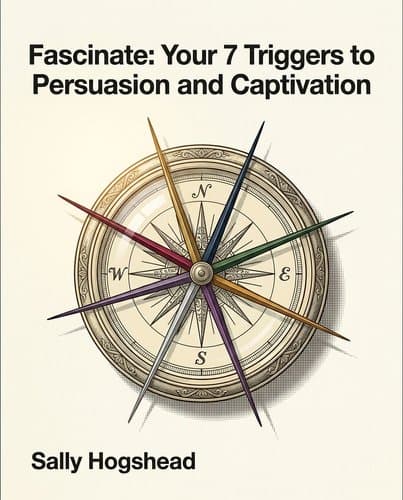
6663244_fascinate
by Sally Hogshead
Seven neurological triggers hijack human attention before rational thought kicks in. Learn to identify and activate them deliberately, and you can make any…
In Brief
Fascinate: Your 7 Triggers to Persuasion and Captivation (2010) reveals that fascination is not a talent but a biological mechanism — seven hardwired triggers that override rational thinking and drive attention, loyalty, and action.
Key Ideas
Audit your trigger mix first
Audit your current trigger mix before designing any message — draw seven beakers and estimate which are full, which are empty, and whether that matches your goal.
Leave audiences perpetually wanting more
Never fully satisfy lust-trigger audiences — sustain desire by teasing the next experience before the current one ends. Satisfaction kills long-term fascination.
Strategic secrecy drives obsessive curiosity
Withhold one key ingredient, story, or process detail deliberately — unanswered questions create obsessive curiosity that transparency cannot.
Consistency outperforms superior single messages
Build trust through repetition before quality claims — the message people hear consistently will outperform a better message they hear once.
Unexplained rules amplify forbidden desire
If you enforce rigid rules without explanation, you are activating the vice trigger whether you intend to or not — restriction amplifies desire for the forbidden thing.
Signal prestige before revealing product
Set the prestige signal before the product, not after — price, scarcity, and emblem communicate rank independent of quality, and audiences accept that signal as the product's value.
Polarization powers authentic brand fascination
A message that generates no negative reaction is almost certainly not generating strong positive reaction either — polarization is a feature of high-fascination brands, not a flaw to manage away.
Who Should Read This
Curious readers interested in Persuasion and Marketing and the science of how the mind actually works.
Fascinate: Your 7 Triggers to Persuasion and Captivation
By Sally Hogshead
9 min read
Why does it matter? Because the things holding your attention right now are doing so without your permission.
Most people assume fascination is something you either have or you don't — like height, or perfect pitch, or a face that photographs well. The charismatic speaker, the brand that earns fanatical loyalty, the person who walks into a room and somehow owns it. Surely they just got lucky with the ingredients.
They didn't. Every single moment of fascination has a specific mechanical cause: one of seven triggers that hit below conscious awareness, skip the part of your brain that asks questions, and produce the same behavior in anyone they reach — interested, hooked, bought in. Sally Hogshead spent years mapping those triggers (evolutionary biology, neuroscience, marketing disasters, things that happened in Salem in 1692) and the finding is uncomfortable: you're not choosing what captivates you. The trigger is.
What's ahead: the seven triggers, how to recognize them, and what it would take to make your own messages do the same thing.
Your Fascinations Are Not Chosen — They Are Triggered
In the summer of 1692, a Salem jury accused an old man named Giles Corey of "fascination" — of enchanting people so completely they lost the ability to think for themselves. A sheriff stood over him with a cane, pushing his tongue back into his mouth, waiting for a confession that would never come. Six men had been adding stones to his chest for two days. Corey's only words were a request for more weight. He died without confessing. The charge wasn't metaphorical. The court believed fascination was a literal force that bypassed rational thought entirely.
They were right about the force. Wrong about whose control it was under.
That's 1692. Here's a lab study, roughly the same mechanics. A group of men wore the same T-shirt for two days: no soap, no deodorant, no cologne. Those shirts then went to women in a blind study: no context, no photos, just scent. Consistently, they preferred the scent of men whose immune-system genes, called MHC genes, were different from their own. Not symmetrical faces. Not charming personalities. Their bodies were running a genetic compatibility check, because offspring with combined immune genes survive better. Neither party knew any of this was happening.
Then the twist. Women on birth control pills showed the opposite preference — drawn to the scent of men with similar MHC genes. The pill makes the body behave as if it's already pregnant, which triggers a different evolutionary logic: stay near genetically similar people who will protect you. The preference flipped completely. The women still thought they were just picking a shirt.
If your body routes attraction through gene-detection systems you didn't know existed, the same is true everywhere else. Your reactions to ideas, brands, messages, and people are shaped by triggers you aren't consciously running. You experience the output (interested, drawn in, tuned out) but not the process generating it.
Corey was executed for something real, even if Salem named it wrong. The capacity to hold attention isn't witchcraft. It is a set of triggers (seven of them), and the rest of this book is about learning to use them deliberately.
The Maze Changes Every Day — Passive Attention No Longer Works
Hampton Court's hedge maze has stood for five hundred years, half a mile of twisting paths behind the palace where Henry VIII once lived. Researchers once brought a chronic amnesiac there every single day. Each time, he said he'd never been. Each time, they handed him a whistle and sent him in. And each time — though he carried no memory of the previous visits — he found the center faster. He was learning a maze he couldn't remember entering.
That's how twentieth-century advertising worked. The model was simple: expose consumers to a brand message often enough, over enough years, and it would eventually take hold — not through any conscious decision, but through sheer accumulation. Consumers were the amnesiac. The media landscape was the maze. Repetition carved the routes.
It worked because the maze held still.
It doesn't anymore. A century ago, average attention span was twenty minutes. Today it's nine seconds — the window before a brain decides to stay or leave. Meanwhile, consumers have built walls: streaming skips, ad blockers, noise-canceling headphones. Even reaching someone no longer means breaking through.
The deeper shift: information used to be scarce, and whoever controlled it had power. Search engines ended that. Data is now a commodity. What's genuinely scarce is sustained focus — and you can't earn it through repetition alone when people can skip, block, and scroll past in under ten seconds. The seven triggers are Hogshead's answer to this problem: not a stylistic upgrade, but a structural requirement for a world that no longer holds still.
Nothing Is Inherently Fascinating — Triggers Applied to Context Create Meaning
A compass needle has no opinions about direction. Point a magnet at it and it swings; remove the magnet, it drifts. The needle isn't navigating — the field is. Fascination works exactly like this.
Two interlocking Cs mean nothing. Configure them as the Chanel logo and consumers pay nearly 50 percent more for those sunglasses than for a functionally identical no-name pair. The logo applies the prestige trigger (Hogshead's shorthand for symbols of rank), and the premium follows. The consumer is buying the trigger, not the lens.
Nothing is inherently fascinating. Fascination happens when a trigger meets a context, and the object is neutral: without a trigger, it's background noise; with one, it commands attention.
That might seem like a luxury-goods argument. Morton salt refutes it. Morton is chemically identical to every competing product. Salt is salt. Yet consumers consistently reach for the branded version. Morton applied a trigger, and meaning followed where chemistry offered none.
Hogshead identifies seven. Alarm makes inaction feel like a cost; you don't deliberate, you respond. Mystique answers nothing and demands everything — the unresolved question becomes the only question in the room. Lust delays delivery until the wanting becomes the point. Prestige signals rank so legibly that others rearrange themselves around it. Power removes the need to ask twice. Vice makes the forbidden thing the only thing worth having. Trust earns its grip by never moving. The chapters ahead develop three of these in depth (Lust, Mystique, Trust), but all seven fire whether you're tracking them or not.
No boring products, no unfascinable companies, no inherently dull messages. Only triggers that haven't been applied yet.
The Brain Peaks at Getting the Grape, Not Eating It
In 1999, Godiva made a decision that should have been smart and turned out to be fatal. They took their gold chocolate boxes — available exclusively in high-end shops, coveted, a thing you gave someone to signal something — and put them in Barnes & Noble. Strip malls. Mass retailers. The chocolates got preservatives to survive the supply chain. Sales went up briefly. Desire collapsed.
Godiva rebuilt it with a blended chocolate drink called Chocolixir, available only inside their stores, prepared in front of you: raspberries, Belgian chocolate chunks, cream, blended to order while you watched. Women described their mouths watering as they walked in, catching the scent of freshly ground chocolate before they'd ordered anything. By 2008, Chocolixir ran in 152 shops. Godiva had changed the ritual of wanting, and the wanting came back.
Here's why it worked. Neuroscientists gave monkeys a grape and scanned their brains throughout. The signal peaked while the monkey held the grape — not while it ate. The moment of getting was the high. Eating was the letdown.
Godiva destroyed that state by accident, then rebuilt it on purpose. The gold box in a strip mall was a grape already eaten. Chocolixir was a grape held.
The implication runs further than chocolate. Satisfaction ends fascination. Whatever you're building — a brand, a presentation, a relationship — send people away wanting the next thing. The lust never gets a chance to resolve.
Lust is a sustained state of reaching. The moment it resolves, it ends. The job is to stay in the moment before the grape touches the tongue. Which raises the question of how you engineer that gap deliberately — and that's exactly where the next trigger lives.
A Fake Opium Story Built a $120M Brand — and That Was the Whole Strategy
Sidney Frank, the American importer who brought Jägermeister to the U.S., is reading a newspaper article about his own product, and it's lying. The Baton Rouge Advocate called it "Liquid Valium," claiming it was laced with opium, Quaaludes, and aphrodisiacs. None of it is true. Frank knows this. He also knows he's holding a photocopier's dream.
He didn't issue a correction. He made copies and plastered them in college bars across the country.
Within months, Jägermeister, a modest digestive liqueur sold to German immigrants, had mythology it couldn't shake. By 1985, it was growing 40 percent per year. The brand's poster showed a man grimacing after a shot, headline reading "So smooth." Everyone who drank it agreed it tasted awful. They ordered it anyway. What they were buying was the question: what exactly is in those dark green bottles? Fifty-six ingredients, officially. None confirmed. The elk's head on the label sparked rumors about elk blood. The opiate stories never quite died.
Hogshead calls this mystique: the fascination trigger built on unanswered questions. Most brands assume transparency builds trust builds loyalty. Mystique runs on different logic: a resolved question is a dead question. The pull is in incompleteness. Frank didn't even need to invent the mystery. He just refused to kill one that appeared. What Frank did — refusing to correct the story — accomplished four things at once: it sparked the question, withheld the answer, built mythology around those fifty-six ingredients, and by living exclusively in bars, limited who could access it.
What makes the case stick is what it reveals about the customer. People describe hating Jäger's taste and ordering it anyway. They're buying the unsolved question — and what drinking it says about them. Give the answer, and you kill the brand. The question has to stay open.
Trust Requires Nothing But Repetition — Which Is Why It Can Be Weaponized
Trust is built by repetition alone. It doesn't require honesty, quality, or earned credibility. The same mechanics that wired brand loyalty into three-year-olds were used by a Nazi propaganda minister to make a nation believe demonstrably false things.
Start with the children. Stanford researchers gave kids ages three to five two sets of identical chicken nuggets: same batch, same kitchen, different packaging. One set in McDonald's boxes, one in plain unmarked wrappers. The children rated the branded nuggets as tasting better, consistently. The researchers extended the test to carrots, milk, and apple juice, foods with no McDonald's association whatsoever. Same result. By age three, the brand had already overridden actual taste perception. The three-year-olds weren't wrong to prefer the branded nuggets. They genuinely tasted better. That's the trigger working exactly as designed. Scale the same mechanism across a nation and you get Goebbels.
Nazi propaganda chief Joseph Goebbels operated on a single working principle: repeat a message consistently, eliminate every competing voice, and people will believe it — not because the message is accurate, but because it's all they've encountered. Hitler laid out the same logic explicitly in Mein Kampf, comparing political propaganda to soap campaigns: declare your claim absolutely, never hedge, never acknowledge the competition. The conclusion is direct: trust requires no moral substance whatsoever. Only consistency. Eliminate contradiction, and even a false message earns belief.
The underlying mechanism is the same in both cases. Without contradiction, repetition reads as safety; familiarity as reliability. Consistency creates preference before the brain asks whether the message deserves it.
The practical consequence: a superior product and a better-told story do not earn more trust than an inferior product and a simpler story told more often. Dominant brands know this. Brands still chasing quality improvements while a competitor repeats a single claim, louder and longer, are learning it the hard way.
The trigger operates with the same mechanics whether the message is true or false, whether the product is chicken nuggets or ideological terror. That's not a caveat. It's the definition.
You're Already Using Triggers — The Only Question Is Whether Deliberately
The question isn't whether you're using the seven triggers. You already are. The question is whether you know which ones, and what they're producing.
DARE is the clearest proof. Drug Abuse Resistance Education spent $1.13 billion annually, operating in 80 percent of American school districts and 54 countries, reaching 36 million young people per year. Police officers delivered zero-tolerance messaging: just say no, drugs are bad, all drugs. The U.S. Surgeon General, the Department of Education, and the General Accounting Office all eventually called it ineffective. At worst, it made drug use more likely.
The program wasn't doing nothing. It was triggering actively — just the wrong things. Zero-tolerance absolutes with no explanation treated every substance as equally exotic forbidden fruit. Authority figures without established trust delivered the lessons. And refusing to answer "why not?" built exactly the kind of mystique that pulls people toward things, not away. The designers intended to reduce a behavior. They applied the mechanics that amplify it. One trigger choice away from the intended outcome, and $1.13 billion made the problem worse.
The framework's final move is diagnostic: assess your current levels honestly, then calibrate. Not toward maximum intensity — push any trigger past the right level and it tips from captivating to repellent, and more is not better. Toward the right combination for your goal. Fascination isn't a talent you develop. It's a field you're already generating. The only question is whether you're generating it on purpose.
The Gap Between Fascinating and Being Fascinated
In the survey behind this book, forty percent of Americans found their own lives fascinating. Ninety-six percent found their children fascinating. Same species, same brains, wildly different numbers — and the gap has nothing to do with talent or luck. Children trigger you constantly: they withhold what they'll do next, they carry mystique simply by existing before language, they promise sensory reward you haven't received yet. They are, by accident, perfect trigger delivery systems. Your life triggers you less because nothing is running the beakers deliberately.
The one caveat Hogshead holds until the end: the triggers shift with culture and technology — it's not a formula to laminate and post above your desk. It's a vocabulary. Learn to name what you're activating and what you're leaving empty, and you've already separated yourself from most of the competition, which is out there producing perfectly good work that nobody remembers.
Notable Quotes
“Boy, sure is hot out there!”
“If you know what the other player is going to do, it's easier to defend against it.”
“tells. With championships on the line, players sometimes go even a step further, because tells get smaller as rank gets higher.”
Frequently Asked Questions
- What is the core concept behind fascination in 'Fascinate: Your 7 Triggers to Persuasion and Captivation'?
- Fascination is not a talent but a biological mechanism — seven hardwired triggers that override rational thinking and drive attention, loyalty, and action. The book teaches you to identify which triggers your message activates, which are missing, and how to deploy them deliberately. Before designing any message, audit your current trigger mix by drawing seven beakers and estimating which are full, which are empty, and whether that matches your goal. This approach transforms fascination from an unpredictable skill into a measurable, repeatable strategy for making any brand or idea impossible to ignore.
- How does the lust trigger sustain long-term customer fascination?
- Never fully satisfy lust-trigger audiences — sustain desire by teasing the next experience before the current one ends. Satisfaction kills long-term fascination. Instead, withhold one key ingredient, story, or process detail deliberately to create obsessive curiosity that transparency cannot match. When audiences encounter incomplete information, they become more invested in resolution. The lust trigger thrives on anticipation and mystery rather than complete fulfillment. This mechanism explains why strategically revealing information in stages maintains engagement better than disclosing everything at once, keeping customers perpetually curious about what comes next.
- Why does restriction amplify desire according to the vice trigger?
- If you enforce rigid rules without explanation, you are activating the vice trigger whether you intend to or not — restriction amplifies desire for the forbidden thing. This psychological principle explains why prohibited products often become more desirable. When audiences encounter unexplained restrictions, they interpret the limitation as a signal of value or power, triggering natural desire to access what's forbidden. Understanding this mechanism reveals that managing behavior through rules alone backfires; communicating reasoning behind restrictions redirects fascination more constructively. The vice trigger demonstrates restriction's paradoxical power to intensify attraction.
- How does the prestige signal determine perceived product value?
- Set the prestige signal before the product, not after — price, scarcity, and emblem communicate rank independent of quality, and audiences accept that signal as the product's value. Luxury markers like exclusivity, price point, and brand imagery establish perceived worth before customers evaluate actual quality. These prestige signals work as independent value communicators that shape expectations and purchasing decisions regardless of inherent product attributes. By strategically deploying prestige signals upfront, brands influence how audiences perceive and value offerings. Prestige becomes the foundation upon which quality claims rest, determining initial acceptance more than objective superiority.
Related Book Summaries

Read the full summary of 6663244_fascinate on InShort