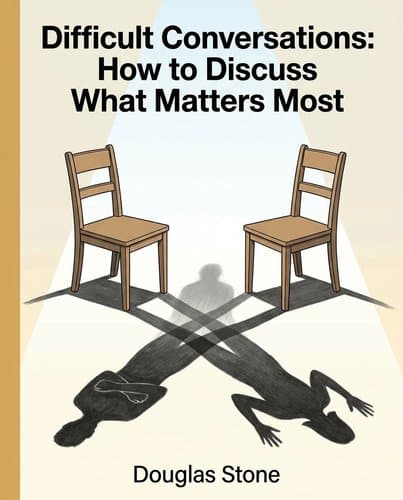
774088_difficult-conversations
by Douglas Stone
Every difficult conversation is actually three conversations happening at once — and the one you're avoiding is always the one running the show.
In Brief
Every difficult conversation is actually three conversations happening at once — and the one you're avoiding is always the one running the show. Learn to name the hidden layers of what happened, unexpressed feelings, and identity threats before they hijack you.
Key Ideas
Identify the layer you're avoiding
Before any difficult conversation, identify which of the three layers is driving your dread: what happened, feelings, or identity. The one you are avoiding is almost always the one running the show.
Treat motives as hypotheses only
Never state your theory about someone's intentions as if it were a fact. You observed their behavior; you invented the motive. Treat it as a hypothesis and ask.
Shift from blame to contribution
Replace 'whose fault is this?' with 'how did each of us contribute?' Blame produces denial and deadlock; contribution produces a shared map and a protocol for next time.
Name feelings before they leak out
Your unexpressed feelings will appear in the conversation regardless — as leaked judgment, sudden explosion, or blocked listening. Name them explicitly before they name themselves.
Ground identity before crucial conversations
Before you speak, identify the identity question at stake: Am I competent? Am I good? Am I worthy of love? Grounding that in advance prevents a mid-conversation collapse when the other person pushes back.
Describe disagreement from neutral observer view
Begin from the Third Story: describe the disagreement as a neutral observer would, naming the difference without assigning fault. It is the only opening both parties can step into without first defending themselves.
Ask questions to create listening
When someone is not listening to you, stop repeating yourself and start asking questions. They cannot hear you until they feel heard.
Who Should Read This
Business operators, founders, and managers interested in Negotiation and Relationships who want frameworks they can apply this week.
Difficult Conversations: How to Discuss What Matters Most
By Douglas Stone & Bruce Patton & Sheila Heen & Roger Fisher
10 min read
Why does it matter? Because the conversation you're losing isn't about delivery — it starts failing long before you open your mouth.
You already know the trap. Avoid the conversation, and the resentment compounds: you feel like a coward, they lose the chance to change, and the whole thing calcifies into something permanent. Have it badly, and you've made things worse than silence. So people try to escape this with better delivery: softer tone, careful timing, diplomatic phrasing. But tact doesn't solve the problem. It's a category error — you're optimizing the throw, not questioning whether you're holding a grenade at all.
The real problem is structural. These conversations go wrong before anyone speaks. You walk in already certain you're right, already certain you know their motives, and quietly defending a version of yourself that can't afford to be challenged. Meanwhile, multiple conversations are running at once, and the one you're ignoring is the one running the show. This book doesn't fix your delivery. It corrects the thinking that makes the grenade necessary in the first place.
Every Difficult Conversation Is Actually Three — and the One You're Ignoring Is Running the Show
Jack, a graphic designer, gets a call late one afternoon from Michael, a friend and client with a brochure due the next morning. Jack cancels dinner with his wife, works through the night, delivers the copies by noon. Then he checks his voicemail: "Well, you really screwed this one up!"
The error was so small a financial professional would struggle to spot it. Jack calls back. What follows is a brief exchange that ends with Jack saying "Alright, alright, I'll do it" — and a friendship strained for months.
What makes that conversation worth examining: read the transcript alongside what Jack was actually thinking, and you see two completely different conversations running at once.
When Michael says "this thing has to be done over," Jack says "wait a second" — but thinks: He's blowing this out of proportion. Nobody would catch this. And I'm furious at myself for letting it slip through.
When Michael says "there's really nothing to argue about," Jack thinks: You approved this yourself this morning.
When Michael issues the ultimatum — "either you're on the team or you're not" — Jack thinks: Just redo it. Not worth the fight. Then says, "Alright, alright. I'll do it."
Jack never said any of the true things. Michael never said his, either — that he'd taken a professional risk hiring Jack again and was quietly asking himself whether that was a mistake.
The gap between what they said and what was actually happening runs on three simultaneous tracks. The first is the what-happened conversation: whether the chart error is Jack's fault, whether Michael's fury is proportionate, whether someone who cancels dinner and pulls an all-nighter deserves a softer landing. The second is the feelings track. Each person is carrying something they're not naming: Jack's sense of being walked on, Michael's fear that he went out on a professional limb for nothing. The third is the identity track, where the private questions run: whether Michael is the kind of person who can fire a friend, and whether Jack is the kind of person who says nothing when he's treated this way. The spoken conversation is about a chart. The real one is about loyalty, competence, and what kind of people they are to each other.
Once you have names for these tracks, something shifts. You start recognizing them in every conversation you've replayed a hundred times without being able to say why it went wrong — the argument that seemed resolved but left everyone hollow, the exchange that ended in agreement and made things worse. The problem wasn't what you said. The real fight was happening somewhere you weren't looking.
The trap is treating the surface conversation as the whole conversation. You rehearse better arguments for the what-happened track, better timing, a calmer tone. But the feelings track — Jack feeling mistreated after an all-nighter, Michael feeling he went out on a limb for nothing — keeps running underneath, untouched. And the identity track, where Jack is quietly asking whether he's the kind of person who gets walked on, determines why he capitulates instead of holding ground.
Difficult conversations are hard not because the words are wrong. They're hard because the actual conversation is happening in the two tracks you're not addressing.
You Invented Their Intentions — and You Almost Certainly Got Them Wrong
Your theory about why they did it is not something you observed. You invented it, and the invention happened so fast, so automatically, that it felt like seeing.
When Lori reaches for ice cream at a party and Leo tells her to ease up, Lori feels humiliated. From that impact, her mind constructs a motive: he wanted to embarrass me. This feels like a perception, as obvious as a fact she witnessed. But Leo's actual intention was to help Lori stick to a diet she'd mentioned wanting to follow. His intention and her impact are simply different facts that her mind collapsed into one.
The first mistake is Lori's: assuming she knows Leo's intent because she knows her own hurt. The second mistake, equally costly, belongs to Leo: once he explains that he meant well, he treats the conversation as resolved. His logic is that if he didn't intend harm, there is no harm worth discussing. So he defends himself — and by defending himself, he never asks why Lori is actually upset, never hears what she is really saying, which is not "you're a bad person" but "you embarrassed me and you didn't care enough to notice."
Both moves feel right in the moment. Lori is naming something real. Leo is correcting a false accusation. The trouble is that Lori's accusation, stated as fact, makes Leo defensive; defensiveness looks like guilt, which confirms Lori's theory. Leo's defense, stated first, makes Lori feel dismissed — and feeling dismissed confirms hers. Each person does the thing that feels like the obvious response, and together those obvious responses form a self-sealing loop.
The book then shows the same conversation replayed — this time, Leo acknowledges the impact before touching his own intentions at all. Lori, no longer needing to push past a defense, shifts from accusation toward reflection. Maybe he was embarrassed too. Maybe she was a bit out of control. The conversation turns from verdict to investigation. Leo's intentions, it turns out, were mixed in ways he hadn't examined. That complexity isn't damning. It's the actual truth, and it's more interesting than the clean story either of them was defending.
Blame Is a Verdict; Contribution Is a Map
Imagine a machine with two interlocking parts that together produce a bad outcome. You could ask which part is defective. Or you could ask how the parts interact and redesign the interface. Blame runs the first inquiry. Contribution runs the second.
The difference plays out in the storyboard story. An ad executive flies to Boulder for a major pitch and discovers at the lectern that his assistant packed the wrong campaign materials. In the blame conversation that follows, he says he doesn't understand how she could let this happen. She apologizes repeatedly. Nothing changes. The cycle that produced the mistake stays intact: his mounting stress, his sharpness when she asked questions, her decision to stay out of his way, her assumption he'd check the bag himself.
In the contribution conversation, he asks one different question: "Did I do anything differently this time?" What surfaces: he'd snapped at her on a previous account when she'd interrupted to ask about storyboards. So this time she stayed back, read his mood, planned to ask when he got off the phone, had to run an errand, assumed he'd do his usual bag check. He confirms he forgot — too overwhelmed. The conversation ends with a specific protocol: she asks regardless of his mood; he works on not making the question feel dangerous.
Blame asks three questions at once: did you cause this, was it bad, what do you deserve? The accused, sensing all three, defends. Contribution asks only: how did we each get here, and what do we each need to change? Whether a batter strikes out depends on the interaction between pitcher and batter; either can tell a story in which they are the central actor, and both are right. Almost every difficult conversation works this way. The question isn't who deserves the verdict. It's how the system works — and what each person can actually change.
Skipping the Feelings Layer Is Like Staging an Opera Without the Music
Fixing who contributed what still leaves one track completely untouched.
Think of an opera performed with all staging, costumes, and choreography intact — but silence where the music should be. The audience can follow the plot in outline. But what made the work worth experiencing is gone.
Most of us approach difficult conversations the same way. We prepare our facts, rehearse our logic, try to keep things professional. Feelings, we sense, are the variable most likely to detonate the exchange, so we manage them, bracket them, keep them offstage. The conversation will go better without all that noise.
It won't. Suppressed feelings do not wait patiently. They show up in tone, in timing, in the argument you pick when the real one feels too dangerous to name. A woman named Jamila, who struggled to tell her husband she loved him, assumed the problem was her own inadequacy as a wife — surely someone who truly loved her husband would find the words. When asked what she would say to him if there were absolutely no consequences, she produced something entirely different: a torrent about feeling unseen, exhausted by his complaints, unappreciated for what she had absorbed. She had never said any of it. She had barely thought it. And it was blocking everything else, sitting behind her expressions of warmth like a stuck door that no amount of pushing from the love side could open.
Here is the counterintuitive part: the suppression she believed was protecting the relationship was exactly what kept it frozen.
She had even framed it as humility — if anyone had the right to be angry, she reasoned, it was her husband for putting up with her.
That framing made the buried anger invisible and untouchable. Once she examined it (not to weaponize it, but just to see it), her portrait of the marriage became more honest. She could hold two things at once: yes, she was frustrated by specific patterns; yes, she genuinely loved this person. She could say both to him, and mean both.
Feelings do not disappear because you decide not to address them. They run the conversation from the back room. The question is not whether they will be present — they already are — but whether you will be the one directing them.
Your Self-Image Is the Hidden Third Party in Every Difficult Conversation
Feelings are one thing running beneath the surface. There's also the question of what this exchange says about who you are.
Ben holds every card. He's already accepted another offer, doesn't need a reference, and his decision is final. By any practical measure, telling his boss should be the easiest conversation of his career. Instead, he can't sleep.
That gap is the Identity Conversation. The practical stakes are gone. What remains is the question his boss's reaction might answer: Am I a loyal soldier, or just someone willing to abandon a mentor for better pay? His father spent a career at one company; loyalty is central to how Ben sees himself. Now he has to deliver news that puts that story in doubt.
Identity is the hidden third party. You've rehearsed the practical track: what you'll say, how they'll react. What you haven't prepared for is the identity question buried in every difficult conversation. Unlike practical stakes, you can't research your way out of it.
The problem is binary framing: if your self-image requires you to be a loyal person, evidence of disloyalty doesn't update your profile — it threatens to flip it entirely. Is Ben loyal or isn't he? Framed that way, there's no safe answer. Either he denies the complication ("I've given this company everything") or collapses into it ("Maybe I've always been selfish"). Both moves destabilize the conversation before it begins.
The exit isn't a better story about yourself — it's a more honest one. Ben has worked weekends, turned down other offers, pushed hard for the company, and he's also leaving for higher pay. Both are true. A self-image that holds both is stable. One that requires the first without the second is a two-legged stool. Difficult conversations are exactly what knocks it over.
The Opening Line Is the Whole Problem — Here Is the Only One That Works
The conversation fails before you finish your first sentence — and the mechanism is structural, not a matter of tone or timing.
Opening from inside your own story hands the listener a verdict before they've spoken. "If you contest Dad's will, it's going to tear our family apart" sounds like a concern but lands like an accusation: you are selfish, you don't care about this family. Their response is almost automatic: defend the implied charge. The conversation about what happened never gets started because the Identity Conversation has already hijacked it.
The fix is structural. Take a roommate dispute over dishes. Jason's version: his roommate Jill leaves dishes in the sink for days, so he ends up cleaning up after her. Jill's version: Jason clears the table before she's finished eating — obsessive, controlling, unable to relax. If either opens with their story, the other spots the verdict in it and responds in kind. You don't get a conversation; you get two lawyers who've already decided the case.
The Third Story strips the verdict out and describes only the gap: Jason and Jill have different standards for when dishes need to be washed, and each finds the other's standard unworkable. No one is a slob. No one is a control freak. The description names one undeniable fact (a difference exists) and leaves the cause of that difference as something to figure out together.
Both people can sign onto that description simultaneously, which is what makes it work. It's the only framing where neither person has to defend themselves before the conversation can begin. You enter as someone trying to understand a gap, not someone already holding a verdict.
You can run this framing in any context. Or in a parent-teacher meeting: "I have some concerns about Nathan's behavior in class, and I know we've seen this differently." Your view is already in the room. So is theirs. You're choosing an entry point where the other person can step in beside you instead of stepping back.
The Fastest Way to Be Heard Is to Stop Trying to Be Heard
Why won't the other person just listen?
The natural assumption is stubbornness — you haven't explained yourself clearly enough, so you try again, reframe, get slightly louder. It doesn't work. The reason is backwards.
They're not listening for the same reason you're struggling to listen to them: they don't feel heard. Until that changes, a clearer argument just makes them dig in harder. It's like pressing harder on a door that opens the other way.
Greta had spent months trying to get her diabetic mother to follow the doctor's regimen: exercise, diet, medication. The conversations always collapsed: Greta pressed, her mother said Greta didn't understand, Greta pressed harder, her mother went silent or cried. So Greta changed her goal entirely. She would only ask questions and acknowledge what she heard. No advice.
What surfaced had nothing to do with willpower. Her mother was grieving — her late husband would have managed the whole regimen, and doing it alone made his absence concrete every day. There was a family history of diabetes deaths; the diagnosis terrified her in ways she hadn't said aloud. Following the rules felt like accepting she was now a sick old woman. And underneath: she didn't actually understand the regimen and was too afraid of being a burden to ask for help.
None of this appeared while Greta was advising. All of it appeared when she stopped. And at the end, without being asked, her mother said: if you could help me figure this out, it would take a big load off my mind.
Listening didn't cost Greta the argument. It made the argument unnecessary.
The Conversation You Avoid Is Still a Conversation
The relationship does not pause while you decide. Every week you spend rehearsing the opening line, the story each of you tells about the other quietly hardens. That is the real cost of avoidance — not the confrontation you are delaying, but the version of events that fills its place.
When Jack went back to Michael, months later, he didn't lead with his grievance. He asked a question: "Was something else going on that day?" There was. An hour before their call, Michael's own client had gone sideways — he'd walked in already defensive and hadn't said so. Jack hadn't known. They agreed on one rule: if either of them was carrying something in, say it at the start. Two sentences of context before the agenda. That was the protocol. The relationship did not end — it was updated.
That is what this framework actually offers. Not smoother conversations. Not resolution. Understanding you could not have reached by staying silent or by pressing harder. The anxiety does not disappear. It just stops being in charge.
Notable Quotes
“She did that to undermine me.”
“He doesn't respect my time.”
“They're trying to make me look bad.”
Frequently Asked Questions
- What is "Difficult Conversations: How to Discuss What Matters Most" about?
- "Difficult Conversations" reveals that "every hard conversation is actually three simultaneous conversations — about what happened, about feelings, and about identity." The book explains that the layer you're avoiding is almost always the one derailing the interaction. It provides a practical framework for separating these layers, diagnosing what's truly at stake, and opening dialogue in a way both parties can engage without defensiveness. This approach helps readers understand why conversations become difficult and how to navigate them constructively.
- What are the key takeaways from "Difficult Conversations"?
- Key takeaways include: identify which of the three conversation layers (what happened, feelings, identity) you're avoiding—it's almost always the one running the show. Never state theories about intentions as facts; ask instead. Replace blame with analysis using "how did each of us contribute?" Express feelings explicitly before they leak out as judgment or explosions. Ground identity questions in advance. "Begin from the Third Story: describe the disagreement as a neutral observer would, naming the difference without assigning fault." When someone won't listen, stop repeating and ask questions—they cannot hear you until they feel heard.
- How does the "Third Story" approach help start difficult conversations?
- The Third Story begins by describing disagreement as a neutral observer would, "naming the difference without assigning fault." This opening is powerful because "it is the only opening both parties can step into without first defending themselves." Rather than starting with blame or your perspective, you present a shared frame that acknowledges disagreement exists. This neutral stance allows both parties to engage constructively without immediate defensiveness, transforming the conversation from debate into collaborative problem-solving where both can participate openly.
- Why is identifying which conversation layer you're avoiding crucial in difficult discussions?
- Before any difficult conversation, identify which of the three layers is driving your dread: what happened, feelings, or identity. "The one you are avoiding is almost always the one running the show." When you sidestep a layer, it operates invisibly, influencing your defensiveness and preventing genuine resolution. By naming the layer you're avoiding in advance, you prevent those issues from sabotaging the conversation. This awareness allows you to address what truly matters instead of being derailed by unspoken concerns.
Related Book Summaries



Read the full summary of 774088_difficult-conversations on InShort