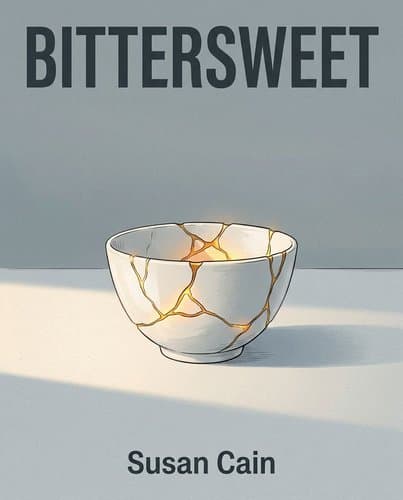
58734811_bittersweet
by Susan Cain
Longing and sorrow aren't obstacles to a meaningful life—they're its fuel. Cain shows why the emotions Western culture trains you to suppress are actually the…
In Brief
Bittersweet (Apri) challenges the Western habit of suppressing difficult emotions like sadness, longing, and melancholy. Drawing on neuroscience, psychology, and cultural history, Susan Cain shows that these states are not weaknesses but the source of creativity, compassion, and connection — and gives readers a framework for transforming pain into meaning rather than managing it away.
Key Ideas
Sadness reveals what matters most
When sadness surfaces, treat it as data about what you care about most — not as a mood to correct. Keltner's neuroscience shows it activates the same circuitry as compassion, which makes suppressing it a direct cost to your capacity for connection.
Longing activates creativity more than pain
If you feel a persistent, inexplicable pull toward something beautiful or unattainable, name it as longing rather than dissatisfaction. Longing is an activating force — pothos, Sehnsucht, viraha across cultures — and research shows it specifically (not negative emotion generally) predicts creative output.
Carry loss forward as companion
Apply the 'moving forward with' frame to significant losses rather than 'moving on from.' Carry the person or the life you lost as a companion into what comes next, instead of treating grief as a problem that ends when you stop feeling it.
Writing transforms grief into physical health
Write honestly about difficult experiences for twenty minutes a day, three days running. Pennebaker's research is consistent: lower blood pressure, fewer doctor visits, stronger relationships, and — for people navigating major transitions — measurably better outcomes in work and life.
Ancestral wounds heal across generations
When you trace emotional patterns that feel larger than your own history — fears, longings, or griefs that seem to predate your own experience — consider the epigenetic evidence. Yehuda's research suggests ancestral trauma is biologically real, which also means healing work you do in your lifetime is not only yours.
Transform suffering into creative offering
Identify one pain you have been trying to solve or suppress that you could instead point outward — toward art, caregiving, advocacy, or craft. The bittersweet tradition across Cohen, Beethoven, Breitbart, and Min Kym is not that suffering is useful; it is that transformed suffering is its own kind of offering.
Who Should Read This
Curious readers interested in Neuroscience and Positive Psychology and the science of how the mind actually works.
Bittersweet
By Susan Cain
10 min read
Why does it matter? Because the emotions you have been trained to suppress are the ones keeping you human.
I learned to keep certain sadnesses quiet before I had words for why. My mother did the same — a particular stillness when a song caught her somewhere she didn't expect.
You have been given an instruction so many times it no longer sounds like one: feel good, stay positive, push through. Entire industries stand ready to help you comply. And when sadness still surfaces — when longing arrives at odd hours, when a certain song cracks something open in your chest — you learn to apologize for it, or at least keep it quiet.
Susan Cain spent twenty-five years wondering why some music made her press her hands together like a small prayer. What she found rewired how she understood nearly everything: creativity, compassion, grief, love. The emotions we have been most carefully trained to suppress turn out to be the actual engine of meaning: the mechanism through which real connection happens and beauty gets made.
Sadness Is the Machine Behind Human Connection, Not Its Enemy
The first time I remember deliberately not crying, I was at my grandfather's bedside. I pressed my lips together and thought: stay useful.
Three years into making Inside Out, Pete Docter knew the film was broken. He had spent that time building Pixar's emotion movie around Fear: Fear was funny, Fear had good gags, Fear made sense as a protagonist. The dialogue was written, the animation partly done. Then he had to screen it for the executive team, and he was certain it was a disaster. The third act required Joy to have learned something. But Fear, for all its comic energy, had nothing to teach her.
What happened next is the book's thesis in miniature. As Docter's anxiety tipped into genuine grief — he began imagining life without his Pixar community and felt himself drowning — he realized that the sorrow itself was telling him something. His despair revealed exactly how much he loved his colleagues. Emotions don't just happen to us, he understood. They connect us. And of all the emotions, Sadness was the strongest connector. Dacher Keltner, the Berkeley psychologist consulting on the film, had already said it plainly: Fear keeps you safe, Anger protects your boundaries, but Sadness triggers compassion. The film was rewritten with Sadness in the starring role. It won the Oscar for Best Animated Feature and became the highest-grossing original film in Pixar history.
This is the inversion that rewires everything downstream. We treat sadness as a cost, something to acknowledge briefly before pushing toward recovery. What Keltner's research showed was that the neural circuitry for compassion and the circuitry for grief run on the same current. Three anatomical sites — the anterior cingulate cortex, the periaqueductal gray, the vagus nerve — fire identically whether you are suffering or witnessing someone else suffer. The vagus nerve is the most striking example: people with stronger vagal responses cooperate more, maintain closer friendships, and are more likely to intervene when they see someone bullied. High status suppresses this circuitry. People artificially elevated in status in lab experiments took more candy, ignored pedestrians, and felt less moved by others' suffering. Suppress the grief, you dim the compassion.
Docter had spent three years afraid that Sadness would make his movie unwatchable. It made it unforgettable.
Longing Is Not a Symptom — It Is the Engine of Every Masterpiece
The Stradivarius never left Min Kym's side. She had remortgaged her flat to buy it — £450,000, three centuries old, the instrument she had shaped her entire life around. At a Pret a Manger in Euston Station, she looked away for a second. It was gone.
She was the youngest student ever admitted to London's Purcell School, a prodigy who debuted with the Berlin Symphony at thirteen. Her teacher Ruggiero Ricci eventually taught her for free, saying he'd learn as much from her as she from him. When she first drew a bow across the Strad's strings, she wrote later, it felt as though Stradivari had fashioned the instrument three hundred years ago specifically for her.
Scotland Yard recovered the violin years later — but the market had shifted. It was worth millions now, purchased by an investor, out of her reach. She lay in bed, shattered, for years.
Then she wrote a memoir. Gone ranged wider than the theft: her family's wartime survival, a crippling perfectionism she had never examined, the self she had built entirely around an instrument. "The person I was with that violin is gone," she said eventually. "But I've been reborn."
Grief that deep is not stagnation. It becomes fuel.
The ancient Greeks called it pothos — the thirst for the unattainable, the same word used for flowers placed on tombs, the hunger that sent Odysseus home. C.S. Lewis named it Sehnsucht: the inconsolable longing for something this world cannot supply, "the scent of a flower we have not found."
The data confirms what every tradition intuited. Economist Karol Jan Borowiecki analyzed 1,400 letters by Mozart, Liszt, and Beethoven using linguistic software and found that negative emotions predicted creative output. Among all negative emotions, sadness was "the main negative feeling that drives creativity." Not anger. Not fear. Sadness specifically.
The Ninth Symphony premiere makes this visible. Completely deaf, Beethoven stood onstage with his back to the audience. A soloist had to turn him around so he could see seventeen thousand people weeping. They wept because he had laced the "Ode to Joy" with sorrow, and that sorrow was what made the joy feel like something larger than joy.
Min had spent years believing loss had destroyed her. Losing the violin forced her to become more than a soloist. "When you heal," she said, "a new part grows."
The 'Stay Positive' Instruction Has a Dark History and Real Casualties
Susan David's father had been paying into his life insurance policy for his entire adult life. Then he was diagnosed with colon cancer at forty-two, and he canceled it — not because he couldn't afford the premiums, but because canceling was proof of faith. Doubt, the culture told him, was dangerous. He died twenty weeks later, leaving his family in grief and debt.
In the months after, Susan performed okayness. She was upbeat, she was fine, she said the right things. Grief came out only through food, in private. She might have continued this way indefinitely if not for an eighth-grade teacher who handed her a blank notebook and told the class to write the truth about their lives, as though no one would ever read it. Susan calls what passed between them love letters. Writing the truth, even in secret, even to no one, was the first time she was allowed to feel what she felt. They saved her.
What her father suffered from was not a personality quirk. It was an ideology centuries in the making.
The logic was old — older than anyone alive. Calvinist theology had already decided who was heaven-bound and who was damned, and what you owed the watching world was visible proof of your election: ceaseless labor, cheerful compliance. Grief implied insufficient faith. When commercial expansion replaced heavenly predestination with earthly success-or-failure logic, the structure stayed identical. Ruin came fast in those decades, whole classes of businessmen wiped out overnight, but the question the culture kept asking wasn't what the system had done wrong. It was what flaw in the man had caused his downfall. A New York state lawmaker said in 1822 that some men fail from forces beyond their control, then added that this group "must be comparatively small."
The word "loser" (once neutral, meaning one who suffers loss) became something you were rather than something that happened to you. By 1908, the Boy Scouts were training boys to force smiles and whistle when feeling sad. The lesson was the same one Susan's father had absorbed: feelings of loss are not evidence that you are human. They are evidence that you have failed.
Susan's father hadn't invented this. He had inherited a system that had been converting grief into moral failing for three centuries, and passed the bill, financial and emotional, to his daughter. The notebook was the first crack in the wall.
Grief's Job Is Not to End — It Is to Travel With You
Think of mourning the way most people think of a broken bone: the goal is for it to mend, and once it does, you stop saying you have a broken bone. You say you had one. The "move on" model of grief works the same way. Healthy grieving follows a path (shock, denial, bargaining, acceptance) and healing means arriving at the end of it. The finished job. Closure.
But Kobayashi Issa was never going to close. One of Japan's master haiku poets, he had watched two infant sons die within weeks of birth, then a daughter named Sato, healthy and bright, taken by smallpox before her second birthday. He knew the Buddhist teaching: life is a dewdrop, ephemeral, and our difficulty accepting this is the root of all suffering. He understood it. He wrote about it. And then he wrote this:
It is true That this world of dew Is a world of dew. But even so…
The first three lines are acceptance. The last three words are the whole poem. "But even so" isn't confusion or failure — it's the truest human sound, recognizable to anyone who has lost someone, across two centuries and every cultural boundary. Issa wasn't failing to move on. He was announcing something more honest: you can be fully aware that loss is woven into life and still refuse, somewhere beneath the ribs, to file it away. The awareness doesn't require the acceptance.
The culture's "let it go" instruction misses something harder to name. Freud thought grief was work you could finish: do it properly and arrive on the other side, clean. The resilience researchers said healthy people bounce back; the wound heals, scar tissue forms, you continue. The Buddhist traditions went further: don't cling to anything and you won't suffer losing it. Each has something true. None quite captures what actually happens to people who live well with loss. Nora McInerny, who remarried after her husband died of brain cancer, put it plainly: she hadn't moved on from him — she'd moved forward with him, his presence still in her work, her child, the person she'd become. Her new husband had fallen in love with exactly that person. The grief hadn't ended. It had become part of how she moved through the world.
That's what actually happens: grief doesn't resolve into absence. It becomes a companion.
The Sorrow You Carry May Be Older Than You Are
The sorrow you feel may not have originated with you. Some of what you carry — the grief that wells up without clear cause, the longing that doesn't trace to anything in your own history — may have arrived before you did, transmitted from people who were broken in ways you never witnessed.
This is not metaphor. When psychiatrist Rachel Yehuda established a Holocaust survivors clinic at Mount Sinai, she expected the survivors to come. They didn't. Their adult children came: middle-aged men and women who still described themselves primarily as someone's son or daughter, three times more likely to develop PTSD after trauma than Jews of similar background without that family history. When Yehuda examined a stress-related gene in thirty-two survivors and twenty-two of their children, she found the same methylation pattern (a chemical tag on the gene that changes how it behaves without altering its sequence) in both groups. The suffering had rewritten something chemical, and that rewriting passed to the next generation before birth.
But if damage travels that path, so can repair. William Breitbart's mother spent part of World War II hiding in a hole beneath a farmhouse stove in Poland, eating potato peels at night to avoid discovery. His father, a deserter from the Russian army turned partisan fighter, broke into that same farmhouse one night looking for food and found her. They survived, made it to New York, had a son. Breitbart grew up in a community of Holocaust survivors, in a home saturated with loss, and understood, without his parents ever voicing it, that surviving meant producing someone who would go out and reduce suffering in the world. He became chair of psychiatry at Memorial Sloan Kettering and developed meaning-centered psychotherapy for dying patients, a form of therapy that asked not what was wrong with them but what still made their days worth having. He built it for the forty percent who still wanted to die even after depression had been treated, people who had lost not physical capacity but any sense that their remaining weeks meant something. His work gave them back their reason to live.
What passed from his parents to him — the mission, the urgency, the drive toward meaning over power — was not chosen. It arrived. And what he built from it reached hundreds of patients who might otherwise have ended their lives wanting nothing. The wound traveled one generation. The healing reached much further.
Whatever Pain You Cannot Resolve, Point It Outward
What do you do with a grief you cannot dissolve? The conventional answer is to process it, resolve it, eventually move past it. The bittersweet tradition offers a different answer: make it your work.
Leonard Cohen was nine when his father died. He wrote an elegy, placed it inside his father's favorite bowtie, and buried it in the garden. That act — not recovery, not acceptance, but transformation — defined the next seven decades of his life. Longing, not peace, was where he did his best work. His last album, released three weeks before his death at eighty-two, was called You Want It Darker. He was not trying to arrive somewhere lighter. He was using the darkness as material.
Cohen drew his framework from Kabbalah, the mystical strand of Judaism that holds that creation was once a vessel filled with divine light. It shattered, scattering fragments everywhere: in sorrow, in beauty, in human connection. Our task is not to wish the vessel whole again but to bend down and pick up the shards. His son Adam called him a transcendence delivery system. Every song was an attempt to hand you something you didn't know you'd lost.
The bittersweet tradition has been building toward this: pain that cannot be resolved is not a problem awaiting diagnosis. It is the most specific information you have about what you love most. The sorrow is not the obstacle to transcendence. It is the mechanism. Whatever you cannot get rid of, you are being asked to make into your offering.
The 'But Even So' Worth Carrying
What Cain is finally asking isn't that you feel better. It's that you stop waiting to feel better before you begin. The longing that won't resolve, the grief that travels forward with you rather than ending — these are not obstacles to the life you want. The question was never how to put them down. It was always what to build with them. Cohen buried an elegy in his father's bowtie. Beethoven wove sorrow into a joy that made thousands weep.
Issa knew his daughter was gone. He also knew that "but even so" would outlast his grief, his century, his language — because every human who has lost something irreplaceable knows that sound from the inside. That's not pathology. That's the mechanism by which one person's interior life becomes legible to another across two hundred years. You have your version of that task. You have probably always known what it is.
Notable Quotes
“mysterious power which everyone senses and no philosopher explains.”
“as he sat on a riverbank and gazed into the distance; it was pothos that set Homer's Odyssey in motion, with the shipwrecked Odysseus longing for home. The author C. S. Lewis called it the”
“for we know not what, or Sehnsucht, a German term based on the words das Sehnen (”
Frequently Asked Questions
- What does Bittersweet by Susan Cain explore?
- Bittersweet challenges the Western habit of suppressing difficult emotions like sadness, longing, and melancholy. Drawing on neuroscience, psychology, and cultural history, Cain shows these states are not weaknesses but sources of creativity, compassion, and connection. The book provides frameworks for transforming pain into meaning rather than managing it away. It explores how sadness reveals what matters most, longing fuels creative output, and grief can become companionship. The work integrates research from neuroscientists like Keltner and psychologists like Pennebaker, alongside cultural traditions and artistic examples spanning from classical composers to contemporary figures, demonstrating how emotional depth creates human understanding.
- How does sadness contribute to compassion and connection according to Bittersweet?
- According to Cain, when sadness surfaces, treat it as data about what you care about most. Keltner's neuroscience shows sadness activates the same circuitry as compassion, making suppressing it a direct cost to your capacity for connection. Rather than treating sadness as a mood to correct, the book encourages viewing it as a signal pointing toward genuine values. This reframe transforms sadness from an obstacle into an asset for building authentic relationships and compassionate responses. By recognizing that sadness and compassion share neural pathways, readers understand suppressing difficult emotions simultaneously damages their capacity for empathy and human connection.
- What role does longing play in creativity according to Bittersweet?
- Bittersweet teaches that if you feel a persistent pull toward something beautiful or unattainable, name it as longing rather than dissatisfaction. Longing is an activating force—pothos, Sehnsucht, viraha across cultures—that research shows specifically (not negative emotion generally) predicts creative output. The book distinguishes longing from mere dissatisfaction or sadness, positioning it as a gateway to artistic expression and imagination. By recognizing and honoring longings rather than dismissing them as problems, readers can channel this force into meaningful creative work. This persistent pull toward something unattainable fuels imagination, making longing a crucial resource for artists and anyone engaged in meaningful creation.
- What methods does Bittersweet recommend for transforming pain into meaning?
- Cain recommends applying the 'moving forward with' frame to losses rather than 'moving on from,' carrying the lost person or life as a companion. She advocates writing honestly about difficult experiences for twenty minutes a day, three days running—Pennebaker's research shows this yields lower blood pressure, fewer doctor visits, and stronger relationships. The book also explores pointing identified pain outward toward art, caregiving, advocacy, or craft. The bittersweet tradition is not that suffering is useful, but that transformed suffering is its own kind of offering, as exemplified by artists like Cohen, Beethoven, and Min Kym across different eras and mediums.
Related Book Summaries


Read the full summary of 58734811_bittersweet on InShort