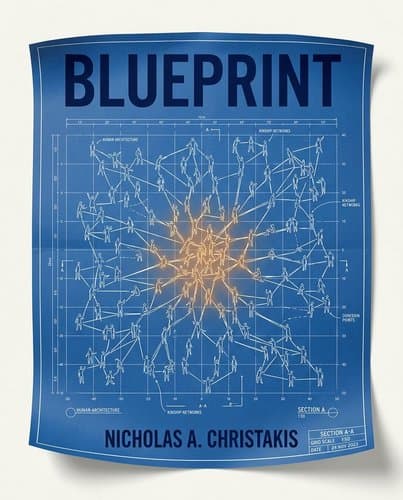
40696923_blueprint
by Nicholas A. Christakis
Human goodness isn't a fragile cultural achievement—it's hardwired into our DNA. Evolution encoded love, friendship, and cooperation into every human society…
In Brief
Blueprint (Marc) argues that natural selection has embedded a universal "social suite" — capacities for love, friendship, cooperation, and learning — into human biology, making good societies an evolutionary inheritance rather than a fragile cultural invention.
Key Ideas
Network topology drives cooperation beyond individuals
When your group or organization is struggling, look at network topology before blaming individual character. The same people connected differently will cooperate or defect — and Christakis's lab proved this experimentally. Intermediate social fluidity (people can change connections, but not too fast) produces the most cooperation.
Work within the natural social suite
Attempts to design societies that eliminate pair-bonding, privatize children's attachments away from parents, or replace individual identity with collective identity require enormous cultural effort and tend to collapse into the familiar patterns anyway. Work with the social suite's eight features, not against them.
Overlapping groups reduce intergroup hostility
In-group bias is not an aberration separable from in-group love — they evolved together. Reducing intergroup hostility works not by eliminating group identity but by creating overlapping, cross-cutting affiliations that multiply a person's 'in-groups' until the relevant out-group keeps shrinking.
Bidirectional coevolution of genes and culture
The nature/nurture debate is a false binary. Cultural practices create genetic selection pressures (dairy herding produced lactose tolerance; sea diving produced enlarged spleens), while genes shape cultural environments (some people are genetically disposed to knit social networks together). The arrow runs in both directions simultaneously.
Biological realism prevents harmful utopianism
Accepting biological constraints on human social behavior isn't the politically dangerous position — the dangerous position is assuming humans are infinitely malleable by the right social engineering. That assumption has historically enabled far more harm than the biological one.
Status visibility matters more than equality
Cooperation is an emergent property, not an individual trait. Visible inequality — not inequality itself — suppresses cooperation by roughly half. If you want more cooperative institutions, consider what status signals you're making visible.
Who Should Read This
Science-curious readers interested in Evolution and Social Psychology who want to go beyond the headlines.
Blueprint
By Nicholas A. Christakis
10 min read
Why does it matter? Because the science of human cruelty is only half the story.
The Invercauld wrecked off the Falklands in 1864. Nineteen men survived. Three made it home.
The instinct is understandable: look at that record and conclude that civilization is a thin coat of paint over something selfish, tribal, and violent. Scientists spent decades confirming the suspicion — game theory, evolutionary biology, social psychology all pointing the same direction. We cooperate when we have to. We defect when we can.
Here's what that consensus missed: the same evolutionary pressures that produced tribalism also produced love, friendship, and the peculiar human compulsion to teach strangers things they didn't ask to learn. Christakis spent years studying what happens when people (shipwrecked sailors, utopian idealists) are stripped of everything and forced to rebuild society from scratch. The results keep coming out the same way. Not because humans are blind to their own darkness, but because goodness turns out to be older than civilization, and considerably harder to erase.
Every Human Society Assembles the Same Eight Ingredients
Human societies look bewilderingly different: different gods, different kinship rules, different ideas about property and honor. But beneath that surface variation, every known society runs on the same eight features. The surface looks like cultural convergence. What's actually happening is older than culture.
The clearest demonstration is a childhood afternoon on Buyukada. In 1970, Christakis and his six-year-old brother (Greek boys who spoke no Turkish) wandered into the pine hills behind their grandfather's house and found a dozen local boys. No shared language. No adult supervision. Within hours, they had organized into raiding teams, developed a barter economy (small throwable cones traded for large "grenade" cones), established hierarchies, and conducted furtive raids on each other's stockpiles. Different haircuts, different throwing styles, but the same social architecture — assembled from scratch, without instruction, by children who couldn't exchange a single word.
Controlled experiments confirm what that afternoon suggested. Give five-year-olds randomly colored T-shirts, colors they know were assigned by chance, and they'll favor kids wearing the same color, allocate more resources to them, and remember their good acts more readily. The bias isn't learned. It precedes any reason to have it.
Both point toward what Christakis calls the social suite: eight features present in every human society. Recognition of individual identity. Love for partners and offspring. Friendship. Social networks. Cooperation. In-group preference. Mild hierarchy, relative egalitarianism rather than strict dominance. And social learning, the ability to teach and absorb knowledge from others.
They're evolutionary outputs — encoded over deep time into our DNA. Culture reshapes the details. The foundation doesn't move.
Same Island, Same Year, Opposite Fates: The Book's Best Natural Experiment
January 1864, Auckland Island, two hundred and ninety miles south of New Zealand. The Grafton has broken apart in Carnley Harbour, and the mate, François Raynal, is too sick to swim. The four other men are barely afloat in freezing water, yet they stop, rig a rope, and haul him through the surf.
Four months later, on the other side of the same island, the Invercauld wrecks. Nineteen men reach the foot of a sheer cliff alive. One is too weak to climb. They leave him and go up.
Both groups are now stranded on the same island, in the same weather, with no knowledge of each other. The Grafton crew numbers five; the Invercauld, nineteen. If survival comes down to physical toughness or numbers, this shouldn't be close.
When their ordeals ended, all five Grafton survivors walked off the island. Of the nineteen Invercauld men, three made it out — after abandonment, starvation, and at least one act of cannibalism.
What separated them was social arrangement. The Grafton men voted for a leader they called "head of family" rather than commander, with the explicit right to replace him by future vote. They treated each other as equals, taught one another mathematics and foreign languages, and when the mate fashioned chess pieces from salvaged materials, they eventually burned the cards they'd made because the captain was a sore loser and fights kept erupting (a small detail that tells you everything about a group willing to sacrifice ego for cohesion). When three of them finally sailed for help, Captain Musgrave returned immediately for the two left behind, then came back a second time on the mere chance that other survivors might still be there.
The Invercauld officers looked after themselves from the first hours. Lower-ranked seamen died at catastrophic rates.
It's the closest thing five centuries of shipwreck history offer to a controlled experiment: same island, same year, comparable resources — opposite outcomes, explained by one variable. It wasn't who was toughest. It was who, in the first minutes after the wreck, went back for the sick man on the rope.
Every Utopia Ends Up Reinventing the Society It Tried to Escape
Those eight features appear in every known society, including ones that never shared a trade route or a myth. The natural test of any universal claim is the deliberate exception: people who knew the pattern and tried to escape it. We have the experiments.
Every intentional community on record has tried to build something genuinely new and ended up rebuilding what it left.
The kibbutzim of early Israel made the most systematic attempt. Children wouldn't live with their parents but with age-peers in communal houses, bet yeladim, seeing their biological mothers and fathers for an hour or two each afternoon. The goal was to free women from domestic labor and dissolve the nuclear family as a social unit. By 1971, a global survey of 183 societies found not a single other culture using dormitory sleeping for infants. The kibbutzim hadn't refined an old practice. They had invented something biologically unprecedented.
It didn't hold. By the 1970s, parents had reclaimed their children. Psychologist Ora Aviezer's verdict was blunt: the program produced no new kind of person; families had simply reasserted themselves. But the experiment left one striking artifact. Children raised together in the communal houses, even unrelated ones, grew up to feel powerful sexual aversion toward each other — the same taboo that normally operates between biological siblings. Their brains had registered childhood co-residence as a kinship signal. The founders set out to dissolve family bonds; the experiment accidentally created new ones.
That's the pattern Christakis documents. The features people try hardest to design away (parent-child attachment, pair-bonding, individual identity, mild hierarchy) are the ones that reassert themselves most forcefully. Some communities collapse when they override these too aggressively. Others survive by quietly reinstating them. Either way, the social suite gets the last word.
Cooperation Isn't Who You Are — It's How You're Connected
The kibbutz story shows what happens when you override the social suite from the top down. A different set of experiments shows why the suite keeps winning even when nobody's trying to suppress it.
Take two handfuls of carbon atoms and connect them one way: you get graphite, soft and dark, good for pencils. Connect the same atoms differently and you get diamond, hard and clear, one of the toughest materials on earth. The atoms are identical. The properties belong to the arrangement, not the atoms themselves.
Christakis ran 785 people through a public goods game to test whether the same logic holds for humans. Participants joined an online social network and received small amounts of real money. Each round, they could keep their cash or donate to neighbors — the platform doubled whatever they gave, so generosity cost you something while benefiting your neighbors more. A natural pull toward reciprocity: be kind today, your neighbor might return it tomorrow.
In one version, the network was locked. If your neighbors were exploiters — people who took your donations and gave nothing back — your only recourse was to stop giving yourself. And that's exactly what happened. Defection spread through the network like a cold, until whole groups had abandoned cooperation.
In another version, same participants, same game, but now people could quietly sever a connection to an exploiter and form a new one. Cooperation held and grew. Generous people clustered together, building tight mutual-aid networks. Exploiters were left isolated.
Same pool of people. Completely different outcomes. The only variable was whether the network could flex.
Most of us assume that generous behavior reflects generous character: that whether someone cooperates is mostly a matter of who they are. The experiments say we've got it mostly backwards. Generosity is something a network can produce or destroy. Wire the same people one way and they take care of each other. Wire them another way and they don't.
The People Who Spent Centuries Engineering Away Love Keep Falling in Love Anyway
Every redesign of social life eventually hits the same obstacle: the drive it was meant to suppress refuses to disappear. Near Tibet, in the mountains where the Na people have farmed for two thousand documented years, a young man is climbing a wall. It's past midnight. He'll leave before dawn, eating nothing in her household, avoiding her relatives. A furtive visitor, not a partner, not a husband. He may visit a hundred women over his lifetime. She may receive as many. This is by design. The Na have spent centuries building a society with no marriage, no acknowledged fathers, and no husbands. As they told Cai Hua, the ethnographer who spent years documenting their lives: "In mating, the aim of the man is to have a good time and to do an act of charity." Possession, exclusivity, romantic love: none of it is the point.
And yet. Cai Hua documented couples who became so consumed by mutual attachment that they fled together to build exclusive lives — the one thing the entire cultural architecture was constructed to prevent. The Na's solution to this recurring problem was to invent a second institution, the "conspicuous visit," in which partners exchange belts and develop informal expectations of exclusivity. To keep love from taking over, they had to give it a back door.
The drive operating below culture traces to a single gene. Neuroscientist Larry Young's lab showed this with two vole species: prairie voles are naturally monogamous; their close relatives, meadow voles, are promiscuous. The difference comes down to vasopressin receptors in the forebrain — monogamous voles have more, positioned to link a specific partner's scent with the brain's reward circuits. Young transferred the single gene coding for those receptors from prairie voles into meadow voles. In the Partner Preference Test, the altered males strongly preferred their own partners; the unaltered males showed no preference. One gene changed the mating architecture of a species.
The same gene variant shows up in human data. A twin study of 2,186 people found that men carrying two copies of vasopressin-receptor allele 334 experienced marital crises at double the rate of men with none — 34% versus 15% — and their spouses, surveyed independently, reported lower marital quality. A molecule, not a custom, is running the circuitry of attachment.
In-Group Love and Out-Group Hostility Run on the Same Wire
The boy's name wasn't recorded, but what he said is. On the first day of contact, he'd suggested that maybe they could make friends with the other group. The next morning, he spotted one of the Rattlers and called him "Dirty Shirt."
That's how fast it happened. In 1954, psychologist Muzafer Sherif sent 22 carefully matched boys — same background, same intelligence, same class — to a summer camp in Oklahoma. The first week, the two groups didn't know each other existed. They named themselves Eagles and Rattlers, made flags, built hierarchies, and called the swimming hole and the flagpole "ours." The bonding was real and immediate.
Then Sherif introduced competition. Baseball games, tug-of-war, pocketknife prizes the boys coveted. Within days, they were raiding each other's cabins. The same in-group solidarity that felt warm in week one had become the engine of hostility in week two.
Here's the uncomfortable part: it was never two separate processes. Mathematical models by evolutionary theorists Sam Bowles and Jung-Kyoo Choi show that neither in-group altruism nor out-group hostility could have evolved without the other. The same selection pressures that made your ancestors willing to die for each other also made them dangerous to anyone outside the circle. In-group love and out-group hostility ran on the same wire, because they had to.
Sherif showed you can dissolve the hostility: engineer a shared problem — a sabotaged water tank, a stuck truck holding everyone's dinner — and the Eagles and Rattlers end up asking to ride home on one bus. But the underlying architecture never disappears. The tendency to form groups, to feel something warmer inside them than outside them, is the same feature that generates the prejudice. Fix one, you weaken the other.
Your Genes Are Redecorating Other People's Social Lives
If a single gene can rewire a species' mating architecture, the question becomes how far that influence extends. The answer is stranger than it first appears.
A diver slips into the Sulawesi Sea, weighted with stones, wooden goggles pressed to his face. Seventy meters down, he moves across the ocean floor, then surfaces, breathes, and goes back under. The Sama-Bajau sea nomads of Southeast Asia have lived this way for roughly a thousand years, spending five hours a day underwater, never more than a boat's length from the ocean. That's long enough for evolution to take notes.
Bajau divers carry a mutation in a gene called PDE10A that gives them unusually large spleens, storage tanks for oxygen-rich blood that empty during extended dives. Neighboring communities on land don't have it. One cultural practice, sustained long enough, rewrote their biology.
Genes also run in the other direction. A study of 1,100 adolescent twins found that roughly half the variation in how many friends a person has is heritable — and so is about half the variation in whether your friends are also friends with each other. Some people are wired to make introductions, to pull acquaintances into the same room. Their genes don't just shape their own personality; they restructure the social world other people inhabit. Whether Sue and Jane become friends may depend partly on a third person's DNA.
Cultural practices become selection pressures, and genes, expressed outward through social behavior, construct the cultural environments that do the selecting. They're not two forces taking turns — they're the same conversation, running in both directions.
Denying Human Biology Has Killed More People Than Accepting It
Which worldview has caused more human suffering — the belief that social behavior has biological roots, or the belief that human nature can be completely remade by the right political arrangements?
Most people say the first. Eugenics is the cautionary tale, and it's a real one. But social determinism has its own body count, and it's enormous.
Stalin was convinced that environment determines everything. Lysenkoism, the Soviet doctrine declaring genetics a bourgeois pseudoscience, wasn't just an academic error; it was the intellectual expression of a political conviction that human nature itself could be forcibly reconstructed. That confidence licensed everything: the Gulag, mass executions, ethnic deportations. Nine million or more died under his rule. Those deaths didn't follow from believing in genetic constraints on human behavior. They followed from believing there were none.
The same logic applies to homosexuality. Denying any biological basis for same-sex attraction reframed it as a choice, and choices can be corrected. The American Psychiatric Association kept homosexuality on its disorder list until 1973; before that, doctors in Britain and the United States prescribed aversion therapy and chemical castration as treatments, following directly from the premise that it was a behavioral error, not a biological reality. The compassionate position (the one that actually reduced suffering) was "it's just biology."
Biology doesn't excuse anything. But "human nature is infinitely malleable" isn't the progressive, protective position it presents itself as. Knowing what we actually are — cooperative, friendship-forming, love-seeking creatures whose social instincts run deep — lets you build institutions that work with human flourishing rather than engineer it out of us. The blueprint isn't a constraint on a good society. It's the only reliable foundation for one.
The Blueprint Doesn't Guarantee Anything — But It Bends in One Direction
The social suite isn't a promise. The Bounty mutineers who settled Pitcairn Island had every feature of it — loyalty, friendship, hierarchy — and still descended into murder. The Invercauld men weren't monsters; they got the social arrangement wrong in the first hours and never recovered. The blueprint can be violated. When it is, the result isn't some new form of human organization. It's collapse.
That collapse, though, is the evidence. The astonishing part is that isolated groups, across five centuries and every ocean, keep finding their way back: voting for leaders, teaching strangers things, falling in love against every cultural incentive, going back for the sick man on the rope. The social needs came first — meeting them is what made survival possible, not a reward for it. Evolution has been running this experiment for a very long time. That goodness keeps winning isn't a hope. It's a finding.
Notable Quotes
“The ability to reduce everything to simple fundamental laws does not imply the ability to start from those laws and reconstruct the universe.”
“the twin difficulties of complexity and scale.”
“to abolish by force the old system of productive relations and establish the new system. The spontaneous process of development gives place to the conscious action of men, peaceful development to violent upheaval, evolution to revolution.”
Frequently Asked Questions
- What is Blueprint by Nicholas Christakis about?
- Blueprint argues that natural selection has embedded a universal social suite—capacities for love, friendship, cooperation, and learning—into human biology, making good societies an evolutionary inheritance rather than a fragile cultural invention. Drawing on genetics, history, and network science, Christakis shows readers how to design organizations and communities that work with this biological blueprint. The book challenges infinite malleability assumptions and demonstrates that accepting biological constraints on human social behavior enables better social outcomes when understood properly.
- What does Blueprint say about network topology and organizational cooperation?
- When your group or organization is struggling, look at network topology before blaming individual character. The same people connected differently will cooperate or defect, and Christakis's lab proved this experimentally. Intermediate social fluidity—where people can change connections but not too fast—produces the most cooperation. Rather than assuming people are the problem, examine how they're connected. The structure of relationships often determines outcomes more powerfully than individual character traits or abilities.
- How does Blueprint suggest addressing intergroup conflict and bias?
- In-group bias and in-group love evolved together and cannot be separated. Reducing intergroup hostility works not by eliminating group identity but by creating overlapping, cross-cutting affiliations that multiply a person's in-groups until the relevant out-group keeps shrinking. This reframes the conflict problem: instead of trying to eliminate tribalism, which ignores evolutionary roots, we acknowledge it and work with it. By deliberately designing situations where people share multiple group memberships, hostility naturally decreases.
- What are the key insights about inequality and cooperation in Blueprint?
- Cooperation is an emergent property arising from group structure, not an individual trait. Visible inequality—not inequality itself—suppresses cooperation by roughly half. If you want more cooperative institutions, consider what status signals you're making visible. Blueprint also explores how the nature/nurture debate is false: cultural practices create genetic selection pressures while genes shape cultural environments. The arrow runs in both directions simultaneously, meaning biological and cultural evolution constantly interact.
Related Book Summaries
Read the full summary of 40696923_blueprint on InShort