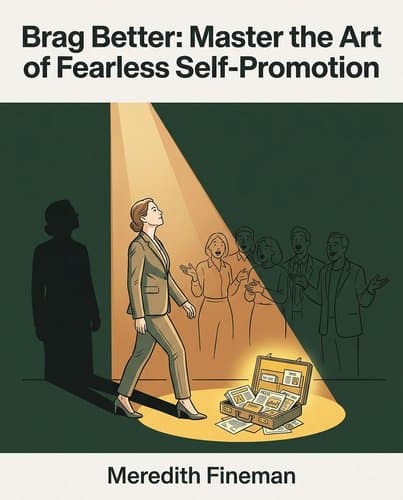
53105899_brag-better
by Meredith Fineman
Silence doesn't signal humility—it hands your opportunities to louder, less qualified people. Learn to quantify your impact, ditch self-deprecating…
In Brief
Brag Better: Master the Art of Fearless Self-Promotion (2020) argues that self-promotion is a learnable skill and a professional obligation — not vanity. It gives qualified professionals concrete tools to articulate their value clearly: quantified accomplishment inventories, targeted audience framing, ready-to-use bio templates, and peer advocacy systems that replace self-doubt with confident, direct communication.
Key Ideas
Quantify Impact With Self-Stats
Build a monthly accomplishment inventory using 'self-stats': quantify your impact in dollars generated, budget managed, team size, and percentage growth. 'I manage a $1.5 million budget that has grown 25% year over year' is harder to dismiss than 'I handle budgeting.'
Replace Apologies With Direct Facts
Cut these phrases from your vocabulary immediately: 'shameless plug,' 'I hate to brag, but...,' 'humblebrag,' 'shameless self-promotion.' Replace each with a direct statement of fact: 'I'd love for you to read this article I wrote' or 'I'd be so grateful if you shared this segment.'
Choose Three Superpower Words
Choose three 'superpower words' — specific adjectives that anchor your professional voice — and use them as a filter. Every bio, pitch, and introduction should fulfill at least one of them consistently over time.
Tailor Metrics to Your Audience
Before any pitch, ask: who exactly is this person, and what do they actually care about? Reframe the same accomplishments in their language — revenue metrics for acquirers, citation counts for academics, student outcomes for educators. The audience determines the emphasis, not the accomplishment.
Script Your Nightmare Question
Write your Nightmare Question — the worst thing you could be asked at 3am — and script a rebuttal. You will almost certainly never be asked it, but naming it and answering it on paper dissolves the irrational dread that's blocking action.
Keep Three Bio Versions Ready
Keep three bio lengths ready at all times — one page, one paragraph, two sentences — all consistent, all updated, all ending with a call to action. When someone wants to promote you, give them the words. Friction kills advocacy.
Find Your Boast Buddy
Find a 'boast buddy' — someone who champions your work in rooms where you aren't present while you do the same for them. Research shows advocates look selfless, recipients get credited for their work, and both parties win. You already brag comfortably for others. Point that skill at each other.
Who Should Read This
Business operators, founders, and managers interested in Professional Growth and Confidence who want frameworks they can apply this week.
Brag Better: Master the Art of Fearless Self-Promotion
By Meredith Fineman
9 min read
Why does it matter? Because your silence is someone else's opportunity.
Somewhere along the way, you learned that doing excellent work was enough — that quality, over time, would make itself known. It's a deeply appealing idea. It's also wrong, and the consequences are specific: someone louder is standing where you should be standing, telling a room what they're capable of while you quietly remain invisible. That silence isn't humility. It's a habit, and habits have origins. The discomfort you feel about talking up your own work was installed — by culture, by conditioning, by a thousand small signals that self-promotion is somehow unseemly. That's what gets dismantled here. What replaces it isn't bluster or performance — it's a precise, repeatable framework for saying what you've done, to the right people, in exactly the right way. Staying quiet isn't modesty. It's abdication.
Staying Quiet Isn't Modesty — It's Ceding Ground to a Less Qualified Voice
Nina was clocking sixteen to eighteen hours a day covering political races, writing briefs, tracking demographics, building a newsletter that was genuinely smart and occasionally funny in a field crowded with dry pundits. She was, by any reasonable measure, the most interesting voice in her lane. She was also invisible.
Nina came to Fineman, her publicist, wanting to break into television. The problem wasn't her knowledge or her presence. The problem was that she'd never stopped to tell anyone those things were there. Her newsletter spoke for itself. Her research spoke for itself. Except none of it did, because where bookers make decisions about unknown names in seconds, silence reads as absence.
Fineman's fix was tactical and a little audacious. She told TV producers in New York that Nina would "be in the area" — then booked Nina's flights to make it true. She refreshed Nina's bios, built her website, got new headshots, and spent weeks nudging bookers to put her in the rotation. Nina smiled through early appearances on panels with five people in the audience. The traction was slow.
Then Nina got her shot at the show they'd been targeting. She walked in as one of several commentators, the kind who fill airtime without anyone remembering their name. When the host asked her a question, she answered with such density and precision that he stopped cycling through the panel and stayed with Nina for the rest of the segment. By the end, he was asking her for advice. Afterward, the producers in the control room — people who run these segments every single day and have seen thousands of commentators — walked out to tell her she'd done something extraordinary. That does not happen. Nina is now on that show weekly, with entire segments built around her ideas.
What changed between newsletter obscurity and weekly TV fixture wasn't Nina's expertise. She had that the whole time. What changed was that someone built a system to put her knowledge in front of the people who needed to hear it, and Nina stopped waiting for her work to carry that load on its own.
Here's what the silence was doing in the meantime: clearing the runway for louder, less prepared voices to fill the space. Television panels, leadership positions, conference keynotes: they don't stay empty. Someone talks. The question is whether it's the most qualified person or the most visible one. Fineman calls people like Nina "The Qualified Quiet": experts who've put in the years and done the work and expect, on some level, that the record will speak for itself. It doesn't. Their silence doesn't read as humility to the people deciding who gets the next opportunity. It reads as unavailability. The promoted option is the visible one. The visible one is whoever showed up.
Your Discomfort With Self-Promotion Was Installed, Not Born
Your discomfort with self-promotion was installed. A system of real incentives and real penalties taught you that assertiveness is costly. You adapted to it rationally.
Researchers who embedded themselves in a professional development program for women at a large American company documented exactly how it plays out. The participants understood that visibility drives advancement — they knew speaking up in meetings and claiming credit for their work were conventional paths to promotion. They chose not to anyway. The reason was not passivity or self-doubt. It was that they had personally witnessed or experienced what happens to women who act with authority in the workplace: they get penalized. So the women chose what the researchers called "intentional invisibility" — staying quiet, softening assertiveness with warmth, getting things done without drawing attention to themselves. The outcome was exactly what you'd predict: well-liked and undervalued. The system was not malfunctioning. It was producing the result it was designed to produce.
What keeps the trap running is that the target isn't fixed. Cindy Kent, a healthcare executive, was told by her organization to dial it back — she was engaging senior leaders too frequently. She adjusted. Two months later, the same organization told her they needed to hear her voice more. She had followed the first instruction correctly and ended up in violation of the second. That is the experience of the trap: there is no rule to learn because the standard keeps moving. The only strategy that never gets you called "too much" is to stay smaller.
Here is what changes when you see this clearly: the discomfort is not yours to carry as a character trait. If your silence is a personality feature, it is permanent. If it is a rational adaptation to a real threat (and it is), then it is something you can choose to override once you understand where it came from. What the system installed, you can uninstall.
The Phrases That Sound Modest Are Quietly Destroying Your Credibility
The talk was over. Fineman had spent an hour walking a room through the mechanics of owning your accomplishments — the research, the case studies, the exact phrases to stop saying. She asked for questions. The first hand went up, and the woman said: "I have a really loud voice and can't stop talking."
Fineman stopped her. This woman, minutes out of a presentation on verbal undercutting, had opened her question with a preemptive apology for her own voice. She'd insulted herself before she'd said anything worth insulting. Fineman coached her to restart. The woman tried again: "I love my loud voice and I have a question."
That shift is the entire correction in miniature.
The phrases feel like social lubrication. "I hate to brag, but..." reads as self-aware and considerate — a wink at your own awkwardness, a signal that you're not one of those people. What they actually do is transfer your anxiety to the listener. If you can't stand behind your own accomplishment, the person hearing it doesn't know how to either. The negative frame bleeds into the content. You've told people to discount what they're about to hear before they've heard it.
The problem runs subtler too. Fineman worked with a founder named Stacy who had two decades in retail before building a fashion-tech platform. Every time Stacy described her work, she said she was "trying" to disrupt the industry. She'd already done it. That single word communicated hesitancy to investors and users encountering her for the first time — the exact moment when precision matters most.
The fix is structural: swap the frame. "I hate to brag, but..." becomes "I'd love for you to read this article I wrote." "Shameless self-promotion" becomes "Please share this post." "Brag alert" becomes "I'd be so grateful if you watched my TV segment." These aren't more aggressive versions of the same move — they're a different move entirely. They tell the listener what the thing is and what to do with it, rather than signaling that you're uncomfortable sharing it. The accomplishment lands clean. The listener knows how to respond. Nobody has to process your anxiety before they can engage with your work.
Bragging Without Knowing Your Audience Is Just Noise
Leah had built a real company. Her education technology platform was growing, profitable, and ready for acquisition. She just needed the right buyer. So she got visible: pitched at entrepreneur conferences, got profiled in startup outlets, networked with fellow founders who found her inspiring. Nothing moved. No conversations with buyers materialized. No acquisition interest.
Fineman's diagnosis was immediate: Leah was bragging to the wrong room. The people she was impressing already liked her and thought she was smart. The executives at the five major companies that could actually write a check for her business weren't at entrepreneur events — they were reading trade publications that covered deals and acquisitions, tracking revenue multiples, and evaluating management quality. They spoke a completely different language than the one Leah had been using.
The fix required changing everything except the company. Instead of leading with how thoughtful and student-centered the platform was, Leah led with numbers: how fast the company had grown, what it was pulling in, what projected profits looked like. The venues shifted too, away from startup coverage and toward the outlets her five target acquirers actually read. Fineman had researched those five companies specifically: what had they previously purchased, where were they getting their information, what did they need to see before they'd seriously consider a deal?
The move is always the same: start with who's in the room, then work backward to what you emphasize, what vocabulary you use, and where you show up. The accomplishments don't change. The case those accomplishments make changes completely depending on who needs to be convinced and of what.
The audience question is also a language question. The same logic compresses all the way down to a single word — the label you use for yourself is already a targeting decision aimed at someone. Fineman spent years in Washington, DC calling herself a "digital strategist" and getting nothing. The moment she said "publicist," people hired her. The word already existed. She'd been avoiding it out of her own discomfort with what it implied, but clarity serves the listener. When someone immediately understands what you do and why it matters to them, the brag lands. When they have to translate, they move on.
Your Fear of Backlash Is More Dangerous Than the Backlash Itself
What's the worst thing someone could say if you start promoting your work? Fineman asks clients to answer this precisely. She calls it the Nightmare Question: the specific accusation that surfaces at 3am when your confidence is lowest. The assignment is to name it — not in vague terms like "people won't take me seriously," but as an actual question you've been secretly rehearsing answers to. Then write the rebuttal.
Her own Nightmare Question is: what gives you the right to a platform when so many people your age have built bigger things? She traces it to the habit of measuring herself against people doing better, imagines a moderator lobbing it at her on a panel, and builds a response: she's grateful, she works hard, she's written two books and trained hundreds of clients. The monster is manageable once it has a face and an answer.
She has never had a client's specific Nightmare Question asked of them. Not once. She used to bet clients a hundred dollars if it ever happened; her publisher blocked her from extending the offer to readers, so she promises a book refund instead. Fear isn't rational, which means reassurance can't defeat it — but making the specific threat concrete and answerable does. Once you've scripted the rebuttal, the 3am voice has already heard the counterargument.
The exercise prepares you for attack. It doesn't prepare you for the opposite. When Fineman's first book came out (something she'd wanted to write her whole life), she deflected every compliment. Brushed them off, felt undeserving, stayed locked in the next deadline. She suspects it cost her: people who wanted to celebrate her likely walked away, and some might have opened doors. Amy Schumer built a sketch around exactly this on her Comedy Central show: a circle of women complimenting each other, every recipient immediately trashing herself, until one woman simply accepts the compliment and her friends' heads explode. The joke lands because it's accurate. You've spent all your energy bracing for a backlash that almost never comes. When the praise arrives instead, you aren't ready for that either. The loop isn't complete until you can stay in the room while someone says something kind about your work and let it reach you.
The Most Powerful Promotion You Can Do Is for Someone Else
Self-promotion scales faster when other people help carry it. The most durable visibility comes from amplification loops: you lift others, others lift you, and the system reaches places solo self-promotion cannot.
The numbers have a punchline: over 80% of people are comfortable discussing other people's accomplishments, while fewer than 40% feel comfortable promoting their own in public. You already have the skill. You've been using it for everyone but yourself.
The Obama White House showed what happens when you deploy it deliberately. When Obama took office, two-thirds of his top aides were men. Female staffers got into the room and watched their ideas get credited to someone else. So they built a system. When one woman made a key point, other women immediately repeated it, naming the original speaker. The repetition forced the room to register both the idea and its source, and denied anyone the chance to quietly claim it. Obama noticed and began calling on women and junior aides more. This tactic is available to any team, in any meeting, today. It costs nothing except the willingness to name someone out loud.
Flip it: ask others to amplify you — and make it easy enough that they actually will. Don't ask someone to share your work and leave them staring at a blank text field. Write the tweet, draft the blurb, hand them a sentence they can send without touching it. The language lands the way you intend. They actually follow through.
The obligation runs further than colleagues and friends. Pass the microphone to someone who wouldn't otherwise get it. Amplification runs in both directions. Silence doesn't only cost you. It hands the room to whoever showed up instead.
The Voice the Room Never Hears
The room does not wait for the most qualified person to feel ready. It fills — with whoever showed up, whoever pitched first, whoever put their name on the work and said here. Every hiring decision, every funded idea, every policy shaped in a conference room gets made by the voices that were present and audible. When you stay quiet, you are not just forfeiting your own advancement. You are removing a perspective from a conversation that will happen without you, and decisions will be made in your absence that affect people who needed you there. That is the actual cost of invisibility — not a missed promotion, but a room full of slightly worse decisions made by slightly less qualified voices. Bragging better is not vanity. It is showing up for everyone who benefits when the right person speaks.
Notable Quotes
“). Most people aren't going to be good on television, and a booker who secures the talent rarely takes a chance on an unknown. However, I had to get Nina into the rotation. I sent Nina on trips to New York and told bookers we would”
“and available for television. (I mean, technically we would be, because I had her travel there, a tactic I still use with a big cheese I want to meet. It only takes a flight or a train to be”
“is this: saying exactly what you mean and acting on what you want. I work with clients all the time who have absorbed the idea that if they are direct, they will be considered bitchy, or rude, or”
Frequently Asked Questions
- What is the main argument of Brag Better?
- Brag Better argues that self-promotion is a learnable skill and a professional obligation, not vanity. Meredith Fineman challenges the cultural stigma around self-promotion by providing concrete tools that help professionals articulate their value clearly and confidently. The book moves beyond generic advice to offer quantified accomplishment inventories, targeted audience framing, bio templates, and peer advocacy systems. These frameworks replace self-doubt with direct communication about achievements. Fineman's core premise is that qualified professionals have a responsibility to communicate their impact—and that this skill can be systematically developed and applied across all professional contexts.
- What is a self-stats inventory and how do you build one?
- A self-stats inventory is a monthly record of quantified accomplishments that replaces vague self-descriptions with concrete metrics. Instead of saying "I handle budgeting," a self-stat states: "I manage a $1.5 million budget that has grown 25% year over year." The framework focuses on impact measured in dollars generated, budget managed, team size, and percentage growth. By building this inventory monthly, professionals create a reliable reference for interviews, bios, and pitches. This approach makes achievements "harder to dismiss" because numbers eliminate ambiguity and provide the evidence base for confident self-promotion conversations.
- What is a boast buddy and how does it work?
- A boast buddy is someone who champions your work in rooms where you aren't present while you reciprocate for them. "You already brag comfortably for others. Point that skill at each other." This mutual advocacy system creates three benefits: advocates appear selfless, recipients get credited for their work, and both parties win. Rather than promoting yourself, you find a peer partner who knows your achievements and speaks on your behalf in relevant contexts. Since people naturally advocate enthusiastically for others, redirecting this skill toward a willing partner leverages existing comfort with promotion while avoiding self-promotion discomfort.
- What phrases should you eliminate from self-promotion?
- "Cut these phrases from your vocabulary immediately: 'shameless plug,' 'I hate to brag, but...,' 'humblebrag,' 'shameless self-promotion.'" These self-deprecating qualifiers undermine your message by signaling apology or discomfort before you've even shared your accomplishment. Replace them with direct, confident statements: "I'd love for you to read this article I wrote" or "I'd be so grateful if you shared this segment." By removing linguistic apologies, you shift from asking permission to celebrate your work toward simply stating facts about your achievements. This language change builds confidence and signals professional legitimacy.
Related Book Summaries


Read the full summary of 53105899_brag-better on InShort