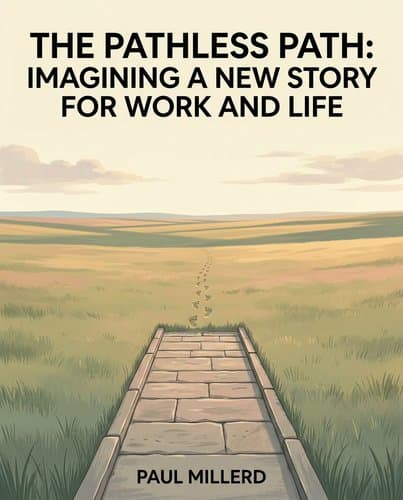
60151185_the-pathless-path
by Paul Millerd
The career path society handed you was engineered for a post-WWII economic blip that ended decades ago—and staying on it costs more than you realize, in ways…
In Brief
The career path society handed you was engineered for a post-WWII economic blip that ended decades ago—and staying on it costs more than you realize, in ways money can't fully explain. Learn to calculate your hidden "misery tax" and design work so compelling you'd never want to escape it.
Key Ideas
Calculate the misery tax honestly
Map your 'misery tax' — the money you spend on coping mechanisms (alcohol, expensive vacations, retail therapy) to sustain a path you resent. Calculate it honestly. Quitting often costs less than staying.
Examine money's role in identity
Apply the Feinberg test before attributing your hesitation to financial need: if a 20% pay cut would feel like an attack on who you are — not just what you earn — money is doing identity work. That's a different problem with a different solution.
Seek real mentors, not theory
Find one 'path expert' — someone ahead of you on a path you're curious about. Seek real-life contact, not just podcasts. Lydia Lee met a digital nomad in Malaysia in person and quit her job within six months. Physical proof overrides theoretical possibility.
Establish one fixed work constraint
Design one 'fixed point' — a single non-negotiable condition for your work life (no alarm clock, every seventh week off, never working weekends). Start with that constraint, not a five-year plan. The constraint forces creative problem-solving about everything else.
Project your negative future self
Run the inversion exercise: write a detailed portrait of 'negative future you' at 55 — the specific circumstances, behaviors, and attitudes that would produce that outcome. The traces of that failure state are probably already present in small doses today.
Purpose matters beyond escape alone
Distinguish 'freedom from' (quitting a job) from 'freedom to' (building something worth doing). If your only plan is to escape, you will achieve exactly that — and then face Fromm's second problem: what to do with freedom when you have it.
Who Should Read This
People working on personal growth in Career Change and Purpose, especially those tired of generic motivational advice.
The Pathless Path: Imagining a New Story For Work and Life
By Paul Millerd
10 min read
Why does it matter? Because the low-grade dread you feel isn't a discipline problem — it's a design problem.
The suspicion that you're the problem is wrong. Not slightly wrong. Structurally wrong. The low-grade friction you feel chasing credentials, climbing the right ladder, landing the titles that are supposed to feel like arrival — that's not laziness or ingratitude. That's your nervous system correctly reading a mismatch. The career architecture most of us inherited was designed for a specific 30-year window of post-WWII conditions that has already closed. The gold watch, the steady climb, the company loyalty — those weren't universal truths. They were a historical accident. Paul Millerd spent a decade inside that system — McKinsey, graduate school, six-figure salaries — before the titles arrived and arrival didn't. What he found on the other side wasn't escape to leisure. It was a harder, more interesting question: not how to stop working, but what kind of work is actually worth doing indefinitely.
The Stable Career Path Was a 30-Year Accident, Not a Law of Nature
The stable career path — steady job, predictable promotions, a gold watch at the end — was not a permanent feature of modern life. It was a specific product of a specific moment, and that moment is over.
After World War II, the United States had eliminated the manufacturing capacity of every nation that could compete with it. What followed was the "long boom": GDP growth of 4–5% annually, full-time jobs with real benefits, and a broad middle class that genuinely got richer every decade. Nine out of ten people born right after the war did better financially than their parents. That statistic became the water everyone swam in. And then the water changed.
Millerd shows it through his father's employer. For the first twenty years of his father's career, through the 1980s and 1990s, the company grew at over 14% annually. In the following two decades, that rate fell to 4%. His father believed he had joined a solid, established corporation. He had actually boarded a rocket ship at the exact moment of launch. The generation that rode that rocket into institutional leadership then spent decades teaching their children to follow the same route, not noticing the rocket had already landed.
You probably felt this mismatch without knowing what to call it. You followed the script: studied hard, got the degree, found the job, and discovered the rewards were smaller, the stability shakier, the work less meaningful than advertised. Call it accurate perception. The map handed to you was drawn for different terrain.
Berntsen and Rubin studied something they call "life scripts": the culturally shared expectations for when major milestones should happen. Graduate by 22, career established by 35, house before 40. Almost every milestone people agree on clusters before 35. After that, the script runs out. There's no cultural consensus about what a good life at 47 looks like: no shared timeline, no cohort hitting the same marks, no external check on whether you're still on track. The map doesn't end at the edge of known territory. It just stops mid-sentence.
The Career Is Quietly Consuming the Life It Was Supposed to Fund
Paul Millerd was sitting in an Arizona living room with twenty-five relatives when he slipped out to a local café to check his work email. His grandfather, recently diagnosed with terminal pancreatic cancer, was in the next room. Everyone else had flown across the country to be there. Millerd drove to get wifi.
A colleague messaged him almost immediately: "What are you doing? Go back with your family." He closed the laptop and returned. His grandfather took his final breaths minutes later.
The instinct to check email wasn't callousness or laziness. Millerd had spent a decade building himself into a reliable, responsive professional, the kind who kept clients happy and never let things slip. That instinct was so deeply grooved it fired in the one moment when it obviously, catastrophically, shouldn't have. He almost missed his grandfather's death because the work-centered life he'd constructed had quietly colonized his reflexes.
The default path doesn't advertise this cost. It promises you can work hard now and live fully later. What it actually delivers, if you stay long enough, is a nervous system that treats "what do my colleagues need" as a more urgent question than "what am I doing here."
Millerd eventually left corporate work, and on his first unemployed morning, sat down to write. A word appeared on the page that surprised him: burnout. He tried to explain it away — burnout was for investment bankers logging 80-hour weeks, not someone who took his vacation days and changed jobs when he stopped learning. But no other word fit.
Herbert Freudenberger coined the term in the 1970s, and the two questions he eventually landed on reframe everything: What if an institution's values are fundamentally opposed to the individual's? What if the individual keeps trying to meet externally imposed criteria of success — and simply cannot?
Burnout isn't a stamina deficit. No morning routine or better manager will fix it. It accumulates when you spend years managing the gap between who the institution needs you to be and who you actually are. That energy doesn't vanish. It builds until there's nowhere left for it to go.
The system is designed to frame this as a personal problem. The implied diagnosis is always the same: more discipline, clearer purpose, a better job. The possibility that what the company rewards and what you value will never converge never gets named. So you try harder, switch jobs, and find yourself wondering why the feeling follows you.
The café was the evidence. Not of a man who didn't love his grandfather. Of a man who had, over a decade of optimization and obedience, handed his own judgment over to work-world reflexes, and hadn't noticed until the moment it cost him something he couldn't get back.
You're Not Staying for Financial Security — You're Staying for an Identity
After a string of failed attempts to get excited about his current job, Millerd finally found a company that seemed worth the leap — a self-organized consultancy that ran on principles he'd actually read a book about. Great interviews. Real intellectual excitement. Then the offer arrived: $50,000 less than he was making.
He was outraged. The number wasn't even close.
His outrage should have surprised him more than it did. Millerd kept a daily 8:30am reminder on his phone listing his four priorities: health, relationships, fun and creativity, career. Career came last — deliberately. He had spent years telling anyone who'd listen that money wasn't what drove him. And yet a pay cut felt not like a math problem to solve but like a direct attack on who he was.
He turned the offer down, and sat with the question it forced open: if money wasn't supposed to matter, why did it hit that hard?
In 2008, a lawyer named Kenneth Feinberg was appointed to set the salaries of bank executives whose institutions had helped trigger the financial crisis. He expected frustration. These people had helped crash the global economy; surely they understood that a cut from five million to one million dollars was something they'd have to absorb. What he encountered was devastation. These were people who had earned more than they could plausibly spend, reacting as though something essential had been taken from them. Feinberg eventually understood: for these men, compensation wasn't a reward — it was the measure of who they were. He wasn't adjusting their compensation. He was erasing their identity.
Millerd read this and recognized himself. He had spent years insisting he was different, that meaning mattered more than money, that the pebble in his shoe was about purpose, not pay. But when the offer came in low, his stated values and his actual reaction told completely different stories. He had to admit he was far more like those executives than he'd wanted to believe.
The practical fears around leaving (health insurance, savings runway, income gaps) are real and worth solving. But they're solvable. People do the math, figure it out, and still don't leave. What most people are actually protecting when they stay is harder to quantify: a self-concept assembled over years from salary figures, job titles, and company names that signal to the world (and to themselves) that they are serious, successful, valuable people. A pay cut reaches further than the bank account. It asks a question you may not be ready to answer: who are you without the number?
You Don't Need a Plan — You Need Wonder and One Small Experiment
Think of learning to swim by reading a manual. You can study every stroke, memorize the physics of buoyancy, understand the technique — and still sink the moment you let go of the wall. Some knowledge only comes from getting wet.
That's the trap at the center of leaving a default path. Most people wait until they have a complete answer: the alternative career mapped out, the savings runway secured, the transformation fully legible. Agnes Callard draws a line between ambition and aspiration. Ambition means knowing what you value and going after it. Aspiration is trying on values you don't yet possess, which means you can't articulate where you're going in advance. The vagueness isn't cowardice. It's the process itself.
Most people stay put because their discomfort is familiar. The calculation works something like: uncertain discomfort seems worse than certain pain plus whatever coping mechanism gets you through the week. What breaks the equation isn't a plan or a savings number. It's wonder — a genuine curiosity about who you might become on the other side. Once wonder is in the mix, the uncertain path pulls harder than the certain one.
Diania Merriam didn't leave her corporate job in a single leap. She started by paying off $30,000 of debt in under a year, not as a financial strategy but as a test of what was possible. That success made her wonder what else she'd assumed was fixed. The next year, instead of asking for a raise, she asked for something stranger: two months of unpaid leave to walk the Camino de Santiago, a 500-mile pilgrimage across Spain. She prepared herself to quit if they refused. They said yes, which surprised her, and that surprise made her wonder what else was negotiable. She eventually launched a conference, then accepted a podcast hosting role at a third of her old salary. She called it a "manageable risk." Each step expanded what she believed was possible, until the next one felt less like courage and more like common sense.
Merriam wasn't testing hypotheses she already understood. She was finding out what she valued by acting on hunches she couldn't yet explain. That's Callard's aspiration: the destination only becomes clear through the journey. Anyone who claims they mapped the whole route before leaving was doing something else, something with lower stakes and a more predictable outcome.
The path cannot be explained in advance. It can only be started.
Quitting Gets You 'Freedom From' — Building Gets You 'Freedom To'
Quitting solves the wrong problem.
In April 2020, Millerd's online consulting course was earning $5,000 a month. He was invited into a program to scale it further. He knew it would work. He spent two days asking himself one question: what would he actually do with the extra money? The answer kept coming back the same way. He would write. He realized nothing was stopping him from doing that right now. He declined the program and wrote this book instead. That's the whole demonstration. Coming alive over getting ahead is not a slogan. It's what happens when you've done enough work to know what you're building toward.
Most people who leave the default path don't reach this. Erich Fromm noticed something like it in the 1940s, watching what happened when the guild, the church, and the village dissolved. Those structures had constrained people, but they'd also given them identity and belonging. Freed from them, millions felt not liberated but purposeless and isolated, susceptible to any movement that offered a ready-made script. Fromm called what they'd gained "negative freedom": liberation from external control. What they lacked was "positive freedom": active self-direction, full engagement with your own life. No one hands you that.
The pressure of lost income triggers an almost reflexive rebuild: freelance clients, a new identity, something to explain at dinner parties. You've escaped one set of constraints only to install another. The problem was never the employer. It was that you'd never asked what you actually wanted to be doing indefinitely.
Getting there requires two deliberate acts. The first is defining enough — not a number, but a description of conditions: what does sufficiency feel like, and what does it allow you to do? Millerd eventually built eight to ten income streams each generating at least $200 a month, accepting two years of lower total income in exchange for not depending catastrophically on any single source. Not austerity. Antifragility — the same logic by which cities outlast any individual business inside them. The second is building a culture worth inhabiting. The question isn't what you'd do if you quit. It's what you're building right now, and whether you'd want to live in it.
Negative freedom opens a door. Positive freedom is what you build on the other side.
The Culture You Build or the One You Inherit
Morrie Schwartz kept showing up. Discussion groups, Tuesday gatherings, students who'd graduated decades earlier and still needed him. No dramatic exit. He built a culture dense enough to outlast him, one that reshaped Mitch Albom's life long after Morrie was gone.
That's the harder question underneath this whole book: not what you'd do if you left your job, but what you're actually building right now.
The escape question keeps you frozen at the threshold. The design question — what culture am I constructing, and would I want to live inside it? — that one you can start answering today.
Notable Quotes
“Since tracked careers worked for them [the baby boomers], they can't imagine that they won't work for their kids, too.”
“whether you were born in 1945 or 1950 or 1955, things got better every year for the first 18 years of your life, and it had nothing to do with you.”
“It may suck, but you're getting something to put on your resume!”
Frequently Asked Questions
- What is The Pathless Path about?
- The Pathless Path challenges the assumption that the standard career trajectory — credentials, promotions, retirement — is the only valid way to structure a life. Paul Millerd argues this "default path" is a historical artifact, not a universal truth. The book equips readers with concrete tools to audit their current path, identify what work they would choose freely, and design a life worth staying in. Rather than prescribing alternatives, Millerd helps readers recognize agency in choosing how to work and live.
- What is the 'misery tax' concept in The Pathless Path?
- The 'misery tax' maps the money you spend on coping mechanisms — alcohol, expensive vacations, retail therapy — to sustain a path you resent. Calculate it honestly because quitting often costs less than staying. This reframing removes the illusion that financial obligation is the primary barrier to change. By quantifying what you're already paying to tolerate dissatisfaction, you gain clarity on whether financial fear holding you back is real or a cover for deeper uncertainty about identity and purpose.
- What are the 'fixed point' and 'path expert' strategies in The Pathless Path?
- A 'fixed point' is a single non-negotiable condition for your work life — no alarm clock, every seventh week off, or never working weekends. Starting with one constraint forces creative problem-solving rather than writing a five-year plan. A 'path expert' is someone ahead of you on a path you're curious about; seek real-life contact, not just podcasts. Lydia Lee met a digital nomad in Malaysia in person and quit her job within six months. Physical proof overrides theoretical possibility.
- What's the difference between 'freedom from' and 'freedom to' in The Pathless Path?
- 'Freedom from' means quitting a job; 'freedom to' means building something worth doing. If your only plan is to escape, you will achieve exactly that — and then face a second problem: what to do with freedom when you have it. This reflects the psychological challenge of freedom itself. Millerd guides readers beyond escape toward designing intentional alternatives, because freedom without direction often creates new dissatisfaction. The goal is clarity about what you're moving toward, not just what you're leaving.
Related Book Summaries
Read the full summary of 60151185_the-pathless-path on InShort