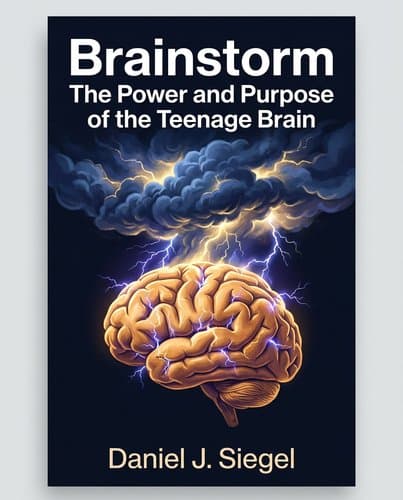
17707532_brainstorm
by Daniel J. Siegel
The traits that make teenagers maddening—risk-taking, emotional intensity, creative restlessness—are neurological gifts adults desperately need to reclaim.
In Brief
Brainstorm: The Power and Purpose of the Teenage Brain (2011) reframes adolescence as a period of neurological transformation with distinct advantages, not just a phase to survive.
Key Ideas
Flipped lids are circuit problems, not character flaws
When a teenager (or adult) 'flips their lid,' the prefrontal cortex has literally lost its regulatory connection to the lower brain — treat it as a circuit problem to repair, not a character flaw to punish
Name emotions to tame limbic intensity
'Name it to tame it' is neurologically real: labeling an emotion in words activates the prefrontal cortex and physiologically dampens the limbic response. Shift from 'I am angry' to 'I notice I feel anger' — the distance changes the brain's response.
Adolescents weigh rewards higher than consequences
Adolescents take risks they know are risky because hyperrationality amplifies rewards and discounts consequences. Understanding this changes the conversation — the question isn't 'what were you thinking?' but 'what did that feel worth to you?'
Connection precedes correction in teenage brains
Connection before correction: the adolescent brain requires 'feeling felt' before it can regulate or learn. Launching into a lecture while a teenager is emotionally flooded skips the step that makes any of it land.
Coherent narratives rewire attachment-based brain patterns
Attachment histories from childhood are stored as brain-firing patterns that show up in how you argue, connect, and misread others today — but the brain remains plastic, and building a 'coherent narrative' of your own history is the mechanism of change, not just a therapeutic exercise
Focused attention is required for learning consolidation
Multitasking isn't just inefficient — it chemically prevents learning. Acetylcholine and BDNF (the neurochemicals that make synaptic change stick) only flood circuits during focused, singular attention. The knowledge from a distracted study session literally isn't there when the exam arrives.
Reactivating adolescent qualities sustains lifelong engagement
The ESSENCE qualities of adolescence (emotional intensity, novelty-seeking, social hunger, creative exploration) don't have to be surrendered in adulthood — their suppression is the mechanism of adult stagnation, and deliberately reactivating them through play, learning, and connection is the neuroscience of staying alive to life
Who Should Read This
Curious readers interested in Neuroscience and Child Development and the science of how the mind actually works.
Brainstorm: The Power and Purpose of the Teenage Brain
By Daniel J. Siegel
11 min read
Why does it matter? Because the teenager you're frustrated with is running the most ambitious brain upgrade of their entire life.
Every adult who has ever watched a teenager do something baffling — drive too fast, pick a catastrophic fight, abandon a perfectly good future for a single thrilling moment — has told themselves the same story: the kid just isn't thinking. That story is wrong. The teenager is thinking, intensely, through a brain that has been systematically rewired to prioritize exactly this: novelty, intensity, social risk, the feeling of being alive right now. The recklessness isn't a glitch. It's the point. Daniel Siegel's argument in Brainstorm isn't that we should excuse adolescent behavior or stop worrying about it. It's that once you understand what the brain is actually doing during those years — and why evolution built it this way — you stop seeing immaturity and start seeing a blueprint. One that most adults, somewhere around thirty, quietly folded up — and forgot they'd ever been given.
The Teenage Brain Isn't Broken — It's Being Rebuilt
The teenage brain isn't an immature adult brain waiting to catch up. It's a brain in the middle of a controlled demolition and rebuild — one that evolution designed on purpose.
Here's what makes that claim land: adolescents are at their physical peak. Fastest reflexes, strongest immune systems, highest resistance to heat and cold. And yet they're three times more likely to die from avoidable causes than either children or adults. That gap is the puzzle. Daniel Siegel watched it close in on someone he loved when a nineteen-year-old driver — going nearly 95 mph, in a replacement sports car after totaling his first two months earlier in a similar crash — killed Siegel's psychiatric mentor, Bill, on an ordinary Friday evening drive. Bill had looked both ways before pulling out. At that speed, he never had a chance. The teen wasn't impaired by anything except his own remodel: weight the thrill heavily, the consequences lightly.
That bias isn't a bug. The brain's reward circuits surge during adolescence, flooding the system with dopamine in response to novelty and risk. At the same time, the prefrontal cortex — the region that pumps the brakes and sees the bigger picture — is being stripped down and rewired through a two-part process: pruning, which removes unused synaptic connections, and myelination, which insulates the remaining ones and speeds electrical signaling by up to 100 times. The result is a brain optimized for a specific evolutionary task: get the young person out of the nest, across unfamiliar territory, and into a new social world before they settle into the same grooves as the previous generation. The remodel isn't producing immaturity. It's producing a drive toward the new.
Every species that goes through adolescence shows some version of this pattern: a lowered fear threshold, a pull toward peers, a hunger for the unfamiliar. The remodel isn't producing a lesser brain. It's producing a different one — built for exploration, not for staying put.
Why Teenagers Take Risks They Know Are Stupid
Katey was seventeen when she smuggled tequila to an end-of-summer party held at her school director's home, talked the director's own daughter into drinking, and ended up in the emergency room having her stomach pumped. When she arrived at her first therapy session the following week — expelled — and Siegel asked what she'd been thinking, she smiled. She'd thought about it, she admitted. She knew what the school's zero-tolerance policy meant. She just decided that getting completely wasted at the director's house was too good to pass up.
That smile is the whole puzzle. Katey wasn't oblivious. She wasn't impulsive in the way we usually mean — she'd planned the evening in advance. What happened inside her brain was something more specific: the evaluation centers amplified the thrill and shrank the consequences until the calculation came out positive. The technical term Siegel uses is hyperrationality — a cognitive mode where the brain doesn't skip the math, it just runs it on a tilted scale. Adolescent brains, flooded with dopamine during this developmental window, process potential rewards with extra intensity while discounting potential costs. Teens often know what the downside is. They weight it differently.
Peer presence makes the calibration more extreme. Studies measuring teen behavior in driving simulations show that risk-taking increases measurably when friends are watching. The same brain, the same person — different company, different calculation. Social context pushes the dopamine reward circuitry further, which is why Katey, even in the planning stage, was already imagining how this would land with her friends. Peer presence doesn't override judgment; it rewires the inputs to it.
This is what makes hyperrationality so hard to argue with from the outside. Katey wasn't wrong that the night would be memorable. She just had no reliable way to feel how much the expulsion would cost her — not because the information was unavailable, but because her brain wasn't yet built to weight it properly. That architecture changes. It just takes time.
Adults Aren't Safer — They're Just Stuck in a Different Rut
What if the problem with teenagers isn't that they live too intensely — but that most adults have quietly stopped living at all?
Siegel's patients tell him their lives feel like ruts. Boring, predictable, socially thin. They've lost the pull toward new experiences, the emotional charge that makes things feel worth doing, the creative restlessness that once made them interesting to themselves. They describe this as maturity. What they've actually done is trade the four qualities adolescence was designed to build — emotional spark, social engagement, novelty-seeking, and creative exploration — for the efficient low-energy state Siegel calls survival mode. The same traits driving teenage chaos are, when the remodel finishes, supposed to fuel adult vitality. Most adults don't let the remodel finish. They suppress those traits because they're inconvenient, and then wonder why everything feels flat.
The evidence Siegel finds most unsettling is about creativity. Ask a five-year-old how many uses a paper clip has and you'll get a torrent of answers — upward of forty, ridiculous and ingenious in equal measure. Ask a high schooler and you'll get three. Divergent thinking, the ability to generate many possible solutions rather than converging on the correct one, peaks in young children and falls sharply once formal schooling begins. Kids learn quickly that there's a right answer and a wrong answer, and that being wrong is punishing. By adulthood, the creative circuitry adolescence was designed to expand has been systematically trained away. The teenager dreaming up unconventional approaches to old problems isn't being reckless. They're doing exactly what the brain's remodel intended. The adult who stopped doing that didn't graduate past it — they surrendered it.
Siegel himself is the cautionary example. A psychiatrist who teaches about brain growth and vitality, he realized at some point that his own daily life contained no play, no novelty, no spontaneity. His solution: an improv acting class for non-actors, plus rollerblading around his neighborhood listening to music. The author of the book telling teenagers their intensity is an asset had to convince his own serious adult mind that goofing off was worth the permission slip.
You Can't Think Your Way Out of a Flipped Lid
When the brain's alarm fires, the local dispatch center floods the zone with first responders and cuts the call to city hall. That's efficient in an actual emergency. The problem is that the adolescent brain — and the adult brain under pressure — fires that same alarm for anything that reads as threat, from a genuine physical danger to a college-graduate son leaving dishes on the stove.
Siegel models this with something you can build with your own hand. Make a fist with your thumb tucked inside your fingers. Your wrist is the spinal cord. Your palm is the brain stem — the ancient, automatic part handling heart rate and breathing. Your thumb folded inward is the limbic region, the emotional core where fear, anger, and attachment signals originate. Your fingers curled over the thumb are the cortex, with the fingernails at the front representing the prefrontal cortex — the region that integrates everything underneath it, weighs consequences, and regulates what comes out of your mouth. Now lift your fingers straight up. The prefrontal cortex has just lost contact with the emotional core. That's what 'flipping your lid' means, physically.
Siegel doesn't offer this as metaphor. He offers it as circuit description. When the limbic system fires intensely — when shame, threat, or territorial instinct surges — the prefrontal cortex doesn't get overruled so much as disconnected. The older regions of the brain, running their faster, cruder programs, produce behavior that the thinking brain would have stopped. The person isn't choosing to act badly. They're running on hardware that predates choice.
He knows this from his own kitchen. His son had just returned home after college, and Siegel came in to find dishes still sitting out hours after his wife had explicitly asked for them to be cleaned up. Something in his brain registered a young male challenging the household's alpha female, and before his prefrontal cortex could run the response he'd planned, the words were out: 'This is our house, not yours. If you don't like the rules, go get your own apartment.' He felt it land wrong the moment it left his mouth.
The repair mattered more than the rupture. The next evening, Siegel came home and apologized directly: this was his son's home, he'd been out of line, four years of hard work deserved better than that. His son accepted it — and quietly observed that Siegel had probably been stressed about something else anyway. That's the insight Siegel wants you to hold: a flipped lid isn't a character verdict, it's a circuit event. What you do afterward is where character actually lives.
Your Childhood Attachment History Is Still Running the Show
Gail's story is the most useful proof that none of this is permanent. Her father was a terrifying alcoholic whose drunken rages created disorganized attachment — the neurological emergency that happens when the person you're biologically wired to run toward for safety is also the person you need to flee. Her mother was warm but emotionally intrusive, generating ambivalent attachment on top of that. By the time Gail entered therapy in her twenties, she regularly dissociated under relational stress, couldn't hold onto a stable sense of herself during conflict, and would sometimes lose access to memories of her own mother.
Every relationship pattern you carry into adulthood was written into your brain before you had the vocabulary to describe it. That's not a metaphor — it's a circuit description. The ways caregivers responded to you in infancy and early childhood created what Siegel calls attachment models: literal firing patterns in the brain that become the default lens for every close relationship that follows. They activate automatically, below awareness, and they're running right now in the way you fight with your teenager, reach out to a partner, or pull back from a friend.
The architecture begins with four requirements. Children need to feel seen — their inner emotional life sensed beneath their behavior — and safe, and soothed when distressed. Together, these three create the fourth: secure attachment. Between a third and half of people didn't consistently receive all three, and those who didn't built different adaptations. Avoidant attachment develops when comfort is repeatedly withheld and the child learns to minimize emotional needs entirely. Ambivalent attachment forms when a caregiver is inconsistent or emotionally intrusive, flooding the child with feelings that aren't even their own.
What Gail built through years of therapy was what researchers call earned security: a coherent narrative linking the logical account of her past to the raw emotional memory of it. Those two sides, finally in conversation, stopped hijacking each other. By the time her son Steven was heading to college — choosing a school five hours away rather than the easy option down the street, close enough to come home when her cancer treatment got hard — he was launching from a genuinely secure base. She had broken the cycle precisely because she understood the mechanism that had built it.
The Brain Can Be Rewired — But Only If You Pay Attention Differently
Picture a teenager at her desk, textbooks open, highlighter in hand, phone face-up beside her. She's been at it for two hours. The exam comes back and almost nothing stuck — not because she didn't put in the time, but because the brain's growth machinery never switched on. Divided attention doesn't produce learning less efficiently. It chemically prevents learning from occurring at all.
Here's why. When you sustain attention on a single thing, a structure just above the brain stem releases acetylcholine, which bathes the active circuits. Simultaneously, BDNF — sometimes described as fertilizer for neurons — floods those same pathways and triggers the gene expression that physically strengthens synaptic connections. That's the chain: focused attention produces specific chemicals that produce structural change. The texting-while-studying brain never sustains attention long enough to trigger that sequence, so no lasting synaptic modification takes place. Multitasking isn't a bad study habit. It's a different neurological state — one that excludes the physical substrate of memory formation.
The same logic runs in the opposite direction for emotion regulation. When you label a feeling — shifting from the experience of anger to the observation 'I notice anger rising in me' — brain imaging shows the prefrontal cortex activating and the limbic system quieting. The distance created by naming isn't philosophical. It's a circuit event: language processing in the prefrontal region literally dampens the amygdala's firing. Siegel calls this 'name it to tame it,' and the mechanism is why it works at all. The remodeling adolescent brain, already prone to fast emotional surges that bypass cortical filtering, gains a measurable stabilizer every time it puts words to what it feels. The name doesn't make the emotion disappear — it gives the prefrontal cortex a handhold.
Taken together, these two findings mean that attention isn't just useful. It's the lever. Where you point it determines which circuits activate, which chemicals flood which pathways, and which connections survive the adolescent pruning. The remodel is happening regardless. The question is what you're building while it does.
Connection Is the Correction — Not the Reward After It
What actually needs to happen before a teenager can hear anything you say?
The answer Siegel keeps returning to isn't patience or the right words — it's a neurological state. The adolescent brain in emotional distress is running on its faster, lower circuits. The prefrontal cortex, the region that evaluates, learns, and takes in feedback, only comes back online once the person feels genuinely understood. Connection isn't the reward you dispense after a teenager behaves well enough to earn it. It's the biological precondition for the brain becoming capable of regulation at all. Skip it and lead with correction, and you're delivering your message to a system that, architecturally, cannot receive it.
Siegel calls this 'feeling felt' — the subjective experience of knowing that your inner world has been accurately read by another person. He built a framework around it: PART, meaning Presence, Attunement, Resonance, Trust. Each step depends on the one before. Picture a parent coming home to a teenager who is clearly upset. She sits down at the kitchen table, phone face-down, says nothing yet. That's Presence — not a technique, just a body in the room that isn't somewhere else. From there, attunement becomes possible, then resonance, and finally trust: the state in which the brain opens rather than defends. What's surprising is that the stakes here go beyond the emotional. Researchers tracking parents of chronically ill children found that this quality of presence registered in the body: better immune function, lower stress markers, and longer telomeres, the molecular caps on chromosomes that shorten with chronic stress. Being genuinely present for another person, it turns out, is good for your cells.
The same childhood attachment patterns explored in earlier chapters are the background noise in every exchange at the kitchen table. An avoidant parent may understand PART intellectually and still cut to problem-solving the moment the feeling gets uncomfortable. A parent with an ambivalent history may flood before the conversation gets anywhere useful. None of this is character. It's circuitry built before language. The useful news is that the brain stays plastic, which means the pattern is not the sentence. Noticing it is already the beginning of changing it.
The Goal Isn't Independence — It's Integration
Imagine two teenagers who both complete adolescence in the textbook sense: they leave home, hold down jobs, pay their own bills — one of them building a sealed-off self that measures success by what he accumulates and how little he needs from anyone, the other carrying her individual identity into genuine relationships and responsibilities beyond herself. By most cultural metrics they're equally successful. By the neuroscience Siegel has spent the whole book building, they're in completely different places.
The final argument Siegel makes is this: the goal was never independence. It was integration.
He captures it in a single invented word — MWe, a mashup of 'me' and 'we.' The idea isn't that you dissolve your individual self into a collective. You hold both simultaneously: the differentiated, bodily self and the relational, interconnected self, linked rather than collapsed together. When a graduate student pushed back on this — she'd worked hard to build a coherent personal narrative from a difficult attachment history, and 'me to we' sounded like someone asking her to hand it over — Siegel refined the phrasing to 'from only me to also we.' You don't lose the first half. You expand it to include the second.
What makes this more than feel-good rhetoric is what Albert Einstein called an 'optical delusion' — the false but pervasive belief that each of us is a sealed unit whose life ends at the skin. Siegel's point is that this isn't a cultural preference you can take or leave. It's a failure of reality-testing. Every insight the book has built about attachment, about brain integration, about how the prefrontal cortex and limbic system have to work together rather than against each other — all of it points to the same conclusion: the self is relational at its core. Pretending otherwise produces, predictably, the chaos and rigidity that impaired integration always produces.
The practical translation Siegel offers is small enough to actually do: savor and serve. Not save the world. Take one attainable act of help. E.B. White spent his career caught between enjoying the world and trying to fix it; Siegel's version of that tension resolves differently — the emotional spark, the social hunger, the appetite for novelty that the teenage brain was rebuilt to produce aren't phases to file away. They're what the adult self needs to stay alive, and to be of use.
The Upgrade You Were Supposed to Keep
The remodel doesn't stop when the diploma arrives. It was never really about the diploma. What adolescence was building — that raw appetite for connection, the willingness to feel something fully before knowing what to do with it, the instinct to reach toward the new — wasn't a phase to be managed and then set aside. It was the upgrade. The question worth sitting with, quietly, is whether you let it complete. Most adults didn't surrender those qualities dramatically. They just stopped protecting them, one practical concession at a time, until the days felt safe and thin. If the teenage brain is a work in progress, so is yours. Integration — of feeling and thinking, of self and other, of who you were and who you're still becoming — isn't something you achieve in adolescence and carry forward. It's the project. It just keeps going, for as long as you're willing to stay in it.
Notable Quotes
“gone down the low road.”
“If you don’t like the rules of the house, you can go out and find a job, earn some money, and move into your own apartment.”
“Don’t gang up on him—she can state for herself the case for needing him to clean up after himself. Don’t double up on him!”
Frequently Asked Questions
- What does it mean when a teenager 'flips their lid'?
- When a teenager "flips their lid," the prefrontal cortex has literally lost its regulatory connection to the lower brain, according to Siegel. This isn't a character flaw or behavioral choice—it's a circuit problem. When this happens, the teenager's ability to think rationally, regulate emotions, or access decision-making is offline. Understanding this as a neurological disconnect rather than a personality failing shifts how parents respond. Instead of punishment, the goal becomes repairing that regulatory circuit. This reframe transforms interactions from punitive to collaborative, treating dysregulation as a problem to solve together, not a defect to criticize.
- How does naming emotions actually change the teenage brain?
- "'Name it to tame it' is neurologically real": labeling a feeling in words activates the prefrontal cortex and physiologically dampens the limbic response. When a teenager shifts from saying "I am angry" to "I notice I feel anger," the distance created by observation changes how the brain processes emotion. This distinction matters because the observer stance engages regulatory circuits that wouldn't activate in pure emotional identification. The practice leverages how the brain's attention system actually works. Building this capacity over time gives teenagers a concrete tool for regulating intensity without denying what they feel.
- Why do teenagers take risks even when they know they're risky?
- Adolescents take risks they know are risky because their developing brains operate differently—not from lack of knowledge but from neurological architecture. According to Siegel, "hyperrationality amplifies rewards and discounts consequences" in the adolescent brain, meaning they're weighting value differently, not miscalculating. Understanding this transforms conversations. Instead of asking "what were you thinking?" (implying a thinking failure), ask "what did that feel worth to you?"—a question that acknowledges neurological reality and invites dialogue about value, not judgment about logic or maturity.
- What are the ESSENCE qualities of adolescence and why shouldn't adults lose them?
- The ESSENCE qualities of adolescence—emotional intensity, novelty-seeking, social hunger, and creative exploration—are adaptive strengths that shouldn't disappear in adulthood. According to Siegel, "their suppression is the mechanism of adult stagnation," meaning that when adults shut down these capacities in the name of maturity, they actually limit growth and vitality. Rather than viewing adolescent intensity as something to outgrow, deliberately reactivating these qualities through play, learning, and connection sustains aliveness across the lifespan. The difference between vital and stagnant adults lies in preserving these brain capacities.
Related Book Summaries

Read the full summary of 17707532_brainstorm on InShort