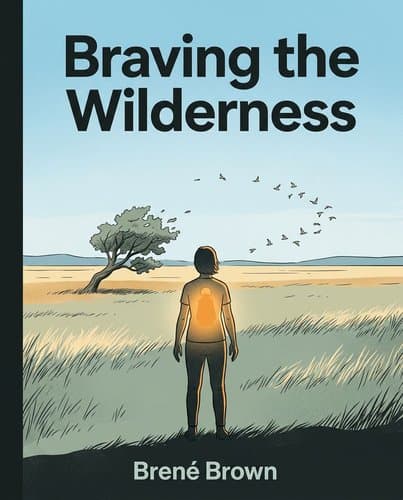
34565022_braving-the-wilderness
by Brené Brown
True belonging isn't earned by fitting in—it's forged by standing alone in your convictions. Brené Brown reveals why the courage to be unpopular is the only…
In Brief
True belonging isn't earned by fitting in—it's forged by standing alone in your convictions. Brené Brown reveals why the courage to be unpopular is the only path to genuine connection, and why loneliness is a public health crisis hiding in plain sight.
Key Ideas
Fitting In Signals Hollow Counterfeit Belonging
When you catch yourself modifying an opinion to fit a room, recognize it specifically as fitting in — not belonging. Fitting in is the counterfeit. The signal that you're doing it is the slight hollowness afterward.
Loneliness is Biological Signal Not Shame
Treat loneliness as a biological signal requiring action, not a personal failing requiring silence. Research puts its mortality risk at 45% increased early death — higher than obesity or excessive drinking. The shame around admitting it is part of what makes it dangerous.
Refuse False Dichotomy's Terms With Integrity
Identify one false dichotomy you're currently being handed — politically, professionally, or personally — and practice refusing its terms without abandoning your actual position. 'I won't participate in this debate as framed' is an act of integrity, not avoidance.
Contempt-Based Bonds Collapse Without Target
Audit your closest bonds: are they built on genuine curiosity and care, or primarily on shared contempt for someone else? Common enemy intimacy feels like deep connection but collapses the moment the target disappears. It's worth knowing which kind you have.
Physical Presence Creates Irreplaceable Connection
Seek at least one in-person collective experience — a concert, a vigil, a community gathering — rather than a digital substitute. Face-to-face presence creates connection that screen-mediated interaction structurally cannot replicate, and research suggests neglecting it carries health consequences equivalent to heavy smoking.
Self-Trust: The Gear for Standing Alone
Apply the BRAVING inventory to yourself: Did you respect your own boundaries this week? Act from your integrity? Ask for what you needed? Self-trust — not confidence or external validation — is the specific gear that makes it possible to stand alone.
Who Should Read This
People working on personal growth in Social Psychology and Self-Improvement, especially those tired of generic motivational advice.
Braving the Wilderness
By Brené Brown
9 min read
Why does it matter? Because every group you've joined to feel accepted has been moving you further from the belonging you were actually looking for.
You've been chasing belonging your whole life — and you're actually pretty good at it. You know which opinions to soften, which parts of yourself to leave in the car, which version of you plays best in which room. You've gotten in. Congratulations. But here's what nobody names: every time you fit in, something slips out the back door. Something that knew what you actually thought, what you actually believed, what you were not willing to trade. Brené Brown spent four years researching what the people who seem most genuinely at home in the world have in common. The answer is the last one most of us would choose. They stopped trying to get belonging from other people. They found it in themselves first. And then they walked into what she calls the wilderness — alone.
Fitting In and Belonging Are Opposites — and You've Spent Years Practicing the Wrong One
She was number 62. Standing at the gym door, Brené Brown ran her eyes down the list of numbers posted after drill team tryouts — 59, 61, 64, 65. She looked again. She was fourteen, had survived two weeks on liquid cabbage soup to make the weigh-in, had practiced the routine until she could run it in her sleep. Every other girl wore blue-and-gold satin and matching hair bows; Brown had shown up in gray cotton shorts over a black leotard, with no makeup, because no one had told her the unwritten dress code. She nailed the routine anyway. Her number wasn't on the list.
Her family was in the station wagon waiting to drive to her grandparents'. Her father had been captain of the football team. Her mother had led her own drill team. Nobody said a single word the entire drive home. In that silence, Brown concluded something that would take decades to unlearn: she didn't belong to her family either.
Everything she did to prepare was an act of fitting in — the starvation diet, the practiced kicks, even the desperate wish for a "big sis" who would decorate her locker. Fitting in is optimization work. You study the environment, identify what's wanted, subtract the parts of yourself that don't fit and amplify the ones that do. Brown got very good at this. After that rejection, she became a chameleon, reading people so precisely she could anticipate what they wanted before they knew themselves. The skill became her career. It also made her, she says, a complete stranger to herself.
That's the trap. Fitting in and belonging feel like the same project — find the right group, learn the codes, eventually land somewhere you're wanted. But they run in opposite directions. Fitting in asks you to change. Belonging asks you to arrive. Every compromise you made to seem acceptable was a transaction that moved you further from the thing you were actually after.
Brown spent four years researching why, and the finding is almost irritatingly simple: true belonging doesn't require you to change who you are. It requires you to be who you are. The question is whether you can stand in that, especially when the list goes up and your number isn't there.
Loneliness Is Killing More People Than Obesity — and We've Agreed to Call It Something Else
Loneliness is a public health crisis with a body count — and we've been treating it like a character flaw.
The data is unambiguous. A meta-analysis found that loneliness increases your odds of dying early by 45 percent. Air pollution raises those odds by 5 percent. Obesity by 20 percent. Excessive drinking by 30 percent. Loneliness is more deadly than all of them. And yet when people feel it, their first instinct is to hide it.
That's what makes it so dangerous. University of Chicago neuroscientist John Cacioppo spent over twenty years studying loneliness and landed on a single conclusion: loneliness is a biological warning signal, as urgent as hunger or thirst. Our brains, wired for social connection, sound an alarm when we drift to the social perimeter. That alarm, left unacknowledged, triggers a kind of social flinching: you stop reaching out, you read neutral faces as hostile, you decide it's safer not to try. Those are exactly the behaviors that guarantee more loneliness. His argument: suppressing your awareness of feeling lonely is as irrational as ignoring hunger. Both are the body alerting you to something essential.
But we do suppress it, because somewhere we absorbed the idea that loneliness means something is wrong with you specifically. That shame is what makes it lethal. The disconnection you've been carrying quietly (from your neighbors, from people who see the world differently, maybe from yourself) isn't evidence of your dysfunction. It's a signal shared by 40 percent of Americans today, double the rate from 1980 (in surveys conducted by AARP and others). The longing isn't private. The crisis is collective. And naming it is what makes it treatable.
The People Who Seem Most at Home in the World Are the Ones Willing to Stand Completely Alone
What if standing alone, the condition you've spent years trying to escape, turns out to be the address of the thing you're looking for?
For over twenty years, Brown thought Maya Angelou had gotten something deeply wrong. In a 1973 interview, Angelou told journalist Bill Moyers: "You are only free when you realize you belong no place — you belong every place — no place at all." Brown's reaction was visceral. She'd spent her whole childhood on the outside of every group: the wrong religion at a Catholic school, the wrong name on a homeroom list, the wrong outfit at drill team tryouts. Belonging nowhere was her pain, not her liberation. How could Angelou call it freedom?
Then, years later, Brown's husband Steve pointed out something she'd been walking past the whole time. After a leadership conference where she'd worn jeans and clogs while every other speaker wore business attire (and still received the highest ratings), he said: "You will always belong anywhere you show up as yourself." She pulled up the full Moyers transcript and found the line she'd been missing. Moyers asked Angelou: "Do you belong to anyone?" Angelou answered: "I belong to myself. I'm very proud of that."
That's what unlocks the paradox. Belonging everywhere and nowhere is what happens when you belong so thoroughly to yourself that no single group can hold your sense of self hostage with their approval or rejection.
Brown's research gives this a name: the wilderness. It's the territory you enter when you're willing to stand alone in your values and convictions, even when it costs you the comfort of the group. She describes it as disorienting and even dangerous, but also the only place where true belonging actually lives. The woman who walked into that conference room in the wrong clothes and got the highest ratings anyway — she wasn't brave enough to belong anywhere. She already did.
The belonging you've been chasing is something you carry, not something received. The moment you require someone else's approval to feel it, you've already surrendered it. And the courage it takes to stop making that trade, to show up in jeans when the dress code says suits, to say "this is who I am" without waiting for permission from the group — that's the thing itself.
Hate Is an Artifact of Distance — the Practice Is Simply to Close It
Her husband had a heart attack at the gym on a Tuesday. When the call came to her at work, the person who drove her to the hospital, who stayed until they knew he'd survive, who picked up the kids from school and fed them dinner, was her closest friend. A Democrat. This lifelong conservative had spent years agreeing that Democrats were losers. She didn't think that about her friend. She loved her friend.
The pattern is stable: virtually every person who held a strong political generalization also knew, personally, someone who demolished it. The standard move is to call her the exception. That's exactly the error. The exception isn't rare. The exception is every actual human being you've ever stood close enough to know.
Hatred needs distance. It runs on abstraction: categories, labels, enemy images. Actual people nearly always erode it. The people in Brown's research who practiced true belonging refused to abstract the person in front of them. They formed opinions from lived experience, even when the result had no clean home in any ideological bunker. They let the person complicate the category.
Two days after his wife was killed among 89 people at the Bataclan concert hall in Paris, Antoine Leiris posted a letter to her murderers. He had grief and rage in full. What he refused to give them was his hate, because hatred requires turning people into abstractions, maintaining an enemy image that only holds at a distance. "To respond to your hate with anger would be to yield to the same ignorance that made you what you are," he wrote. He wasn't performing forgiveness. He was refusing to do the cognitive work hatred demands.
Brown reads that as a form of power, not surrender. Anger tethered to something real — to love, to loss, to the specific face of a person — can become courage or change. Rage that needs distance to survive becomes something you pay for with the rest of your life.
The Most Courageous Thing in a Polarized Room Is Refusing to Pick Either Side
Accepting the terms of a false dichotomy is how you lose yourself in a room even while speaking loudly — the specific act of integrity is refusing those terms, and it almost always means standing alone.
Harry Frankfurt's 2005 essay "On Bullshit" became an unlikely bestseller because it named something people already felt: lying defies the truth, but bullshitting dismisses the entire enterprise of truth, which is the more dangerous move. When people feel pressed to opine on things they don't actually understand, they abandon the idea that objective facts are even worth pursuing and collapse into something simpler. Once they stop caring whether they're right and only care about which tribe they're in, the false dichotomy is never far behind — usually dressed as moral clarity.
Brown ran straight into one at a social event. She mentioned to a small group that she and her father were planning to teach her son to shoot skeet. A woman fixed her with a look of contempt and announced: if you support gun ownership, you support the NRA. No other options. Brown, who had grown up in a Texas hunting family where gun safety was a prerequisite to touching a weapon, and who had watched the NRA transform from a safety-and-merit-badge organization into something she didn't recognize, found the equation absurd. She supports background checks, waiting periods, and bans on large magazines and armor-piercing ammunition. She opposes campus carry. Every one of those positions the false dichotomy simply erases.
She refused to continue on the woman's terms. She said, clearly and with as much empathy as she could manage, that she wasn't going to debate a question reduced to you either support guns or you don't. The woman stormed off. The group may have hated her for it. But Brown knew what she came out of that moment with: she belonged to herself. Not to the room, not to the side that would have loved her for saying the expected thing. To herself.
What makes this hard is that false dichotomies feel like urgency. They're designed to. Refusing them means opting for the wilderness: the space where neither side claims you and you have to be your own company.
You Share More With Strangers Turning On Their Headlights Than With People You Bond Over Hating Someone
January 28, 1986. Brown is driving down FM 1960 in Houston when cars ahead of her start pulling over, not for an ambulance, not for anything visible. Through the window of a pickup truck at the curb, she sees a man with his head buried in his hands on his steering wheel. She pulls over and turns on the radio just in time to hear the announcement: the space shuttle Challenger has exploded. For a few minutes, strangers sit with strangers on a four-lane thoroughfare. Then, without any signal or instruction, they pull back into traffic with their headlights on. A wordless procession of grief by people who would never meet again. Brown says: if you ask where she was when Challenger happened, she'll tell you she was with her people — the people of FM 1960.
That phrase, her people, is the whole point. Brown's research identifies a practice of true belonging: deliberately seeking collective moments of joy and pain with strangers, in person. Sociologist Émile Durkheim called the phenomenon collective effervescence (a "sensation of sacredness" that arises when you become part of something larger than yourself). The people in Brown's research with the most durable sense of belonging actively sought these experiences: concerts, funerals, sporting events, grief. Not for comfort, but because those moments demonstrate, at the level of felt experience, that human connection is real and available.
Then Brown names the counterfeit — and she's honest about how good it feels. There's nothing faster than bonding with someone over shared contempt. It's immediately gratifying, sometimes funny, and feels exactly like connection. But when she tried a no-gossip practice during her shame research, she found that several relationships she'd called friendships had nothing underneath the snark. Scaled to culture, this becomes what she calls 'common enemy intimacy': you don't really know each other, but you hate the same people. It burns hot, burns fast, and leaves you lonelier than before. The FM 1960 headlights and a group text mocking someone you both dislike can feel nearly identical in the chest. One of them is real.
You Don't Find the Wilderness. You Become It.
There's a specific kind of exhaustion that comes from looking for something you're already holding, checking every pocket, retracing every step, certain it must be somewhere else. That's what it feels like to spend years treating belonging as a destination.
Brown's final reframe arrives quietly and lands hard. Braving the wilderness, standing alone, refusing to perform your way into rooms where you don't fit — the whole project was never about finding a place. It was about recognizing that you carry the thing itself. She prescribes a practice: stop scanning the world for evidence that you don't fit. You'll always find it if you're looking, because you've made that search your mission. Self-worth isn't a negotiation you run with the room. You either carry it or you don't.
Jen Hatmaker, writer and pastor, learned this when she publicly backed LGBTQ inclusion within a conservative Christian community and watched her belonging evaporate in real time. What she found on the other side wasn't desolation. It was a population. The wilderness, she discovered, is where the creatives and the prophets and the system-buckers have always gathered, building and belonging on different terms. The loneliest part was the threshold: the stretch between safety in the rearview and the unknown ahead. Inside, she found company. And she came out of it bearing what a friend of hers called a limp: permanent, like the biblical Jacob's after he wrestled an angel through the night. A mark of determined struggle that becomes, in the right company, a credential.
Brown arrives, finally, at four words: "I am the wilderness." Think of Hatmaker at that threshold — already the wilderness before she had a name for it. The untamed thing you've been learning to navigate is also what you're made of. Belonging everywhere and nowhere isn't a destination you reach. It's the condition you've been living in all along, once you stop asking permission to be there.
The Question You've Been Asking Wrong
The wilderness isn't where you land when better options are closed. It's what you're made of. Stop walking into rooms watching for signals that you don't fit, and you've already answered the only question worth asking — not where you belong, but whether you're willing to be the person who belongs to themselves.
Notable Quotes
“I will not let you go unless you bless me!,”
“You are like Jacob. You refused to let go of God until He blessed you in this space. And He will. You will indeed find new land. But you'll always walk with a limp.”
“Not belonging at school is really hard. But it's nothing compared to what it feels like when you don't belong at home.”
Frequently Asked Questions
- What is the difference between fitting in and belonging in Braving the Wilderness?
- Brené Brown distinguishes fitting in as counterfeit belonging. When you fit in, you modify your opinions to match the room; when you belong, you're accepted as your authentic self. The signal you're fitting in rather than belonging is "the slight hollowness afterward." This hollowness reveals the emotional cost of conformity. True belonging, by contrast, requires courage to stand apart and maintain integrity without sacrificing acceptance. Recognizing this distinction is crucial because fitting in creates the illusion of connection while preventing the genuine acceptance that comes with being truly known and valued for who you are.
- Why is loneliness treated as a biological signal in Braving the Wilderness?
- Research cited in the book shows loneliness carries a "45% increased early death" risk—higher than obesity or excessive drinking. This puts loneliness in the category of serious health concerns deserving medical attention, not personal shame. The danger is compounded because "the shame around admitting it is part of what makes it dangerous." By treating loneliness as a biological signal requiring action rather than a personal failing requiring silence, people can address it without stigma. This reframing encourages seeking connection and support as a health intervention, not as weakness.
- What does Braving the Wilderness mean by refusing false dichotomies?
- Brené Brown identifies false dichotomies as oversimplified either/or framings that limit authentic thinking. Rather than accepting these manufactured binary choices, she encourages practicing refusal while maintaining your actual position. "'I won't participate in this debate as framed' is an act of integrity, not avoidance." This approach lets you reject the false choice without abandoning your genuine beliefs. It's a tool for maintaining self-trust when pressured into false certainty. By refusing the terms of a debate while holding your position, you protect your integrity and demonstrate the courage required for true belonging.
- What is the BRAVING inventory and how do you use it?
- The BRAVING inventory is a self-trust assessment tool in Braving the Wilderness. It evaluates whether you respected your own boundaries, acted from integrity, and asked for what you needed. Self-trust—not confidence or external validation—is the essential foundation for standing alone, which enables true belonging. By auditing yourself against the inventory, you identify where you're compromising integrity and can strengthen your internal compass. This regular practice builds the courage necessary to resist conformity and stand apart from the crowd with conviction. Self-trust is the gear that makes it possible to brave the wilderness.
Related Book Summaries



Read the full summary of 34565022_braving-the-wilderness on InShort