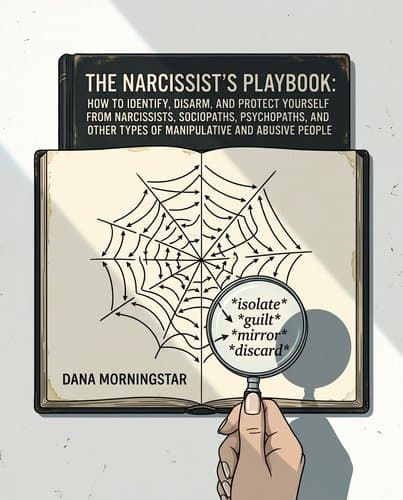
45419100_the-narcissist-s-playbook
by Dana Morningstar
Manipulators don't find you by accident—they exploit vulnerabilities your childhood wired in. Learn to decode their exact tactics, set boundaries they can't…
In Brief
The Narcissist's Playbook: How to Identify, Disarm, and Protect Yourself from Narcissists, Sociopaths, Psychopaths, and Other Types of Manipulative and Abusive People (2019) maps the tactics that manipulative and abusive people use to gain and hold psychological power over others.
Key Ideas
No requires no explanation or justification
Never explain your reasons when saying no to a manipulator — they will use your justifications to dismantle your excuses one by one. A firm 'No, that's not going to work for me' requires no defense.
Only enforce consequences you actually mean
Only set a consequence you will actually enforce. An empty threat teaches the manipulator that your limits don't exist and licenses escalation.
Three person types need three responses
Identify which of three categories your difficult person falls into: actively working on their behavior, unaware they have a problem, or enjoying being exactly who they are. Each category requires a completely different response — patience, education, or strategic exit.
Childhood passivity patterns enable adult manipulation
Your childhood coping mechanisms are still running in adult relationships. If you fought a controlling parent and found resistance fruitless, you likely stopped resisting — and that learned passivity is legible to people who exploit it.
Prepare physiological interrupts for vulnerabilities
When a manipulator attacks your known vulnerability during a conflict, they're not expressing a truth about you — they're exploiting a pressure point. Identify your Achilles' heel in advance and prepare a physiological or cognitive interrupt before the next confrontation.
Accept situations, still take necessary action
Acceptance doesn't mean passivity: you still report the stolen car to police. It means stopping the what-if loop that drains you without changing anything about the situation.
Stick to specifics, avoid 'always' accusations
The phrases 'you always' and 'you never' signal that a conflict has left the realm of the resolvable. In your own difficult conversations, stay anchored to specific incidents and 'I' statements rather than character indictments.
Who Should Read This
People working on personal growth in Behavioral Psychology and Social Psychology, especially those tired of generic motivational advice.
The Narcissist's Playbook: How to Identify, Disarm, and Protect Yourself from Narcissists, Sociopaths, Psychopaths, and Other Types of Manipulative and Abusive People
By Dana Morningstar
9 min read
Why does it matter? Because the people who hurt you were counting on you not knowing their playbook.
There's a version of unlucky that starts to feel suspicious. You leave one difficult relationship, rebuild, and somehow find yourself in another one — same dynamic, different face. You start to wonder if there's something about you that attracts this. There is, but not in the way you think. The reason isn't a character flaw. But you'll have to go further back than the relationship to find it. Toxic people don't find you by accident. They read those patterns the way a con artist reads a mark, and they move fast. This book is the map you should have had long before you needed it — not to fix them, but to rebuild yourself at the exact point they were always counting on finding.
The Word 'Narcissist' Is So Overused It Now Protects the Actual Narcissists
A friend of mine was in the middle of a brutal divorce (missing his kids, bending over backwards to be fair to his ex) when she called him a narcissist. The label landed like a verdict. Looking at him, I saw only a man worn down by loss, trying to do right by the people he loved. A narcissist? The opposite.
That moment cracked something open. "Narcissist" had become what "classic" became when slang got hold of it. When every album teenagers love gets called a classic, the word stops telling you anything about the Beatles. When every selfish or difficult person gets called a narcissist (in arguments, on social media, in therapy-speak borrowed without the therapy), the word stops telling you anything about actual Narcissistic Personality Disorder. The clinical term, which describes people who genuinely cannot register your pain as real, who expect the world to orbit them, and who carry a surprisingly fragile ego beneath all the performance, gets buried under a mountain of casual accusations.
The cost of that burial is real. When everyone's ex is a narcissist, you can't be taken seriously when yours genuinely is one. Your friends have heard the word too many times. Your own instincts, which have probably been screaming that something is deeply wrong, get second-guessed because the vocabulary has been worn smooth. And because the clinical picture of NPD spans eleven distinct types, many victims spend years doubting themselves because their abuser doesn't match the loud, obvious stereotype. The covert narcissist, for instance, doesn't demand the spotlight — he sulks, plays the wounded party, and makes you feel guilty for having needs. He's the last person anyone pictures when they hear the word.
That's exactly where the self-blame creeps in. If the word doesn't fit, maybe the problem is you. The language was supposed to help you name what was happening. Instead, it handed your abuser cover.
Manipulation Is Invisible Because It Arrives Dressed as Love
Susan's first clue that something was wrong should have been a good thing. She'd told her boyfriend Shaun she was going out with friends, and instead of arguing, he'd looked a little hurt and said he'd planned a romantic evening for the two of them. She canceled her plans, touched that he'd gone to the trouble.
That became the pattern. Every time she wanted to see friends, he had already arranged something. Every time she needed to stay late at work, he had a quiet dinner waiting. The friction was always gentle, always loving, always just enough to make canceling feel like the kinder choice. There was no single moment she could point to and say: that was when it started. Six months in, her friends had stopped calling. Her family hadn't seen her in half a year. When they finally did, she'd lost weight and moved through the world like someone who'd learned to take up less space.
That's the thing about manipulation that actually works: it doesn't announce itself. The version we imagine — explicit threats, obvious cruelty, a raised fist — is the version we know to run from. What Shaun deployed was harder to name precisely because it felt like love. He never demanded she stay home. He simply made leaving feel like choosing him less.
Manipulation is the load-bearing structure of toxic behavior, not the loudest part. It operates through psychology rather than force: controlling what someone believes about themselves, about the relationship, about what's normal. And the closer it resembles genuine affection, the deeper it embeds before the victim can see it clearly.
From the outside, Shaun's behavior is obvious. From the inside, it never is. That's not a failure of intelligence. Manipulators who use warmth as their method have been practicing for years. The person before Susan was the rehearsal — they arrived already knowing which moments to press, how much hurt in the eyes was too much, when to back off. By the time you're in it, you're not dealing with someone learning on the fly. You're dealing with an expert. Blaming yourself afterward — I should have seen it sooner — misses the point entirely. You were supposed to think it was love. That was the design.
Not Every Difficult Person Is a Predator — and Treating Them the Same Way Fails Both
The most important thing to know about the difficult people in your life isn't what they've done — it's which of three categories they fall into.
The first group knows something is wrong with how they operate and is doing real work to change it. They seek help, try to communicate differently, stay honest about the damage they cause. They still hurt you. But there's a ceiling on it, because someone capable of hearing feedback exists on the other side.
The second group hasn't recognized the problem yet. Harder, but not closed. With the right approach and enough patience, recognition is at least possible.
Then there's the third group: people who know exactly who they are and have decided it works for them. No interest in change, because they see no reason for it. Treating all three categories the same isn't just ineffective. It's dangerous. A friend once described confronting her partner about his controlling behavior, then watching him use everything she'd said as ammunition in the next argument. Not as an invitation to do better. As a map of her vulnerabilities. The honest conversation that might reach someone in the first group becomes raw material in the hands of someone in the third.
It sounds harsh to accept this about someone you care about. But what clarity about categories actually gives you isn't a plan for fixing the relationship — it's an honest answer about whether the relationship is fixable at all. Most people delay that question far too long, telling themselves the person must be in category one or two, even as everything in front of them points to three. Naming the category correctly is, it turns out, the first act of protecting yourself.
The Vulnerability Wasn't a Character Flaw — It Was Installed Before You Could Choose
Why do intelligent, self-aware people stay in relationships that are obviously hurting them? The common answer is low self-esteem, or poor judgment, or — if the relationship goes on long enough — some character defect that makes a person drawn to chaos. None of those answers are exactly wrong. They're just not early enough in the story.
The real answer starts in childhood. If you grew up with a parent who demanded total compliance, you probably pushed back at some point. You were a child — pushing back is normal. But if that resistance never worked, if every fight cost more than it returned, you eventually stopped trying. That wasn't surrender. That was adaptation. A child who can't change the rules learns to work around them, goes quiet, absorbs rather than resists. It was the smartest move available at the time.
The problem is the move didn't retire when you left home. It came with you. When a controlling partner or an impossible boss shows up in your adult life, the old pattern activates — not because you've decided to be passive, but because somewhere along the way, your body learned that fighting back costs more than it returns. From the outside, that looks like weakness, or willingness. The resistance that once cost too much just quietly stops forming.
The author spent years unable to earn any positive response from her parents: no pride, no warmth, no acknowledgment, regardless of what she did. Her internal explanation was that she must be the problem. When she finally recognized what was actually happening — that she'd been running a childhood script, bending herself toward people who simply couldn't give her what she needed — the shift wasn't confined to that one relationship. The same pattern had been quietly operating through every difficult relationship in her life. Seeing it clearly was what broke the whole loop.
That's the most self-compassionate thing in here, and also the most demanding. You didn't tolerate toxic behavior because you were naive or weak. You tolerated it because a system built before you could think critically about it told you that was how relationships work. Once you can see it, you can rewrite it — and cataloguing everything wrong with other people won't get you there. That part is only yours to do.
The Countermeasures Are Scripted — Because Emotion Is What They're Counting On
Samantha's parents want a two-week summer holiday. They have a card they know how to play: we never get to see the grandchildren, they say. Who knows how much longer we'll be around. It isn't a request so much as a guilt mechanism dressed in love language, and Samantha knows it. What she doesn't know yet is why every honest conversation she's tried to have about it has made things worse.
The instinct is to explain. To tell them how these comments make her feel, to ask them to understand the pressure she's already under, to appeal to their sense of fairness. That instinct is wrong. Not because her feelings aren't valid, but because a manipulator treats emotional disclosure as research. The moment you explain why two weeks won't work, you've handed them a schedule to work around. The moment you say you feel guilty when they phrase it that way, you've told them the phrase works.
Before an answer, there's a question worth asking: "Are you asking me or telling me?" Not an accusation — a mirror. Someone who genuinely wants to spend time with you will answer it thoughtfully. Someone issuing a demand disguised as an invitation will feel the exposure.
When the answer comes, one scripted response does the job without opening any doors: "Thanks for the offer — it sounds lovely, but we can't commit. Maybe we could do a week instead." The word "no" never appears. There's no apology for having a life, no explanation of competing demands. Samantha hasn't said she's too busy or too stressed; she's said she can't commit, and offered something smaller. There's nothing to argue with. Nothing to schedule around. No feeling to weaponize.
This cuts against most advice about communicating your needs. With someone who genuinely cares about you, explaining your reasons leads to understanding. With a manipulator, your reasons are a map of vulnerabilities. Every constraint you name is one they can help you remove. The explanation you thought would create empathy becomes the to-do list for dismantling your no.
The same logic applies to consequences. If a partner raises their voice and you've said you'll leave if that happens, leave. Not because it will change them. Because if you don't, the limit was never real, and they know it now. Only set a consequence you'll actually follow through on. An unenforced consequence doesn't just fail to protect you; it teaches the manipulator that your limits are suggestions.
The thread through all of it is the same: remove emotion from the exchange. Not because your feelings don't matter, but because showing them to a manipulator is handing over the controls. Scripted responses work not because they're warm but because they're not. The manipulator expects to find feeling they can steer. When they don't, there's nothing to grab.
Emotional Abuse Isn't 'Feeling Bad' — It's Documented Physiological Damage
Emotional abuse leaves physical marks — they're just harder to photograph than bruises.
A nervous system that has spent months or years on high alert in a toxic environment doesn't simply stand down when the relationship ends. The body has learned that danger is the baseline. That wiring doesn't switch off. Stress signals keep firing even when there's nothing to respond to, and that becomes chronic physical pain. Sometimes it surfaces at old injury sites that healed years ago. Sometimes it's entirely random. Either way, you're hurting from a wound no one can point to, and because there's no visible cause, it's easy to dismiss. By others, and by yourself.
The data makes that dismissal impossible to sustain. Between 60 and 90 percent of people with PTSD also experience insomnia: not occasional bad sleep, but clinically disrupted sleep three or more nights a week for months at a stretch. And roughly 27 percent of PTSD sufferers have attempted suicide at some point. These aren't self-reported feelings. They're outcomes. The same dynamic that had you questioning your own perceptions also made you doubt whether what happened was serious enough to warrant help. It was. Those two numbers are why.
Here's what matters most after all the tactics: the self-doubt you feel about whether you were really that affected — that doubt isn't yours. It was installed. Abusers benefit from you minimizing what was done to you, because minimizing delays recovery and keeps you in reach. The voice telling you that you're overreacting is the same voice that had something to gain from you believing that.
Taking the damage seriously isn't wallowing. It's the only accurate starting point.
The Exit Isn't Defeating Them — It's Building a Life They Can't Enter
The toxic person didn't choose you because you were broken. They chose you because something in your history made you patient with behavior that deserved a door slammed in its face. If it hadn't been you, it would have been someone else — someone with their own learned compliance, their own old reasons for staying quiet. That's not absolution for them. It's just the truth about how this works.
What you're actually building, when you apply any of this, isn't a better argument or a fairer relationship. It's a self that no longer fits the profile. The childhood pattern gets interrupted. The reflexive apology stops forming. The tolerance that once felt like kindness gets correctly renamed. And one day there's a door. You're the only one who decides who comes through it. That's the whole game. That's what winning looks like.
Notable Quotes
“Are you sure you're feeling alright?”
“You are just being crazy,”
“He is in a mood again.”
Frequently Asked Questions
- What does The Narcissist's Playbook teach?
- The Narcissist's Playbook maps the tactics that manipulative and abusive people use to gain and hold psychological power over others. The book teaches readers to recognize how their own histories created vulnerabilities to exploitation and provides concrete tools—from enforcing boundaries to managing conflict language—to rebuild themselves into harder targets for manipulation. By identifying patterns of manipulation and understanding personal weaknesses, readers gain the knowledge and strategies needed to protect themselves from sociopaths, psychopaths, narcissists, and other exploitative people who seek to control them.
- What are the three types of difficult people in The Narcissist's Playbook?
- Difficult people fall into three distinct groups based on their capacity and willingness for change: those actively improving themselves, those unaware of their impact, and those satisfied with their harmful behavior. The book emphasizes that these groups require fundamentally different approaches. People improving themselves respond to patience and support; those lacking awareness might benefit from education; those enjoying their behavior typically require strategic distance. Determining which group a person falls into is essential to decide whether investing in the relationship or disengaging makes sense.
- How should you say no to a manipulator according to The Narcissist's Playbook?
- "Never explain your reasons when saying no to a manipulator — they will use your justifications to dismantle your excuses one by one. A firm 'No, that's not going to work for me' requires no defense." This principle prevents manipulators from picking apart your logic and finding creative workarounds. By withholding explanations, you eliminate ammunition they could use to negotiate, pressure, or shame you into compliance. The boundary stands on its own strength without needing justification or defense, making it far more effective against manipulation.
- How do childhood experiences affect vulnerability to manipulation?
- "Your childhood coping mechanisms are still running in adult relationships. If you fought a controlling parent and found resistance fruitless, you likely stopped resisting—and that learned passivity is legible to people who exploit it." Understanding these patterns is the first step toward meaningful change. By recognizing how past survival strategies shape present behavior, you can interrupt automatic responses that make you vulnerable to manipulation. This awareness allows you to develop new coping mechanisms that don't render you susceptible to being exploited by manipulative people.
Related Book Summaries


Read the full summary of 45419100_the-narcissist-s-playbook on InShort