228472105_breadwinners
by Melissa Hogenboom
The domestic and professional scripts governing who earns, cleans, and decides aren't natural—they're inherited power structures with measurable neuroscience…
In Brief
The domestic and professional scripts governing who earns, cleans, and decides aren't natural—they're inherited power structures with measurable neuroscience behind them. Hogenboom reveals how invisible hierarchies quietly shape every relationship, and gives you the frameworks to renegotiate them before they quietly reshape you.
Key Ideas
Money reveals invisible household decision power
Track who holds decision-making power in your home by following the money — whoever earns more typically gets more domestic veto power, often invisibly. Name it before you can renegotiate it.
Renegotiate roles instead of overcompensating housework
When a woman out-earns her partner, watch for 'gender deviance neutralization' — the documented tendency to compensate by doing more housework. The equalizer isn't earning less; it's explicit renegotiation of domestic roles.
Hand over complete tasks, not just help
Practice the 'end-to-end task handover': don't ask your partner to 'help' with a task — hand over the entire cognitive chain, from research to execution, so you stop being the invisible project manager.
Silence often masks invisible power struggles
Use Aafke Komter's three-power framework as a diagnostic: most couples have almost no Manifest conflict but are saturated with Invisible power. If you 'always agree,' ask who's been quiet to keep the peace.
Use-it-or-lose-it parental leave drives systemic change
State policy is not background noise — it is the primary engine of behavioral change. Advocate for parental leave structures that include a use-it-or-lose-it quota for fathers, because individual pioneering without structural permission rarely scales.
Powerlessness mimics personality flaws, not character
Before assuming a colleague or partner is 'just like that,' ask whether their behavior maps onto the documented effects of powerlessness: impaired executive function, fixation on details, difficulty seeing the big picture. Power is a cognitive state, not a personality.
Decouple self-esteem from breadwinner identity scripts
Uncouple your self-esteem from your earnings — specifically if you're a man in a relationship where your partner out-earns you. The 42,000-person study showing unemployed men were happier when their partner was also unemployed is a data point about inherited identity scripts, not an inevitable truth about your life.
Who Should Read This
Readers interested in Social Issues and Relationships, looking for practical insights they can apply to their own lives.
Breadwinners: and other power imbalances that influence your life
By Melissa Hogenboom
12 min read
Why does it matter? Because the power imbalances shaping your home life aren't personal choices — they're inherited scripts written before you were born.
You probably think you know how the chores got divided. Someone was better at cooking, someone cared more about a clean bathroom, someone's job was just less flexible — and over time, a system emerged that felt, if not perfect, then at least yours. Melissa Hogenboom's argument is that this feeling of organic inevitability is precisely the illusion worth examining. What looks like personality fit or mutual compromise is often the downstream effect of power structures so old they predate money — structures that encode themselves in who earns more, who asks for flexibility, who quietly absorbs the mental overhead of a family running smoothly. That argument would be easy to dismiss if the evidence didn't keep pulling the rug out. And the uncomfortable promise of this book is that once you can actually see these dynamics — in your paycheck, your kitchen, your relationship — you lose the luxury of calling them natural.
The Person Who Earns More Gets to Do Less — and We've Agreed Not to Talk About It
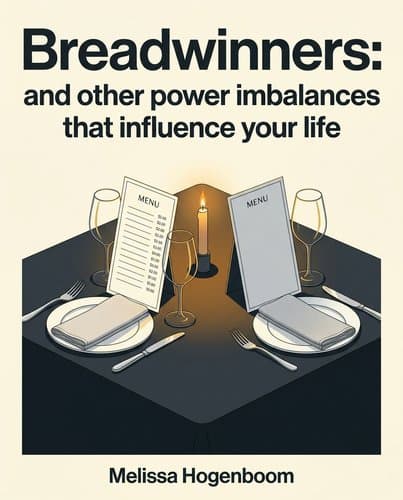
Imagine sitting down to dinner at an expensive Florentine restaurant, the kind that doesn't bother printing prices. Melissa Hogenboom discovered why when the bill arrived: her menu had no numbers on it, while her boyfriend's did. The restaurant had simply decided she didn't need to know what things cost. It's a small absurdity — but also a near-perfect diagram of how financial power works in relationships. Someone is assumed to be in charge of the money, and that assumption shapes everything around it, often without a single word being spoken.
The diagram runs deeper than restaurant menus. When US researchers examined census data, they found that couples where wives out-earned their husbands were systematically lying about it to the government — the wives under-reporting their incomes, the husbands inflating theirs, together manufacturing a fiction of male breadwinning on official federal records. The researchers called this 'manning up and womaning down.' The social pressure alone was enough to make people falsify federal records.
What makes this uncomfortable isn't the dishonesty — it's what the dishonesty reveals about the machinery underneath. Sociologist Yang Hu, studying over six thousand UK couples, found that high-earning men routinely use their income as a bargaining chip: they exchange a higher paycheck for a lighter domestic load, handing money to a partner who then handles the mental and physical work of spending it. The money flows one way; the housework flows the other. Researchers call it exchange-bargaining — the idea that financial leverage can be traded for domestic relief. The catch is that it only works in one direction.
When women become the higher earner, the bargaining power doesn't follow. Instead of doing less at home, breadwinning women typically do more — unconsciously compensating for violating the expectation that men should earn more. The financial map and the domestic map refuse to realign. What looks like a personality quirk (she's tidier, he's oblivious) is often just a precise readout of who brings home more money.
A Woman Can Out-Earn Her Husband and Still End Up Doing More at Home
The assumption is intuitive enough: if she becomes the breadwinner, the domestic load will eventually redistribute itself to match. Financial power is real power, and real power rebalances things. The research says otherwise, in a way that is genuinely difficult to explain away.
Helen Kowalewska, a sociologist at Lancaster University, analyzed roughly 42,000 responses across nine European countries and found something that takes a moment to absorb. When men were unemployed and their female partners were working, those men rated their life satisfaction at 5.86 out of 10. When both partners were out of work — no income coming in from either direction — men rated their satisfaction higher. Let that sit. A man with a working wife, bills being paid, was less happy than a man whose family had no earner at all. The only variable that improved his wellbeing was the removal of her income. Not the presence of his own — the absence of hers.
That's what happens when an identity built around providing collides with a reality that contradicts it. Her success doesn't just fail to help him; it registers as his failure.
The consequences spread into the domestic division of labor through what researchers call 'gender deviance neutralization.' When women out-earn their partners, many begin doing more housework, not less — trading extra domestic labor to protect a partner's self-esteem and reclaim a sense of femininity the situation seems to threaten. The focus here isn't on what he's calculating; it's on what she's absorbing. She hasn't been asked to do more. The pressure is social and psychological, operating below the level of any explicit negotiation. And the timing matters: this pattern barely appears in couples without children. It emerges after motherhood, when gender roles tighten and the pressure to perform them intensifies.
The result is a peculiar double bind. She gains the income but not the leverage that income is supposed to provide. Financial positional power exists. It is simply absorbed, neutralized, and handed back in the form of greater domestic responsibility.
Power Isn't Just a Social Status — It Rewires How You Treat People
Think of power as a dial, not a label. When we say someone 'has power,' we tend to picture a title, a salary, a corner office. But what the research shows is that feeling powerful — even briefly, even arbitrarily — changes how the brain processes other people. Not metaphorically. Measurably.
The clearest demonstration sits in a simple lab setup. Three people, one randomly assigned the role of 'leader,' work through a task together. Then a plate of five cookies arrives — enough for one each, with two left over. Social convention does the rest: almost no one takes the last cookie, because doing so announces that you don't care what others think of you. Almost no one, that is, except the designated leader. That person routinely reached for a second cookie. Ate it open-mouthed. Crumbs everywhere. Zero apparent awareness that this might look bad. The role had existed for minutes. They had done nothing to earn it. Yet something had already shifted — specifically, their capacity to register anyone else's perspective.
Psychologist Dacher Keltner calls this the power paradox, and it runs deeper than bad table manners. Power requires empathy to acquire — Keltner's long-running study of university dormitories found that the students who rose to influence were the ones who scored highest on enthusiasm, kindness, and openness. But once they arrived there, those same faculties began to erode. Some people in positions of power develop a cognitive profile that resembles frontal lobe damage: ruder, more overconfident, less troubled by the ethical weight of their own actions.
It shows up in behavior well outside the lab. Studies of drivers in traffic found that people behind the wheel of expensive cars were significantly more likely to cut off pedestrians and ignore right-of-way rules than drivers of cheaper vehicles — same road, same rules, different sense of status. No one appointed them leader. The car did it.
The Letter E test captures something similar. Ask someone to draw the letter on their own forehead: a person primed to feel powerful will draw it facing themselves — legible to their own eyes, backwards to everyone watching. It takes five seconds and tells you everything.
The mechanism is straightforward. Power reduces your practical need to model other minds. If you set the deadlines and control the resources, you can afford to stop asking how things look from someone else's position. Over time, that capacity quietly atrophies.
Why does this matter for the domestic and workplace dynamics we've already been examining? Because these aren't personality flaws in the people holding power — they're what power does to almost anyone who holds it. The higher earner who stops noticing the domestic load, the manager who can't understand why a junior employee seems paralyzed by a simple request: these aren't mysteries of individual character. They are, in some measurable sense, the cognitive cost of being in charge.
The Invisible Power Running Your Relationship Is the Kind You Never Argue About
How do you know whether your relationship is actually equal, or just quiet? The difference matters more than it sounds. Aafke Komter, studying married couples in the 1980s, identified three forms of power inside a marriage. Manifest power is the visible kind — open disagreements where one person's preferences win. Latent power is subtler: one partner avoids raising something entirely, knowing it won't go their way, and swallows the resentment rather than risk the argument. Then there's invisible power, the hardest to see and the most pervasive — inequalities so thoroughly normalized that both partners have stopped registering them as inequalities at all. They're just how things work.
When sociologists Jaclyn Wong and Allison Daminger analyzed dozens of interviews with contemporary heterosexual couples, they found almost no manifest conflict and very little latent resentment. What they found instead was this third kind operating nearly everywhere, in couples who genuinely believed they'd escaped it. The telling detail: when asked about major household decisions, almost every participant reached for the word 'us.' We decided together. We talked it through. We agreed. Upon closer examination, one partner — almost always the woman — had done the anticipating, the researching, the shortlisting, the coordinating. The other had weighed in at the end. Wong and Daminger called this the myth of mutuality: 'us' was doing heavy lifting, papering over an unequal division of cognitive labor that neither party had chosen to notice.
One couple, Rebecca and Joseph, shows how complete the asymmetry can be without producing a single argument. When Joseph needed to find work in a new location, both partners treated his search as their shared project — researching markets, managing logistics, coordinating the move. Rebecca's career remained her private problem, something she navigated alone.
The absence of conflict, it turns out, is often the signature of invisible power, not its defeat. When the less powerful partner has already internalized that their needs won't be prioritized, there's nothing to argue about. The resentment doesn't disappear — it just has nowhere to go.
Same-Sex Couples Didn't Get a Gendered Script — and Their Homes Look Different Because of It
The domestic imbalance isn't a product of temperament, biology, or who gets home first. It's a product of a script — and couples who don't receive that script end up with measurably different homes.
The evidence is consistent enough to be uncomfortable. Research across multiple countries finds that same-sex couples divide housework and childcare far more equally than different-sex couples. Not because they've figured something out that heterosexual couples haven't. Because they have no default to fall back on. When two women or two men form a household, neither arrives with a socially assigned role. Everything gets negotiated — who cooks, who handles the school runs, who tracks the pediatric appointments. That negotiation, forced by the absence of a script, produces outcomes that heterosexual couples spend years trying to engineer deliberately.
The structural logic shows up most clearly in one specific decision that Swedish lesbian couples face: who carries the child first. These couples spent considerable time discussing the question in advance, because they understood exactly what was at stake. Whichever partner gave birth would likely become the primary caregiver — and the other would, in the researchers' words, 'just keep going' at work. To prevent that imbalance from hardening, many couples planned for both partners to carry a child at different points, ensuring that neither could treat caregiving as someone else's default responsibility. Heterosexual couples rarely have this conversation before a baby arrives. By the time the imbalance becomes visible, it's already load-bearing.
The pattern extends to finances. Economist Maaike van der Vleuten, studying couples across four Nordic countries, found that same-sex partnerships show significantly smaller earnings gaps than different-sex ones — and mothers in same-sex relationships experience a much smaller career penalty after having children. The motherhood penalty isn't an automatic cost of having children. It's a cost of the unequal arrangement that tends to follow. Remove the gendered script, and much of the penalty disappears with it.
For heterosexual couples, the implication is clarifying rather than comforting: this isn't who you are. It's what you inherited.
Sweden Found a Simple Way to Improve Mothers' Mental Health. It Involves Fathers.
What happens when policy actually tries to intervene? Sweden is the clearest test case. In the late 1990s, Swedish fathers took almost no parental leave. Today most of them do — and the shift didn't happen because a generation of Swedish men suddenly decided to be better partners. It happened because the government set aside three months of the 480-day leave entitlement solely for fathers, on a use-it-or-lose-it basis. You take it or the family loses it. That single structural nudge turned paternity leave from an optional gesture into a social expectation, and what had once seemed radical became, within a decade, the obvious thing to do.
The consequences rippled outward in measurably concrete ways. For every month a Swedish father took leave, his partner's earnings rose by roughly seven percent. When fathers had flexible access to that time, their partners were eighteen percent less likely to need medication for anxiety. A New York Times headline captured the arithmetic with dry clarity: Sweden found a simple way to improve new mothers' health. It involves fathers. The domestic redistribution turned out to be a public health intervention.
Japan is the other side of the equation. The parental leave policy is, on paper, generous. In practice, almost no fathers use it. A rigidly vertical corporate culture — where total devotion to your employer is the baseline expectation — makes the policy functionally inert. The gender pay gap sits at 21.3 percent. Policy without cultural permission changes nothing.
What Sweden proves, and Japan confirms, is that the domestic imbalance isn't a communication failure between two people who haven't found the right words yet. It's a policy architecture problem. Where the architecture gives fathers structural permission to care — and attaches a real cost to not using it — behavior shifts at scale, earnings follow, and the mental load redistributes. Individual couples can negotiate heroically and still lose to the default. Change the default, and most couples don't need to be heroes.
We Promote the Wrong People and Then Wonder Why Leadership Feels Broken
Think of the military analyst who keeps studying which parts of returning bombers took the most enemy fire, hoping to learn where to add armor. The planes that come back riddled with holes are not proof of weakness — they're proof of survival. The fatal vulnerabilities belong to planes that never returned at all. Abraham Wald, a statistician working for the US military in the Second World War, spotted this error and named it: survivorship bias. We study the wrong sample and build confident theories from it.
The same error runs through everything we think we know about effective leadership. We observe whoever made it to the top, catalogue their traits, and treat that as a map to competence. But selection has already filtered for something else entirely. Keltner's dormitory research established that the students who rose to social influence were those who scored highest on warmth and openness — not dominance, not volume. What the survivorship framing adds is this: those traits began dissolving the moment the students arrived. The same empathy erosion Keltner documented is built into the architecture of how leadership works. We select for warmth, then install people into conditions that strip it away.
Which means we tend to end up promoting the people most drawn to power — who are, on average, more narcissistic and self-serving than those who aren't — and then watch the empathy that genuine leadership demands get eroded by the position itself. The broken feeling isn't a staffing accident. It's the architecture.
Power Isn't Domination — It's Responsibility, and You Can Redistribute It Starting at Home
Katty Kay had been the primary breadwinner for fifteen years before she and her husband had a real conversation about what that meant. The BBC presenter had spent more than a decade as the higher earner, travelling constantly for high-profile interviews, watching her career pull further ahead — and never once sitting down to say: this changes what we each owe the household. When sick children needed picking up from school, the calls still came to her first. The resentment arrived gradually, almost imperceptibly, until it had mass. Her husband, meanwhile, had grown up watching a father who never packed a lunchbox or organised a playdate, and genuinely believed he was already doing more than his share. Both of them were operating from unstated assumptions. Neither was lying. The silence had simply become its own power structure.
Her advice, given plainly: talk about it the moment the dynamic changes. Not in the middle of an argument, not once the resentment has calcified, but as soon as the map shifts. What she describes — the creeping accumulation of unaddressed expectation — is what happens when power operates through omission. Nobody decided she would still be first to get the school call. It just kept happening, because nothing had been said to interrupt it.
The hardest practical move the research supports is handing tasks over completely, not partially. The difference between a partner 'helping' with something and actually owning it is the difference between having an assistant and being free. If the mental chain — anticipating that something needs doing, researching options, making the decision, following through — stays with one person even after the execution has been delegated, the cognitive load hasn't moved at all. It's just been split at the cheapest possible point. Think of it this way: handing someone a grocery list is not the same as handing over dinner. Full redistribution means the other person carries the entire sequence — what needs buying, what's running low, what the kids will actually eat — without anyone waiting in the background to catch what falls through.
The research runs in a clear direction here. When people in power feel genuinely responsible for others — rather than liberated from them — they behave differently. Physical proximity matters. Face-to-face contact makes it harder to depersonalise someone whose wellbeing depends on you. Shared identity matters too: the shift from 'I' and 'you' to 'we' isn't sentimental noise, it changes whose problems register as yours. And naming your own capacity to act matters: participants who recalled a moment of personal agency were more likely to simply move the fan that was blowing cold air on them. The first step toward redistribution is usually just saying out loud what has been silently assumed — before the silence becomes something harder to shift.
The Script You Didn't Write
The restaurant menu without prices wasn't a quirk — it was a mirror. What you've been reading is an account of the same assumption, dressed in a thousand different forms: who earns, who defers, who stays quiet, who reaches for the extra cookie. None of it was chosen. Most of it was inherited, silently, from people who inherited it the same way. But here is what distinguishes the couples and leaders who actually shift the balance: they stopped mistaking silence for harmony and unspoken arrangements for agreement. They named what was operating invisibly — the earnings gap that became a veto, the script Rebecca couldn't quite abandon even after she out-earned Joseph, the self-worth quietly mortgaged to a paycheck. That naming isn't a therapeutic exercise. It's where negotiation becomes possible. Power, at its most useful, isn't something you accumulate. It's something you redistribute — starting with the conversation that hasn't happened yet.
Notable Quotes
“We agreed the whole time . . . we came to this decision together.”
Frequently Asked Questions
- What does Breadwinners examine?
- Breadwinners: and other power imbalances that influence your life examines the invisible power structures shaping domestic and professional life. Melissa Hogenboom draws on neuroscience, sociology, and large-scale research to show how inherited gender scripts distort relationships, earnings, and decision-making. The book provides readers with concrete frameworks to identify and renegotiate these dynamics at home, at work, and through policy. By analyzing power as a cognitive state rather than an inevitable personality trait, Hogenboom reveals how powerlessness affects behavior, executive function, and the capacity for big-picture thinking.
- What are the key frameworks in Breadwinners for understanding power dynamics?
- Hogenboom presents Aafke Komter's three-power framework as a diagnostic: most couples have almost no Manifest conflict but are saturated with Invisible power. If you 'always agree,' ask who's been quiet to keep the peace. The book emphasizes tracking decision-making power through money—whoever earns more typically gets more domestic veto power, often invisibly. Rather than accepting these patterns, the book advocates for explicit renegotiation through an 'end-to-end task handover.' This means handing over the entire cognitive chain, from research to execution, so you stop being the invisible project manager. The key insight is that naming these invisible power dynamics is the first step toward renegotiating them.
- What does Breadwinners say about gender roles and earnings?
- When a woman out-earns her partner, Hogenboom describes a phenomenon called 'gender deviance neutralization'—the documented tendency to compensate by doing more housework. The solution isn't earning less; it's explicit renegotiation of domestic roles. She also addresses the cognitive and emotional toll of power imbalances, noting that unemployed men were happier when their partners were also unemployed—a finding that reflects inherited identity scripts, not inevitable truth. By uncoupling self-esteem from earnings, particularly for men in relationships where their partner out-earns them, couples can break these patterns. The book emphasizes that structural policy changes—like use-it-or-lose-it parental leave for fathers—are essential because individual pioneering without structural permission rarely scales.
- How does Breadwinners connect power imbalances to personality and behavior?
- Hogenboom argues that before assuming a colleague or partner is 'just like that,' we should ask whether their behavior maps onto the documented effects of powerlessness. She explains that power functions as a cognitive state, not a personality trait—and when someone lacks power, they experience impaired executive function, fixation on details, and difficulty seeing the big picture. Rather than accepting these behaviors as inherent personality flaws, the book reveals they're often symptoms of power imbalances. This reframing is crucial: apparent personality differences may reflect structural inequalities that can be negotiated and changed. Understanding this shifts focus from individual blame to systemic change, both at home and through policy.
Related Book Summaries



Read the full summary of 228472105_breadwinners on InShort