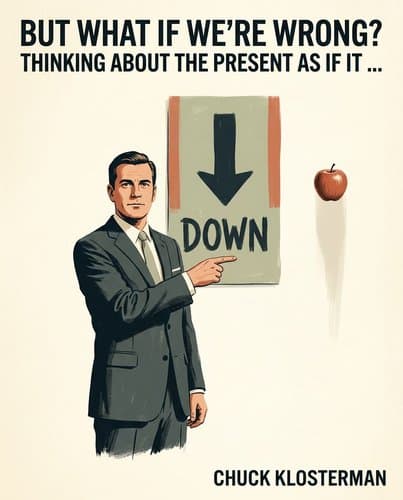
27068734_but-what-if-we-re-wrong-thinking-about-the-present
by Chuck Klosterman
Certainty is the feeling you get right before history proves you catastrophically wrong. Chuck Klosterman dismantles what "everyone knows" about culture…
In Brief
But What If We're Wrong? Thinking About the Present As If It ... (June) examines how the mechanisms that produce collective certainty — consensus, logic, and present-tense evidence — are historically the same mechanisms that guarantee collective error.
Key Ideas
Certainty signals potential collective wrongness
Treat strong certainty as a warning sign, not confirmation — 'obviously true' is often what collective wrongness feels like from the inside. The people who were wrong about gravity for twenty centuries weren't stupid; they were the smartest people alive.
Survival determines what we call greatness
Merit doesn't determine cultural survival; we reverse-engineer 'greatness' from whoever happens to survive. The 1936 Colophon voters weren't bad predictors — they just couldn't see their own moment as temporary. Neither can we.
Notice acceptable gaps to find future values
To predict what future generations will value, don't look at the most visible or praised candidates — look for what it's still acceptable to publicly ignore without anyone noticing the gap. Then accept that naming that group disqualifies it.
Internet erases awareness of past mistakes
The Internet doesn't help us detect collective wrongness; it erases the memory of being wrong by merging past and present into a permanent now. We were always right about wrestling. Renata Adler was always there. The thirty years of error no longer exist.
Question unassailable foundational beliefs most rigorously
Your most foundational beliefs — about freedom, democracy, quality, progress — deserve the most scrutiny precisely because they feel unassailable. The mechanism of failure is usually the thing everyone agreed was too important to question.
Who Should Read This
Thoughtful readers interested in Cultural Studies and Social Psychology willing to slow down and wrestle with ideas.
But What If We're Wrong? Thinking About the Present As If It ...
By Chuck Klosterman
11 min read
Why does it matter? Because the things you're most certain about are the likeliest candidates for what you're most wrong about.
The people who thought rocks fall because rocks belong on the ground weren't stupid. They were Aristotle's intellectual descendants, the sharpest minds of their era, reasoning carefully from the best available evidence. They were wrong for twenty consecutive centuries. The problem wasn't ignorance. It was certainty. Chuck Klosterman's uncomfortable central argument is that the very mechanisms that make a belief feel solid (consensus, logic, present-tense evidence) are the ones that have always guaranteed collective embarrassment. This isn't a book about information you're missing. It's about the confidence that makes missing information invisible. You'll finish it unable to assert anything about culture, science, or politics without a small, persistent awareness that you might be the 14th-century equivalent of someone who thought gravity was rocks having a destination — and that awareness will feel, unexpectedly, like relief.
Mankind Was Wrong About Gravity for Twenty Centuries — And That Should Terrify You
Brian Greene is sitting in his Columbia University office when he tells a music critic that gravity is probably wrong.
Not wrong the way a bad guess is wrong — wrong the way Aristotle was wrong, which is to say, totally, confidently, and for roughly two thousand years. Greene is a string theorist famous enough to guest-star on The Big Bang Theory and give a TED talk on parallel universes that 2.5 million people have watched. He is, by most measures, one of the people most qualified alive to explain how the universe works. And sitting across from Chuck Klosterman (a writer whose physics credentials amount to "I took physics in high school and did not fail"), Greene says something that lands like a dropped stone: gravity, he says, is "the least stable of our ideas, and the most ripe for a major shift."
Here's what that means in practice. For roughly twenty centuries, the best explanation for why objects don't float was Aristotle's: things fall because they have a natural place, and that place is Earth. Rocks want to be on the ground. The idea was elegant, it matched observable evidence, and it was defended by history's most formidable philosophical mind. It was also completely wrong. Newton's correction, an invisible force field anchoring the moon in orbit, held for about two hundred years before Einstein showed that gravity wasn't a force at all but a warping of space and time. Then quantum mechanics complicated that picture. Then string theory arrived, requiring extra dimensions just to make the math work. And now a faction of physicists suspects gravity isn't even a fundamental feature of reality; it's "emergent," something that arises from deeper, unnamed mechanisms the way temperature arises from molecular motion.
Notice the trajectory. The understanding doesn't just improve; it transforms so completely that each previous version becomes unrecognizable. Newton didn't refine Aristotle; he made Aristotle's entire framework irrelevant. Einstein didn't improve Newton; he changed what the thing being described even was. Each version felt, to the people holding it, like the final answer. Each was wrong.
The obvious defense is that we have the scientific method now: particle accelerators, peer review, mathematics that predicted Neptune's location before anyone pointed a telescope at it.
Then Klosterman asks Greene a question: what's his confidence level that someone examining his TED talk in three hundred years will conclude he was almost entirely correct? Greene doesn't hesitate. "Tiny. Less than one percent." His reasoning isn't false modesty — it's pattern recognition. Every generation believes it's closing in on the final answer. Every subsequent generation explains why it wasn't. Here is a world-recognized expert surrounded by the best mathematical tools his civilization has ever produced, placing less confidence in his life's work than you'd place on a coin flip.
That's not a crisis of information. That's a structural problem. It's been there the whole time.
We Don't Know Who Survived Because They Were Great — We Call Them Great Because They Survived
Ask anyone to name the greatest architect of the twentieth century. Ask an actual architect, an architectural historian, even a friend of Frank Gehry. They'll mostly say Frank Lloyd Wright. Klosterman said Wright too. Then he noticed something.
The consensus is nearly unanimous, with a catch: the only people positioned to contest it are those with enough expertise to have other candidates in mind, and even most of them agree. The verdict looks like proof that merit works. True greatness rises so far above the competition that experts and laypeople arrive at the same answer. Klosterman doesn't buy it, and his reason is personal.
He believes architecture should be "organic" — buildings should exist in harmony with their surroundings rather than against them. Then he notices where that belief came from. Wright pioneered organic architecture, Wright was pre-labeled brilliant, and the philosophy attached to the label. Klosterman is certain of it, says so twice: if Wright had built his reputation on the opposite idea, that buildings should assert human dominion over nature, he would look at those same rooflines and see that philosophy alive in every cantilever. The buildings don't change. The story we bring to them does.
The conclusion is almost brutal: history is defined by people who don't really understand what they're defining. Because most people can't name three other candidates for the title, the Wright consensus faces no real challenge, solidifies into fact, and becomes the premise from which all further judgments about what architecture should be get made.
Klosterman isn't describing bias or laziness. It's the normal function of how meaning gets made and preserved. Quality has to be good enough to enter the conversation. After that, the conversation takes over. Lasting reputation doesn't come from the people who understood the work. It comes from the ones who inherited the verdict without examining it — and mean it completely when they pass it on.
The Next Kafka Can't Be Anyone You Can Name
If the real problem is that we keep canonizing the same narrow slice of humanity, couldn't we fix it by deliberately looking elsewhere? Expand the aperture, seek the systematically overlooked, consciously counteract our own bias. It sounds like the obvious correction — and it collapses the moment you actually try it.
Franz Kafka is Klosterman's model for what literary greatness incubated in obscurity actually looks like. Not a cave hermit: Kafka published in small German-language literary journals, gave readings his contemporaries remembered as genuinely funny, had a close friend named Max Brod who believed in him. But he also burned roughly ninety percent of what he ever wrote, died of tuberculosis at forty in a Viennese sanatorium, and left behind no meaningful public reputation. The ten percent that survived transformed Western fiction so completely that his name became an adjective. The obscurity of his life is now inseparable from his work — we read his characters' bewilderment not as artistic invention but as testimony from a man who had no audience to perform for, because there wasn't one.
So who is the contemporary equivalent? Klosterman's answer: someone writing in a medium invisible to mainstream canonization machinery, probably in the encrypted, search-engine-invisible corners of the internet, where work could circulate among a tiny chosen audience for decades before anyone outside it knows it exists. Future canonization requires that today's literary establishment have no idea who this person is. The kingmakers noticing you is the beginning of disqualification.
That's where Klosterman tries to get more specific and runs into what he calls Klosterman's Razor. He raises Native Americans: a population reduced from roughly one hundred million before European contact to about three million today, confined largely to reservations on marginal land, absent from even the diversity conversations where you'd expect them centered. Who is the most recognizable Native American actor, musician, or politician outside their immediate context? The silence around that question is loud. That's exactly the kind of deep erasure that could produce someone brilliant, working unnoticed, discovered long after they're gone.
Then he disqualifies the example immediately. Being able to name it means it won't be them. Klosterman's Razor: any candidate he can articulate is evidence against his own premise. The contemporary Kafka must represent a group it's still socially acceptable to dismiss — which means a group that can't be named in a text anyone might actually read, because naming starts the process of protection. So he sends the reader to find it themselves. Think about who you could disparage in a room full of people without anyone shifting in their seat. Whatever group came to mind — that's roughly where to look. The more unsettling the answer feels, the closer you probably are.
The escape hatch seals itself the moment you step through it.
The Internet Didn't Fix Collective Wrongness — It Made Us Unable to Remember Being Wrong
When Dusty Rhodes died in 2015, the tributes arrived within hours: television segments, longform retrospectives, the kind of cultural accounting usually reserved for artists who shaped a generation. And shape it he had, the coverage implied. Here was a working-class hero whose persona quietly embedded a critique of Reagan-era economic inequality into the spectacle of professional wrestling. The pieces were warm, confident, entirely comfortable with their own certainty.
What none of them mentioned was that during the 1980s, almost nobody thought professional wrestling mattered at all. Even the teenage boys who watched it rarely took it seriously as a cultural object. There were no thinkpieces. The medium existed beneath the floor of critical consideration. And yet the obituaries arrived pre-loaded with the conclusion: of course this man was important, of course we all understood this, of course acknowledging his significance required no adjustment to our self-image as thoughtful observers of culture. No admission that we'd been wrong about wrestling. Because retroactively, we hadn't been. We were always right about it.
Klosterman identifies this as one of the stranger things the Internet has done to human consciousness. The obvious story about digital information is that it made us better at tracking truth: instant fact-checking, collective memory, a searchable record of every public claim ever made. What it actually did is collapse past and present into a single fixed moment, where every position anyone ever held sits available, ready to confirm whatever conclusion you've already reached. It doesn't help you discover that you were wrong. It helps you forget you ever thought differently.
Search for any currently canonical artist and you'll find pieces from 2002 or 2004 calling them important, written by people who were mostly trend-following at the time. Those articles accumulate into the historical record of a consensus that never quite existed, now surfacing as evidence that serious people were always paying attention. The antecedent gets manufactured retroactively, on demand.
Between believing something and being corrected on it, there was once a gap that preserved a record of wrongness. The Internet didn't eliminate that gap. It filled the space with so much competing material that the gap became invisible. History stops being a timeline and starts behaving like a search engine: put in the right query and you'll find someone who believed what you believe, when you need them to have believed it. The wrestlers were always legends. The forgotten novel was never really gone. We were always right.
America's Founding Principles Aren't Its Protection — They're the Mechanism of Its Failure
Picture yourself as a historian in the year 2400, writing a survey chapter on the rise and fall of the United States the way textbooks now handle the Spanish Armada — casually, in about three paragraphs, the foreboding obvious in retrospect. What would you write?
Probably something like this: A republic built its entire identity on a single document of fewer than five thousand words. The document could be amended, but the process was difficult enough that it happened only seventeen times across two hundred years (one of those changes just reversed an earlier one, which is the kind of detail that belongs in a comedy sketch but is instead constitutional history). The country tripled its population, quintupled its territory, lurched from an agricultural economy to an industrial one to a digital one, yet applied the same document throughout, the underlying logic untouched. The document's prime commitments were liberty and representation. They were also so beloved that questioning their value became professional suicide for anyone seeking elected office. So no one did. The populace, comfortable in the certainty that they had inherited something unassailable, decided to use it forever, regardless of what changed.
From 2400, you would not find that ending surprising.
Klosterman's most unsettling thought experiment doesn't require exotic political theory to land. You just need to accept one thing: the places most resistant to scrutiny are the places most likely to hide structural failure. The Constitution isn't exempt from criticism because it's beyond criticism. It's treated that way because questioning it gets you treated as evidence that something is wrong with you. That's a self-sealing argument. And self-sealing arguments are where civilizations quietly rot.
Here, finally stated directly, is Klosterman's hedgehog thought. (Isaiah Berlin divided thinkers into foxes, who know many things, and hedgehogs, who know one big thing.) America's eventual failure probably won't come from the problems anyone can already see. It will come from the uncompromising faith in whatever feels too pure to question. The things considered unimpeachable are the things most likely to be the problem. What feels like bedrock now is what becomes the fault line.
That's uncomfortable to hold. But once you sit with it, it's the only intellectually honest position available: not nihilism or despair, just the recognition that the ideas most worth scrutinizing are exactly the ones that feel most obviously correct. The values so embedded that questioning them feels like madness. The principles you defend before you've thought about whether they deserve defending.
Klosterman isn't calling for a revolution. He's just sitting on his balcony in Akron, watching the hedgehog wait for an apple to fall, thinking about what it means to know one big thing — and wondering whether he does.
The Only Honest Intellectual Posture Left
Here's the thing Klosterman admits in the end: he can't escape it either. He spent the whole book arguing that confident collective certainty is usually wrong — then noticed he'd become confidently certain of that. The sports analytics chapter crystallizes the trap. The Moneyball analysts who statistically demolished baseball's received wisdom were right, but right in a context where being wrong had never cost them anything. No one's season ended because of their error. Correctness without consequence isn't wisdom; it's a hobby. The point was never to nail the future. It was to apply to your own beliefs the same suspicion you'd happily turn on Aristotle's. Not because all views are equally fragile. Because the history of ideas has earned that humility from you — and you're still the one deciding whether to give it.
Notable Quotes
“I'm 99.9 percent certain that gravity exists”
“Why do I believe this so much?”
“Are we really going to blame the First Amendment?”
Frequently Asked Questions
- What does Klosterman say about treating certainty as a warning sign?
- Your most confident beliefs deserve scrutiny because certainty signals historical error, not truth. The people who were wrong about gravity for twenty centuries weren't stupid; they were the smartest people alive. What feels obviously true from inside a moment is precisely how collective wrongness appears. Treating strong certainty as a warning sign rather than confirmation lets us hold even foundational assumptions with deliberate, productive suspicion. This framework recognizes that consensus and present-tense evidence—the mechanisms that build collective certainty—are historically the same mechanisms that guarantee collective error.
- Why can't we predict which cultural ideas will survive?
- Merit doesn't determine what survives culturally; we reverse-engineer 'greatness' from whoever happens to survive. The 1936 Colophon voters weren't bad predictors—they just couldn't see their own moment as temporary. Neither can we. What we call 'quality' today may be completely discredited tomorrow, not because of flawed judgment but because historical moment shapes what gets preserved. Since we can't see our present as temporary, we can't reliably predict which current ideas, artworks, or thinkers will matter to future generations.
- What does Klosterman say about the Internet and collective error?
- The Internet doesn't help us detect collective wrongness; it erases the memory of being wrong by merging past and present into a permanent now. We were always right about wrestling. Renata Adler was always there. The thirty years of error no longer exist. Digital technology allows us to continuously revise our collective memory so that past errors seem to never have happened, preventing the crucial learning from acknowledging mistakes. This erasure of error means we lose the mechanism that might help us recognize when we're collectively wrong today.
- What framework does Klosterman provide for identifying collective blindness?
- To predict what future generations will value, look for what it's still acceptable to publicly ignore without anyone noticing the gap. Then accept that naming that group disqualifies it. This counterintuitive framework reveals blind spots—the things our culture overlooks without realizing we're overlooking them. By identifying what we collectively dismiss or don't notice, we identify where we're likely wrong. The moment you explicitly name an ignored category, it loses its invisibility and becomes part of the visible debate, eliminating its predictive power.
Related Book Summaries


Read the full summary of 27068734_but-what-if-we-re-wrong-thinking-about-the-present on InShort