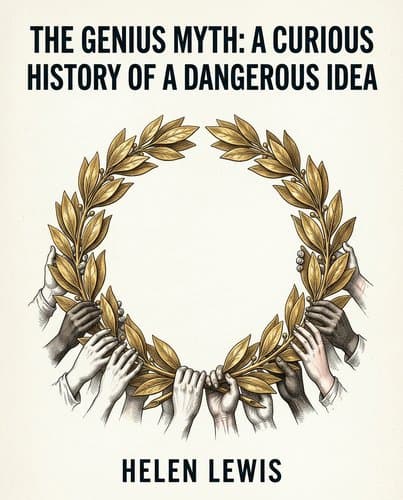
228026850_the-genius-myth
by Helen Lewis
The 'genius' label isn't a neutral observation—it's a social technology engineered to concentrate power, erase collaborators, and grant the anointed unlimited…
In Brief
The 'genius' label isn't a neutral observation—it's a social technology engineered to concentrate power, erase collaborators, and grant the anointed unlimited moral credit. Lewis dismantles how this dangerous myth warps our understanding of creativity, discovery, and who actually deserves the spotlight.
Key Ideas
Question who benefits from genius labels
When you hear someone called a genius, ask: who benefits from that label? There is almost always a commercial, nationalist, or institutional interest behind the anointing — it is never a neutral observation.
Genius belongs to acts, not people
Treat 'genius' as a property of specific acts and works, not of whole people. 'War and Peace is an act of genius; Lev Tolstoy was a demanding aristocrat who went very peculiar indeed.' This framing lets you appreciate the work without granting its creator unlimited moral credit.
Credit goes to best self-promoters
The remembered name in any discovery is usually the most aggressive self-promoter, not the most original thinker — Newton trashed Leibniz, Wallace called his own book Darwinism. When a breakthrough seems like the product of one person, look for the Ogburn-Thomas list of simultaneous inventors and the assistants whose names left the logbook.
Genius requires no suffering as payment
The 'deficit model' — the idea that great ability must be paid for by suffering, disability, or social failure — is a narrative convenience, not a law of nature. Biopics require it; reality does not. Be suspicious when someone's genius story requires a tragic flaw to be legible.
Expertise doesn't transfer between domains
High IQ and domain-specific achievement do not transfer. The same person who revolutionised rocketry destroyed a social platform — not because he got stupider, but because one was a physics problem and the other was a social and psychological problem the genius-identity gave him no tools to recognise.
Invisible collaborators hidden from genius myths
Look for who is missing from every genius story: the spouse copying manuscripts, the assistant who signed the logbook, the widow who hung the paintings. The structural absence of these people from the mythology is the mythology doing its work.
Who Should Read This
History readers interested in Cultural Studies and Social Psychology who want a deeper understanding of how we got here.
The Genius Myth: A Curious History of a Dangerous Idea
By Helen Lewis
12 min read
Why does it matter? Because every time you call someone a genius, you're casting a vote in a political election.
Think about the last time someone called a tech founder a genius. Notice what happened next — how their offensive tweets became "provocations," how their management style became "demanding excellence," how their failed ventures became "bold experiments." The label didn't describe a person. It issued a verdict: this one is above the usual rules. Genius was never really a compliment. It's a licensing scheme — a social technology with ancient roots and modern victims, designed to concentrate credit, excuse cruelty, and quietly bury everyone whose talent never got the political backing to be anointed. By the time you're done here, you'll struggle to hear the word applied to anyone — a tortured artist, a Silicon Valley disruptor, a child prodigy — without asking the prior question: who benefits from this verdict, and who's paying the price?
'Genius' Was Never a Description — It Was Always a Deal
In 1769, the actor David Garrick organised a three-day festival in Stratford-upon-Avon to celebrate William Shakespeare. Visitors bought handkerchiefs, ribbons, and toothpicks carved from a tree that had once stood in Shakespeare's garden. Garrick himself delivered an ode in praise of the playwright, set to the music of 'Rule Britannia.' Not a single Shakespeare play was performed. The man being celebrated had been dead for 153 years and could not object.
Garrick didn't stage the jubilee because he'd made a sober assessment of Shakespeare's literary importance. He staged it because he was an actor-manager who understood that worshipping Shakespeare meant siphoning off some of the glory for himself. A contemporary critic put it plainly: Garrick had made himself the high priest of a new religion, and was already making money from the golden calf. England, meanwhile, got something it badly wanted — a national poet whose greatness could be pointed to as evidence of the country's own greatness. The empire needed a Shakespeare the way a brand needs a logo.
Shakespeare himself got toothpicks. The people doing the anointing got considerably more.
The arrangement hasn't changed shape. Today, Elon Musk performs eccentricity loudly — the strange children's names, the provocations, the 'hardcore' mythology — and gets the title. Tim Berners-Lee, whose invention of the World Wide Web is the foundation on which every Musk venture depends, describes his work in modest, technical language and remains famous mainly among people who already know the field. The difference isn't the scale of the achievement. It's who fits the story we want to tell, and whose elevation is useful to someone with power. The nations that wrap their identity around a single name are the ones doing the most work to keep the label in circulation — and Shakespeare, three and a half centuries on, is still selling toothpicks.
The Machinery Behind Every Famous Genius Is Deliberate, and Often Venal
The canonical geniuses you can name — van Gogh, Shakespeare, Michelangelo — each required a deliberate manufacturing operation to become canonical. The work wasn't enough. Someone had to build the myth, and they usually did it for reasons that had nothing to do with posterity.
Consider what actually stood between Vincent van Gogh and complete oblivion. When his brother Theo died in 1891, leaving behind a young widow named Johanna with a baby son, she inherited roughly 200 paintings and a boarding-house in a small Dutch town. The paintings were worth almost nothing. One critic, shown both the canvases and the brothers' correspondence, initially dismissed the work as nearly vulgar. But Johanna understood something the critic didn't: biography sells art. The story of two brothers — one a dealer who funded a visionary, one a visionary who couldn't survive the world — was exactly the kind of emotional package that fin-de-siècle European taste was hungry for. She curated that narrative carefully: showing letters alongside paintings, planting the image of van Gogh as a raw outsider too sensitive for Paris salons, and making a calculated decision to buy back Starry Night from its owner. Her reasoning was cold-eyed — a painting visibly saturated with mental instability had iconic potential, and she paid well under market rate for something she was already certain the market had mispriced. She was right. The work that followed from her choices — culminating in a 484-painting exhibition in Amsterdam in 1905 — turned a penniless, obscure artist into a national symbol and, eventually, one of the most reproduced painters in human history.
This was not biography as tribute. It was brand strategy. A single house fire in Bussum in the 1890s and Van Gogh is a footnote, if that. His fame is a contingent, manufactured thing — the product of one woman's deliberate choices about what narrative to push, which critic to cultivate, which painting to reacquire.
Genius Runs in Families — Unless You Look Closely at the Data
In 1925, the Stanford psychologist Lewis Terman launched what he called a study of genius. His researchers fanned out across California, armed with IQ tests, and recruited around 1,500 children with scores above 135. These were the 'Termites,' and Terman planned to track them for life, mining their careers for the secret ingredients of greatness. The project was enormous, the data meticulous, the ambition almost cosmic. There was just one problem: two boys sat the test and were turned away. Their IQs were too low. Those boys were William Shockley and Luis Alvarez. Both later won Nobel Prizes in physics. The study designed specifically to identify future geniuses had screened out its two best candidates before it started.
The irony compounds. The Termites themselves — followed for decades, their dental cavities and gland sizes dutifully recorded — turned out to be high achievers rather than towering visionaries. By Terman's own admission in 1947, not one of them looked likely to match Newton or Darwin. A study titled 'Genetic Studies of Genius' had successfully located a cohort of very clever, moderately successful Californians. Terman blamed the era for not producing greater geniuses. He did not blame the instrument.
This pattern goes back to Francis Galton, who built his 1869 taxonomy of hereditary greatness on obituary length and presence in popular textbooks — criteria he simply assumed were objective. When the evidence didn't fit, the framework bent rather than broke.
Burt's student — Hans Eysenck, defending the psychologist Cyril Burt after Burt's twin-study data was exposed as almost certainly fabricated — made the circularity explicit. A genius who bends the rules in pursuit of a great discovery should be forgiven, Eysenck argued, because 'usually the genius is right — if he were not, we should not regard him as a genius.' Read that sentence twice. The genius label is assigned after the fact, based on whether the conclusion turns out to be correct. If the conclusion is wrong, they weren't a genius. If they faked data to reach a right conclusion, they were a genius and we excuse the cheating. The category can never be falsified because it's defined by its own outcomes. It is not a scientific description. It is a verdict rendered in retrospect — and as Terman's rejected Nobelists prove, the jury gets it wrong with startling regularity.
Breakthroughs Don't Come From Lone Sparks — They Come From Overcrowded Moments
Imagine two people in separate rooms, each trying to reach the same destination, each without a map, each arriving within months of each other. You'd probably conclude it was a strange coincidence. Now imagine it happening 148 times.
In 1922, two sociologists named William Ogburn and Dorothy Thomas published a paper cataloguing simultaneous independent discoveries across the history of science and technology. The telephone: Alexander Graham Bell and Elisha Gray filed their patents on the same day. Evolution by natural selection: Charles Darwin and Alfred Russel Wallace independently worked it out, prompting Darwin to finally publish what he'd been sitting on for years. Calculus: Isaac Newton and Gottfried Leibniz arrived at it separately, touching off one of history's nastier priority disputes. The list ran to 148 cases — logarithms, photography, thermometers, the steamboat — and the pattern was hard to explain away as accident. Ogburn and Thomas concluded that at a certain cultural moment, an invention becomes effectively inevitable. The steamboat had to arrive once humanity already knew about boats and steam power. Someone was going to combine them. The only real question was who.
That question — who — turns out to have a deeply unsentimental answer. In most cases on that list, we remember one name and not the other. The remembered name usually belongs to the person who filed the patent fastest, promoted themselves most aggressively, or did the most effective job of erasing the competition. Newton accused Leibniz of plagiarism, waged a years-long smear campaign — including through the Royal Society committee investigating the dispute, which Newton himself chaired — and won the credit for calculus in the English-speaking world. Wallace, after independently discovering the same mechanism as Darwin, titled his follow-up book simply Darwinism. Newton's example is the instruction manual; Wallace's is the cautionary tale.
Once you see this, the sociology of credit starts to look like a separate skill entirely, one that compounds over time. The sociologist Robert Merton noticed that early success in science reshapes every subsequent condition of a researcher's life: the Nobel laureate gets a better lab, bigger grants, more assistants, and has their name placed first on any paper that emerges from their institution regardless of who did the work. Merton called this the Matthew Effect, after the Gospel verse about abundance flowing to those who already have it. The genius myth doesn't just celebrate exceptional people — it manufactures them, iteratively, by redirecting every resource toward whoever won the first round.
What gets lost in that story is the actual mechanism of discovery. The music theorist Brian Eno coined the word scenius for it: the collective intelligence of a particular moment and place, the invisible network of shared tools, prior work, and cross-pollinating conversations that makes any single breakthrough possible. Stuart Kauffman's adjacent possible captures the same idea from a different angle — the space of what can be invented expands only as previous inventions are made, which is why the telephone and the steamboat each arrived on schedule once the preconditions existed. The lone genius didn't find the idea. The idea was already there, and the genius was whoever happened to be standing closest when it surfaced.
The People Who Actually Built the Work Have No Names
The Matthew Effect operates at the level of institutions and prizes, but zoom in far enough and you find the same logic running inside marriages and households — the same mechanism for deciding whose name the work travels under.
At Astapovo station in November 1910, Sofia Tolstaya stood outside a room in the stationmaster's house, begging the disciples gathered around her dying husband to let her in. She was admitted only after Lev Tolstoy had lost consciousness — barred from the deathbed of a man she had spent nearly fifty years keeping alive.
The specifics of what that life cost her are worth sitting with. For seven years she hand-copied the manuscript of War and Peace, with Lev bringing her fresh revised pages each evening to start again. She did this while pregnant, and when pregnancy became childbirth, she went on copying in bed during her recovery. She was pregnant sixteen times in a marriage to a man opposed to contraception. When their son died at seven, she mourned; when the grief unlocked something in Tolstoy, he borrowed it for the novel he was writing at the time. Lev himself described the dynamic without quite recognising what he was admitting: he could only write at home, where everything was arranged to feed his creativity. The arrangement was Sofia.
What makes this more than a Victorian domestic tragedy is the ending. The cult of Tolstoy — the disciples who gathered at their estate, who eventually edged Sofia out in favour of a young spiritual heir named Vladimir Chertkov — needed her gone from the story. After her death in 1919, her memoir went unpublished and her papers were withheld from researchers for eighty years. In her absence, the approved narrative reshaped itself: the novels were the work of a lone prophet, and the woman who had physically produced them, copied them, sustained them through her own body, was recast as the materialistic obstacle to his sainthood.
Genius mythology requires a single name at the centre. Everyone else must either disappear or be demoted to a supporting role — and the demotion is rarely accidental. It is load-bearing.
The cost of that arrangement is still visible if you know where to look. Lee Krasner, a trained painter who was already exhibiting when she met Jackson Pollock, spent her marriage working on a bedroom tabletop while he had a barn for eighteen-foot canvases, managing his drinking and his schedule and his reputation. After his death she spent years holding his estate together, selling paintings slowly and only to museums, driving up values for the entire abstract expressionist movement. A Pollock now trades at $200 million. The peak sale for a Krasner is $11 million. The market has its own way of recording who the myth decided mattered.
When You Believe Your Own Myth, You Become Dangerous
The genius label doesn't just flatter the person it crowns — it removes the safeguards that protect everyone around them.
William Shockley is the cleanest proof. The Nobel Prize-winning physicist who helped invent the transistor spent the second half of his life convinced that his technical brilliance translated into authority over human genetics, race, and reproduction. The label encouraged him to see himself as an omni-expert, and the results were catastrophic — not primarily for him, but for everyone he touched with his conclusions.
In a 1980 Playboy interview, Shockley sat down with a Black journalist named Syl Jones and explained, without apparent embarrassment, that his children represented a 'significant regression' from his own capabilities — because their mother's academic credentials were lower than his. He was discussing his own family as though they were a failed experiment. He then outlined a scheme that had occupied years of his thinking: pay people roughly a thousand dollars per IQ point below 100 to agree to be sterilised. When Jones asked whether any of this reminded him of a mass movement from the previous four decades, Shockley replied that it was nothing like what the question implied, because participation would be voluntary. The Nazi comparison, he said, was unfair. His plan wouldn't require concentration camps.
That's the genius myth in its most destructive form. Shockley genuinely could not see the boundary between the domain where his intelligence was formidable — semiconductor physics — and the domain where he was simply a man with harmful prejudices dressed up in technical language. The Nobel Prize had told him he was a special category of person. Special people, the logic runs, don't have domains. They have insights.
The people around a celebrated genius absorb that logic too, which is how the harm spreads outward. Anthony Pelosi, a psychiatrist, spent thirty years trying to get institutions to examine Hans Eysenck's cancer research — work that downplayed smoking as a cause of lung cancer while Eysenck collected £800,000 from tobacco companies. Colleagues who raised concerns were told that academic disputes were common and legal support would be needed. Journals sat on the questions. Professional bodies deflected. Twenty-six of Eysenck's papers were eventually declared unsafe by his own university, with dozens more drawing formal expressions of concern — but only after his death, when the protection his status conferred finally expired. Pelosi had warned, years earlier, that this would come back to bite the institutions that looked away. It did. The bite landed on patients who had been treated with interventions built on data that was, at best, impossible.
The 'Tortured' Part Isn't a Side Effect — It's the Selling Point
The deficit model runs deeper than admiration for adversity — the suffering isn't incidental to the myth; it's what the myth is made of. We don't celebrate tortured artists despite their difficulties. The difficulties are the product.
Call it the deficit model: the idea that extraordinary talent requires a human price, that every credit in the ledger of genius must be balanced by a debit somewhere else. Beethoven went deaf. Milton went blind. Leonardo was so overwhelmed by inspiration that he couldn't finish anything. The bittersweet charge these stories carry isn't a side effect of the biography — it's the biography's purpose. Without the tragedy, you just have a person who was good at their job for thirty years. Nobody options that.
The clearest proof that the deficit must be curated, not merely present, is the case of Michael Laudor. In 1995 he was profiled by the New York Times as a schizophrenic who had, against all odds, become editor of the Yale Law Review — a real, functioning, redemptive arc. Ron Howard bought the film rights. Brad Pitt was attached to star. The memoir was titled The Laws of Madness. The deficit model had found its ideal subject: a brilliant brain at war with itself, winning.
Then Laudor stopped taking his medication, and the reality of untreated schizophrenia produced not a third act but a killing. He murdered his girlfriend, convinced she was a robot. The film was never made.
What the Laudor story exposes is the machinery underneath. The deficit model can accommodate poetic suffering — deafness, blindness, a scattered genius who never quite finished the masterpiece. What it cannot survive is suffering that is ugly, random, and ends in a woman stabbed to death in her own home. That outcome has no redemptive shape, no moment of transcendence, no third-act award acceptance. The myth requires sanitised damage. Real damage breaks the story — which tells you exactly what the story was always for.
An Animating Spirit, Not a Class of People
The Romans believed a genius was a spirit that inhabited a place or a moment — something that arrived, did its work, and moved on. It didn't live in a person permanently, like a crown they could never take off. That older idea is actually more honest, and more useful. War and Peace is an act of genius; Lev Tolstoy was a demanding aristocrat who became genuinely cruel to live with. Holding both things at once doesn't diminish the novel — it just stops the novel from laundering the man. The real question Lewis leaves you with is harder than any of the history: how many people with something extraordinary to offer have we simply never heard from, because we decided before they opened their mouths which faces, which names, which kinds of suffering were allowed to count? You don't have to stop marvelling. You just have to keep asking questions after you do.
Frequently Asked Questions
- What is 'The Genius Myth' about?
- "The Genius Myth: A Curious History of a Dangerous Idea" (2025) dismantles the idea that genius is an objective quality found in rare individuals. The book reveals genius instead as a social construct used to concentrate credit, excuse harmful behavior, and exclude the many who made landmark achievements possible. Drawing on history, psychology, and biography, Helen Lewis provides readers with tools to evaluate talent more honestly and separate exceptional works from the flawed people who produced them. The book challenges us to question who benefits when someone is labeled a genius.
- What are the key takeaways from 'The Genius Myth'?
- Lewis presents several crucial insights about genius and talent. When you hear someone called a genius, ask who benefits from that label—there's always a commercial, nationalist, or institutional interest. Treat 'genius' as a property of specific acts and works, not whole people. The remembered name in any discovery is usually the most aggressive self-promoter, not the most original thinker. The 'deficit model'—the narrative that great ability requires suffering—is a narrative convenience, not a law of nature. High IQ and domain-specific achievement do not transfer across fields. Finally, look for those systematically absent from genius stories: the spouse copying manuscripts, the assistant who signed the logbook, the widow who hung the paintings.
- How does Helen Lewis suggest we should evaluate talent more honestly in 'The Genius Myth'?
- Lewis proposes treating 'genius' as a property of specific acts and works, not whole people. She illustrates with this example: "'War and Peace is an act of genius; Lev Tolstoy was a demanding aristocrat who went very peculiar indeed.' This framing lets you appreciate the work without granting its creator unlimited moral credit." Lewis also emphasizes that high IQ and domain-specific achievement do not transfer across fields. She warns against the 'deficit model'—the narrative that great ability must be compensated by suffering. By questioning who benefits from genius labels and examining collaborative contributions, we can appreciate exceptional works while evaluating creators more honestly.
- What does 'The Genius Myth' reveal about how genius narratives hide collaborative work?
- Lewis reveals that spouses, assistants, and widows are systematically absent from genius stories. She notes, "the remembered name in any discovery is usually the most aggressive self-promoter, not the most original thinker—Newton trashed Leibniz, Wallace called his own book Darwinism." Lewis encourages looking for simultaneous inventors and assistants whose names left the logbook. "The structural absence of these people from the mythology is the mythology doing its work." By recognizing how genius narratives concentrate credit on single figures while erasing collaboration, readers can understand how breakthroughs actually occur—as products of many people working together, not solitary geniuses.
Related Book Summaries


Read the full summary of 228026850_the-genius-myth on InShort