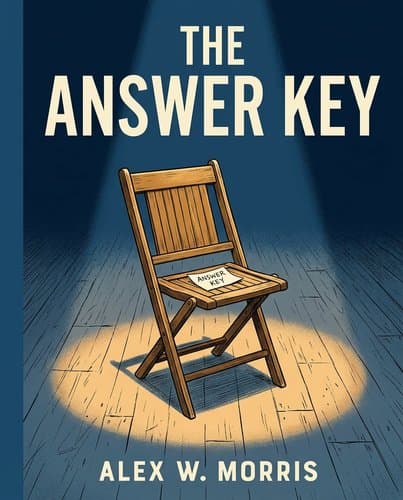
221303769_buffett-and-munger-unscripted
by Alex W. Morris
Three decades of unscripted wisdom from Buffett and Munger distilled into actionable principles—learn to value businesses like an owner, exploit Mr.
In Brief
Buffett and Munger Unscripted: Three Decades of Investment and Business Insights from the Berkshire Hathaway Annual Shareholder Meetings (2025) compiles the investment philosophy of Warren Buffett and Charlie Munger as expressed across thirty years of Berkshire Hathaway shareholder meetings.
Key Ideas
Define value before any investment
Define investing with Aesop's framework before any other: how many birds are in the bush, when do they come out, and what are current interest rates? Any investment that can't be described in those terms probably can't be understood well enough to own.
Honest circles beat imaginary ones
Draw your circle of competence honestly and respect its edge. The binary test: if you have doubts about whether something is in your circle, it isn't. A small, honest circle beats a large imaginary one every time.
Market volatility serves prepared buyers
Treat market volatility as a service, not a threat. Mr. Market exists to offer you prices, not advice. If the underlying business is sound, a 50% price drop is an opportunity — but only if you decided what the business was worth before the drop happened.
Skeptical accounting reveals management character
Evaluate accounting with the same skepticism you apply to salesmanship. EBITDA ignores depreciation — a real cost. Stock options are compensation — a real expense. When management chooses metrics that make expenses disappear, they're telling you something about their character.
Capital allocation reveals CEO quality
Separate the manager's job (running the business) from the capital allocator's job (deciding what to do with the cash it generates). Ask whether the CEO has a 'money mind' — and watch how they handle buybacks when their stock is cheap versus expensive.
Write down potential mistakes early
Build in feedback mechanisms that force disconfirming evidence. Surround yourself with one honest, non-subservient partner rather than a staff that tells you what you want to hear. Write down the reasons you might be wrong before you act, not after.
Long-term thinking wins the game
Patience is the structural advantage most investors refuse to exercise. The short-term obsession of public markets means anyone willing to think in five- to twenty-year horizons is playing a different — and easier — game than almost everyone else in the room.
Who Should Read This
Business operators, founders, and managers interested in Investing and Wealth Building who want frameworks they can apply this week.
Buffett and Munger Unscripted: Three Decades of Investment and Business Insights from the Berkshire Hathaway Annual Shareholder Meetings
By Alex W. Morris
13 min read
Why does it matter? Because almost everything you've been taught about investing is sophisticated-sounding nonsense.
Every year for three decades, two of the wealthiest investors alive sat on a stage in Omaha and handed out the answer key. No charge. No credentials required. They said: ignore the formulas, ignore the forecasters, ignore Beta and the efficient market hypothesis — none of it describes how businesses actually work or how wealth actually compounds. They said the edge is embarrassingly simple: know what something is worth, buy it when the price is lower than that, and have the psychological constitution to sit still while everyone around you loses their mind. The audience listened, applauded, went home, and kept doing exactly what Buffett and Munger told them not to do. This book is the distillation of what they actually said — not the quotable bumper-sticker version, but the reasoning underneath it. If simple were the same as easy, this would already be obvious to everyone.
The High Priests and Their Useless Formulas
Finance professors, Buffett and Munger have argued for decades, built an elaborate cathedral over the wrong foundation. The priesthood — their word — convinced students and markets that risk meant price volatility, that Beta measured something real, that Black-Scholes was the correct tool for valuing long-term options. The problem was not that these ideas were complicated. The problem was that they were wrong, and the reason they spread anyway is almost perfectly illustrated by Munger's story about an eye doctor he once consulted.
Munger visited a prominent ophthalmologist and noticed the clinic was still performing an outdated cataract procedure — cutting with a knife — long after better techniques had been invented. When he asked why a prestigious medical school was teaching an obsolete operation, the doctor explained without embarrassment: it was a wonderful operation to teach. The formula was clear, the steps were repeatable, the students felt productive. That, Munger concluded, is exactly what happened in corporate finance. Beta is a wonderful thing to teach. You give students a formula, you present the problem, they punch in numbers, answers come out. There is only one difficulty: it is, in his word, balderdash.
Buffett's version of the same critique is more direct. Business schools drifted away from the one question that actually matters — what is this business worth? — because that question is hard to teach and the instructor usually cannot answer it. So universities built entire departments around measuring volatility instead of value, treating a stock's price swings as a proxy for its underlying risk. The Washington Post sat there as a permanent rebuttal: when its stock fell roughly fifty percent in a matter of months in 1973, its academic Beta rose, which meant, by the standard model, the company had gotten riskier. The business — television stations, a dominant newspaper — had not changed. The price had dropped, which made a sound business cheaper to own, and Buffett bought more.
Aesop Had It Right in 600 B.C. — He Just Forgot to Mention Interest Rates
Picture yourself buying a small farm in 1960. Before you sign anything, you ask one question: what will this land produce over my lifetime, and what is that stream of future income worth to me today? You do not call it a 'discounted cash flow analysis.' You just think like an owner.
Buffett's insight — and the one he credits to Aesop — is that every investment reduces to exactly that calculation, whether you're buying a cornfield or a hundred million shares of Coca-Cola. Around 600 B.C., Aesop observed that a bird in the hand is worth two in the bush. Buffett's contribution, offered with some amusement, is that Aesop forgot two variables: when you get the birds from the bush, and what the prevailing interest rate is. Fold those in and you have defined all of investing for the past twenty-six centuries. How many birds? When? Compared to what else?
That last question — compared to what else — is what demolishes the growth-versus-value distinction that finance courses and Wall Street marketing departments labored so hard to construct. Growth is simply a variable inside the value equation. It helps you only when a company can deploy additional capital at returns exceeding the interest rate. When it cannot, growth destroys value. The airline industry made this concrete: it grew relentlessly for decades while investors collectively lost money, because each new dollar of capital earned less than it cost. See's Candies grew modestly and generated cash that compounded elsewhere. The difference was not 'value' versus 'growth.' It was whether the birds being added to the bush outnumbered the birds being spent getting there.
Investing is not complicated. It is psychologically demanding — which is an entirely different problem.
The $100,000 That Almost Prevented Modern Berkshire
In 1972, with the asking price for a California candy company sitting at exactly $25 million, Charlie Munger told a friend they would walk if the sellers wanted a dollar more. The sellers did not ask. The deal closed. The near-miss is arguably the most consequential $100,000 in the history of American investment — not because of what See's Candies itself earned, though $1.5 billion in pre-tax profit on $30 million of reinvested capital over the following decades is a staggering number, but because of what owning it taught two men who thought they already knew everything they needed to know.
Before See's, Buffett and Munger had been trained in the Ben Graham tradition: find businesses selling below their liquidation value and buy them cheap. It worked fine when the positions were small enough to exit cleanly. What it couldn't teach was the difference between a business you buy and later escape, and a business that compounds for you while you do nothing. See's — a West Coast chocolate company with fanatical customer loyalty and almost no need for reinvestment — was that second kind. When they bought it, it ran $30 million in annual sales off $9 million in tangible assets. Decades later, sales had crossed $300 million with only $40 million in assets required to support them. The business did not need their capital. It threw off cash they could redeploy elsewhere, which is the whole game.
The deeper lesson wasn't financial — it was perceptual. Owning a brand, watching customers pay more every year without flinching, seeing that loyalty persist while competitors spent fortunes trying to dent it: that experience rewired how they read a business. When Buffett looked at Coca-Cola in 1988, he was not reading financial statements in a vacuum. He was pattern-matching against sixteen years of watching See's customers queue up on Valentine's Day for a box of chocolates they would never swap for a cheaper substitute. A discount cola, he now understood viscerally, made the same promise as the cheap candy box — it told the recipient you took the low bid. That understanding came from ownership, not analysis.
Kraft Heinz reminded them there is still a price too high — that a wonderful business earning $6 billion pre-tax on $7 billion of tangible assets can become a poor investment the moment you overpay for it. The business earns what its fundamentals dictate, indifferent to your purchase price. What changed between the two deals wasn't the principle; it was the discipline of applying it. They had learned one lesson completely. They were still learning the other.
Mr. Market Is a Psychotic Drunk — Stop Taking His Advice
Imagine you own a small business with a partner who, every single morning, shows up at your door and names a price at which he'll either buy your share or sell you his. Some days he's euphoric and names a wild premium. Other days he's despondent and practically gives the thing away. The business itself — its customers, its products, its earning power — hasn't changed. Only his mood has. Now imagine using his mood as your primary investment signal. You would fire that partner immediately.
That is Ben Graham's Mr. Market, as Buffett tells it. The metaphor works because it makes the irrationality visible. A landlord who owns a rental building doesn't check Zillow every morning and feel compelled to sell because the estimate dropped. Nobody calls that landlord reckless for ignoring it. Yet stock investors — with access to better information about their businesses than almost any private owner — routinely let a number that wiggles on a screen override their own judgment about what they actually own.
Berkshire's own stock has been cut in half at least four times since Buffett took over. Each time, the underlying business was fine. The insurance operations, the railroads, the consumer brands — none of it changed materially. What changed was Mr. Market's mood, and anyone who mistook that mood for information about the business suffered accordingly.
The barrier here is not intellect. Buffett is direct about this: financial fear strikes some people with far more force than others, the way extreme heights do. If a fifty percent decline makes you want to sell, no analytical framework will save you, because the next person you talk to will confirm your panic and you will act on it. The skill — and it may be partly innate — is treating a collapsing price quote not as a verdict on the business but as an offer from a distressed partner. The lower the offer, the more interesting it becomes.
The Circle Has an Edge — and Honest Investors Know Exactly Where It Is
Most investors assume a bigger circle of competence means better results — more industries understood, more opportunities available. Buffett and Munger spent decades dismantling that.
Munger's formulation is almost paradoxical until you sit with it: a circle isn't a competence unless you know where its edge is. The boundary is the whole thing. An investor who vaguely believes they understand a business — who feels roughly familiar with the industry, has read a few articles, knows what the company makes — doesn't have a competence at all. They have a comfortable illusion, and comfortable illusions are how capital gets permanently destroyed.
Buffett's rule is binary for exactly this reason. Not 'mostly confident' or 'reasonably sure' — if you have doubts, you're already outside the circle. He watched GEICO pay Google ten or eleven dollars per ad click, studied the economics, and still passed. Not because he was incurious. Because he couldn't answer the one question that would have put it inside the circle: how much competition would eventually arrive, and would it be a game where one player dominated or four players bled each other out? Without that answer, he was standing at the edge — which meant he was outside.
The payoff of this honesty is the one-foot bar. Investing doesn't reward difficulty. There are no style points for attempting the harder problem. Chewing gum tastes the same as it did twenty years ago and will taste the same in twenty more — that's a one-foot bar, and you earn exactly the same return jumping over it as you would have earned betting on which cloud service dominates enterprise computing in 2035. The hard problems don't pay more. They just fail more often. A small circle, honestly drawn, beats a large one with blurry edges every time.
Float: The $165 Billion Magic Trick With a Catastrophic Failure Mode
Float is Berkshire's actual engine — not the brands, not the reputation, not the dealmaking instincts. Everything else runs on this fuel. The mechanics are genuinely strange: policyholders hand Berkshire money in advance, claims take years to settle, and during that interval Berkshire holds and invests capital it doesn't technically own. If the underwriting breaks even, that capital was free. If the underwriting profits, Berkshire was paid to borrow it. At $165 billion, it functions like a bank with no interest expense, no depositors who can withdraw on demand, and no regulator dictating where it goes.
The catch — and this is where insurance becomes the most dangerous business in the world, not a boring one — is that the same structure creating this engine makes it trivially easy to destroy yourself. Buffett's image is exact: you could sit in a rowboat in the middle of the Atlantic and whisper that you're willing to write policies at foolish prices, and brokers would swim to you, fins showing. The cash arrives immediately. The losses don't show up for years. So you keep going, convinced you're brilliant, until the roof collapses all at once.
GEICO in the early 1980s shows how fast this happens. A handful of reinsurance policies, total premium collected around $70,000. By the time the losses finally resolved, Berkshire had paid out $93 million — a ratio of roughly 1,300 to one, and no one knew the scale of the problem until years after the policies were written. The earthquake, as Buffett puts it, doesn't consult your pricing model before it strikes.
Berkshire's own reinsurance operation was mediocre for fifteen years — from 1970 until a consultant named Ajit Jain walked in on a Saturday in the mid-1980s, having never worked in insurance, and rebuilt the operation from scratch. What Jain understood, and what most competitors structurally cannot afford to understand, is that rational pricing sometimes means writing almost nothing. National Indemnity let premium volume fall eighty-five percent over thirteen years to avoid underpriced risk. No public company under quarterly earnings pressure could survive that optics. Berkshire could, and the long-run numbers proved why patience of that kind is worth more than almost any analytical edge.
Pi Equals Three: How Corporate America Legislated Away an Expense
Somewhere in Indiana, a state legislator once introduced a bill to change the value of pi. Not because he had discovered new mathematics, but because 3.14159 was inconvenient for schoolchildren. The bill failed, but the impulse — reality is uncomfortable, so let's vote on a different one — turned out to describe something more durable than one eccentric lawmaker.
In the 1990s, the Financial Accounting Standards Board proposed that stock options granted to employees should be recorded as a compensation expense. The logic was airtight: ask any executive whether receiving a salary plus an option is more valuable than receiving just the salary. Every one of them would say yes. If it's more valuable, it's compensation. If it's compensation, it's an expense. If it's an expense, it belongs in the income statement. The argument was never successfully rebutted — because it couldn't be. So corporate America did what the Indiana legislator had tried: it applied political pressure until the math changed. Lobbying campaigns, threats to defund FASB, a coordinated push through Congress to strip the accounting board of its authority. FASB caved. The auditing firms, who had initially sided with the correct answer, caved to their clients. Pi became three.
Munger's verdict, delivered without elaboration: corruption won.
What Buffett found genuinely disturbing wasn't the outcome alone. Companies had always found ways to shade their numbers. What disgusted him was the ambition to have the cheating officially endorsed — to make the lie the standard. And that, he and Munger argue, is what accounting manipulation ultimately reveals. It's a character test. The willingness to legislate away an inconvenient expense is the same willingness, expressed differently, that shows up in discounted insurance reserves, smoothed quarterly earnings, and acquisitions structured to avoid recognition of the actual price paid. When the numbers stop meaning what they say, you are no longer analyzing a business — you are reading a script someone else wrote to fool you.
The CEO Who Can't Allocate Capital Is the Most Dangerous Person in the Room
Most people would say a CEO's job is strategy, leadership, culture. Buffett's answer is different: at most companies, at most sizes, the defining function is deciding where the capital goes. And almost nothing about the career path that produces a CEO develops that skill.
The image Buffett reaches for is a musician. Someone spends twenty-five years becoming a virtuoso violinist — sales, legal, engineering, whatever the discipline — and then the organization finally hands them the ultimate reward: the top job. Except on the first morning, they walk onto the stage and discover the instrument is a piano. No practice, no training, just an expectation that brilliance in one domain transfers automatically to another. It doesn't. The CEO who rose through drug development knows an enormous amount about drug development. Capital allocation is a different cognitive instrument entirely.
What makes this worse is Buffett's observation about what he calls the 'money mind.' It isn't IQ. He has watched people with 140-point test scores make serially catastrophic financial decisions, because their wiring simply doesn't include this aptitude — and credentials don't install it. Meanwhile, other people who would struggle on a standardized test have never made a bad money decision in their lives. You cannot hire around the gap, outsource it to a strategy division, or solve it by bringing in investment bankers to sanity-check acquisitions. The bankers, as Munger dryly notes, know what answer their client wants before they walk in the door.
The Pyromaniac Was Warned — Then They Let Him Strike Another Match
April 28, 1991. The CEO of Salomon Brothers, its president, and its general counsel are sitting in a room together when a colleague named John Meriwether tells them something that should have ended the meeting immediately: a trader named Paul Mozer has been submitting fraudulent bids to the United States Treasury. The CEO, John Gutfreund, promises to report it to the Federal Reserve Bank of New York. Then he doesn't. Too unpleasant, too inconvenient, easy to defer just one more day. On May 15, another Treasury auction opens, and Mozer — who has not been stopped, warned, or watched — does it again. The pyromaniac, as Buffett frames it, had been warned he was a pyromaniac. Then they handed him another match.
The failure at Salomon was not a compliance failure. It was a moment-of-truth failure. The incentive system that allowed Mozer to behave that way in the first place was bad. But the thing that nearly destroyed the firm was the six weeks between the April meeting and the second auction — the CEO who knew and chose to wait.
Wells Fargo is the same anatomy in a different body. The bank had an incentive system that measured how many products each customer held: checking account, savings account, auto loan, credit card. Employees were graded, promoted, and paid based on that number. The problem is that you cannot manufacture demand for financial products that customers don't want — but you can open accounts without asking them. That's what thousands of employees eventually did, not because they were unusually dishonest, but because the system rewarded the metric and left the method unexamined. A compliance department cannot fix that. The problem was upstream of compliance, baked into the design.
Both failures shared the same anatomy: someone at the top decided the inconvenient information could wait until tomorrow — and tomorrow kept coming. What Buffett draws from both episodes is structural. The most dangerous thing in the world, when a CEO finally learns something has gone badly wrong, is a schedule that lets him think about it until tomorrow.
The Durable Advantage Is Structure, Not Genius
Think of State Farm, founded in 1922 by a retired farmer with no obvious advantage over the incumbents except one: Mecherle structured the business so that the people selling insurance were also the people who suffered when claims came in. The incentive aligned with the customer's actual interest, not the transaction. By the time Buffett studied it, State Farm had grown to roughly three times Allstate's market share and ranked among the largest companies in the country by net worth. Buffett called it a subject worth studying in business schools — and the reason it belongs at the end of this summary is that State Farm never required genius. It required structure.
Munger once observed that if you removed the top fifteen investment decisions from Berkshire's entire history, the performance would be ordinary. Not bad — ordinary. Which means the edge was never a systematic process generating constant alpha. It was the structural patience to sit still long enough for a handful of genuinely obvious opportunities to arrive, then act on them decisively instead of hedging into something more defensible. The world, as Buffett notes, is overwhelmingly short-term focused — quarterly earnings managed to beat analyst estimates by a penny, capital allocation driven by what the press release will look like in ninety days. That environment doesn't require you to be smarter than everyone else. It just requires you to not participate in it.
The circle of competence, honestly drawn. A feedback mechanism that forces you to read your own mistakes before they compound. Patience measured in years, not quarters. And a refusal — structural, not occasional — to do the dumb thing even when everyone around you is doing it. That's the whole system. Genius would be convenient, but it turns out it was never the point.
The Question Buffett Left Unanswered
Here is the tension the book never quite resolves, and probably can't: concentration is rational when you genuinely understand a business, but Buffett and Munger have spent decades watching people — smart people, credentialed people — confuse familiarity with understanding. The circle works. The problem is that the feeling of being inside it and the feeling of merely believing you're inside it are nearly identical from the inside. Munger says honesty lets you sense the edge. That's true, as far as it goes. But the hardest moment in this entire framework isn't the patience, or ignoring Mr. Market, or resisting the dumb thing everyone else is doing. It's the quieter, earlier moment — when you're alone with your reasoning, before you act — and you have to decide whether what you're holding is genuine conviction or an unusually well-dressed story you've been telling yourself. No formula touches that moment. Which is, of course, exactly what Buffett and Munger have been saying all along.
Notable Quotes
“I think value investors are going to have a harder time now that there’s so many of them competing for a diminished bunch of opportunities. My advice is to get used to making less.”
“Whatever you think you know about technology, I think I know less.”
“It’s bad enough that people want to cheat on their accounting, and they do cheat on their accounting. But to want it to be endorsed as the system is really kind of disgusting.”
Frequently Asked Questions
- What is the Aesop's framework for investing in Buffett and Munger Unscripted?
- "Define investing with Aesop's framework before any other: how many birds are in the bush, when do they come out, and what are current interest rates?" This framework, presented in Buffett and Munger Unscripted, provides a simple yet powerful model for evaluating any investment. The three questions represent: valuation (how many birds/profits), timing (when you receive them), and context (current interest rates for comparison). Any investment that cannot be described in these terms probably cannot be understood well enough to own. This principle emphasizes simplicity and clarity in investment analysis, filtering out unnecessary complexity and keeping focus on fundamentals.
- What does Buffett and Munger Unscripted say about circle of competence?
- Buffett and Munger Unscripted emphasizes drawing your circle of competence honestly and respecting its edge. The binary test is straightforward: if you have doubts about whether something is in your circle, it isn't. This principle prioritizes humble self-assessment over overconfidence. A small, honest circle beats a large imaginary one every time. The book teaches that many investors harm themselves by pretending to understand investments they don't actually grasp. By acknowledging the limits of your knowledge and investing only within genuine areas of expertise, you avoid costly mistakes. Honesty about what you don't know is as valuable as knowledge itself.
- How should investors treat market volatility according to Buffett and Munger Unscripted?
- Buffett and Munger Unscripted teaches that investors should treat market volatility as a service, not a threat. "Mr. Market exists to offer you prices, not advice." This perspective separates emotional reactions from rational decision-making. If the underlying business is sound, a 50% price drop is an opportunity—but only if you decided what the business was worth before the drop happened. The key is determining intrinsic value independently of market prices. By decoupling valuation from price fluctuations, disciplined investors capitalize on others' fear. This approach requires the psychological fortitude and long-term thinking Buffett and Munger exemplify, treating temporary price movements as opportunities rather than threats.
- What does Buffett and Munger Unscripted teach about evaluating management?
- Buffett and Munger Unscripted teaches evaluating management through accounting skepticism and capital allocation discipline. "When management chooses metrics that make expenses disappear, they're telling you something about their character." The book emphasizes that EBITDA ignores depreciation—a real cost—and stock options are compensation—a real expense. Beyond accounting, the book teaches separating the manager's operational job from the capital allocator's job of deploying generated cash. Ask whether the CEO possesses a "money mind" by observing how they handle stock buybacks when prices are cheap versus expensive. These distinctions reveal whether management truly prioritizes shareholder value or merely creates convenient narratives around performance.
Related Book Summaries
Read the full summary of 221303769_buffett-and-munger-unscripted on InShort