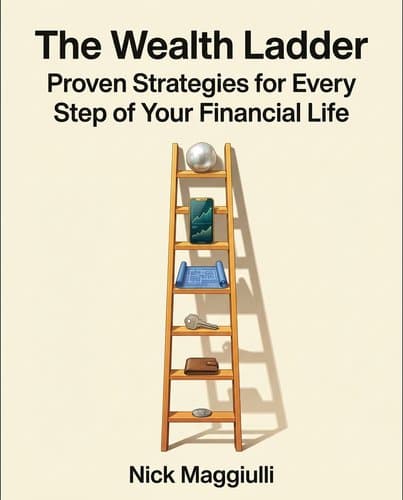
220687901_the-wealth-ladder
by Nick Maggiulli
Most financial advice fails you not because it's wrong, but because it's calibrated for a different wealth level than yours. Nick Maggiulli reveals exactly…
In Brief
Most financial advice fails you not because it's wrong, but because it's calibrated for a different wealth level than yours. Nick Maggiulli reveals exactly which strategies apply at each rung of the wealth ladder—so you stop wasting effort on advice meant for someone else's financial reality.
Key Ideas
Match strategy to current wealth level
Identify your current wealth level before acting on any financial advice — budgeting is a Level 1 strategy, starting a business is a Level 4 strategy, and applying either in the wrong context wastes effort at best and causes harm at worst.
0.01% rule defines trivial spending threshold
Use the 0.01% Rule to define 'trivial' spending: whatever 0.01% of your current net worth equals is the threshold below which a purchase has no meaningful long-term impact on your finances. This number moves up as you climb.
Spend based on liquid net worth only
Base your spending level on liquid net worth, not total net worth. A $1.1M household with $250k in accessible funds should spend at Level 3, not Level 4.
Overconcentration in primary residence risks stability
At Level 3, the primary risk isn't insufficient income — it's overconcentration in a primary residence. Households that fall back to Level 2 typically do so because 65% of their assets are locked in a home, not income-producing investments.
First decade of investing compounds most growth
The compounding math is front-loaded: the first decade of consistent investing contributes more than 50% of your eventual portfolio value. 'Start early' is not a motivational platitude — it's a specific arithmetic advantage that cannot be recovered later.
Business equity required to escape salary ceiling
To escape Level 4, you almost certainly need business equity, not a higher salary. Even saving $300k/year at 5% takes 17 years to reach $10M. The most successful founders average age 45 — experience and networks matter more than youth.
Diversification preserves wealth better than concentration
Concentration creates Level 5 wealth. Diversification preserves it. The same overconfidence in a single asset that drove the ascent is the primary cause of falling back — sell a portion, diversify, and accept a lower ceiling in exchange for a floor.
Income happiness benefits follow logarithmic progression
The $75k happiness plateau was measuring the ceiling of unhappiness, not happiness itself. For most people, emotional wellbeing continues to rise with income — but logarithmically. The next dollar buys less satisfaction than the last.
Four close friendships provide substantial wellbeing value
Seeing a close friend most days is worth roughly $100k in additional annual income in wellbeing terms. Four close friendships is the research-supported threshold — beyond that, the marginal benefit diminishes. Treat social investment with the same seriousness as financial investment.
Who Should Read This
Business operators, founders, and managers interested in Personal Finance and Investing who want frameworks they can apply this week.
The Wealth Ladder: Proven Strategies for Every Step of Your Financial Life
By Nick Maggiulli
12 min read
Why does it matter? Because the financial advice you're following was written for someone on a completely different rung than you.
You've heard two financial advisors give opposite advice and wondered which one was wrong. Here's the uncomfortable answer: neither. The advisor who said "track every dollar" was right. So was the one who said "stop obsessing over small expenses." The problem isn't bad advice — it's that both advisors were giving you directions to different destinations on a map you didn't know existed. Most financial guidance isn't wrong. It's miscalibrated. It's Level 6 wisdom handed to someone standing on Level 2, or survival tactics offered to someone who's already survived. Nick Maggiulli spent years inside the wealth-management world watching smart, hardworking people fail not from laziness but from applying the right strategy to the wrong situation. What follows is the map they were missing — and once you see which level you're actually on, you'll understand why the advice that helps your neighbor is making your situation worse.
The Reason Financial Advice Contradicts Itself Isn't the Advice — It's You
Every piece of financial advice you've ever received is correct. That's not reassurance — it's a diagnosis. Budgeting zealots and "ditch the spreadsheet, scale the business" evangelists are both right, and the reason they seem to contradict each other is that they're answering different questions for different people. The real skill isn't finding better advice. It's knowing which rung you're standing on.
Nick Maggiulli frames this through a chess opponent he couldn't crack. As a teenager, he'd learned to play by memorizing standard openings — the first ten moves of dozens of established games. It worked well enough. But at his first serious competition, he watched a player named Victor who seemed to be playing an entirely different sport. Victor accepted or ignored the same gambits based on who was sitting across from him. He was reading the position; everyone else was reciting lines. What Maggiulli eventually understood was that putting in more hours with the openings book wouldn't fix that. The problem wasn't effort. It was the framework.
The same trap runs through personal finance. Most advice is implicitly level-specific — designed for a particular rung on what Maggiulli calls the Wealth Ladder: six stages separated by factors of ten. Under $10,000, $10k–$100k, $100k–$1M, $1M–$10M, $10M–$100M, and $100M+. Budgeting is a tool for the bottom rungs, where a single spending decision is a meaningful slice of your total wealth. At the top, the math doesn't move. Launching and scaling a company makes sense when you have a financial cushion to absorb the failure rate; it's reckless when you're living without one. Neither advisor is wrong. They're just speaking to someone at a specific altitude and forgetting to say so.
Here's what that means practically: if you've been applying advice without first asking "which level is this designed for," you haven't been following a strategy. You've been memorizing openings. The Wealth Ladder is the frame that makes the question answerable.
The Invisible Architecture of Your Spending Is Already Set — You Just Don't Know the Rules
Around 40 BC, Cleopatra made a bet with the Roman general Mark Antony: she could spend the modern equivalent of $20 million on a single meal. He laughed. The next evening, she removed one of the largest pearls ever documented from her earring, dropped it into a cup of vinegar strong enough to dissolve it, and drank it. Antony conceded before she could reach for the second earring. The pearl was worth a fortune to almost everyone alive. To Cleopatra, it was a rounding error.
That gap — between what a sum means to you and what it means in absolute terms — is exactly what Nick Maggiulli's 0.01% Rule formalizes. Take one ten-thousandth of your net worth. That's the threshold below which a single spending decision stops mattering to your long-term finances. At $10,000 in net worth, the threshold is a dollar — the difference between regular and cage-free eggs. At $100,000, it's ten dollars — the gap between a burger and the salmon. At $1 million, it's a hundred dollars. The number that should feel trivial to you moves with you as you climb.
The practical consequence is sharp: your spending framework should be calibrated to your accumulated wealth, not your income. Income fluctuates — research shows that sharp income drops are more likely to be permanent for high earners than temporary, and the share of households experiencing a 50% income collapse nearly doubled between the early 1970s and early 2000s. Wealth is sturdier. Spending against it is more honest math.
That number comes with one adjustment worth making. Total net worth and usable net worth aren't the same figure. Someone with $1.1 million on paper — most of it locked in home equity and retirement accounts — has roughly $250,000 they can actually spend against. Spend at the level your liquid assets justify, not your balance sheet total. The architecture is already there. Most people just haven't looked at the blueprint.
Your Income Determines Where You Start. It Won't Determine Where You Finish.
What if the strategy that built your income is exactly what's now keeping it from growing into wealth?
Kōnosuke Matsushita lived that tension at every stage of his career. At fifteen he took an entry-level job in Japan's electrical industry and climbed steadily until, by his early twenties, he held the highest position available to him. At that point the logical move — grind harder, become indispensable — was also a trap. The skills that got him to inspector were salaried skills with a ceiling built in. So he designed a better electrical socket, pitched it upward, got rejected, and left to start his own company. Then, years later, he hit the same wall again: his business had grown beyond what one person could manage, and the habits that made him a great founder — controlling every detail, doing the sales himself — were strangling the company. He solved it by creating autonomous divisions that let managers own their own product lines. That structure became so influential that other Japanese firms copied it wholesale, eventually earning Matsushita the informal title 'the god of management' — a name that would have meant nothing if he'd kept doing what worked at the previous stage.
The pattern is the point. Each time Matsushita succeeded, the thing that produced that success became the obstacle to the next level. More effort in the same direction wouldn't have helped. The lever had to change entirely. That's the question worth sitting with if you're somewhere in the $100k–$1M range: are you grinding harder at something that already has a ceiling, or have you found the lever that actually moves at this altitude?
What the Wealthy Actually Own Is Not What You Think They Own
Data from the Federal Reserve's 2022 Survey of Consumer Finances draws a clean line through the six wealth levels. At the bottom, households below $10,000 hold roughly 85% of everything they own in vehicles and cash — things that depreciate or sit idle. Move up to Levels 2 and 3, the $10,000-to-$1 million range, and the primary residence takes over, swallowing 65 to 75 cents of every dollar of wealth among homeowners. Ninety percent of Level 3 households own one. It builds equity, it's tangible, it transfers to the next generation. The house is the plan.
A home that doubles in value is still, in an important sense, a consumption good. You live in it. You heat it, repair it, insure it. It doesn't send you a check. The households in Levels 4 through 6 understand this distinction in their balance sheets, even if they couldn't put it into words: those in Levels 1 through 3 typically hold 20% or less of their total assets in income-producing vehicles — stocks, bonds, rental property, business equity. Those in Levels 4 through 6 hold 50% or more.
That gap — 20% versus 50% — is the wealth divide. Not income, not hustle, not luck. It's the ratio of assets that make money versus assets that cost money. Moving up the ladder is, almost mechanically, the process of shifting that ratio. The house is a foundation. What you build on it determines everything else — and what that building actually looks like, compounded over time, is where the math gets interesting.
The Real Ceiling Isn't Your Salary — It's the Math of Compounding You've Been Ignoring
Imagine a marathon where every step you took made the next one 10% longer. Your first stride covers about two feet. Unremarkable. But each step compounds on the last, and by the time you cross the finish line — in fewer than 100 strides total — your final step alone spans roughly two and a half miles. Every early step, however modest, contributed to making that final one possible. Cut the first ten steps and you don't just lose ten steps; you lose the geometric foundation everything else was built on.
Compounding works the same way, and most people underestimate it because they're picturing a treadmill when they should be picturing a rocket.
Here's the arithmetic that should rearrange your priorities: take someone who invests $10,000 a year for 40 years at 7% annual growth. They end up with roughly $2 million, having contributed $400,000 in total. The surprising part isn't the final number — it's where that number came from. The first ten years of contributions account for more than half the final portfolio's value. The last thirty years, combined, contribute less. Early money has more runway to compound on itself. That first $10,000 doesn't just sit quietly; it multiplies into roughly $140,000 by the end, representing 7% of the entire portfolio despite being only 2.5% of the contributions. An investment made in year 30? It barely registers.
This is why the early years matter so disproportionately — and why it has a specific consequence for anyone sitting in Level 3, the $100,000 to $1 million range. Reaching $1 million in the example above takes over 30 years. The discipline required isn't a one-time decision; it's a thirty-year commitment to not stopping. The households that actually make the jump to Level 4 aren't doing something exotic: they start with higher incomes (about 52% higher, on average) and they don't let housing swallow their balance sheet. Spending nearly as much as households that earn significantly more is, per decades of PSID tracking data, the most reliable way to slide backward.
The math is unambiguous: time is the only input in this equation you cannot buy back.
Level 4 Is the Cruelest Rung: Comfortable Enough to Stay, Not Rich Enough to Leave
In 1982, the Pacific island of Nauru was the wealthiest nation on earth by per-capita income — phosphate exports bringing in the equivalent of $88,000 per resident annually. The government set up a sovereign trust fund and, for a moment, the math looked perfect. Then the phosphate reserves began thinning. Desperate to replace that income, Nauru's officials poured money into a London stage musical about Leonardo da Vinci that folded almost immediately, plus a string of real estate projects that went sideways. By 2004, a trust that had held over $3 billion had shrunk to $50 million. The wealth was real. The strategy for protecting it was not.
Nauru's mistake isn't an exotic geopolitical curiosity — it's the Level 4 trap in miniature. Once you've accumulated $1 million to $10 million, roughly 53% of your assets are typically sitting in income-producing investments: stocks, bonds, business equity, real estate. That's exactly what you want. It's also what makes the next mistake so expensive. A 10% loss in Level 3 costs you $10,000 on a $100,000 portfolio. The same percentage loss in Level 4 costs $100,000 minimum. What was merely painful one rung down becomes structurally damaging here.
The cruelest part of Level 4 isn't the risk. It's the stall. Succession put it plainly when Connor Roy tells Cousin Greg, fresh off a $5 million inheritance, that five million is a nightmare — can't retire, not worth it to work. That's the Level 4 feeling precisely. And the math confirms it: starting from $1 million, saving $300,000 a year and earning 5% annually still takes seventeen years to reach $10 million. Seventeen years of an extraordinarily high savings rate, sustained, after already making it to seven figures. The median person entering Level 4 is sixty-two years old. That timeline doesn't work.
So the only credible path to Level 5 isn't saving harder — it's equity. Business ownership, specifically: building or joining something early enough to own a meaningful stake, then selling it. The strategies that carried you to Level 4 — disciplined saving, solid investments, a high-paying career — are exactly the strategies that will leave you parked there.
To Reach the Top, You Must Start a Business. To Stay There, You Must Treat It Like a Risk You're Managing.
Business ownership is the required vehicle to reach Level 5 — and the primary way people fall back out of it. Both things are true simultaneously, and understanding the tension between them is what separates the people who make it from those who don't.
Among households with more than $500,000 in annual discretionary income, 63% trace it to a business they founded or joined early enough to own a real stake. Not investment returns, not salaries — ownership. And the entrepreneurs who actually pull it off tend to be around 45 when they do it, not 25. The reason is boring but important: they arrive with domain expertise, a network that answers their calls, and enough financial cushion to absorb early mistakes. Youth and urgency aren't the edge. Experience is.
The pattern also suggests the first exit is rarely the defining one. Mark Cuban pocketed roughly $2 million when he sold MicroSolutions in his early thirties — comfortable money, but not life-altering wealth. That exit funded the next bet, which was. MIT research puts a number on this: each additional company an entrepreneur sells is associated with 52% more revenue in their current venture. The first business teaches you how to build a business. The second one benefits from everything the first one cost you.
But here is the uncomfortable ceiling: the same concentration that creates Level 5 wealth will destroy it if you don't deliberately dismantle it afterward. Seán Quinn was once the richest man in Ireland. He concentrated too heavily in a single Irish bank. When that bet turned, so did everything else — Ireland's richest man became Ireland's most famous cautionary tale. The story isn't unusual; it's the dominant failure mode at this level. Overconcentration in one asset, usually your own business or a closely related sector, is how most people fall back down the ladder. The difference between Quinn and the entrepreneurs who stay at Level 5 is the deliberate, unglamorous work of diversifying before you have to.
The traits that drive someone to build a concentrated position — conviction, risk tolerance, an unwillingness to dilute the upside — are the same traits that make them resistant to diversifying once it works. Concentration got you here. That's exactly why it feels wrong to undo it. But the work of staying in Level 5 is the deliberate, unglamorous process of converting a concentrated bet into a diversified portfolio — trading the rocket fuel for ballast, before the wind changes.
The Wealthiest People in the World Are Still Waiting to Feel Wealthy
In November 2023, a few weeks before his death, Charlie Munger sat down for what would be one of his final interviews. The interviewer praised his record. Munger brushed it aside. What he actually thought about, he said, was the wealth he'd nearly left on the table by not being quite smart enough. He had multiple billions. He wished he'd had multiple trillions.
Sit with that for a moment. A man who spent eighty years compiling one of the most admired fortunes in American history, and his dominant feeling near the end was mild disappointment at the gap between what he had and what he almost had.
This is how the upper rungs work, and it doesn't resolve when you get richer. It compounds. Every level you climb puts you in rooms with people who have more, and the psychological distance between your number and theirs dwarfs anything you felt at the earlier levels. A survey from 1987 makes the pattern concrete: people earning under $30,000 said $50,000 would make them content; people already earning over $100,000 said they'd need $250,000. The threshold of 'enough' scaled proportionally with what they already had. It always does.
Roy Raymond discovered this the hard way. In 1982, he sold Victoria's Secret for $1 million — real money, top 0.2% of American wealth at the time. He could have locked it into ten-year Treasury bonds then paying 13% annually and cleared over $400,000 a year without lifting a finger. Instead, the exit felt like a starting line. He poured his money into a luxury children's goods company that went bankrupt within two years. The company wasn't incorporated properly, so the liability came home with him — his houses in San Francisco and Lake Tahoe were seized. His marriage broke apart. He kept trying: another venture, then another, none of them working. In 1993, three days after the IRS filed a lien on his earnings, he walked to the middle of the Golden Gate Bridge.
Raymond never reached Level 6. Munger did, and felt the same pull. The ladder's cruelest feature isn't that it's hard to climb. It's that reaching the next rung doesn't quiet the hunger. It recalibrates it.
The Things That Actually Determine Your Wellbeing Cost Almost Nothing
What if the biggest returns available to you don't show up on any brokerage statement?
The neuroscientist Matthew Lieberman ran the numbers on what various social experiences are worth in salary equivalents — the additional annual income you'd need to compensate for losing them. Seeing a close friend most days: $100,000 a year. Being married: another $100,000. Seeing a neighbor regularly: $60,000. Those aren't feel-good estimates. They're derived from well-being data across thousands of people. And they dwarf what most people earn from a year of aggressive saving.
Financial wealth is a mineral — like salt — that improves the life around it. Salt makes food taste more like itself. Money makes a good life more vivid. But a plate of salt with nothing to eat it with isn't a meal. The ladder exists to salt something worth salting.
The research on money and happiness supports this from a different angle. For most people, emotional well-being does keep rising with income past the old $75,000 threshold — but logarithmically, meaning each additional unit of happiness requires exponentially more wealth to produce. Eventually the math becomes punishing. The only way off that treadmill is to stop measuring your life in the currency that got you onto it.
His own path — 1,500 hours of writing for free — led him to the same conclusion. He reached Level 4 not through inheritance or a lucky bet but through content as leverage. And what he found at the top is that the most valuable things — four close friends, daily movement, purposeful work, time with family — are also the cheapest. Not because money doesn't matter. It does, urgently, at the bottom rungs. But once you have enough, the returns on more money shrink while the returns on everything else stay enormous. The ladder was always the means. This is what it was for.
The Ladder Is the Map, Not the Destination
You have the map now. The question is whether you know what you're navigating toward. The money matters. It matters at the bottom rungs, where a single bad month can undo a year of progress. But past a certain altitude, more wealth stops buying more life and starts buying more scoreboard. Maggiulli's map is genuinely better than the one most people are using — but a better map only helps if you know the destination. The ladder is salt. You still have to decide what you're cooking.
Notable Quotes
“What’s fifty grand to a mother****er like me? Can you please remind me?”
“the Point Zero One Percent Rule”
“Every senator looks in the mirror and sees a president.”
Frequently Asked Questions
- How does the wealth ladder framework improve financial advice?
- The Wealth Ladder argues that most financial advice fails because it's calibrated for the wrong wealth level. Nick Maggiulli identifies five rungs and shows readers how to match strategies to their position. The core principle: "budgeting is a Level 1 strategy, starting a business is a Level 4 strategy, and applying either in the wrong context wastes effort at best and causes harm at worst." This prevents misaligned advice—someone at Level 2 shouldn't focus on business ventures, just as Level 4 individuals shouldn't obsess over budgeting categories. Identifying your rung first ensures you apply appropriate, actionable strategies for your financial reality.
- What is the 0.01% Rule for defining trivial spending?
- The 0.01% Rule helps eliminate decision fatigue by defining spending below a meaningful threshold. "Whatever 0.01% of your current net worth equals is the threshold below which a purchase has no meaningful long-term impact on your finances. This number moves up as you climb." For someone with $1M net worth, purchases under $100 are trivial. The rule also addresses a crucial distinction: base spending on liquid net worth, not total net worth. A household with $1.1M total but only $250k accessible should spend at Level 3, not Level 4, because home equity is illiquid and concentrated risk.
- Why is business equity more critical than salary for building wealth?
- Building Level 5 wealth almost certainly requires business equity, not higher salary alone. The compounding math proves this: "even saving $300k/year at 5% takes 17 years to reach $10M." Experience and networks matter more than youth—"the most successful founders average age 45." At the highest level, concentration creates wealth, but diversification preserves it. The book emphasizes that "the same overconfidence in a single asset that drove the ascent is the primary cause of falling back." Salary growth cannot match the compounding and concentrated returns that business equity provides, making entrepreneurship essential for escaping Level 4.
- What does the book say about money and friendship's impact on wellbeing?
- The book challenges the "$75k happiness plateau," explaining it was "measuring the ceiling of unhappiness, not happiness itself." For most people, "emotional wellbeing continues to rise with income — but logarithmically," meaning each dollar provides diminishing satisfaction. Critically, the book quantifies friendship's value: "seeing a close friend most days is worth roughly $100k in additional annual income in wellbeing terms." The research-backed optimal threshold is "four close friendships"—beyond that, marginal benefits diminish. This suggests treating social investment with financial investment's seriousness, balancing wealth accumulation with meaningful relationships for genuine life satisfaction.
Related Book Summaries

Read the full summary of 220687901_the-wealth-ladder on InShort