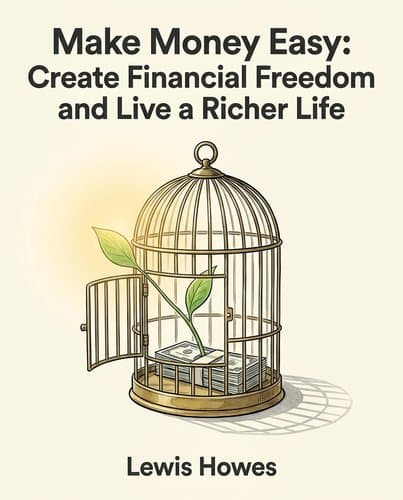
218663509_make-money-easy
by Lewis Howes
Financial freedom isn't a retirement destination—it's a mathematical equation you can solve today. Learn how your savings rate, not your salary, determines…
In Brief
Financial freedom isn't a retirement destination—it's a mathematical equation you can solve today. Learn how your savings rate, not your salary, determines exactly when work becomes optional, with precise calculations showing how small cuts to spending eliminate tens of thousands from your target number.
Key Ideas
Calculate FI Using 25x Annual Spending
Calculate your FI Number: multiply your annual spending by 25. Every $10/week you cut from spending reduces that target by $13,000 — run the numbers on your three biggest expenses first.
Savings Rate Determines Financial Independence Timeline
Track your savings rate, not your income. A 25% savings rate reaches FI in roughly 32 years; a 50% rate gets there in 17. Moving from 20% to 25% accelerates your date by five years.
Choose Low-Cost Index Funds Below 0.2%
Prefer index funds with fees below 0.2% (e.g., VAS + VGS, or an all-in-one like DHHF). A 1% fee vs a 0.2% fee on $100k over 30 years costs you $152,000 in lost wealth.
Franking Credits Boost Australian Share Returns
For Australian shares, factor in franking credits: a 4% dividend yield can become 5%+ effective yield tax-free, versus property's gross yield of 3–4% that shrinks to ~2% net after rates, insurance, and repairs.
Semi-FI Unlocks Flexible Part-Time Work Options
Test 'Semi-FI': when investments cover 50% of expenses (or when your home is paid off), shift to part-time work. One day a week at $25/hr adds $10k/year — equivalent to holding an extra $250k in investments.
Annual Bill Optimization Yields Extraordinary Returns
Run an annual Optimisation Day: renegotiate your mortgage rate, insurance, phone, and utilities. Saving $2,000/year on bills means needing $50,000 less to reach FI — and the 'per-hour' rate for this work is extraordinary.
Prioritize Cashflow Assets Over Total Net Worth
Don't conflate net worth with passive income. Before chasing a larger portfolio, confirm your assets are generating cashflow — equity locked in property or super doesn't pay your grocery bill in your 40s.
Who Should Read This
Business operators, founders, and managers interested in Financial Independence and Personal Finance who want frameworks they can apply this week.
Make Money Easy: Create Financial Freedom and Live a Richer Life
By Lewis Howes
10 min read
Why does it matter? Because the rat race is optional — and the math to prove it has been hiding in plain sight for decades.
Australian full-time wages have doubled in real purchasing power since 1966 — and almost nobody has noticed. That gap between what workers earn and what they actually need has been silently widening for decades, and consumer culture has been just as silently filling it with subscription services, bigger houses, and cars bought on credit to impress strangers. The average Australian household already earns enough to retire in their 30s or 40s. They're not doing that. Not because the math is hard — the math is embarrassingly simple — but because nobody told them the game they're actually playing. This book is that conversation. It'll show you why your savings rate, not your salary or your stock picks, is the one number that determines when you stop selling your time. And once you run your own numbers, you'll spend the rest of the week angry about every year you didn't.
The 19-Year-Old in the Factory Was Right: The 'Work, Spend, Repeat' Cycle Is a Design Failure, Not a Law of Nature
A 19-year-old gets fired from a sheet metal factory in Australia and feels nothing. No panic, no dread — just relief. He has $20,000 saved, which buys him a summer at a run-down beach house with friends, zero obligations, and the quiet realisation that money isn't just for spending. It's for buying time. What he saw before the door hit him on the way out was harder to shake than losing the job: colleagues in their 40s and 60s with the same hollow look, shuffling through the same motions, trapped not by bad luck but by a pattern so normalised nobody questioned it. Work, spend, eat, sleep, repeat.
Here's what makes that pattern infuriating rather than just sad. Between 1966 and 2016, Australian full-time wages grew at 6.7% per year while inflation ran at 5.2%. That 1.5% gap, compounded over fifty years, means 2016 workers took home double the real income of their 1966 counterparts. Not slightly more — double. Zoom further back: real wages in Australia are roughly four times what they were in 1900. A US Bureau of Labor Statistics study tracking household spending across that century found food and clothing consumed 57% of income in 1900 and just 17% by 2003. The cost of survival, relative to wages, collapsed.
So where did the surplus go? Consumer culture absorbed it before most people noticed it had arrived. Better cars, better kitchens, better holidays, better phones. There's no ceiling on 'better' the way there is on 'more.' Spending expanded to fill whatever income arrived — the same way a work task expands to fill the time available. The result is a population with twice the real purchasing power of their grandparents, living pay-cheque to pay-cheque, genuinely convinced the system is stacked against them.
It isn't stacked against you. It's just very good at taking your money before you decide what to do with it. The 19-year-old in the factory figured this out with $20,000 and a beach house before most people figure it out at all.
Your Savings Rate Is the Throttle — Everything Else Is a Passenger
Income is a passenger. Savings rate is the throttle. Get that backwards and you can earn half a million dollars a year and still cross the finish line at the same time as someone earning a tenth of that.
Here's the proof: a doctor on $500,000 who saves $50,000 a year has a 10% savings rate. A labourer on $50,000 who saves $5,000 has a 10% savings rate. Same percentage, same destination, same arrival date — the doctor just gets a fancier waiting room. The income gap is irrelevant. The only number that determines when you stop working is how wide the gap is between what comes in and what goes out.
The savings rate matters even more in the early years than most people expect. Take a couple earning $100,000 combined and spending $50,000 — a solid 50% savings rate. After a decade investing that surplus at 7% annual returns, they'd have roughly $720,000. Sounds like compounding did the heavy lifting, right? It didn't. $500,000 of that came from physically putting money aside. Investment growth contributed just $220,000. In plain English: they did 70% of the work; the market did 30%. Compounding is back-loaded — it gets spectacular eventually, but in the first decade it's your actual savings doing the heavy lifting. Which means the savings rate is the variable you control most completely and the one that dominates your early results.
The leverage here is sharper than it looks. Nudging your savings rate from 20% to 25% — on a $75,000 income, that's $3,750 a year, roughly the cost of a mid-range holiday — pulls your financial independence date forward by five full years. Not five months. Five years of Monday mornings you don't have to show up for. Most people spend more than that trying to signal success to people they barely like.
A Dollar Saved Is Worth Twenty-Five Dollars Earned — The Multiplier Nobody Teaches You
Think of your spending like a loan you take out against your future freedom. Every dollar you send out the door doesn't just cost you a dollar — it costs you twenty-five, because that's how much capital you'd need parked in investments to replace it forever. A $50-a-week habit runs $2,600 a year. Multiply by 25 and you need $65,000 sitting in a portfolio just to sustain that one habit in retirement. Cut it, and you don't just pocket $2,600 — you retire $65,000 earlier. That's the 25x multiplier, the direct arithmetic consequence of the 4% rule, and it reframes frugality completely. You're not pinching pennies. You're doing arbitrage.
Run it the other direction: every $10 a week you trim — a round at the pub, a few lunches, one streaming service — is $520 a year you don't need to spend. Which means $13,000 less you need to accumulate before you can quit. Find five of those and you've moved your finish line by $65,000 without earning a cent more. The maths works whether you're cutting a coffee habit or spending an annual hour or two taking a sharpened blade to every recurring charge: mortgage rate, insurance premiums, phone plan, utilities. The per-hour return on that afternoon is almost certainly higher than your day job.
What makes this lever so underrated is the compounding on both ends. Spending less today means you need a smaller target number, and it means more cash goes into investments now, growing at 7% a year while you sleep. The back-loaded nature of compounding — where the bulk of the gains land in the final years — means the earlier you widen the gap between income and spending, the more obscene the eventual payoff. You're not waiting passively. Every dollar you don't spend today is a seed you plant earlier in that exponential curve.
Frugality isn't deprivation. It's leverage. The person who understands the 25x multiplier looks at a $50 weekly habit and sees $65,000 of their life. Then they decide whether it's worth it.
The 'Big Wins' That Actually Move the Needle: Housing, Cars, and the McMansion Nobody Needed
What's the biggest reason Australians with decent salaries end up with nothing to show for it? Not bad luck. Not stagnant wages. Housing and cars — specifically, the quiet cultural pressure to over-size both — is where most of the surplus goes, and most people never notice because everyone around them is doing the same thing.
Australia now has the largest average home floor area in the world. Bigger than the United States, which practically invented the McMansion. Meanwhile, 77% of Australian households have at least one spare bedroom sitting empty, which means the average family isn't just buying more space than they need — they're borrowing money at mortgage rates to store it, heating and cooling it, paying council rates on it, and watching it consume capital that could be compounding in an index fund instead. Buying the biggest home you can qualify for isn't a financial strategy. It's lifestyle inflation wearing a hard hat.
Cars are the other leak. A $30,000 car financed over five years regularly ends up costing $50,000 once interest is counted, then sits at around $10,000 in resale value by the time the last payment clears. That's a $40,000 loss on an asset you needed to get to work. Registration, insurance, and depreciation alone run close to $3,000 a year before a drop of fuel is added — and two cars in a household means you're burning $6,000 annually, minimum, before you've driven anywhere.
The fix isn't asceticism — it's sizing down. One fewer bedroom saves thousands in rent or tens of thousands off a purchase price. One-car households, or choosing to live somewhere walkable, convert that $3,000 drain into investment contributions. Small adjustments on the two biggest line items produce outsized results because they're recurring: the savings compound every year, and the reduced spending target means you need less capital to be free. The question is whether your house and driveway are eating the difference.
High Roller Harry Has $5 Million in Property and Zero Passive Income
Meet Harry. He's worth $3 million on paper, owns $5 million in property across several well-located capital-city addresses, and still sets his alarm for Monday morning. Here's why: his $2 million in debt costs him 3% annually in interest — $60,000 a year. His rental portfolio, after council rates, insurance, and repairs consume roughly 40% of gross income, nets about 2% — also $60,000 a year. The math is brutal in its precision. His entire property empire produces exactly zero passive income. He's equity-rich and cashflow-broke, a multi-millionaire who needs his job the way someone on minimum wage does.
Now meet Martin, who has half Harry's net worth — $1.5 million in shares, no property at all. He rents his home, drives a modest car, and collects around $60,000 a year in dividends. Factor in franking credits — the tax credits attached to Australian share dividends because the company already paid corporate tax on those profits — and the effective yield climbs above 5%. Martin's expenses are covered. He doesn't set an alarm if he doesn't want to. Despite being half as wealthy by any conventional measure, Martin is the only one of the two who is actually free.
Property's reputation for wealth-building rests almost entirely on capital growth, not income. Gross rental yields run around 3.5% in major cities, but the real number — after the costs that quietly devour rental income — lands closer to 2%. Shares deliver their returns directly as spendable cash, and the Australian tax system effectively boosts those dividends further through franking credits. No tenants, no repairs, no property managers taking their cut.
A single index fund tracking Australia's 300 largest companies captures 82% of the total local share market — every sector, every major company — for a management fee around 0.1% per year. Add a global fund and you own a slice of every major business on earth for less than a rounding error in fees. The enemy isn't the market. It's fees, complexity, and the behavioral trap of trying to outsmart a system where professional analysts already know everything you know. Harry spent decades accumulating leverage. Martin just kept buying index funds. One of them is free.
Own Everything, Pick Nothing: Why Index Funds Beat Stock-Pickers — and Most ESG Funds Too
Stock-picking sounds reasonable until you see one number. A study tracking US stocks from 1989 to 2015 found that 20% of companies generated the entire market's 1,200% gain. The remaining 80% collectively returned nothing — and four in ten actually lost money. That's not a bad year or a bad sector. It's how markets work, consistently, because a handful of extraordinary companies — the ones you didn't know to back in 1989 — do most of the heavy lifting while the rest muddle along or die. The professional stock-pickers who spend their careers hunting for these winners still fail to beat the index most of the time, because missing even a few of that 20% is enough to wreck your returns. An index fund sidesteps the whole problem by owning everything. The winners ride your portfolio up automatically. You don't need to find them because you already hold them.
Fees are the second trap, and they're sneakier because 1% sounds harmless. It isn't. Run $100,000 at 7% annual returns for 30 years and the difference between a 1% fee fund and a 0.2% fee fund is $564,000 versus $716,000 — a 20% gap in final wealth from a number that barely registers. Fees compound the same way returns do, just in reverse, silently chewing through your balance every year while you're not watching.
The ESG question has a hole in it: when you buy shares on the stock market, you're buying them from another investor, not from the company itself. Avoiding a company's shares doesn't touch its profits, customers, or operations — so accepting 0.5% lower annual returns in an ESG fund, on a $1 million portfolio, costs you $5,000 a year.
'A Little Bit More' Is the Most Expensive Addiction You've Never Been Warned About
When is enough actually enough? Not philosophically — mathematically. The investor who sets a $1.5 million target, hits it, then extends to $2 million 'just to be safe,' hits that, and then starts moving the goalposts again — that person isn't being prudent. They're running the rat race under a different brand name. The finish line keeps moving because the fear that moves it never gets addressed.
You can't save your way out of fear.
Here's the number that dissolves it: 25%. Retire with $1 million and a $40,000 annual budget, and you only need $10,000 of flexibility — one day a week of part-time work, a small side project, trimming a single budget category in a rough year — to hit a 100% historical success rate across any 150-year period on record. Not 90%. Not 'pretty good odds.' One hundred percent. The jump doesn't require a bigger net. It requires a modest flex rate and the honesty to admit you're not going to sit motionless for fifty years anyway.
Generating an extra $10,000 a year after leaving full-time work — one day a week at a modest hourly rate — means that's $250,000 of capital you don't need to accumulate. You'd spend years grinding toward that extra quarter-million at the office. You could replace it with a single shift a week and a library card.
The people holding out for a bigger number aren't buying more security. They're paying with years of their life for a feeling that more money has never actually delivered to anyone.
The Turtle at the Lake: What Financial Freedom Actually Looks Like
A Tuesday morning in Perth. Dave is kneeling beside a lake, watching something the size of a 20-cent coin drag itself toward the water. It's a turtle hatchling — one of dozens he's shepherded from the nest in his garden, past the ravens and foxes, to this moment. The tiny shell catches the light, the legs scramble, and then it's gone, swimming off into a lake that must look, from its perspective, like an infinite world. He sits there for a long time. Nobody else is around. Almost every neighbour is at a desk somewhere. The whole scene exists because he quit his job.
This is what the math actually purchases. Not a bigger house or a faster car — those are just different forms of the same trap — but a Tuesday with nothing more urgent than walking a hatchling to a lake. The 25x multiplier, the savings rate, the index funds: all of that is just the mechanism. It disappears once it works, and what's left is the thing it was always pointing toward: time, unscheduled and yours.
Bronnie Ware spent years as a palliative care nurse and wrote down what people said they regretted as they were dying. Four themes kept surfacing: working too hard, not having the courage to live honestly, neglecting the people they loved, and never letting themselves be happy. Not one of those regrets is solved by money. But all four are structurally easier to avoid when you're not locked into a 40-year schedule someone else designed. Financial independence doesn't hand you a good life. It removes the obstacles to one.
The hatchlings don't wait for a better moment. When the coast is clear, they go.
The Only Question That Actually Matters
Australian real wages have been high enough to retire early since roughly the time your parents were watching Countdown on a Friday night. The maths hasn't been the barrier for forty years. The barrier is identity — specifically, the version of yourself that buys things to look like someone who doesn't need to. Every dollar you redirect from that performance toward a low-cost index fund is a fraction of a free Tuesday morning. Enough Tuesdays compound into a life that looks, from the outside, like luck, and feels, from the inside, like the only sane response to having figured something out early. The people with the biggest driveways are often the least free — they just have nicer props for their captivity. You're not depriving yourself by consuming less. You're buying time. The choice has always been yours. Now you know what to do with it.
Notable Quotes
“aren’t house prices in Australia kind of a deal breaker when it comes to getting ahead, let alone retiring early?”
“But I’ll be paying rent forever?”
“It must be laying its eggs!”
Frequently Asked Questions
- How do I calculate my Financial Independence number?
- To calculate your FI Number, multiply your annual spending by 25. This target represents the amount you need invested to generate sufficient passive income for life. The book emphasizes that small spending cuts have outsized impact: every $10/week you cut from expenses reduces your FI target by $13,000. The strategy is to run the numbers on your three biggest expenses first, since optimizing housing, transport, and food decisions creates the largest FI number reductions and accelerates your timeline toward financial independence.
- Why should I track my savings rate instead of my income?
- Your savings rate—not income—determines your timeline to financial independence. The book demonstrates that a 25% savings rate reaches FI in roughly 32 years, while a 50% rate achieves it in just 17 years. Even modest improvements compound significantly: moving from 20% to 25% accelerates your FI date by five years. This metric works for everyone regardless of income level, making it universally applicable. Focusing on what you save rather than what you earn puts control directly in your hands.
- What investment fees should I target according to Make Money Easy?
- Prefer index funds with fees below 0.2%, such as VAS + VGS, or all-in-one options like DHHF. The cost difference is substantial: a 1% fee versus a 0.2% fee on $100,000 over 30 years costs you $152,000 in lost wealth. Low-cost index investing is foundational to reaching financial independence efficiently. Fee minimization is one of the most controllable variables in wealth building, requiring minimal effort after initial setup but delivering enormous long-term returns through compounding.
- What is Semi-FI and when should I test it?
- Semi-FI occurs when your investments cover 50% of your expenses—or when your home is paid off—allowing you to shift to part-time work. One day per week at $25/hour adds $10,000 annually, equivalent to holding an extra $250,000 in investments. Testing Semi-FI reduces pressure on your remaining portfolio while maintaining income. This strategy bridges the gap between full employment and complete financial independence, offering psychological and practical benefits while allowing you to test retirement lifestyle choices.
Related Book Summaries
Read the full summary of 218663509_make-money-easy on InShort