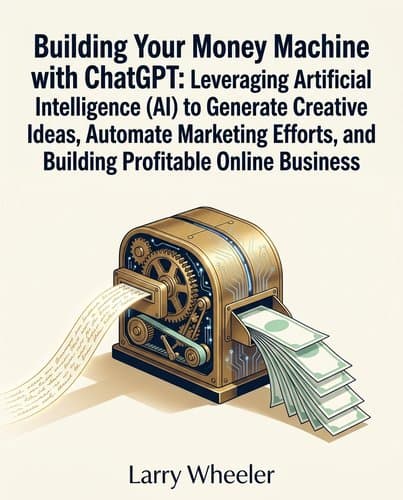
214866066_building-your-money-machine-with-chatgpt
by Larry Wheeler
Most people use ChatGPT like a search engine—this guide shows you how to wield it like a full business team, with specific prompting frameworks that compress…
In Brief
Building Your Money Machine with ChatGPT: Leveraging Artificial Intelligence (AI) to Generate Creative Ideas, Automate Marketing Efforts, and Building Profitable Online Business (2024) shows how to use ChatGPT as a professional-grade business consultant rather than a basic search tool.
Key Ideas
Prime AI With Expert Persona First
Before asking ChatGPT anything business-critical, prime it with a persona: 'You are an expert copywriter with deep experience in [your industry] writing for [your target audience].' This single step shifts output from generic to professional-grade.
Sequential Prompting Simplifies Complex Problems
Break complex business problems into sequential prompts rather than one big question. For a fundraising crisis: first identify core problems, then set constraints, then brainstorm solutions, then tackle donor retention, then acquisition. Each prompt builds on the last.
BANT Framework Compresses Sales Debriefs
Use the BANT prompt on your own sales call transcripts: paste the transcript, ask for a structured breakdown of Budget, Authority, Need, and Timeline, plus next steps. It compresses a 30-minute debrief into two minutes.
Find Niches at Signal Intersections
For market research, feed ChatGPT a mix of social media hashtags, Reddit threads, customer reviews, and competitor data — then ask it to identify intersections, not just trends. The niche worth pursuing lives at the intersection of two signals no one has combined yet.
Layer Specialized Tools With ChatGPT
Stack specialized tools on top of ChatGPT rather than asking ChatGPT to do everything: Brandwatch for sentiment, SimilarWeb for competitor traffic, Uizard for UI mockups, Bubble.io for no-code builds. ChatGPT is the synthesis and strategy layer, not the only tool.
Prototype Fast, Fail Cheap, Iterate
Treat your first product as a dress rehearsal, not a launch. Use AI to prototype fast, gather real feedback, and iterate — the goal is to fail cheaply and quickly rather than perfectly and expensively.
Prompting Mastery Replaces Capital Investment
The barriers to entry have shifted from capital to skill. The entrepreneur who wins is not the one with access to AI (everyone has that), but the one who learns to prompt it like a professional consultant rather than a search engine.
Who Should Read This
Readers interested in Artificial Intelligence and Startups, looking for practical insights they can apply to their own lives.
Building Your Money Machine with ChatGPT: Leveraging Artificial Intelligence (AI) to Generate Creative Ideas, Automate Marketing Efforts, and Building Profitable Online Business
By Larry Wheeler
10 min read
Why does it matter? Because the gap between 'I have a business idea' and 'I have a running business' just collapsed to a few good prompts — and most people haven't noticed yet.
Most people assume building a real business requires money, expertise, or both — a team to hire, a developer to pay, a marketing agency to brief. That assumption is costing founders months of unnecessary waiting. A solo operator with a laptop and a well-constructed prompt can now run competitive market research, generate a product launch campaign, stand up customer service, and qualify sales leads — not in weeks, but in an afternoon. The book is built around one uncomfortable truth: ChatGPT isn't a search engine with better grammar. It's a professional-grade thinking partner, and the difference between using it like one versus the other is entirely learnable. This summary shows you exactly how.
AI Isn't a Search Engine — It's a Business in a Box (If You Know How to Ask)
Think of a recipe. Give a chef the constraint of 'vegetarian, under 30 minutes, using what's in the fridge,' and they don't randomly throw ingredients together — they explore the space of what's possible within those guardrails and return something coherent, surprising, and usable. That's closer to what ChatGPT actually does than anything resembling a search engine.
Most people treat it like a fancier Google — a place to retrieve information that already exists somewhere. The shift worth making is understanding it as a generative system: one that produces new output by working within your constraints and everything it's learned. When you ask it to write a business plan, it isn't finding a business plan and showing it to you. It's constructing one, the way a chef constructs a dish.
Tell an AI: this song needs a memorable chorus, has to fit a specific genre, and must run at a radio-friendly length. Those aren't limitations — they're the frame. Inside that frame, the AI explores options from experimental to conventional and filters for coherence. What comes back isn't random noise, and it isn't a copy of an existing song. It's something new that fits your specifications.
This is why the gap between 'I have a business idea' and 'I have a business' has quietly collapsed for anyone paying attention. The same generative logic that builds a song can draft your brand positioning, outline a pricing model, or stress-test an MVP feature list — provided you give it real constraints to work inside. The tool isn't a smarter Google. It's a collaborator that inhabits possibility space on your behalf and returns with options you can actually use.
You Can Research an Entire Market Before Spending a Dollar
Imagine you run a small custom sneaker brand and you're trying to figure out your next product line. You have a pile of raw signal — Instagram comments tagged #sneakerheads, Reddit threads from r/sneakers, customer reviews, a few fashion blogs bookmarked on your browser — but no analyst to make sense of it. So you feed it all into ChatGPT and ask it what it sees.
What comes back isn't a vague trend report. The AI identifies two currents running through the data simultaneously: a growing appetite for eco-friendly materials and a nostalgia pull toward '90s retro aesthetics. Separately, neither observation is new. But the intersection — retro design executed in recycled materials — is a niche nobody in your competitive set had named yet. ChatGPT doesn't stop at naming it. It sketches a product concept, outlines a marketing campaign built around nostalgia and sustainability, and suggests the emotional story to tell across channels.
Then something more interesting happens after launch. You feed the new data — sales figures, social engagement by demographic, post-purchase feedback — back into the same system. It surfaces a specific finding: one age group on Instagram is engaging far above average. That becomes the brief for the next campaign: tighter targeting, an influencer partnership, a more focused message. The research loop doesn't end at launch; it tightens.
That's the shift. Market research used to require time, budget, and access — a firm, a consultant, a stack of subscription tools. What the sneaker example shows is that the inputs (publicly available social data, your own sales history, customer reviews) were always there. The bottleneck was synthesis: turning fragmented signal into a named opportunity with an action attached. ChatGPT is a synthesis engine. It doesn't invent the market. It finds the shape already hidden in the noise.
The practical implication is simple: your first dollar of market research doesn't have to be a dollar at all.
The Whole Business Stack, Automated — From Inventory to Customer Service
Alex built a boutique clothing store from nothing, and then nearly destroyed herself running it. By the time the business was profitable, she was handling customer messages at midnight, manually reconciling invoices on Sunday mornings, and guessing at inventory orders on gut instinct refined by exhaustion. The shop was working. Alex wasn't.
What most people miss when they think about AI and business is this: the leverage isn't in the writing tasks. It's in the operational layer — the unglamorous machinery that keeps a business from eating its owner alive.
Take the Tranquil Tea example Wheeler builds throughout this section. The owner of a small organic tea company wants customers to be able to learn about a rare jasmine blossom blend at two in the morning — without hiring anyone to answer the phone. A ChatGPT-powered chatbot becomes a virtual sommelier: it fields questions, reads the customer's mood, and recommends a specific tea accordingly. No night crew. No missed inquiries. The human owner wakes up to completed conversations rather than a queue of unanswered messages.
The more surprising move happens when you look at what the same system does with the data those conversations generate. After processing customer feedback, purchase history, and social signals, it surfaces a finding: the people buying Chamomile Nights tea are drawn to it specifically for relaxation — which means they're the same people likely to want lavender-scented candles. The AI doesn't just automate the customer service touchpoint. It finds the cross-sell hiding inside it.
For Alex, the same logic extends across the whole business. ChatGPT connects to her accounting software and generates cash flow statements she used to build by hand. It analyzes historical sales patterns alongside external signals — seasonal trends, local events — and produces inventory forecasts, so she stops either overstocking or running dry. For her appointment-based services, it handles scheduling end-to-end, cutting the administrative drag that used to consume her mornings.
What changes isn't the work — it's the job description. When the operational layer runs itself, the owner stops being a firefighter and starts being a strategist: someone who reads the insights the system surfaces and decides what to do with them.
One Product, Three Audiences: How AI Tailors Your Message Without You Writing Three Campaigns
Imagine you're at a party with three conversations happening at once: a stressed parent worried about their kid falling behind in school, a university student cramming for finals, and a teacher hunting for ways to make lessons stick. You have one product that helps all three. The mistake is walking up to each of them and saying the same thing. The skill — the thing that used to require a full marketing team — is knowing which version of your message belongs in which conversation.
Wheeler uses a fictional AI tutoring platform called LearnJam to work through this. LearnJam has one core value proposition: personalized learning. But personalized learning means completely different things depending on who's listening. For a student, it's a competitive edge — ace your exams. For a parent, it's relief — give your child a path that fits them. For a teacher, it's professional leverage — upgrade how you deliver lessons. Three audiences, three emotional registers, one product underneath.
AI doesn't just help you write those three versions of the message. It figures out which version to send to whom, and why, by reading the signals people leave behind — social media interactions, browsing behavior, the specific frustrations they voice in reviews. Feed that data into ChatGPT and what comes back isn't a generic customer profile. It's a map of what each segment actually cares about, translated directly into message framing.
The move that makes this more than smart copywriting is emotional targeting. Listing LearnJam's features does almost nothing for a worried parent. What moves them is a story about a student who was struggling and then wasn't — the anxiety recognized, then resolved. ChatGPT reads the emotional current running through each group's language and figures out which story moves them — then writes to that. One product. One AI system. Three campaigns that feel like they were each written by someone who knows the reader personally.
None of this happens automatically, though. It depends entirely on how you ask.
Most People Are Using ChatGPT Like a Bad Google Search — Here's the Craft That Changes Everything
The gap between mediocre ChatGPT output and genuinely useful output isn't about how many times you rephrase the question. It's about architecture — and it's learnable in an afternoon.
Here's the tell: most people type into ChatGPT the same way they'd type into a search bar. 'Tips for writing.' 'How do I improve my marketing.' 'Help with fundraising.' These prompts produce the AI equivalent of a Wikipedia intro — broad, technically accurate, and completely useless for making a decision. The problem isn't the tool. A vague question creates a vague answer, and no amount of trying again fixes that.
Wheeler's illustration of this is a non-profit facing a drop in donations. The amateur move is to ask ChatGPT how to fix fundraising, collect the generic five-point list that comes back, and end up with advice too generic to act on. The professional move is to break the problem into five sequential prompts: first, ask the AI to identify the likely root causes of a donation decline; then ask separately for solutions within a tight budget; then brainstorm unconventional fundraising formats; then generate a specific plan for re-engaging lapsed donors; then tackle how to attract first-time supporters. Five focused questions instead of one sprawling one.
Each prompt works because it gives the AI a bounded problem with a specific output to aim for. When you ask 'how do I fix fundraising,' the AI has to guess what you mean, who you're talking to, what constraints you're operating under, and what kind of answer would actually help. It guesses conservatively, which produces generic output. When you tell it exactly what slice of the problem you're working on, it can go deep instead of wide.
The other piece of the architecture is persona. Instead of asking ChatGPT for advice, you cast it in a role — a seasoned digital marketer advising a restaurant owner who has never touched social media, for instance. That framing forces the AI to filter everything it knows through a specific professional lens and calibrate to a specific experience level. The result reads like it came from someone who actually knows the field and actually understands where the person asking is starting from. Same knowledge base. Completely different output, because the constraints told the AI what kind of answer was wanted.
This is the craft that separates the business models that actually work from the ones that never quite get there.
Ten Businesses You Could Launch Next Month (And Exactly What to Automate)
Which of the ten business models is the right one to start? Wrong frame. The better question is: in any of them, which decisions require a human, and which ones just require someone to have been paying a human to make them?
Take the fitness coaching model Wheeler sketches. A client fills out a Typeform survey about their goals, fitness history, and schedule. That data feeds into ChatGPT, which generates the training logic — periodization, progression, exercise selection based on the constraints. A specialized app like MikeAI then outputs the actual custom workout plan. Three tools, assembled in sequence, no code written. The human coach doesn't disappear from this business, but their job shifts. They're no longer building programs from scratch for every client. They're making the upstream judgment calls: which goals are realistic, which client data signals something the AI might misread, when to override the output because the person behind the survey is clearly more fragile than their answers let on. Automation handles volume. The human handles the exceptions that matter.
This pattern runs through every viable model in the book. A translation and localization service uses ChatGPT to handle language conversion at scale — but someone still decides which cultural references need reworking rather than direct translation, because the AI can produce fluent text that lands badly with the actual audience. Wheeler is consistent on this: the businesses that work are the ones where the founder is clear-eyed about which layer they're operating in.
The practical implication is that the hard part of launching one of these businesses isn't picking the model. It's drawing the line accurately — knowing what to hand off and what to hold. Get that wrong in one direction and you're still doing everything manually, just with a more expensive browser tab open. Get it wrong in the other direction and you've automated a judgment call that needed a human, and your clients notice before you do. Get it right, and what you have is a business that runs at a scale you couldn't afford to staff before last year.
The Competitive Advantage Is Real — But It Won't Last Forever
The competitive advantage AI gives small businesses right now is real — and it is temporary. The same tools letting a solo founder compete with an enterprise sales team are simultaneously helping that enterprise automate its global expansion and pre-score every inbound lead. Access to ChatGPT is not a moat. What you do with it, and how fast you iterate, is.
Wheeler's cold-calling example makes the structural shift visible. Cold calling has always been the part of sales that gets delegated to whoever is most desperate — rejection-heavy, momentum-killing, and hard to improve because you can rarely see what went wrong. ChatGPT changes the job description. You feed it information about a prospect's industry, job title, and specific pain points, and it drafts a script tuned to that person's world rather than a generic pitch. After the call, if the prospect doesn't convert, the system doesn't sulk — it analyzes response rates, spots patterns across dozens of attempts, and rewrites the script. The machine absorbs the rejection so the human doesn't have to, and gets better every round. A solo founder running this process competes differently than one who isn't. But the moment a mid-sized competitor runs the same loop at ten times the volume, the gap closes fast.
The ethical friction Wheeler raises is more than a philosophical footnote. If the AI generating those personalized scripts produces something misleading — an overclaimed feature, a manipulative emotional trigger — nobody has a clean answer yet for who is responsible: the developer who built the tool, or the founder who ran the prompt. The founder running the script is closer to the problem than the developer who built the tool, and that proximity matters. Legal systems haven't caught up. That uncertainty is a reason for caution embedded in the same technology Wheeler is asking you to treat as infrastructure.
The honest version of the opportunity looks like this: the window is open now, and the founders who move through it first — who develop real skill at prompt architecture and build the habit of feeding output back into the system to tighten the next round — will have compounded that advantage before the window narrows. The tool is available to everyone. The discipline to use it precisely is not.
The Prompt Is the New Business Plan
The gate hasn't disappeared — it's just been remodeled. You no longer need the capital, the connections, or the agency retainer. What you need is the ability to ask a precise question to a system that will take a sloppy one and hand you something uselessly broad in return. That's a real skill, and it's learnable, which makes it more democratic than what came before. But democracy of access has never guaranteed democracy of outcome. The founders who compound this advantage fastest will be the ones who treat every output as a draft, feed it back into the loop, and get sharper with every iteration. The ones who don't will have a very expensive browser tab and a vague sense that the tool doesn't work. The gap between knowing and starting is now just a first prompt. The only remaining question is whether you'll start before the window gets crowded.
Notable Quotes
“Analyze the below transcript from my sales call [transcript] Now do a BANT analysis and return the output in the following format: client background, client budget, decision-makers, client needs, client concerns/challenges, next steps and actions”
“What do my customers think about our new product line?”
“Customers love your Chamomile Nights tea for its calming effects. Consider a bundled offer with our lavender-scented candles for the ultimate relaxation package.”
Frequently Asked Questions
- What is "Building Your Money Machine with ChatGPT" about?
- "Building Your Money Machine with ChatGPT" shows how to use ChatGPT as a professional-grade business consultant rather than a basic search tool. The book delivers practical prompting strategies—from persona-priming to sequential problem-solving—that let solo entrepreneurs handle marketing, research, and product development at a fraction of traditional costs. It covers how to integrate ChatGPT with specialized tools like Brandwatch and SimilarWeb. The core premise is that competitive advantage comes not from access to AI itself, but from the ability to prompt it effectively like a professional consultant.
- How should you prime ChatGPT for business use?
- Prime ChatGPT with a persona before asking anything business-critical—this single step shifts outputs from generic to professional-grade quality. Tell it: "You are an expert copywriter with deep experience in [your industry] writing for [your target audience]." Rather than treating ChatGPT as a basic search engine, persona-priming transforms it into a specialized consultant tailored to your industry and audience needs. This foundational technique unlocks higher-quality outputs across all downstream business applications, from copywriting to strategy and detailed market research analysis.
- What's the recommended approach for using ChatGPT to solve complex business problems?
- Break complex business problems into sequential prompts rather than asking one big question. For example, in a fundraising crisis: first identify core problems, then set constraints, then brainstorm solutions, then tackle donor retention, then acquisition. Each prompt builds on the last. This sequential approach allows ChatGPT to handle nuance and dependencies that a single prompt would miss. By breaking down problems logically, entrepreneurs can extract sophisticated analysis and actionable strategies. The key is building context incrementally rather than overwhelming the AI with all requirements at once.
- How should you approach your first business product when using AI?
- Treat your first product as a dress rehearsal, not a launch. Use AI to prototype quickly, gather real feedback, and iterate—the goal is to fail cheaply and quickly rather than perfectly and expensively. This approach reduces the financial and psychological burden of getting everything right on day one. By embracing rapid experimentation, entrepreneurs can learn market realities while conserving capital. The competitive advantage belongs not to those with perfect first products, but to those who iterate fastest based on real customer data.
Related Book Summaries
Read the full summary of 214866066_building-your-money-machine-with-chatgpt on InShort