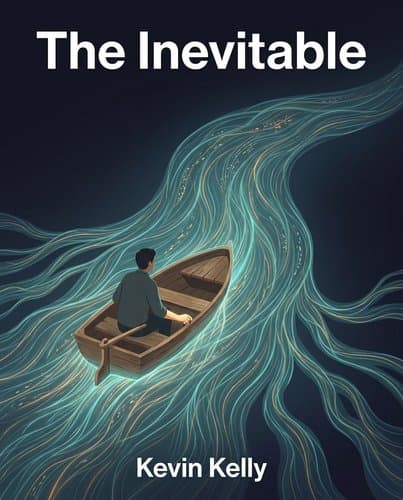
27209431_the-inevitable
by Kevin Kelly
Technology's future is already written into the laws of physics and networks—your only choice is whether you get swept away or learn to read the current and…
In Brief
Technology's future is already written into the laws of physics and networks—your only choice is whether you get swept away or learn to read the current and steer. Kevin Kelly maps 12 unstoppable forces reshaping civilization so you can stop fighting change and start civilizing it.
Key Ideas
Accept inevitable technology, shape regulation
When a technology's trajectory is fixed, stop spending energy on prohibition and redirect it toward civilizing the particulars — lobby for how it's regulated, not whether it exists.
Build value on uncopyable traits
When your medium becomes free, map the 'generatives' — the uncopyable qualities in your work (trust, immediacy, personalization, patronage, interpretation) — and build your value there instead of competing on the copy.
Ask questions, direct human-AI work
Pair with AI rather than compete against it: the centaur model (human+AI) currently beats pure AI, but your irreplaceable contribution is formulating the question and directing the collaboration, not executing the task.
Choose access over ownership
For fast-depreciating goods and services, lean toward access over ownership — the discipline of not owning keeps you agile and unburdened by assets that become liabilities as the underlying technology shifts.
Demand reciprocity in surveillance
When you feel surveilled, the right target is asymmetry — demand reciprocity and accountability from whoever is watching, rather than fighting the existence of tracking itself.
Question quality over answer quantity
Invest in the quality of your questions, not the quantity of your answers. In a world where 2 trillion questions per year get instant free replies, the person who asks the question no one else thought to ask is the one who creates new territory.
Spot structural forces in disruption
Read each disruptive company not as an industry anomaly but as an early expression of a structural force — ask which of Kelly's forces it embodies (dematerialization, decentralization, platform synergy) and you'll see where the same logic will surface next.
Who Should Read This
Readers interested in Futurism and Artificial Intelligence, looking for practical insights they can apply to their own lives.
The Inevitable
By Kevin Kelly
10 min read
Why does it matter? Because the chaos of technological change has a map — and learning to read it changes what's worth fighting and what's worth shaping.
Technology feels like weather — it arrives without warning, bends no rules to our preferences, and cares nothing for our plans. One decade you're buying CDs; the next, ownership feels antiquated. One decade your job is safe; the next, an algorithm does it cheaper. We assume the people who saw these shifts coming were either lucky or unusually farsighted.
Kevin Kelly spent thirty years at the center of the internet's invention and was wrong, repeatedly, about where it was going. So were the smartest people in the room. That pattern of collective blindness is the evidence for his argument: the forces driving digital disruption aren't random. They run on a current baked into the nature of information itself. And once you can read it, the question stops being whether to fight the tide and starts being where to swim.
Technology Isn't Random — It Has a Direction, and Even the Experts Kept Missing It
Kelly's own magazine got the internet completely wrong. Wired, which he co-founded, was publishing a vision of the future as 5,000 professionally produced TV channels, just better cable. Even the people most excited about what was coming couldn't see its shape.
With that in mind, take the 1989 meeting with ABC's leadership. Kelly left with one parting piece of advice: register abc.com before anyone else did. The domain was unclaimed, free, available in minutes. He checked a week later. Still sitting there.
He'd come to argue that the internet was about to upend their business. The executives were baffled. All that free content, the amateur participation, the sharing — none of it made sense to people whose model was built on passive viewers and professional production. A senior vice president named Stephen Weiswasser delivered the verdict: the internet was a passing fad destined to join CB radio in the footnotes, and nobody was going to turn couch potatoes into active online participants. They showed Kelly the door.
Kelly's explanation for all of this, his own blindness and ABC's both, is the book's central argument. Technology has directional bias baked into the physics of the medium itself. Bits are free to copy, so digital systems drift toward ubiquitous duplication regardless of what any government or company decides. Networks generate value that compounds as nodes multiply, so they grow toward spanning everything. These are properties of physics, not policy. The specific form the internet took — commercial or nonprofit, national or international — wasn't fixed in advance. But a network-of-networks spanning the globe was, the same way four-wheeled vehicles were inevitable even though the SUV wasn't.
Once you see this, the appropriate response changes. You stop trying to hold back a tide that will arrive regardless and start working on the particulars, which are genuinely negotiable. ABC couldn't have stopped the decentralization of media. It could have shaped how it arrived. The domain abc.com was exactly that kind of particular. They missed it because they couldn't tell the force from the form.
When Copies Cost Nothing, Everything Valuable Becomes What You Can't Copy
Imagine what happened to candles when electricity arrived. For most of human history, candlelight was for the poor — the wealthy burned oil lamps and gas jets, anything more reliable. When electricity became cheap enough to leave the lights on all night without counting the cost, the economics flipped: candles migrated upmarket. A set of tapered candles at a dinner table today is a luxury signal. The cheap thing became the scarce thing.
The same inversion is happening to digital content.
The internet is, at its core, a copying machine. Every file you send gets duplicated in transit: memory, cache, servers, routers. This isn't a design flaw; it's how data travels. Once something digital touches the network, copies multiply and persist. Trying to stop the copying, Kelly argues, would mean stopping the internet itself.
So if perfect copies are free and infinite, what happens to value? The same thing cheap electricity did to candles: it inverts. When copies are superabundant, copies become worthless. Value migrates to whatever can't be copied.
Kelly calls these uncopyable qualities "generatives": things that must be generated fresh at the moment of transaction, can't be stockpiled, and can't be faked for long. One is immediacy. A film will stream free in ninety days. People still pay opening-weekend prices to see it the night it opens. The copy is coming. The now costs extra.
The most counterintuitive generative is patronage. The easy assumption is that audiences will pocket whatever's free. Radiohead tested this in 2007, releasing In Rainbows on a pay-what-you-want basis — fans could download it for nothing if they chose. The average payment landed at $2.26 per download, and the band earned more from that single release than from all their previous label albums combined. Millions of CDs followed. People wanted to pay because doing so created a connection to the people who made the music. That connection is genuinely uncopyable.
A different economy forms around these qualities: not the economics of copies, but of context, timing, and trust. Copies travel free. Everything else is worth paying for.
AI Won't Take Your Job — It Will Take Your Tasks, Which Is Not the Same Thing
Garry Kasparov lost to a machine in 1997 and spent the years after doing something nobody expected: he made the machine his partner.
After IBM's Deep Blue beat the reigning world chess champion, Kasparov pioneered freestyle chess: competitions where players could use any combination of human and computer help they chose. You could play unassisted, let a computer play through you, or operate as a hybrid, listening to the AI's suggestions but occasionally overriding them, the way you follow GPS but ignore it when a shortcut looks obvious.
The hybrid won. In a major freestyle tournament in 2014, pure AI engines took 42 games. Human-AI centaurs took 53. The best player wasn't a machine — it was a team called Intagrand, several humans working alongside several different chess programs. What should have looked like catastrophe didn't destroy human chess at all. There are now twice as many grandmasters as when Deep Blue first beat Kasparov. The AI made human players better.
The centaur model, built on collaboration rather than replacement, scales because the human's role isn't speed or calculation — it's knowing what should be done at all. That's how most human work will change. AI takes the tasks. You handle the parts requiring judgment and novelty.
That's the reassuring case. Then Kelly quietly introduces evidence that points somewhere else.
DeepMind gave an AI the 1980s arcade game Breakout and told it nothing except to keep increasing its score. By game 300, it never missed. The strange part came later: the AI discovered an exploit no human player had ever found in the game's entire history, a tunneling method the designers hadn't imagined. It wasn't getting better at the human strategy. It had abandoned the human strategy and found an alien one.
The centaur model doesn't resolve that tension cleanly. Human-AI collaboration works while humans can evaluate what the AI proposes, recognizing a good chess move or sensing when navigation has gone wrong. But if the AI is operating on logic no human has ever tried, the human's role in the hybrid starts to thin. Magnus Carlsen, the reigning world champion, trained extensively with AI engines and was praised as "the most computerlike of all human players," a compliment for thinking more like the machine. At some point you have to wonder which direction the collaboration is pulling.
The jobs won't vanish; they'll change. But into what, and on whose terms, stays genuinely open.
The Most Successful Companies of the Next Decade Will Own Almost Nothing
Imagine subscribing to clothes. A fresh outfit each day, returned when you're done. Camping gear summoned when you need it, gone when you don't. All music, movies, and books through a single monthly service. This isn't a prediction; it's already the structure. Uber owns no vehicles, Facebook creates no content, Alibaba holds no inventory, Airbnb owns no real estate.
Two forces drive it more than any others. Physical things are shedding their mass. A beer can weighed 73 grams in 1950; today it weighs 13, doing the same job with a fifth of the material. GDP per kilogram of inputs nearly doubled from 1977 to 2000. Hardware is behaving like software: the capability stays, the atoms go.
And the most powerful computing on earth is now something you rent by the minute. The server farms that train the world's largest AI models and handle billions of searches belong to Amazon and Google. The companies using that infrastructure don't own it; they summon it, pay for the moment, and release it. Owning it outright would be waste.
When the right tool arrives within an hour and disappears when you're done with it, accumulating things you rarely use stops being prudent. It becomes a burden.
One man in 2050 tries to explain this to his father. He subscribes to clothes, summons camping gear on demand, gets every book ever written through one service. His father asks if he feels untethered. He says the opposite — he feels like a hunter-gatherer who conjures a tool when needed and moves on. It's the farmer, he says, who needs a barn.
The direction isn't negotiable. What remains negotiable (who controls the platforms, what rights users keep, how data is shared) is exactly where the important choices live.
You're Already Being Tracked — The Only Question Is Whether You Can Track Back
Picture a small town where your neighbor across the street watches you leave for work, notices you brought home a new television, sees whose car is parked outside on weekends. You find this uncomfortable — until you realize you're doing the same thing back. You know which nights she stays late at the office, what goes into her grocery cart. The mutual watching pays off: when a stranger tries your door while you're away, she calls the police. When she travels, you collect her mail.
This isn't a violation of some older, private way of living. It was the older way of living. For most of human history, people existed inside exactly this kind of ambient surveillance: tribal, visible, accountable in both directions. What digital tracking has broken isn't the norm of watching. It's the norm of symmetry.
Google knows your location, your search history, your purchasing patterns, the exact pages of ebooks where you stopped reading. You know nothing about Google in return. You're watched but can't watch back. The data gets used in ways you can't see, for purposes you haven't agreed to, by institutions that face no consequences for getting it wrong. The asymmetry is the injury.
The fight worth having isn't over whether tracking happens — the physics of a networked world guarantee it. The fight is over the terms. Mutual transparency, where the tracked can see the trackers and hold them accountable, turns surveillance into something closer to that small-town street: uncomfortable sometimes, but livable, because both sides are visible.
Prohibiting tracking is a fantasy. Regulating its character is a choice you can actually make. The small-town neighbor couldn't opt out of being seen either. She just made sure she could see back.
Answers Are Becoming Worthless. The Question Is the New Scarce Resource.
Has access to every answer ever written made humanity wiser, or just faster at looking things up?
Kelly's answer is the second, and he treats it as good news once you see what it implies.
Every year, two trillion questions get typed into search engines. Researchers at the University of Michigan tested what those answers are actually worth: students were sent to answer Google-style queries using only a university library. Average time in the stacks: 22 minutes. Average time on Google: 7 minutes. At average wages, that's $1.37 saved per search, and the price keeps falling. Answers are approaching free, instant, and everywhere.
Which is exactly when Pablo Picasso's 1964 remark stops sounding like a dismissal and starts sounding like prophecy. Told that computers were becoming powerful enough to answer any question put to them, Picasso shrugged: "Computers are useless. They only give you answers." He wasn't being contrarian. He was fifty years early with an accurate diagnosis of where value was heading.
When answers are cheap, the bottleneck shifts upstream, to whoever formulates the right question. Einstein, as a boy, wondered what the world would look like if you were riding alongside a beam of light. No database could have generated that question. It required someone willing to sit with a productive uncertainty, to wonder about something with no obvious answer yet. That question became the theory of relativity.
A question worth asking does three things an answer can't: it resists immediate resolution, it opens new territory, and it generates more questions than it closes. The answer machine can expand infinitely. The capacity to form the next question doesn't scale the same way. That asymmetry — answers cheap, questions scarce — is where human irreplaceability lives.
We Are the First Humans to Witness a Planetary Mind Coming Online
Pull up a satellite photograph of Earth at night. City lights cluster in brilliant nodes, bright at their cores, thinning toward their edges, then sending thin branching threads of illuminated highway out toward the next cluster. The image is unmistakable once you see it: you're looking at a nervous system. The cities are neurons. The highways are axons. The whole thing is firing.
Kelly's name for this thing is the holos — the planetary layer formed by 7 billion human minds, 15 billion wired devices, and whatever behavior emerges when you run them together at scale. The numbers strain comprehension: each of those 15 billion devices contains up to 4 billion transistors, so the holos operates on roughly a sextillion processing units in total. The human brain runs on about 86 billion neurons. The holos already exceeds human neural complexity by a factor of a trillion — and unlike your brain, it doubles every few years. It has been running without interruption for thirty years. No machine humanity has ever built comes close to that uptime record.
Kelly uses the phase transition to explain why this feels simultaneously underwhelming and enormous. Water heats incrementally. Nothing seems to change. Until suddenly it doesn't. Same molecules, entirely new behavior. We are at that threshold now: old forces like centralized authority and uniform broadcast slowly fading, new ones like sharing and distributed access rising to replace them. The products of 2045 are unknowable. The direction is not.
Every generation gets to watch something begin, but not every beginning is a phase transition. This one is. The planetary nervous system in that satellite photograph is, right now, crossing the threshold that separates a collection of parts from something that behaves like a whole. You are watching it happen. Depending on your disposition, that is either terrifying or the most interesting place a human being has ever been.
You Are Not Late — You Are Exactly at the Beginning
The ABC executives who couldn't register a free domain weren't stupid. They were looking at something genuinely new and reaching for the closest familiar shape. You will do the same thing. So will I. The specific form the next decade takes will surprise everyone paying the most attention.
What he's offering isn't a map. It's something stranger and more useful: the posture of someone who knows the tide will arrive and has decided to spend his energy on where it lands rather than whether it does. Accepting the direction isn't the same as accepting the outcome. The tide arrives; what it meets is still being decided.
A planetary nervous system is coming online for the first time in the history of life on earth. You are present for that. The anxiety and the wonder are both appropriate. The question that actually matters: given that the direction is fixed, what will you choose to civilize?
Notable Quotes
“It was not designed for doing commerce, and it does not gracefully accommodate new arrivals.”
“The article was written by an astrophysicist and network expert, Cliff Stoll, who argued that online shopping and online communities were an unrealistic fantasy that betrayed common sense.”
“Yet Nicholas Negroponte, director of the MIT Media Lab, predicts that we'll soon buy books and newspapers straight over the Internet. Uh, sure.”
Frequently Asked Questions
- What is The Inevitable about?
- The Inevitable identifies twelve technological forces shaping the next thirty years and argues their trajectories are inevitable and largely fixed. Rather than fighting these forces, Kevin Kelly guides readers on how to steer strategically with them—understanding how to build economic value when copies become free, collaborate with AI as a partner, and adapt to ubiquitous tracking. The book provides a practical framework for reading technological change, showing where to redirect energy from resistance toward actively shaping how technologies develop and are governed.
- What should I do when a technology's trajectory is fixed?
- When a technology's trajectory is fixed, stop spending energy on prohibition and redirect it toward civilizing the particulars — lobby for how it's regulated, not whether it exists. Instead of resisting the technology itself, focus efforts on shaping its governance and specific implementation. This pragmatic approach acknowledges that certain technological forces are unstoppable, so the smart strategy is to influence their development and use rather than expend resources trying to prevent their emergence.
- How can I build value when my medium becomes free?
- When your medium becomes free, map the 'generatives' — the uncopyable qualities in your work (trust, immediacy, personalization, patronage, interpretation) — and build your value there instead of competing on the copy. This strategy shifts focus from protecting copies to cultivating irreplaceable human qualities. In a world where information is freely available, competitive advantage comes from trustworthiness, direct connection, customization, creator support, and insightful analysis—dimensions of value that can't be replicated or commodified.
- What is the centaur model in AI?
- The centaur model (human+AI) currently beats pure AI alone, making it the optimal approach for technological collaboration. Your irreplaceable contribution is formulating the question and directing the collaboration, not executing the task itself. By pairing human judgment, creativity, and problem-framing ability with AI's computational power and pattern recognition capabilities, you create a dynamic partnership where each side strengthens the other's weaknesses, positioning you for significant advantage in an AI-augmented world.
Related Book Summaries
Read the full summary of 27209431_the-inevitable on InShort