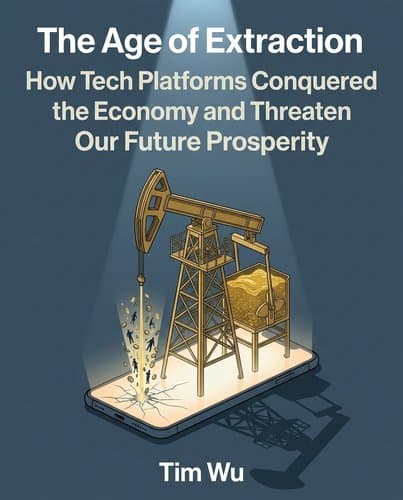
226747018_the-age-of-extraction
by Tim Wu
Tech giants aren't just profitable—they're extracting wealth from workers, competitors, and democracy itself through market power disguised as innovation.
In Brief
Tech giants aren't just profitable—they're extracting wealth from workers, competitors, and democracy itself through market power disguised as innovation. Tim Wu reveals how profit-to-payroll ratios, suppressed wages, and 'free' services that harvest your data expose a rigged economy demanding urgent antitrust reform.
Key Ideas
High profits signal market dominance, not efficiency
When a company's profit-to-payroll ratio exceeds 300% (as at Apple and Facebook), its profits are not a sign of productivity — they are a sign of market power. Treat soaring corporate profits during wage stagnation as a diagnostic, not a celebration.
Free services extract user data as payment
'Free' digital services are barter transactions. You are trading behavioral data and attention for access. The economic value of that trade accrues almost entirely to the platform, not to you — and your usage actively deepens the moat that keeps competitors out.
Labor market stability can mask stagnation
Job stability and longer tenure are not unambiguous goods. In a high-market-power economy, low labor market dynamism means fewer open positions, less upward mobility, and the misallocation of human talent — a still surface concealing a stagnant current underneath.
Stable prices amid falling costs reveal power
The markup data offers a simple diagnostic: in a healthy competitive market, cost savings pass through to prices. If a firm consistently keeps prices stable while input costs fall (incomplete pass-through), it has market power. Watch for this in every industry, not just tech.
Antitrust must protect workers, not just consumers
Antitrust enforcement focused exclusively on consumer prices (the Bork 'consumer welfare' standard) is structurally blind to how consolidation suppresses wages, kills startups, and corrupts democratic politics. Effective reform requires expanding the standard to include workers and competitive dynamism.
Invisible market failures are key policy data
The startups that weren't launched, the workers who didn't relocate, the firms that went bankrupt after Amazon entered their market — these are the most important data points for understanding market power, and they are systematically absent from the data we use to make policy. Demand better data.
Who Should Read This
Readers interested in Artificial Intelligence and Macroeconomics, looking for practical insights they can apply to their own lives.
The Age of Extraction: How Tech Platforms Conquered the Economy and Threaten Our Future Prosperity
By Tim Wu
12 min read
Why does it matter? Because the economy you think is competitive is quietly being owned by a handful of firms — and that's why your paycheck isn't keeping up.
Here's a thought that should bother you: the stock market has been on a forty-year tear, corporate profits have hit levels that would make a Gilded Age robber baron blush, and the median American worker earns, in real terms, almost exactly what they earned in 1980. Not a little less. Almost exactly the same. We've been told this is a paradox — that the puzzle of rising profits alongside stagnant wages defies easy explanation. It doesn't. There is a precise mechanism, hiding in plain sight, that drives the two apart: a small number of firms have used network effects and data monopolies to make themselves nearly impossible to compete with, and then used that position to squeeze everyone who works for them or sells to them. Once you see it, you can't unsee it — and you'll stop blaming yourself, or your choices, or your work ethic, for the gap between what the economy produces and what you're paid to help build it.
The Moat Is the Message: How Winning a Market Becomes a License to Never Compete Again
The free market is not the natural state of things. It is a fragile institutional achievement, and right now it is losing.
Here is what that looks like in the data. When economists Jan De Loecker and Jan Eeckhout analyzed seven decades of company accounting records, they found that average U.S. markups — the gap between what a firm charges and what it costs to produce — rose from 1.21 in 1980 to 1.54 in 2019. Firms that once charged 21 percent above cost now charge 54 percent above cost. But the detail that should stop you cold is this: the median markup barely moved. The average climbed because a cohort of dominant firms at the 90th percentile saw their markups explode from 1.5 to 2.5 over that same period. Half of all firms are competing as hard as ever. The other extreme has escaped competition almost entirely. Those firms at the top now capture so much of the economy that profit-to-payroll ratios — what companies pay their owners versus their workers — jumped from 5 percent in 1984 to over 300 percent at Apple and Facebook.
None of this required a conspiracy. The mechanism is structural, and the eBay story makes it visible. When Yahoo launched a competing auction platform in 1998, it did something any textbook competitor would do: it charged sellers nothing, financing itself through advertising instead. Zero fees versus eBay's fees should have been decisive. It wasn't. Buyers congregated where sellers were concentrated; sellers followed buyers. eBay had arrived first and built a thick market, and that thickness was itself the product. Yahoo couldn't replicate it by being cheaper. It could only replicate it by being first — which it wasn't, in America. In Japan, where Yahoo got there before eBay, the situation is exactly reversed: Yahoo dominates, eBay cannot get a foothold. The winner in a network market isn't the better product. It's whichever product reached critical mass first. The moat, once dug, fills itself.
We inherited a mental model in which monopoly is a temporary aberration — a prize that innovation briefly captures before competition erodes it away. The markup data says otherwise. For a growing share of the economy, winning a market has become a license to stop competing.
You Are Building the Moat Every Time You Search, Swipe, or Click
What do you actually pay for Google Maps? Everything the app learns about you. Every route you request, every detour you take, every business you stop at — data flows in one direction, from you to Google, and the navigation is what you receive in exchange. The service is not free. It is a barter transaction, and you are the supplier.
The mechanism that makes this barter lopsided operates through three reinforcing engines, each running on user behavior as its fuel. Scale drives the first: as firms like Walmart and Amazon invest in logistics infrastructure, their per-unit costs fall, making it mathematically harder for a new entrant to price competitively. Network effects drive the second — the eBay dynamic, where the platform becomes more valuable as more people use it, so competitors can never catch up simply by being cheaper. Learning drives the third, and CAPTCHA tests make it visible in miniature.
When a website asks you to identify traffic lights or fire hydrants in a grid of photographs, you are not proving you're human. You are labeling training data for image-recognition algorithms — performing cognitive labor, without pay, that will eventually allow those same algorithms to replace human recognition entirely. The wit of it is almost impressive: the company turned a security checkbox into a global, unpaid workforce. Every solve reduces the cost of the next one. You are the raw material that builds the moat.
Here is the paradox worth pausing on. The technological progress we experience as democratizing — free navigation, free search, free social connection — is the same mechanism by which a handful of firms accumulate data advantages no competitor can replicate. We celebrate the gift. We are also building the moat, one click at a time.
The Profit Paradox: Profitable Firms That Destroy More Jobs Than They Create
Here is a claim worth sitting with: profitable firms, in sufficient numbers, destroy more jobs than they create. Not through layoffs or offshoring. Through arithmetic.
A firm with market power charges prices above what competition would force it to accept. Higher prices mean fewer buyers, less output, fewer workers hired. That single firm's decision barely registers in the labor market. But imagine every sector has a dominant firm running the same calculation: tech, textiles, retail, beer, pharmaceuticals, each one employing a few fewer people than competition would require. Economist Jan Eeckhout calls this the swarm of locusts: a single insect landing on a crop causes no measurable damage; the swarm strips it bare. The individual effects vanish. The aggregate effect does not. Wages fall across the entire economy, including at the small, perfectly competitive businesses — the pet stores and diners — that never had market power to begin with.
The numbers that document this stripping are almost too clean to believe. For decades after World War II, economists treated the stability of labor's share of GDP as a near-law of nature — workers reliably took home about two-thirds of total output, capital took one-third, and no amount of structural change seemed to move either figure. Then, after 1980, labor's share began falling. It now sits near 59 percent. The missing slice isn't flowing to capital returns — capital's share has also dipped. It's accumulating as pure profit: the excess above what any competitive market would permit.
Median weekly wages in constant 2019 dollars were $812 in 1980 and $917 in 2019. Thirty-nine years. A gain of roughly $100 a week, against a backdrop of GDP nearly doubling. The median worker's claim on the economy's output has roughly halved. Meanwhile, male labor force inactivity — men who have simply stopped looking for work — has tripled since the 1960s to 11 percent. They are people for whom the available wages no longer justify the costs of participating, responding rationally to a labor market that has been slowly, methodically drained of pressure. The economy can be booming, unemployment can look fine, corporate profits can be at record highs — and wages stagnate anyway. That's not a paradox. That's the mechanism.
Same Street, Different Economy: The Neighborhood That Maps the Superstar World
On a quiet residential street behind Princeton High School, Joe and Betty sit outside their house on warm afternoons — a sprawling 1960s ranch house, lawn immaculate, nothing renovated since it was built. In the driveway: a Mercury Grand Marquis, at least fifteen years old. A few doors down, a developer recently tore down an identical house and replaced it in six months with a three-story structure with cathedral ceilings and a two-car garage. The new neighbors, Wei and Li Min, are pharmaceutical PhDs in their thirties, their parents living with them to watch the children. They drive a Tesla and a Volvo. Their combined income probably clears $400,000. Joe and Betty's likely falls below the national average. Same block, same property taxes, same American suburb — and an economic distance between them that is almost cosmological.
The temptation is to read this as a story about credentials and effort. It isn't. The divergence between these two households maps almost perfectly onto a structural transformation that has nothing to do with individual choices. When a small cohort of dominant firms expanded their market power after 1980 — charging more, hiring fewer workers, suppressing wages economy-wide — they redirected economic rewards toward a narrow band of high-skilled specialists needed to build and defend their competitive moats. Pharmaceutical scientists, software engineers, financiers. The Wei and Li Mins of the world. Everyone else, including competent people who followed the rules of an older economy, found themselves in a labor market that had been slowly, systematically drained of pressure.
The consequences fan out from that single block in ways that feel abstract until you see them whole. Male labor force participation has steadily eroded as wages at the lower half of the distribution stopped justifying the cost of working. And at the far end of the distribution, something grimmer: mortality among middle-aged Americans with limited education has actually risen since the late 1990s, driven by suicide and drug poisoning. Anne Case and Angus Deaton, who documented this pattern, found nothing comparable in any other wealthy nation. These are not deaths of bad luck. They are deaths of economic despair — what happens when the work that gave a life structure and dignity stops being available, and nothing replaces it.
Joe and Betty are not unlucky. They are the address where the superstar economy prints its consequences — the house that stays unchanged while the neighborhood rearranges itself around it.
The Stability Trap: Why Longer Job Tenure Is a Sign the Economy Is Broken
Average job duration in the United States rose from 3.2 years in the early 1990s to 4.2 years today. Labor market dynamism — the rate at which firms renew their workforces — fell from 35 percent in 1980 to 25 percent today. People hold jobs longer. Companies churn through workers less. On the surface, this looks like stability. The mechanism producing it is anything but — think of a motorbike with suspension so soft it no longer responds to the road. That's not comfort. That's disconnection.
Return to the gas station intersection. Two stations selling at two dollars a gallon, crude oil costs fall, and competition forces both to pass the savings on — prices drop, volumes rise, hiring adjusts. Complete pass-through. Now remove one station. The lone owner pockets most of the cost drop as margin, output barely shifts, no new hires needed, no layoffs either. The shock from the road never reaches the wheels. A dominant firm doesn't respond to economic conditions the way a competitive firm must, which means it doesn't hire aggressively in good times or shed workers in bad ones. The workforce stays frozen.
Multiply that logic across sectors and you get an economy where surface stability conceals something genuinely alarming. Inter-state migration has halved since 1980 — from three percent to one and a half percent annually — because frozen hiring means fewer openings elsewhere, which means fewer reasons to move. People don't chase opportunities that don't exist. Without that churn, the labor market develops what might be called a promotion-by-funeral problem: the only way a slot opens up is if someone already in it leaves, retires, or dies. The workers at the bottom wait. The misallocation compounds. An economy that feels stable is quietly cementing everyone in place.
What happens, then, when the next wave of productivity arrives into a market already this frozen?
Why AI Won't Save Your Wages — Even If It Saves Your Company Millions
Imagine a factory that doubles its output tomorrow while the number of workers stays exactly the same. Under genuine competition, that surplus has nowhere to hide — rival firms bid wages up and prices down until the productivity gain flows out to workers and consumers. The factory owner captures a normal return. Everyone else captures the rest. This is what economists mean when they say technology raises living standards: the gains propagate outward because no single player can pocket them.
Rerun the same scenario with a dominant firm behind a moat. Output doubles, costs fall, and the savings stay inside the castle. The firm doesn't lower prices much — it has no competitive reason to. It doesn't raise wages much — workers have nowhere better to go. The productivity gain shows up as profit, as bonuses for the narrow class of engineers and executives who built the moat, and as dividends. The factory floor stays flat.
AI and wages follow exactly this logic — and it has nothing to do with whether AI destroys jobs or creates them. When Google Translate shifted from statistical word-mapping to neural translation in 2016, eBay sellers using the improved tool exported 17.5 percent more than they had before. A clear, measurable productivity gain. But that same neural architecture — requiring massive training data, improving with every query, cheaper per unit the more it scales — also deepens exactly the moats that keep gains from spreading. More data generates better models; better models attract more users; more users generate more data. The firm that gets there first builds an advantage that compounds on its own. The productivity gain and the concentration mechanism are the same thing.
The threat isn't AI taking your job. It's AI making your job worth less.
The Evidence We Can't See Is the Evidence That Matters Most
Abraham Wald was a Jewish mathematician who fled Austria after the Nazi invasion and ended up, during the Second World War, advising the U.S. military on how to protect its bombers. Engineers had carefully mapped the bullet holes on returning aircraft and proposed reinforcing the areas most frequently hit — the wings and tail sections. Wald looked at the same data and recommended the opposite: reinforce the underbelly, where almost no holes appeared. The engineers were baffled. He explained that they were only seeing the planes that made it back. The bombers hit in the underbelly were at the bottom of the North Sea. The most important evidence was exactly where the data went silent.
The labor market operates under the same blind spot. When Amazon enters a local retail market, some stores close. Standard analysis tracks what remains: jobs at Amazon, prices at Amazon, Amazon's profits. The mom-and-pop shops that quietly folded are in the data. What isn't are the businesses that saw Amazon coming and never opened — the entrepreneur who ran the numbers, decided competing was impossible, and became a warehouse worker instead. Every suppressed startup, every worker who stopped moving toward opportunity because opportunity stopped appearing, every competitor deterred before launching: gone from the record, precisely because market power worked.
You cannot fix what you cannot see. U.S. unemployment statistics are built from telephone surveys of 60,000 households out of 330 million people, using methodology designed when rotary phones were novel and response rates were 80 percent. Today response rates have collapsed to 8 percent. Meanwhile, Amazon tracks the real-time purchase behavior of 150 million Prime members. The government running antitrust law has eighteenth-century instruments; the firms that antitrust law is supposed to restrain have instruments from the future.
Corporate Responsibility Won't Fix This. Only Antitrust Can.
Corporate responsibility cannot fix market power, and the Boeing 737 MAX makes this argument in the most brutal terms available. Before the first plane left the ground, Boeing's engineers knew the anti-stall software relied on a single sensor with no redundancy. Fixing it meant delays, cost overruns, and furious shareholders. So Boeing's executives ran a quiet actuarial calculation: the probability of catastrophic failure was low, the financial cost of grounding was certain, and the personal downside in the worst case was bounded — bankruptcy, not prison. They gambled. Two planes went down within six months. Three hundred and forty-six people died. After the second crash, Boeing's stock dropped eleven percent. The executives who made the call suffered roughly the cost of a bad quarter. The free-market argument — that reputational damage disciplines rogue companies — dissolves entirely when the machine is complex, the information is private, and the incentive to gamble is steep enough. No stakeholder capitalism would have changed Boeing's math. Only a regulator with genuine independence and genuine teeth could have forced the second sensor in before the first flight.
The same logic has hollowed out antitrust enforcement across the entire economy. When Robert Bork reframed antitrust law in 1978 around a single question — does this merger raise consumer prices? — he gave regulators permission to ignore what consolidation does to workers, to potential competitors, to the flow of political influence. Federal merger challenges dropped from nearly sixteen cases per year before 2000 to three per year afterward. The dominant firms those mergers created then generated profits large enough to fund the lobbying campaigns that kept the case rate low. The moat finances the lobbyist who prevents the moat from being filled. That is not a scandal solvable by enlightened leadership. It is a closed loop, and it opens from the outside or it doesn't open at all.
The optimism here is genuine but specific. The problem is not an economic mystery — the mechanism is well understood, the tools exist, and history offers working models. Consider interoperability rather than breakup: force dominant platforms to let competitors operate on their infrastructure. What would that look like in practice? If Instagram were required to open its social graph, a user on a rival app could follow an Instagram account and see its posts without ever touching Instagram's interface. The network effect that locks users in would become a bridge rather than a wall. What is required is a competition authority genuinely insulated from the lobbying cycle it is meant to interrupt — independent the way a central bank is independent, staffed to match the complexity of the firms it oversees, and given a mandate that includes workers and innovation, not just next quarter's prices. The obstacle is political will. That is a harder problem than economics, but it is a solvable one — and confusing it with an unsolvable one is itself a form of surrender.
The Illusion That Keeps the Moat Full
George Orwell's observation that the trouble with competitions is that somebody wins them sounds like a joke until you follow it all the way down. We built an economy that treats winning as self-justifying — the trophy is its own argument. But the markup data, the wage charts, the missing startups, the men who stopped looking for work: these are the invoice that arrives after the celebration. They are what winning costs everyone who didn't.
None of this is mysterious. We have the diagnosis, the tools, the historical precedents. What we lack is a competition authority genuinely insulated from the profits it exists to restrain — and that is a democracy problem, not an economics one. Think about the man who stopped looking for work, or the entrepreneur who never opened. What changes for them is not a new index or a revised merger threshold. What changes is whether anyone in government decides that their situation matters more than the lobbying budget of the firm that helped cause it. That decision is still available. It has not been made yet. The reader who understands why is exactly the kind of citizen a functional competition policy requires.
Notable Quotes
“The trouble with competitions is that somebody wins them.”
Frequently Asked Questions
- What does "The Age of Extraction" argue about tech platforms and economic inequality?
- The book argues that technological progress concentrates wealth rather than spreading it, and that dominant platforms extract enormous value from workers, consumers, and democracy. Tim Wu demonstrates that when a company's profit-to-payroll ratio exceeds 300% (as at Apple and Facebook), "its profits are not a sign of productivity — they are a sign of market power." Rather than celebrating rising corporate profits during wage stagnation, we should treat these metrics as diagnostic indicators of market concentration. Wu's analysis reveals how digital monopolies have structured their business models to extract maximum value while providing minimal compensation to the workers and users generating that value.
- How can you identify market power in tech companies and other industries?
- Tim Wu provides a simple diagnostic: "in a healthy competitive market, cost savings pass through to prices. If a firm consistently keeps prices stable while input costs fall (incomplete pass-through), it has market power." Watch for this incomplete pass-through pattern across all industries. Additionally, when a company's profit-to-payroll ratio substantially exceeds the expected range, or when "free" digital services extract behavioral data and attention while hoarding the economic value for themselves, these are reliable signals of entrenched market power. The key is recognizing these patterns as diagnostic tools.
- Why is the current consumer welfare standard for antitrust enforcement inadequate?
- The current antitrust standard, known as the Bork "consumer welfare" standard, is "structurally blind to how consolidation suppresses wages, kills startups, and corrupts democratic politics." Wu argues this framework is insufficient because it focuses narrowly on consumer prices while ignoring broader economic impacts. Effective antitrust reform requires expanding beyond this limited standard to include worker welfare and competitive dynamism. Without this broader lens, regulators cannot see how market consolidation damages labor markets, entrepreneurship, and democratic institutions—the true costs of extraction.
- What does Tim Wu mean by "free" digital services being barter transactions?
- Wu explains that "'Free' digital services are barter transactions. You are trading behavioral data and attention for access." He further notes that "The economic value of that trade accrues almost entirely to the platform, not to you—and your usage actively deepens the moat that keeps competitors out." This asymmetrical exchange reveals that users receive minimal value while platforms capture enormous profits and strengthen their competitive advantages. Users' engagement reinforces platform dominance, making it nearly impossible for meaningful alternatives to emerge and break their market control.
Related Book Summaries


Read the full summary of 226747018_the-age-of-extraction on InShort