19485243_business-execution-for-results
by Stephen Lynch
Most companies fail at Lean not because of flawed tools, but because leaders refuse to change themselves before demanding change from others.
In Brief
Most companies fail at Lean not because of flawed tools, but because leaders refuse to change themselves before demanding change from others. Lynch shows how to build a culture where Kanban boards and Kaizen cycles actually stick—measured in real financial outcomes, not consultant-driven theater.
Key Ideas
Map processes from customer perspective first
Before launching any Lean initiative, map your current processes from the customer's point of view — not management's — and interview front-line salespeople and actual customers personally before drawing conclusions
Culture is primary, tools are secondary
Treat the cultural shift as the primary project and the tools (Kanban boards, 5S, Kaizen cycles) as supporting evidence that the culture is working; if the tools disappear when the consultant leaves, the culture was never there
Build cross-level teams, not just leadership
Never compose the implementation team exclusively from department heads reporting to the MD; include people from all hierarchical levels, because the information you most need to surface is exactly what a sycophantic top-down team will suppress
Radical reset first, continuous improvement next
Use Kaikaku (radical reset) when incrementalism has failed or the baseline is broken, then switch to Kaizen (continuous improvement) to polish the new baseline — don't confuse the spark with the fuel
Define measurable KPIs before you start
Define specific, measurable KPIs before implementation begins (e.g., 15% more new customers, 20% reduction in setup time) so Lean improvements can be proven in financial terms that satisfy internal skeptics
Cross-train in three areas minimum
Cross-train every employee in at least three functional areas; single-point-of-failure specialists are a bottleneck waiting to happen in any small team
Redesign growth paths when plateaus hit
When performance declines after a successful Lean rollout, the cause is usually exhausted challenges rather than process failure — sit down with employees and ask what kind of challenges they're looking for, then redesign their growth path
Measure cash-to-cash cycle not just operations
Measure your Cash-to-Cash cycle (Days Sales Outstanding + Inventory Days − Days Payable Outstanding) to expose how much liquidity is trapped in your supply chain; this is a more meaningful Lean metric than most operational KPIs
Leaders must change their behavior first
If you are not personally willing to change your own behavior, don't start a Lean program — the research consistently shows that employee resistance at every level is downstream of the same resistance at the top
Who Should Read This
Business operators, founders, and managers interested in Leadership and Management who want frameworks they can apply this week.
Business Execution for RESULTS: A Practical Guide for Leaders of Small to Mid-Sized Firms
By Stephen Lynch
12 min read
Why does it matter? Because the process you're trying to fix is probably not the real problem.
Imagine a mortgage application touching thirty pairs of hands before approval. Your instinct, and almost every consultant you've ever hired, would say: fix the process. Redesign the workflow. Buy better software. Reorganize the org chart. That instinct is understandable — and it's precisely where most improvement initiatives collapse. Because the process isn't the real problem. The real problem is that leaders will restructure everything in the organization except themselves, and Lean Management only works when the culture beneath the surface matches the tools sitting on top of it. Most companies get the visible ten percent right and leave the other ninety untouched. This book is about that ninety percent: what it actually looks like to change your own behavior first, and why that uncomfortable act is the only thing that makes everything else stick.
Growth Built the Bureaucracy That's Killing You
Jairam Sridharan, president of Axis Bank in India, noticed something troubling: fewer and fewer customers were applying for mortgages. When he traced the problem back, it wasn't interest rates or competition. It was paperwork — specifically, every mortgage application passing through thirty pairs of hands before anyone made a decision. Customers weren't being driven away by price. They were being driven away by the organization itself.
The fix Axis Bank landed on wasn't a new software platform. It was a philosophy borrowed from Japanese manufacturing floors and translated into the language of service businesses. Lean Management. Strip out everything that doesn't directly improve the process. Make the customer wait for value, not for bureaucracy.
What makes the Axis Bank story genuinely unsettling is that the bank wasn't failing when those thirty handoffs accumulated. It was probably growing. That's precisely when the trap springs. A company two or three years into solid performance — rising sales, satisfied customers, a team starting to gel — reaches a natural inflection point. Leaders who were once scrappy and reflective start adding layers. A new approval step here, a coordination role there, a committee to oversee what one person used to decide alone. None of it feels like empire-building in the moment. It feels like professionalism. It feels like scale.
But each addition shifts the organization's center of gravity away from the customer and toward itself. Processes that exist to serve the work gradually accumulate processes that only serve each other. By the time the mortgage queue stretches through thirty hands, nobody remembers which of those steps ever made sense.
Lean's central claim is that bureaucracy isn't a symptom of something going wrong — it's a natural byproduct of things going right. Growth creates complexity, complexity creates coordination needs, and coordination needs create structure. Every successful company is building the machine that will eventually slow it down. The only question is whether anyone is paying attention when it happens.
The 90% of Lean That Never Appears in the Brochure
Imagine you buy a gym membership, hire a personal trainer, and upgrade your diet tracking app. Six months later, you're still not fit. The problem isn't the tools — it's that you haven't changed how you actually live. Lean Management runs into exactly this wall.
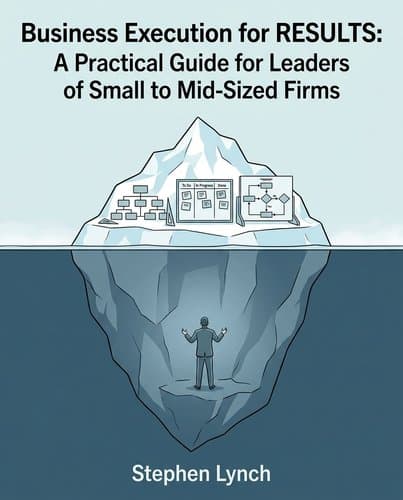
Mike Rother, a researcher who spent years studying Toyota's methods, captured the problem with an image that's hard to forget: an iceberg. The tools and techniques of Lean — new software, reorganized workspaces, specific production methods — represent the 10% visible above the waterline. The remaining 90%, submerged and invisible, is the cultural shift: the willingness to rethink behaviors, admit mistakes openly, and challenge the assumptions that made you successful in the first place. Most companies implement the visible tip, declare the project complete, and leave the iceberg untouched.
This isn't ignorance. It's avoidance. The tools are easier to sell internally because they're concrete and bounded. You can point to the new desk arrangement. You can demo the software. Culture, by contrast, requires managers to change themselves, which means admitting that their current way of operating has been part of the problem. For many leaders, that's the real cost of Lean, and it's not on any vendor's invoice.
The practical result is that structural changes without cultural ones collapse back into old patterns. When companies restructure around the visible toolkit alone, they're decorating the surface of an iceberg they haven't examined. The water temperature stays the same. The 90% doesn't move.
"Less is more" takes on a specific meaning in this context: fewer tools wielded by people with a genuinely different attitude, not more tools applied to unchanged habits. It's a warning, not an aesthetic preference. An organization that has internalized Lean doesn't need an elaborate toolkit to keep improving, because improvement has become the default behavior. One that hasn't will find even the best toolkit gradually gathering dust.
The section of the iceberg you haven't addressed yet — that's where your leverage is.
The Person Least Qualified to Lead the Change Is Often Running It
Who actually knows where the waste is hiding in your organization?
Not you — and that's the structural problem. Research on Lean failures in small and mid-sized firms points consistently to the same origin: a leader who wants the efficiency gains without changing their own behavior first. The resistance that shows up downstream — middle managers dragging their feet, shop-floor workers waiting to be told what to do — isn't the source of the problem. It's the echo of what's happening at the top.
Consider the most common team structure assembled to run a Lean initiative: department heads in a room, with the managing director at the head of the table. It looks like leadership. It functions like a filter. When the person with the most authority is also running the meeting, everyone else unconsciously audits what they're about to say before saying it. The honest friction — the operational snags that middle managers actually see every day — gets smoothed away before it reaches the surface. The team produces consensus. The company produces nothing useful.
This is the Managing Director trap: the belief that putting the most powerful person in charge of the change process accelerates it, when in practice it insulates that person from the information the process depends on. The middle layer of any organization carries localized knowledge that executives structurally cannot have. When that layer goes quiet to avoid discomfort, the whole effort runs on incomplete data dressed up as alignment.
The deeper problem is the assumption Lean directly challenges: that organizational transformation is something you commission rather than something you do. Lean cannot be handed to a designated Lean Manager to execute while leadership carries on unchanged. Short, flat-hierarchy check-ins work precisely because they shift the floor to the people doing the work and ask them directly: where are the problems, and what do we do about them right now? But those meetings only produce honest answers if leadership has already signaled that honest answers are welcome. If the people at the top don't visibly alter how they run meetings, respond to mistakes, and spend their time, front-line staff clock the gap between stated values and actual behavior within weeks — and adjust accordingly.
The uncomfortable reversal is this: every employee behavior you want to change is, in part, a learned response to how you've been leading. Fix that first, and make it safe and worthwhile for them to say so.
Customer Value Is Defined by the Customer, Not Your Conference Room
A technology conference convened somewhere in Asia to connect young people with ideas about civil society and open data. Registration numbers looked healthy — the event was free, which helped. Sponsors paid the bills, and in exchange they shaped the agenda, picked the themes, and approved the speakers. The organizers never asked attendees what they already knew, what they hoped to learn, or whether the subject matter made any sense to them. On the day, participants sat through presentations aimed at satisfying the sponsors' ideological priorities and left, by most accounts, confused and unable to follow what had been said. High registration. Zero value. The organizers had mistaken attendance for interest, and interest for comprehension.
The corrective Lynch prescribes is deliberately unglamorous. Before a lean project gets moving, three things need to happen in sequence: talk to the people on your front line who interact with customers every day, because they already know things the conference room doesn't; then go talk to customers directly — in person, in conversation, not through a survey where you control the question format and they give you a number between one and five; and if you're launching something new, test it with a small group before you scale it. None of these steps require a strategy offsite or a new framework. They require leaving the building.
The discipline is in treating customer value as something discovered rather than declared. Your internal consensus about what you're offering is not irrelevant — but it's a hypothesis, not a fact. The moment you stop testing that hypothesis against actual people, you're the conference organizer booking speakers for an audience you've never met.
Waste Is Invisible to Anyone Who Isn't Doing the Work
Who actually knows where the waste is hiding in your organization? Almost certainly not your executive team's last strategic review. It's the person making the coffee.
A restaurant owner, looking to tighten operations, did something most managers skip: he went and watched. Not with a clipboard and a framework — just watched. A barista showed him that every espresso shot required wiping excess grounds off the portafilter edge to create a clean, level surface. Standard technique. Nobody questioned it. Multiply that small handful of discarded grounds by every drink, every day, across a year, and it added up to several kilograms of wasted coffee — waste that was obvious to the person doing the work and invisible to anyone reviewing the financials.
Lean's practical core is this: the information already exists. It lives in the hands and habits of the people closest to the process. The organizational challenge isn't analysis — it's creating conditions where front-line employees will actually tell you what they see.
That gap exists for a predictable reason. When pointing out inefficiency has historically gotten people ignored, dismissed, or quietly marked as troublemakers, they stop pointing. The knowledge doesn't disappear; it goes underground. Lean's job is to reverse that dynamic — to build an environment where surfacing a problem is valued over defending the status quo. Meetings become a useful diagnostic here: if your standing meetings are structured so that a team leader or senior manager does most of the talking, you've built a system that filters exactly the information you need. Short, flat-hierarchy check-ins — borrowed from software development's daily stand-ups — work because they shift the floor to the people doing the work and ask them directly: where are the problems, and what do we do about them right now?
This is also why Lean consistently warns against keeping improvement work inside the conference room. Waste reduction conducted entirely by people who don't touch the day-to-day process tends to produce solutions to problems that aren't actually there, while leaving the real friction untouched. The barista wasn't waiting to be surveyed. He just needed someone to show up and pay attention.
The shift this requires is simple but real: you are not the best-positioned person to identify what's broken. Your employees are. Your job is to make it safe and worthwhile for them to say so.
The Tools Work. The Problem Is What Comes After.
Three Lean tools, three different jobs — and confusing them is how Lean implementations quietly fail.
Kaizen is the one most leaders reach for first, and for good reason. Its premise is disarmingly simple: improvement never stops, it operates at every level, and small changes compound into something significant over time. Western management absorbed this as the Continuous Improvement Process, built around suggestion schemes, ongoing training, and flattening hierarchy. The philosophy is sound. The failure mode is subtle. Continuous incremental improvement only works on existing products and services — and if nobody occasionally steps back to ask whether the thing being improved still makes sense, you end up with a monster. The web agency that started in software development, moved into app builds, and eventually added virtual reality didn't get there through negligence. It got there through Kaizen applied without judgment. At some point the right move wasn't another improvement cycle; it was splitting the entity apart. Never resting is a virtue right up until it becomes an excuse not to reconsider.
That's precisely where Kaikaku earns its place. Developed as the radical counterpart to Kaizen, it runs on a short fuse by design — introduced as a project, not a philosophy. Its most clarifying rule, articulated by Hiroyuki Hirano, is that a fifty-percent implementation done immediately beats a perfect solution delivered late. Kaikaku exists to break institutional inertia, not to refine what's already there. Think of it as the initial spark: it sets a new baseline by forcing a genuine break from the status quo, which Kaizen then polishes over time. The two aren't competing approaches — they're a sequence.
Kanban handles something neither of the above touches: visibility into whether work is actually moving. Its mechanism is a board divided into columns — To Do, Doing, Done — each with a hard capacity limit. That ceiling is everything. Without it, the board is just a to-do list. With it, the system cannot accept more work than it can process, which forces bottlenecks into the open before they become stoppages. The tool doesn't improve the work. It shows you where the flow has broken down, so you can.
Lean Leadership Means Working Yourself Out of the Daily Job
A senior manager at an American manufacturing company returns from a plant visit, writes up his observations, and sends a report to his team. He never leaves the office. Lonnie Wilson, a lean consultant who spent years diagnosing why American firms kept underperforming their Japanese counterparts, identified this habit as the central failure of Western management: the belief that you can lead through data and memos without ever standing next to the people doing the actual work. The consequence, Wilson argued, wasn't just inefficiency. It was a mental model that turned employees into line items — costs to be cut rather than people whose judgment and capability were the only thing that made the capital equipment worth anything at all.
Toyota's answer was a four-stage development path that every manager walked in sequence. First, self-reflection: understanding your own behavior well enough to improve it. Second, coaching individuals so they can evaluate themselves. Third, building team capability — how groups work together, where the friction is, how to apply a continuous improvement mindset collectively. Only after completing all three could a manager reach the fourth stage: strategic vision and organizational design. The sequence is the point. A leader who skips straight to strategy without doing the earlier work produces a coherent-sounding vision that the organization has no capacity to execute, because the people beneath them have never been developed to think or act independently. Structural changes applied to an unreformed culture are cosmetic. The org chart changes; the habits don't.
The uncomfortable reversal built into this model is that Lean leadership is primarily self-development work — and its measure of success is becoming less necessary in daily operations. When your employees can identify waste, solve problems, and take responsibility without waiting to be told, you've done your job. The temptation for most managers is to read that as a threat. The right reading is a promotion: you've freed yourself to focus on structure, direction, and the long view instead of troubleshooting what should already be handled. That shift requires genuinely handing over control — not as a management technique, but as an act of trust. Salary increases buy compliance for a quarter. Trusting someone with real responsibility changes how they think about their work. The difference is the distance between a manager who tells people what to do and one who makes people capable of deciding for themselves.
Why the Transformation You Already Tried Didn't Stick
Why did the last improvement initiative you ran stop improving?
The car dealer who implemented Lean across his workshop branches had every visible metric moving in the right direction. Cars turned around faster. Material consumption dropped, partly through a smarter method of refilling engine oil. Every repair got properly documented through a new IT system. Then, gradually, repair times crept back up. The processes hadn't changed. The mechanics were doing the work correctly. But when the dealer went to the workshops and watched, what he saw wasn't incompetence — it was indifference. The enthusiasm had drained out. When he asked, the answer was simple: the system worked, the improvements were real, but there was nothing left to discover. The work had become routine. The tools had succeeded. The culture hadn't kept up.
That's the failure mode that catches most improvement initiatives: leadership changes the methodology without changing the philosophy underneath, and once the novelty fades, the old culture flows back in like water finding its level. The mechanics didn't need better processes — they'd already built those. They needed challenges, and nobody had built a system for generating them. The dealer's fix was to sit with them and ask what kind of growth they were chasing, which pointed toward technical training in electronics and engine technology. A small pivot, but it required treating employees as the source of the answer rather than recipients of the solution.
Which brings us to the person at the center of that system. The person blocking your Lean implementation is almost certainly you. Martin Busse, a researcher who mapped the factors separating durable Lean programs from ones that quietly expire, put 'seeing mistakes as an opportunity' and 'improvement at the place of action' near the top of his list. Both are impossible to sustain in an organization where the default response to a problem is to assign blame and issue a corrected procedure. The philosophy has to change first, or the tools operate inside a container that gradually crushes them.
Before asking which tool you used incorrectly last time, ask what you personally kept doing the same way. Fix that first.
The Lean Promise Is Not a Project With a Completion Date
Richard Hemsley took on one of the more thankless assignments in corporate history: rolling out Lean across 30,000 employees at the Royal Bank of Scotland. The scale alone would have been enough to make the initiative memorable. What made it instructive was what he noticed afterward. Previous improvement efforts at the bank had produced real results — productivity up, quality improving — and then quietly decayed. The gains didn't hold. When Hemsley traced back what had been different this time, he landed on something almost embarrassingly simple: they kept going. Training continued after launch. Development continued after the initial metrics looked good. The implementation phase ended, but the work didn't. That persistence, he concluded, was the difference. Not the methodology, not the rollout plan — the decision to treat Lean as the new permanent operating mode rather than a project someone could eventually sign off as complete.
Most improvement initiatives get this wrong, and they get it wrong because the project framing feels responsible. You scope it, fund it, staff it, measure it, and close it. That discipline works for software builds and office relocations. It fails for cultural change, because culture doesn't respect project timelines. The moment leadership signals that Lean is finished, the organization hears something it has been waiting to hear: we can relax now. The old patterns don't rush back dramatically — they seep back, the way a room returns to ambient temperature after you stop heating it.
Every durable example in this book shares one structural feature. Zara redesigning its entire supply chain around daily customer feedback. Rügenwalder Mühle pivoting a heritage sausage brand toward vegan production before the trend peaked. Honda rebuilding roadside garages across Southeast Asia into professional workshops. None of them were launched and handed off. They were run by leaders who had decided, personally and permanently, to keep asking whether the work could be better.
That's the specific obligation Lean leaves you with: not a better launch plan, but a decision about who you intend to be on the other side of it.
The Question Lean Is Actually Asking You
Lean ultimately asks you to examine an assumption you hold about yourself. Not your processes, not your org chart, not your KPIs — you. The Royal Bank of Scotland had run improvement programs before Hemsley arrived. The methodology wasn't the variable. The decision to keep going after the launch euphoria faded was. That decision isn't made once in a kickoff meeting. It's made again every time the old instincts feel more comfortable than the new ones. That's the only completion date Lean has — and it's always tomorrow.
Notable Quotes
“In Lean-Management-led operations, not only practitioners are “customer”
“A big success factor in the company are the executives and the management. Both showed great commitment to the employees, where they were visible and available.”
“Therefore, machines have become pure capital that does not require management attention. Worse still was the belief that employees were ultimately only cost centres, not even capital, that could be exchanged at will.”
Frequently Asked Questions
- What is Business Execution for RESULTS about?
- Business Execution for RESULTS is a 2013 guide for small to mid-sized firm leaders on implementing Lean Management. The book provides a structured framework showing how to align culture, people, and processes to drive measurable performance gains. Lynch emphasizes that sustainable execution depends on leaders changing their own behavior before demanding change from others. The framework positions cultural shift as the primary project, with tools like Kanban boards and Kaizen cycles serving as supporting evidence that the culture is working.
- What are the key takeaways from Business Execution for RESULTS?
- The key takeaways center on process mapping from the customer's perspective, prioritizing culture over tools, building diverse implementation teams, and understanding when to use radical versus incremental improvement. Lynch stresses defining measurable KPIs before implementation, cross-training employees to eliminate bottlenecks, and addressing performance declines by understanding employee growth needs. Additionally, measuring the Cash-to-Cash cycle reveals trapped liquidity more effectively than standard operational metrics. Most critically, Lynch argues that "If you are not personally willing to change your own behavior, don't start a Lean program — the research consistently shows that employee resistance at every level is downstream of the same resistance at the top."
- What approach does Business Execution for RESULTS recommend for implementing Lean in small firms?
- The book recommends starting with process mapping from the customer's point of view rather than management's perspective. Lynch advises building implementation teams across all hierarchical levels, not just department heads, to surface critical information that top-down teams suppress. He distinguishes between Kaikaku (radical reset when incrementalism fails) and Kaizen (continuous improvement), emphasizing that cultural transformation is primary while tools are secondary. Lynch cautions that "if the tools disappear when the consultant leaves, the culture was never there." The framework emphasizes defining specific, measurable KPIs before implementation begins to prove Lean improvements in financial terms and satisfy internal skeptics.
- What does Business Execution for RESULTS say about leadership's role in change management?
- Lynch argues that leadership behavior is critical to successful Lean implementation and emphasizes that "sustainable execution depends on leaders changing their own behavior before demanding change from others." Rather than issuing top-down mandates, Lynch recommends leaders directly interview front-line employees and actual customers personally before drawing conclusions. He emphasizes cross-training employees in at least three functional areas to eliminate single-point-of-failure specialists that create operational bottlenecks. When performance declines after a successful rollout, Lynch suggests the cause is usually exhausted challenges rather than process failure—leaders should redesign their team's growth paths. Fundamentally, Lynch argues that employee resistance stems from leadership resistance.
Related Book Summaries

Read the full summary of 19485243_business-execution-for-results on InShort