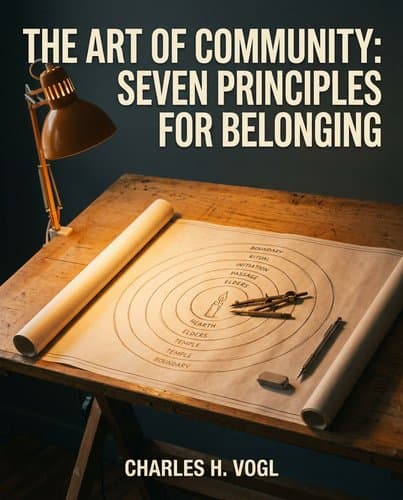
28762683_the-art-of-community
by Charles H. Vogl
Belonging isn't accidental—it's architectural. Master seven concrete principles used by every enduring community to deliberately design initiation, inner…
In Brief
The Art of Community: Seven Principles for Belonging (2016) argues that belonging is not a product of charisma or luck but of deliberate design.
Key Ideas
Actions reveal true community values
Audit your community's implicit values by tracking where leaders put their time and attention — not what the mission statement says. The gap between stated values and enforced values predicts community health better than any other single signal.
Make gatekeeping transparent, not implicit
Name your community's boundary explicitly, including who enforces it and on what criteria. Hidden gatekeeping based on unarticulated values is more corrosive to trust than a clearly stated selection criterion, even a restrictive one.
Design visible rituals for member onboarding
Design a visible initiation for new members — a personal call, a specific inner-ring invitation, a formal welcome that marks the crossing. Without a deliberate signal, members fill the vacuum with 'accidental initiations' you didn't choose and can't control.
Integrate four essential community story types
Build all four story types into your community: an origin story (how you were inspired to begin), a values story (a time the community paid a real cost for what it claims to believe), a vulnerable story (a failure disclosed rather than concealed), and personal stories from ordinary members. Most communities only tell one.
Widened concern marks true inner ring maturity
Diagnose inner rings by asking whether movement through them expands members' concern for others. If progressing inward narrows concern to the group alone, you're building a status structure. If it widens concern toward the world outside, you're building maturation.
Self-audit for cult-like structural dynamics
Run the cult checklist on your own community: Does the leader have absolute, unaccountable moral authority? Are exits available and unthreatened? Is the worldview connected or polarized? Is growing the group treated as more important than enriching current members? If any answer goes the wrong way, that's the structural problem to fix.
Demonstrate mutual concern through specific recognition
Tell one person today, specifically, what they did and that it mattered. Community forms when people believe they have mutual concern for one another — and the fastest way to generate that belief is to demonstrate it first, in a single phone call or conversation.
Who Should Read This
Business operators, founders, and managers interested in Leadership and Team Building who want frameworks they can apply this week.
The Art of Community: Seven Principles for Belonging
By Charles H. Vogl
9 min read
Why does it matter? Because the community you're searching for won't appear — it has to be built.
The team Slack where everyone's enthusiastic and somehow nobody knows each other. You've been in rooms like that — full of people who share your values — and still felt completely alone. You've probably blamed yourself. Too reserved, too busy, not trying hard enough. But the collapse of close social ties in the past generation isn't a personal failing; it's what happens when the structural scaffolding of belonging quietly disappears and nobody notices until they're already isolated. What Vogl found, after years studying communities that work and ones that hollow out, is both more precise and more hopeful than anything about charisma or luck: belonging is architecture. Seven specific principles, present in every community worth keeping. Miss one and you'll feel it. Know all seven and you can build from nothing.
Picnics Per Capita Are Down 60% — and That's the Least of Our Problems
Melo asked Vogl to lunch at the Yale Commons the month before he graduated. They sat at a long table on the north side, just the two of them, and Melo told him something Vogl hadn't known.
His first year at Yale had nearly destroyed him. He'd come from the Philippines on one of Yale's rare full scholarships, but the culture, the New England cold, and the academic pressure had been brutal on their own. Then his wife, a physician, discovered she couldn't practice medicine in Connecticut. She moved hundreds of miles away so they could pay their bills. His mother's cancer worsened that semester. When she died, he couldn't afford a last-minute flight to Manila. He couldn't be there to say goodbye. He cried alone at night in New Haven.
That summer, back home in Manila, he decided he wasn't going back. The scholarship didn't matter. He simply couldn't do it.
What changed his mind was an invitation to dinner — not a grand gesture, just a standing invitation to weekly meals at a fellow student's home. When he remembered those invitations, he remembered something else: that he belonged somewhere, that he wasn't alone. That was enough to bring him back.
He graduated the next month.
The numbers are blunt. The share of Americans who say they have no one to talk to about something hard has tripled in a generation. Average social network size has shrunk by a third. A meta-analysis of 300,000 people found weak social ties as damaging to health as alcoholism — equivalent to smoking fifteen cigarettes a day. The institutions that once counteracted this have hollowed out: club attendance went from two-thirds of Americans participating in the 1970s to two-thirds never attending by the late 1990s.
Loneliness is not a diagnosis. It's a census result.
Every Real Community Has a Boundary — Pretending Otherwise Just Makes It Invisible and Dangerous
Every real community has a boundary. The only decision you make is whether that boundary is named.
Vogl encountered a New York community that had convinced itself otherwise — a group drawing from multiple spiritual traditions that called itself Interspiritual. At their founding meeting, participants insisted the group was open to anyone, regardless of belief, practice, or background. This wasn't posturing; they believed it sincerely.
Then Vogl dug into their history. Some years earlier, a member had begun enthusiastically advocating for polyamory and polygamy. The group panicked, not at the ideas themselves but at the fear of being defined by association. After extended conversations, two longtime members quietly asked him not to return. He didn't. The community moved on and apparently forgot it had happened.
What Vogl found, when he named what had occurred, was the community enforcing its actual boundary. Two men who described themselves as facilitators (not leaders, certainly not gatekeepers) had made a call that stuck, because they held the authority. The group had excluded someone according to unarticulated values that, it turned out, they all shared. They just hadn't said so out loud.
Refuse to name the boundary, and it doesn't disappear. Enforcement goes underground, operated by whoever holds informal authority, applying criteria you can't see, through mechanisms no one has agreed to. Outsiders can't tell what's required to belong. Insiders can't be sure the rules applying to them apply equally to everyone else.
Named boundaries do the opposite. Adam, a San Francisco executive chef, makes the same logic explicit: the kitchen during his dinners belongs only to the chefs, and everyone in the room knows it. Transparent boundaries create safety for members and offer value-aligned outsiders a clear path in. The only alternative is a community where the real rules are held by whoever has the power to enforce them, accountable to no one.
Getting In Doesn't Solve Belonging — That Requires a Deliberate Signal
Scott's phone rang just after midnight. He'd just ended a relationship, and he called Vogl — across three time zones — not a publicist, not a manager, but someone he trusted enough to be completely undone in front of. For two hours he shared fears he hadn't said out loud to anyone. By the time they hung up, Vogl knew something had shifted.
Vogl had been to Scott's Manhattan townhouse many times before that call. Scott was someone well-known in the music world; dozens of people each week angled for invitations, name-dropped his friendship, positioned themselves near him at gatherings. Vogl had stood in those rooms too, wine glass in hand, genuinely unsure whether he was any different from the rest of the outer ring.
He was. But he couldn't have known it until Scott called.
Getting accepted and belonging aren't the same event. You can be admitted to a graduate program or a friendship circle and still spend months privately uncertain whether you've really crossed the line. The door opens; you walk through; then you wait for something that tells you the door was meant for you.
Vogl calls what happened in that phone call an initiation. Not because it was planned, but because it was unmistakable. The medium didn't matter. Scott could have done the same thing with words: You're different from most of the people who come through here. That matters to me. Either way, the signal has to be legible. It has to say: you are on the inside, and I know it.
When communities skip this, when no one sends the signal, members don't stop needing it. They start reading anything that might substitute: an offhand compliment from a leader, an unexpected invitation, being asked to teach. The initiation happens anyway, accidentally, invisibly, controlled by no one. The only question is whether it's designed or left to chance.
Rituals and Symbols Are Not Decoration — They Are the Technology of Meaning
Think of a ritual as a timestamp on meaning. The activity itself — the candles, the song, the toast — is almost beside the point. What matters is that the community has agreed, without necessarily saying so, that this moment counts.
Psychologist Roy Baumeister's research separates happiness from meaningfulness along one axis: time. Happiness is present-tense. Meaningfulness requires connecting now to what came before and what comes after. Rituals are how that connection happens.
The proof is in a pot of green Jell-O. For decades, a grandmother made the same dish every Thanksgiving. One year, inspired by a New York Times recipe, she made something different. Her guests were upset — not because the new dish was worse, but because the ritual had changed. Something that had silently accumulated weight over years had been broken, and no one knew it was there until it wasn't. Vogl calls unnamed shifts in ritual the hidden cause of many holiday fights. That's not irrationality. That's people defending the only mechanism they have for stitching years together.
Symbols compress the same function into something portable — shorthand for everything the community values. They work best when abstract enough to mean different things to different people. The Peace Corps circular logo places a dove inside an American flag; there's no depiction of a volunteer teaching a class or digging a well. That gap between inside and outside is the symbol doing its job.
Both are learnable tools. You don't inherit them from an institution. You build them.
Your Community Has Four Kinds of Stories to Tell — and Probably Only Uses One
Most communities can name their origin story without pausing. The harder question: when did you last tell a story about something it cost you?
Vogl identifies four distinct story types, each doing work the others cannot. Origin stories explain how the founders were inspired and invited others in. Values stories show stated beliefs colliding with real expense, and the community paying anyway. Vulnerable stories disclose failure publicly and without spin: a leader telling a community of 150,000 that his engineers had accidentally deleted their videos, with no timeline for recovery. Personal stories give ordinary members a chance to invest something of themselves in the group — a long-tenured member standing up to say what the community meant during a hard year. Think of them as four tools. Most communities only pick up one.
New Belgium Brewing, an employee-owned beer company in Colorado, carries a values story its people have told for decades. Early on, leadership wanted to switch from coal electricity to wind power, but the contract required a large upfront cash payment — the same money already set aside as year-end employee bonuses. They explained the dilemma and left the room. An hour later, employees voted unanimously to skip their bonuses. The story works not because it ends well but because the cost was real and borne by the people telling it. That's what makes the company's environmentalist values something other than marketing copy.
Origin earns legitimacy. Values earns respect. Vulnerability earns trust. Personal earns belonging. Each lands differently. Most communities have only the first memorized, and the absent types are almost always the ones requiring real cost or real disclosure. That's not coincidence. It's exactly why they're worth telling.
Inner Rings Are Inevitable — the Only Question Is Whether They Lead Somewhere Worth Going
Think of two teachers running the same martial art school, accepting the same students, advancing them through the same belt ranks. From outside, both dojos look identical. But what each teacher demands at each level turns out to be everything.
That's the architecture of The Karate Kid. Daniel arrives in California wanting only to defend himself, a visitor motivated entirely by self-interest. He finds two apparent masters: Miyagi, who is calm, and Kreese, who treats aggression as philosophy. Miyagi agrees to train him, but the early assignments are bewildering: painting fences, sanding floors, washing cars. Only later does Daniel discover that these tasks were building actual karate technique. Tokens mark the transitions: a headband when Daniel first crosses inside, a competition uniform when he advances to competitor. The training wasn't preparation for membership; it was transformation of character.
What reveals Miyagi as the authentic elder isn't his skill. It's what he does with his authority. When Daniel is still a stranger, Miyagi defends him. In a sequel, when Kreese abuses one of his own students, Miyagi intervenes, protecting someone from his rival's camp. Kreese, by contrast, instructs his competitors to injure Daniel mid-tournament. He has equal technique but the opposite orientation: his concern stops at the edge of his own group.
One question cuts through it: as you move deeper into the rings, does your concern for others widen or narrow? Miyagi's advanced students inherit his broad generosity; Kreese's inherit his contempt for outsiders. Same hierarchy, opposite destination.
C.S. Lewis named the trap version in a 1944 speech: pursuing inner rings for their own sake is like peeling an onion — "if you succeed there will be nothing left."
The diagnostic keeps them separate. Rings built around widening concern produce something real at the center. Rings built around loyalty to the ring produce only more rings.
The Same Architecture That Builds CrossFit Can Build a Cult
Every principle in this book also appears in Jonestown.
That's not a warning about this framework. It's a warning about what frameworks can't protect you from on their own. Boundary-setting, initiation, ritual, symbol, inner rings — morally neutral technologies. A CrossFit gym uses them. So did Jim Jones. The difference is in the architecture underneath.
Vogl offers a checklist, and the most useful thing about it is what it excludes. Members who dress alike, spend all their time together, recruit enthusiastically, and speak about the group like converts — that describes most high school marching bands, or the food co-op two neighborhoods over. Enthusiasm and cohesion aren't cult markers. The test is structural.
Eight features mark a harmful cult: the leader holds absolute moral authority, unchallengeable; leadership answers to no higher body; members must demonstrate unquestioning commitment or be rejected; outside relationships are severed; exit carries threats: physical, psychological, financial; the worldview divides into us and them; the group's exceptional mission justifies any means, including acts members would have found unthinkable before joining; acquiring new members trumps enriching current ones.
The healthy version is the direct inversion. Leader authority is bounded and contestable; commitment coexists with outside relationships and dissent. Exit is always available. The worldview is connected rather than polarized, and leadership answers to someone — a board, an elder group, the general membership. Growth is one priority among equals.
Run your community down both columns. Wherever the cult side describes you more accurately, you have a structural problem, not a vibe problem, not a personality problem. The tools don't care what you intend. The architecture is what survives.
The Call You Could Make This Afternoon
Vogl's birthday ritual is simple: a cleared calendar, a phone, the names of people who mattered that year. No grand gestures. Just — here's what you did, here's why it landed, I wanted you to know. He leaves voicemails. He doesn't wait for callbacks. Within a few hours, he's built something most people spend years trying to engineer.
The seven principles in this book are real architecture — boundaries, initiations, rituals, stories, inner rings. But underneath all of it is something simpler: someone deciding to go first. To say, out loud and to a specific person, you matter and I can tell you exactly why. Melo came back to Yale because of a standing dinner invitation. Community doesn't require a policy. It requires one person, one name, one true thing to say. You probably have that already.
Notable Quotes
“Will this decision help us build on our core values?”
“In 2008, over half of all applications to Harvard with exceptionally high SAT scores were Asian, yet they made up only 17 percent of the entering class. Asians are the fastest growing racial group in America, but their proportion of Harvard undergraduates has been flat for two decades.”
“We seek promising students who will contribute to the Harvard community during their college years, and to society throughout their lives.”
Frequently Asked Questions
- What is The Art of Community about?
- The Art of Community argues that belonging is not a product of charisma or luck but of deliberate design. Charles H. Vogl draws on examples from durable communities across history to demonstrate that any leader can intentionally build groups where members feel genuine mutual concern. Rather than treating community as something that emerges organically, the book presents belonging as an outcome of deliberate structural choices. By applying seven concrete principles—covering values, boundaries, initiation, storytelling, and inner rings—leaders can create environments where members experience authentic connection and commitment to one another.
- What are the seven principles in The Art of Community?
- Vogl identifies seven concrete principles for building community that cover values, boundaries, initiation, storytelling, and inner rings. Leaders should audit where they actually invest time and attention to reveal implicit values, name community boundaries explicitly with clear criteria, and design visible initiations that mark new member entry. Communities should incorporate four types of stories—origin, values, vulnerable, and personal—rather than just one. Leaders must diagnose whether inner rings expand or narrow members' concern for others, run a cult checklist to ensure healthy power structures, and demonstrate mutual concern through direct affirmation. These structural choices create environments where genuine belonging emerges.
- What does Vogl say about auditing community values?
- Vogl argues that community health depends more on auditing actual values than on mission statements. Leaders should track where they invest time, attention, and resources to reveal implicit values. "The gap between stated values and enforced values predicts community health better than any other single signal." When leadership behavior contradicts stated values, members lose trust and confidence. This disconnect matters more than any other factor, making honest assessment of implicit values essential for building genuine belonging and authentic community health outcomes.
- Why should community boundaries be stated explicitly?
- Vogl emphasizes that community boundaries should be stated explicitly rather than maintained through hidden gatekeeping. Leaders should clearly articulate who can join, who enforces membership standards, and what criteria determine inclusion. "Hidden gatekeeping based on unarticulated values is more corrosive to trust than a clearly stated selection criterion, even a restrictive one." Clear boundaries—even restrictive ones—build trust because members understand the rules and expectations. Transparent entry criteria create healthier communities than implicit standards that members sense but cannot articulate or understand.
Related Book Summaries

Read the full summary of 28762683_the-art-of-community on InShort