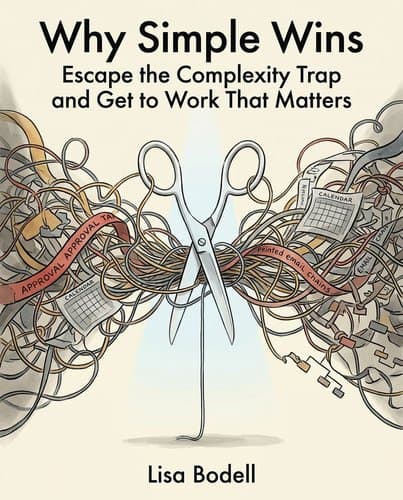
28695464_why-simple-wins
by Lisa Bodell
Complexity isn't something that happens to organizations—it's something they build themselves. Discover why the most powerful leadership move is subtraction…
In Brief
Complexity isn't something that happens to organizations—it's something they build themselves. Discover why the most powerful leadership move is subtraction, with concrete tools like "Kill a Stupid Rule" to reclaim hours buried under pointless meetings, redundant processes, and self-imposed red tape.
Key Ideas
Audit Reveals Administrative Time Drain
Audit one week of your calendar and classify every hour: how much went to work you were hired to do vs. coordination, status updates, and administration? The number will likely disturb you — and that's the starting point.
Two Questions Kill Unnecessary Meetings
Before sending your next meeting invite, apply a two-question test: Could this be an email? And does every person on the list actually need to be there? Removing one unnecessary attendee from every recurring meeting compounds across a year.
Crowdsource Process Waste Elimination Sessions
Run a Kill a Stupid Rule session with your team: give everyone 15 minutes to write down every rule, process, or requirement that slows them down. Then go through each one. Expect to discover that a significant share are misperceptions, not mandates — and kill those immediately.
Matrix Targets Immediate Elimination Candidates
Plot your ten most time-consuming recurring tasks on a two-by-two matrix: complexity (1–5, no middle score) vs. value (high/low). Anything in the high-complexity/low-value quadrant is a candidate for elimination this week, not next quarter.
MURA Filter Ensures Process Simplicity
Apply the MURA test to any process or communication before releasing it: Is it Minimal, Understandable, Repeatable, and Accessible? Failing any one of the four is a signal to simplify before adding further.
Fear Manufactures Unnecessary Organizational Complexity
Recognize the fear signature in your own behavior: the meeting you added 'just to keep people in the loop,' the slide deck that grew to 40 pages, the report nobody asked for. These aren't signs of diligence — they're complexity being manufactured by anxiety.
Name Freed Capacity's New Purpose
When launching any simplification effort — even a small one — explicitly name what the freed-up capacity will be redirected toward. Without that answer, people assume simplification means job cuts, and participation collapses.
Who Should Read This
Business operators, founders, and managers interested in Management and Leadership who want frameworks they can apply this week.
Why Simple Wins: Escape the Complexity Trap and Get to Work That Matters
By Lisa Bodell
9 min read
Why does it matter? Because the most important work on your plate is getting zero hours.
You know the feeling. You close your laptop at seven, vaguely aware that the one thing that actually required your brain — the thing you came in early to tackle — never got touched. Not because you were distracted. Because the day consumed itself: a status meeting that could've been an email, a form that now requires a new form, an inbox that refills the moment you empty it. Researchers have started putting a number on just how little of the week goes toward actual work. It's worse than most people expect. The rest goes to collaboration theater. Here's what makes that infuriating: almost none of it was inevitable. It was built, layer by layer, by well-meaning people inside your own organization — possibly including you — and a surprising amount of it can be dismantled the same way: piece by piece.
The Work You Were Hired to Do Is Getting Zero Hours
Mike McCall — a manager whose week was tracked in full for this book — arrives at his desk before 8 a.m. with a single priority: developing the long-term product strategy his company urgently needs. His business unit has missed its sales targets, management wants new growth channels, and strategic thinking is why they hired him. He has one week to make progress. He makes none.
What fills that week instead is a granular catalog of other people's urgency. There's a project status meeting he had no reason to attend (a colleague had simply invited everyone; an email would have sufficed). There's a two-hour milestone meeting where the vague agenda meant people came unprepared, the session ran over, and no one captured next steps before half the room had to leave. Between meetings he manages the 70 overnight emails waiting when he arrived, plus a hundred more accumulating through the day. At noon, a colleague appears: senior management wants revised budget numbers by Thursday, three time zones need coordinating. Two hours. Then an HR email: the hiring approval he'd already received requires a new compliance form, or the candidate he interviewed yesterday takes a competing offer. One more hour. He leaves at six, eats with his kids, waits for them to go to bed, gets back on email for Asia, stays up late finishing the budget figures, and spends a half-hour in live chat correcting a health insurance billing error.
Zero minutes on strategy. This is a typical Tuesday.
What Mike experiences as personal frustration is a structural condition, and it has been measured. Bain studied a single weekly executive committee meeting at one large company: eleven unit heads, a regular status update. When they traced the downstream effects, they found the eleven unit heads each gathered their own senior advisors to prepare, who in turn assembled their own teams. One standing meeting on one calendar generated more than 130 meetings throughout the organization. Annual cost: 300,000 hours, $15 million. That's not one person's calendar problem. That's a system consuming itself. The individual numbers confirm it: the typical manager spends 21 of a 47-hour week in group meetings and 11 more on email, leaving fewer than 6.5 hours of uninterrupted work. Less than one full working day.
The Complexity You're Drowning In Was Built by Your Own Team
Most of the complexity strangling your organization is homegrown. Regulations are real. Legacy IT systems are real. But the research points somewhere more uncomfortable: the bulk of the friction grinding people down was built by people inside the organization, in direct response to real problems, with genuinely good intentions.
Here's what that looks like. A large financial services firm discovered that somewhere between 2 and 3 percent of its consultants had been expensing their family's laundry on business trips, using hotel services the company was footing anyway. Executives faced a real problem, however minor, and responded the way executives do: they fixed it. New rules. Caps on laundered shirts. The privilege restricted to senior managers on extended trips.
The 2 to 3 percent stopped. Something else started. The remaining 95-plus percent, the employees who had done absolutely nothing wrong, now had to carefully pack and count their shirts before every trip, track against the cap, and worry about being flagged for an infraction they had never committed. People traveling to Asia for weeks at a time ended up wearing dirty clothes near the end of the journey or paying out of pocket for a service the company still technically offered under the right conditions. A rule designed for a tiny minority had become a compliance burden for everyone.
The Laundry Decree, as it came to be called, is memorable because the disproportion is so obvious in retrospect. But its diagnostic value is precisely that no one involved acted badly. Executives saw a real problem and addressed it. Each step was rational. The result still cost more — in time, morale, logistical friction — than the original problem ever did.
The mechanism is accumulation. Every problem generates a rule. Every rule generates edge cases. No one audits whether the original problem still justifies what it now costs everyone else, so the burden gets absorbed quietly and the rule stays. A vendor overcharged, so now every contract needs three approvals. A project derailed, so now there's a weekly status meeting. The responses were reasonable. What built up over time was not.
Complexity isn't something that happens to organizations. It's something organizations do to themselves, choice by choice, until the accumulated weight of all those reasonable responses becomes unreasonable to work inside.
You Keep Adding More Because Complexity Feels Like Diligence
When was the last time you made something more complex — not the faceless bureaucracy, but you, specifically — because leaving it as-is felt irresponsible?
That question is harder to answer honestly than it sounds. Most people experiencing organizational complexity locate the source somewhere else: a risk-averse legal team, an executive who won't let go of control, a colleague who cc's the entire department. The complexity you personally contribute is nearly invisible, because it never feels like complexity in the moment. It feels like diligence.
Consider what happened at a company running on thin margins. Leaders needed a real-time read on performance, so they built one: a dashboard with six color-coded numbers, clean and readable at a glance. The tool worked. Then it started to grow.
Someone on the leadership team worried the numbers didn't capture everything. Were they missing something? They added a metric. Someone else noticed the existing figures didn't reflect their team's contributions accurately. Could leadership include something that offered a fuller picture? That went in too. Senior leaders, aware that their performance was visible in the data, lobbied for deeper indicators that would let them demonstrate analytical sophistication to their peers. Each addition was individually defensible. Everyone was doing what careful, responsible people do when they feel exposed: they added cover.
After a year, the dashboard was so dense that administrators had to shrink the font just to keep all the numbers on one page. No one could read it anymore. A tool designed to provide clarity had become a monument to collective self-protection.
No one in that room thought of themselves as the person making things worse. Each person who lobbied for an addition believed they were correcting an oversight, filling a gap, doing their job thoroughly. The fear that drove every individual decision, fear of being caught without the right metric when something went wrong, felt exactly like professionalism.
Most of the complexity you've been frustrated by wasn't generated by careless people. It was generated by careful ones, each managing their own anxiety, each adding just one more thing, none of them seeing the whole they were building together. The person who makes your life harder doesn't know they're doing it. Neither, in all likelihood, do you. Recognizing it in yourself, though, is the prerequisite for doing anything about it.
The Companies Winning Aren't the Most Sophisticated — They're the Simplest
Southwest Airlines made what seemed like a strange strategic bet: standardize its entire fleet around a single aircraft model, the Boeing 737, while competitors like American Airlines flew a patchwork of fourteen types. The logic for variety seemed sound — different planes for different routes, different loads, different markets. Southwest rejected it anyway.
What followed didn't show up in any single line item. Mechanics only needed to be trained on one aircraft. Spare parts inventory collapsed to a single catalog. When weather forced a last-minute swap, any plane could substitute for any other — crews already familiar, gates already compatible, logistics already solved. In a storm that paralyzed a competitor managing fourteen configurations, Southwest kept moving.
American's onetime CEO put the cost of that complexity plainly: the expense of running a mixed fleet wasn't offset by anything customers would pay more for. Complexity consumed resources without producing value anyone wanted.
Southwest's simplicity showed up where it mattered. For years the airline led the industry simultaneously in on-time performance, baggage handling, and complaint rates. No competitor came close. Customers chose Southwest again and again, and the loyalty compounded.
Siegel+Gale spent six years tracking which brands consumers consider simple to deal with. Publicly traded companies in the top ten of its index outperformed the global stock index by 214 percent. That's simplicity generating returns, not just saving friction.
The choice to simplify is a structural bet: absorb the short-term pain and buy something a complex rival can't easily acquire. Tesco hired BCG to cut 30 percent of its SKUs, absorbed the supplier backlash, and beat London's expectations the first Christmas under the new regime. Scripps Health redesigned its emergency room from scratch: patients had been interviewed four times before seeing a doctor, with one in eight leaving without being seen. After the redesign, a doctor and nurse met patients together, immediately. Wait times halved. Walk-outs hit zero. Revenue rose 20 percent; $200 million came out of annual costs.
And then there's Vancity. The Canadian credit union looked at the complexity it had built and concluded it served the organization's internal processes far more than its members. Simplifying wasn't just an efficiency play. It was a decision about who the institution existed for.
That's where simplification stops being a maintenance task and becomes strategy. Markets reward it directly: the 214 percent outperformance isn't a rounding error. But the more durable reason to act is the one Vancity named: complexity, left untended, gradually shifts an organization's attention inward. Cutting it is how you turn that attention back out.
Half the Rules Blocking Your Best Work Were Never Real Rules
How many of the rules slowing you down right now are actually rules?
Not policies written into a handbook. Not mandates from legal or compliance. The rules that feel like they must exist: the forms people assume are required, the meetings everyone believes they have to attend, the approvals that seem demanded somewhere up the chain. How many of those have you ever checked?
Liz Tinkham, a senior managing director at Accenture, ran this experiment with forty of her top leaders: seasoned managers alongside newer team members, spanning technology, sales, marketing, and strategy. She asked them to spend fifteen minutes in pairs identifying rules that frustrated them or slowed down their work. Fifteen minutes.
They produced 41 rules on Post-it Notes.
Tinkham went through every one with the group and killed many on the spot. The finding that stopped the room wasn't which rules she eliminated — it was how many "rules" didn't exist at all. People had assumed they were required to attend certain monthly meetings; Tinkham clarified that only three actually needed their presence. Others believed that pitching a new sales idea required specific financial forms submitted in advance; no such requirement existed. The rules they'd been obeying for months were organizational folklore: things no one had mandated, solidified into walls because no one thought to push. Most constraints people assume are structural turn out to be negotiable the moment someone asks.
At the end of the session, only a handful of items remained genuinely unresolved — actual corporate-level mandates requiring escalation. Everything else dissolved on contact with reality.
The mistake most simplification efforts make is treating a conversation problem like a program problem. You don't need a steering committee to find out whether the form you fill out every week is something anyone reads. You need to ask. You don't need executive sponsorship to discover that three of the five people in your standing Tuesday meeting could stop attending without consequence. You need fifteen minutes and a room.
The Accenture session worked because Tinkham made herself part of the target. She opened the floor to rules she herself might have put in place. That posture turned a complaint session into a room full of people who left with actual authority to act differently.
You can start tomorrow. Not with forty people, not with a facilitator, not with a program name. Pick three rules that slow your team down. Ask whether each one is a genuine mandate or an assumption no one has questioned. More often than you'd expect, half of what's blocking your best work was never a rule at all.
The Question Anyone Can Ask Tomorrow
The complexity eating your Tuesday wasn't handed down from on high. It accumulated — meeting by meeting, rule by rule, by people who were trying, like you, to look careful and cover their tracks. Liz Tinkham needed fifteen minutes to surface forty-one "rules" that mostly weren't. That gap between what people assume is required and what's actually required is where your time has been going.
You don't need a mandate to start recovering it. The people inside that overhead aren't just losing hours — they're losing the feeling that their work matters, and when the unnecessary parts go away, that's what comes back first. Before the next meeting invite goes out, before the next approval layer gets added, before the next report no one requested becomes someone's weekly job, pause and ask the one question at the center of the book: does this need to exist? Not "is it useful?" Not "could it help?" Does it need to exist? Answered honestly, that question is enough to begin.
Notable Quotes
“In so many ways, simplicity made the airline easier to run, more flexible, and better able to meet the needs of customers. Meanwhile, American Airlines struggled to compete with the mishmash of planes in its fleet. As American's onetime CEO Gerard Arpey once explained:”
“It's no coincidence that for years Southwest won the customer satisfaction”
“In due course, all those happier customers chose Southwest over the more established players. Advantage Southwest! Siegel+Gale has calculated that consumers are often willing to pay a”
Frequently Asked Questions
- What is Why Simple Wins about?
- Why Simple Wins argues that organizational complexity is self-inflicted — built up through unnecessary meetings, redundant processes, and anxiety-driven busywork. The book equips leaders and teams with concrete tools to eliminate complexity and reclaim capacity for meaningful work. It emphasizes that simplification requires deliberate subtraction: killing pointless rules, auditing time spent, and removing processes that don't add value. The core message is that the path back to work that matters starts with recognizing how organizations manufacture complexity through fear and miscommunication, then systematically removing it.
- What is the calendar audit method in Why Simple Wins?
- Audit one week of your calendar and classify every hour into two categories: work you were hired to do versus coordination, status updates, and administration. This simple exercise reveals how much time is consumed by non-core activities. As the book emphasizes, "the number will likely disturb you — and that's the starting point." The audit forces quantification of what most leaders have never measured. Once you see actual time allocation, you can justify meaningful change. This diagnostic step is critical because you cannot manage what you don't measure, and the awareness it creates precedes successful intervention.
- What tools does Why Simple Wins provide to eliminate workplace complexity?
- Why Simple Wins offers several concrete techniques to systematize simplification. Apply a two-question meeting test: Could this be an email, and does every person actually need to be there? Run Kill a Stupid Rule sessions where teams identify processes slowing them down in 15 minutes. Plot time-consuming tasks on a complexity-versus-value matrix to identify high-complexity/low-value work for immediate elimination. Use the MURA test to verify that any process is Minimal, Understandable, Repeatable, and Accessible. These four tools transform simplification from abstract aspiration into measurable action.
- How does fear drive organizational complexity according to Why Simple Wins?
- Lisa Bodell identifies fear and anxiety as hidden drivers of organizational complexity, not process failures alone. She describes 'the fear signature' in behaviors like adding meetings to keep people informed, expanding presentations to 40 pages, and creating unsolicited reports. Bodell explains: "These aren't signs of diligence — they're complexity being manufactured by anxiety." She stresses that before launching any simplification effort, leaders must explicitly name what freed-up capacity will be redirected toward. Without this clarity, people assume simplification means job cuts. Recognizing fear as the root cause shifts focus from processes to psychology.
Related Book Summaries

Read the full summary of 28695464_why-simple-wins on InShort