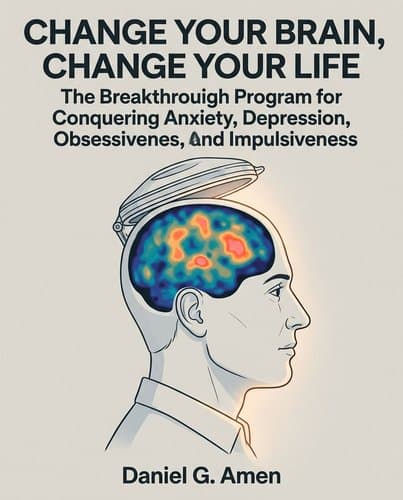
51373_change-your-brain-change-your-life
by Daniel G. Amen
Depression, rage, and anxiety aren't character flaws—they're broken circuits in a brain that can be scanned, targeted, and rewired.
In Brief
Change Your Brain, Change Your Life: The Breakthrough Program for Conquering Anxiety, Depression, Obsessiveness, Anger, and Impulsiveness (1998) argues that anxiety, depression, rage, and obsessiveness are often rooted in identifiable brain patterns rather than character flaws.
Key Ideas
Check brain function when therapy alone fails
If depression, rage, anxiety, or obsessiveness haven't responded to therapy or willpower alone, ask whether anyone has examined how your brain is actually functioning — behavioral symptoms can reflect distinct, imageable brain patterns, not just psychological ones.
Sudden behavioral shifts may signal brain events
When someone's behavior changes suddenly and doesn't match their baseline — especially in a child — consider neurological causes before attributing it to psychology, character, or relationships. A personality shift can be a brain event.
Amen's systems guide doctors, not self-diagnosis
Amen's five brain systems (deep limbic, basal ganglia, prefrontal cortex, cingulate, temporal lobes) are a useful lens for having more targeted conversations with your doctor — not a self-diagnosis tool. The book's own footnotes acknowledge these systems are far more complex and interconnected than the map suggests.
Brain patterns remove blame, require active treatment
Removing moral blame for a brain pattern doesn't remove responsibility for treatment. 'Your brain is broken, not you' still requires you to consistently choose medication, therapy, and behavioral strategies. The hardware frame makes change more tractable — it doesn't make it automatic.
Demand neurological imaging for behavioral symptoms
Push back on the 'real symptoms' standard. If a doctor won't investigate a brain-behavior link until there are seizures or speech problems, ask directly: can behavioral symptoms — aggression, suicidal ideation, personality change — warrant neurological imaging? In Amen's experience, often yes.
Who Should Read This
People working on personal growth in Neuroscience and Mental Health, especially those tired of generic motivational advice.
Change Your Brain, Change Your Life: The Breakthrough Program for Conquering Anxiety, Depression, Obsessiveness, Anger, and Impulsiveness
By Daniel G. Amen
10 min read
Why does it matter? Because the diagnosis that finally explains your suffering might be a picture of your brain, not a verdict on your character.
You've done the work. The therapy, the journaling, the medication adjustments, the honest conversations with yourself about childhood and patterns and what you really want. And still — the rage that ambushes you from nowhere, the depression that doesn't lift, the loop of thought you can't climb out of. At some point, the only conclusion left is that something is wrong with you. Your character. Your will. Your soul.
What if the problem isn't any of those things? What if psychiatry has spent a century treating the mind without ever looking at the brain? And what if your brain has a specific, visible, fixable flaw that no amount of insight or intention could ever touch? Daniel Amen has the scans to prove it. And once you see what he sees, you cannot go back to blaming yourself the same way again.
Most of What We Call Weakness Is a Broken Circuit Nobody Has Photographed Yet
Sally lands in a psychiatric hospital at forty: depression, anxiety, suicidal ideation, and an IQ of 140 that has done her no visible good. She'd never finished college. She'd spent decades as a lab technician when everyone, including herself, understood she was capable of more. The standard explanation was available to anyone who looked: she was an underachiever, someone who couldn't quite push through. A psychiatrist named Daniel Amen ordered a brain scan.
At rest, the scan looked normal. Then the technician gave her a concentration task. In a healthy brain, harder thinking triggers more blood flow to the prefrontal cortex, the region behind the forehead responsible for focus, planning, and impulse control. Sally's brain did the opposite. As she worked to concentrate, prefrontal activity collapsed, falling exactly where it needed to rise. A circuit running backward, visible on a screen.
A small dose of Ritalin gave the circuit what it needed. Her brain began firing the way it was supposed to. She went back to school, finished her degree, and stopped explaining herself. Her own account of the discovery: having ADD is a medical condition, the same way needing glasses is a medical condition — not a failure to see hard enough.
What Amen saw in Sally was what he'd been watching accumulate since 1990, when a physician named Jack Paldi, one of the first doctors Amen had seen use imaging to track the effects of medication, showed him before-and-after brain scans where a drug had visibly changed activity patterns. Around the same time, a paper in the New England Journal of Medicine confirmed that adults with ADD show less prefrontal activity when they concentrate, not more. Two data points in the same week, pointing at the same conclusion: what looked like a willpower failure was a firing failure.
From those two data points, Amen drew a conclusion that was simple and hard to accept. Your brain is the hardware your psychological life runs on. When a circuit misfires, the outputs look like problems with your character: depression, rage, obsession, anxiety, impulsiveness. They're problems with your hardware. And hardware, unlike character, can be imaged, named, and treated with something more precise than encouragement.
Sally's math stays stark. A 140-IQ mind. Three decades of dismissed potential. Shame she'd carried as her own fault, because no one had thought to look at what her brain was actually doing when she tried to focus. The explanation had always been there, waiting for someone with a scanner and a different question. Amen's question, the one that runs through every case in this book, is how many other people are being written off for the same reason.
Andrew Had No Left Temporal Lobe — and Three Specialists Said That Wasn't a 'Real Symptom'
Andrew sat across from Amen looking angry and sad in a way that nine-year-olds don't. His parents had driven eight hours straight from Southern California after his mother called in tears. Over the past year, Andrew had gone from a happy, energetic child to one who drew pictures of himself hanging from a tree, talked about wanting to hurt himself and others, and had attacked a girl on a baseball field for no reason he could articulate. Amen knew the family personally; he was Andrew's godfather. He'd seen enough of their home life to rule out the obvious explanations. No abuse. No bullying. No recent injury. Nothing in the standard account.
He ordered a SPECT scan, a type of nuclear imaging that maps blood flow across the brain in real time. When the image came up, he thought the technician had made a procedural error. Andrew appeared to have no left temporal lobe. An MRI confirmed it: a cyst roughly the size of a golf ball had occupied that space, displacing the tissue responsible for managing aggression. Amen knew from his research that the left temporal lobe was heavily implicated in violent ideation. He had a child producing homicidal drawings and a brain scan that explained them. What followed is the part the medical establishment would probably prefer to forget.
He called Andrew's pediatrician. Three pediatric neurologists were consulted. All three concluded the behavior was probably unrelated to the cyst and refused to recommend surgery until Andrew developed "real symptoms." A specialist in San Francisco said the same. Then Amen called a colleague at Harvard Medical School, a pediatric neurologist at the center of the field. She said the same thing: real symptoms. He pushed back. A child with suicidal and homicidal ideation, a child who had assaulted someone — didn't that qualify? She explained what the phrase meant to her: seizures, or speech problems.
You could not design a cleaner illustration of the problem. The field had defined "real" in a way that made behavior invisible. Seizures were real. Paralysis was real. A child who had stopped smiling, who drew himself dead, who attacked people without knowing why — that registered in a different column, not connected by medicine's own logic to a golf-ball-sized void where brain tissue should have been.
Amen eventually reached Jorge Lazareff, a pediatric neurosurgeon at UCLA who'd operated on three other aggressive children with left temporal lobe cysts and had been wondering whether the cysts were the cause. He agreed to remove Andrew's. When Andrew came out of anesthesia, he smiled at his mother. First smile in a year. The violent thoughts were gone.
The Harvard colleague wasn't being cruel. She was following the logic her field runs on: observable neurological deficits belong to neurology; behavior belongs to psychiatry. That division of labor, coherent on paper, meant no one in the referral chain was required to ask whether a cyst where a child's impulse-regulation tissue should be might explain why the child was drawing pictures of himself dead. Amen's conclusion, sharpened by fury, is that this isn't an organizational failure. It's what happens when medicine hasn't yet accepted the basic proposition that the brain produces behavior.
A Suicidal Man Predicted His Own Brain Scan From a Checklist — and That's Both the Proof and the Caution
On January 14, 1999 — two weeks after Change Your Brain, Change Your Life was published — a man in his late fifties was lying in bed working out how to kill himself. He'd been deeply depressed for months, couldn't get along with anyone, had a temper that cost him relationships. He'd already tried psychiatry, already tried medication. Nothing had shifted. His girlfriend turned on the TV.
Amen happened to be on the Today show, explaining brain scans. The man watched, bought the book, and sat down with the self-assessment checklists inside it. Each chapter maps one of five brain systems and offers symptom clusters readers can score against: the deep limbic region, which sets your emotional baseline (when overactive, it makes everything feel gray and effortful); the basal ganglia, the seat of anxiety and low-level physical dread; the prefrontal cortex, which governs focus and impulse control (the part that can't hold a thought long enough to finish a sentence); the cingulate gyrus, the gear that gets stuck, cycling the same worry or grievance on loop; and the temporal lobes, tied to mood, memory, and sudden rages that seem to come from nowhere. Working through the checklists, the man identified three problem areas: his left temporal lobe, his deep limbic system, and his prefrontal cortex.
He flew to the Amen Clinic. They ordered a SPECT scan. The image showed exactly what he'd predicted: a left temporal lobe underperforming, a deep limbic system overactive, a prefrontal cortex that couldn't hold steady. Three weeks on a medication combination and he had no suicidal thoughts. His mood had lifted. His mind felt cleaner. He told the clinic they'd saved his life.
A man with no medical training, working from a paperback checklist, correctly mapped the circuitry driving his suffering before a single scan was taken. Amen's book is full of cases like this: people who read the chapters, worked through the symptom lists, formed a strong expectation, then traveled to California to watch a scan confirm it. The pattern is striking. It is not a controlled study.
What the checklists genuinely do is powerful. They give suffering a map: a way to point at something physiological rather than moral, to reframe decades of perceived weakness as circuit dysfunction, to build a vocabulary for conversations with doctors that most people have never had. For someone who has spent years explaining themselves as lazy, weak-willed, or fundamentally broken, that reframing is real relief.
But buried in the book's own front matter is a footnote worth reading slowly. Amen acknowledges there that he condensed the five brain systems for clarity and that they are, in reality, far more entangled than his framework suggests. The patients who matched their scans are not a neutral sample — they were people who read the book, formed a strong expectation, then traveled to confirm it. The checklists aren't diagnostic instruments; they're engagement tools. The system that "matches" your symptoms may reflect a real pattern, or it may reflect the shape of the story you brought to the checklist. None of this undoes the man's recovery, or what Amen has observed across thousands of scans. The checklists are a beginning. A more intelligent way to ask questions of a doctor, a more generous way to understand your own history. A map that gets you closer to the territory. Not the territory itself.
Blaming the Hardware Sets You Free — Then Hands You the Repair Manual
If your vision is blurry, no one recommends concentration. You don't hear optometrists telling patients to try harder to see — to will the image into clarity. You get glasses. The correction is external, mechanical, matched to the specific shape of the problem. What changes is not your effort but your optics.
Sally put it plainly after her diagnosis. Having ADD isn't a moral failure, she told Amen. It's a medical problem, the same way needing glasses is a medical problem. The statement sounds obvious once you say it out loud. It was not obvious to her for three decades.
The glasses analogy does real work, but there's a move hiding inside it. No one blames you for needing glasses. But glasses still require you to put them on, and keep wearing them even when you'd rather not. The object is external; the choice to use it is not. The hardware frame works the same way: it lifts shame from the patient's shoulders (you didn't choose a prefrontal cortex that goes quiet under pressure, you didn't design your own deep limbic system to run hot) while quietly leaving something else in their hands. The Israeli woman who had crossed the world to the Amen Clinic after years of fruitless counseling didn't just get a prescription. She adopted brain-based strategies alongside medication. Treatment still required her to show up for it, consistently, over time.
Here's where the hardware frame gets misread. The worry is that locating the problem in neurology removes accountability: that saying "my cingulate gyrus is overactive" becomes a way of not changing anything. It works the other way. What the hardware frame removes is the shame loop: the experience of suffering, trying to stop, failing, and concluding that the failure reveals something essential about your character. Shame loops don't produce change. A teacher told Amen she hadn't believed in mental illness before reading the book — she'd assumed depression and anxiety were matters of will. When her daughter called from college with suicidal thoughts, her old instinct would have been to say: snap out of it, pray harder. Instead, she suspected a cingulate problem. When the cingulate runs too hot, thoughts loop: the same worry cycling back, attention that won't shift no matter how much you want it to. She found a physician, got her daughter evaluated. The diagnosis was OCD. Treatment worked. The shift wasn't from responsibility to excuse. It was from contempt to action.
That's the door the hardware frame opens. Not the door marked "nothing is your fault." The door marked "something concrete is wrong, something concrete can help, and now we know where to look."
The Question Worth Asking Before Any Other
The teacher who would have told her daughter to snap out of it wasn't cruel — she was normal. She was carrying the same reflexes you probably carry: that suffering without a visible wound is a failure of will, that the mind can discipline itself into health if the person wants it badly enough. Those reflexes feel like common sense. They also close every useful door.
What Amen is really asking, beneath the scans and the symptom checklists, is one prior question: before you decide what kind of person this is, have you looked at what their brain is actually doing? That question doesn't resolve every complexity the framework carries. But it converts blame into information — and information, unlike blame, gives you somewhere to go.
Notable Quotes
“I practically jumped down her throat; how more real could Andrew's symptoms be?”
“Dr. Amen's groundbreaking work will forever change the fields of psychiatry and psychology. A healthy brain is prerequisite to a healthy life. Dr. Amen provides a practical guide.”
“to differentiate it from the classic term”
Frequently Asked Questions
- What is the main argument of Change Your Brain, Change Your Life?
- The book argues that anxiety, depression, rage, and obsessiveness often stem from identifiable brain patterns rather than character flaws. Psychiatrist Daniel Amen uses neuroimaging research to map five brain systems—deep limbic, basal ganglia, prefrontal cortex, cingulate, and temporal lobes—to specific symptoms. He demonstrates how targeted treatments combining medication, therapy, and lifestyle changes can produce lasting relief. The central premise removes moral blame by reframing behavioral symptoms as potential brain events. However, the book's own footnotes acknowledge these systems are far more complex and interconnected than the simplified map suggests, cautioning readers against treating it as a complete diagnostic tool rather than a framework for informed conversations with healthcare providers.
- When should behavioral symptoms be investigated neurologically?
- When someone's behavior changes suddenly and doesn't match their baseline—especially in children—consider neurological causes before attributing it to psychology, character, or relationships. A personality shift can be a brain event. Amen emphasizes that doctors should investigate brain-behavior links when behavioral symptoms like aggression, suicidal ideation, or personality change occur, not just when there are obvious neurological signs like seizures or speech problems. This doesn't mean every behavioral issue is neurological, but it argues for broader investigation. If conventional therapy or willpower alone haven't resolved symptoms, neuroimaging may reveal treatable patterns that psychological approaches missed, warranting a more integrated diagnostic approach.
- Is the five-brain-systems model reliable for self-diagnosis?
- No—Amen's five brain systems provide a useful framework for targeted conversations with doctors, not a self-diagnosis tool. The book's own footnotes acknowledge these systems are far more complex and interconnected than the simplified map suggests. The model helps organize thinking about brain-behavior links and gives patients language to discuss symptoms with healthcare providers. If depression, rage, anxiety, or obsessiveness haven't responded to therapy or willpower alone, ask whether anyone has examined how your brain is actually functioning. Use the framework as a conversation starter, not as a substitute for professional neuroimaging or clinical assessment. The limitation is acknowledged within the book itself.
- Does removing blame for brain patterns eliminate personal responsibility for treatment?
- Removing moral blame for a brain pattern doesn't remove responsibility for treatment. The reframe 'Your brain is broken, not you' still requires you to consistently choose medication, therapy, and behavioral strategies. Amen's hardware frame makes change more tractable—it relocates the problem from character to neurobiology—but it doesn't make change automatic. Understanding that aggression or depression has a neurological basis is liberating, but only if it leads to action. The book combines two insights: symptoms reflect brain function, not moral failure, and you remain responsible for addressing them. This is both compassionate and demanding—it removes shame while maintaining agency.
Related Book Summaries


Read the full summary of 51373_change-your-brain-change-your-life on InShort