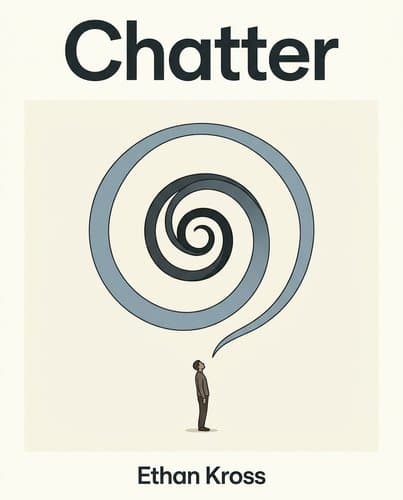
53330118_chatter
by Ethan Kross
Your inner voice can be your greatest advisor or your cruelest critic—and switching from "I" to your own name creates measurable mental distance in under a…
In Brief
Your inner voice can be your greatest advisor or your cruelest critic—and switching from "I" to your own name creates measurable mental distance in under a second. Kross reveals how tiny language shifts, invisible acts of support, and 15-minute writing sessions silence self-defeating spirals before they spiral out.
Key Ideas
Use Third-Person Language for Distance
When overwhelmed, switch from 'I' to your own name: 'What should [Your Name] do here?' instead of 'What should I do?' This single language shift produces measurable distance in under one second and works when other techniques are too depleted to use.
Apply Friend-Advice to Yourself
Before any important decision under stress, ask explicitly what advice you would give a close friend facing the same situation — then apply that answer to yourself. The wisdom gap between self and other is real and large enough to affect life-or-death medical decisions.
Validate Emotions Before Reframing
When supporting someone in distress, validate their emotions first, then pivot to perspective. Do not keep asking 'tell me more about what happened' — that is co-rumination dressed as empathy. The sequence matters: warmth first, reframe second.
Invisible Help Preserves Self-Competence
Offer support invisibly when possible. Doing something helpful — clearing dishes, handling a task — without signaling that you're doing it preserves the other person's sense of competence and avoids triggering the helplessness that visible help can produce.
Narrative Distance Writing Reduces Distress
After an upsetting event, write about it for 15–20 minutes as if narrating what happened to someone else. Grammar does not matter. The narrator's distance does. Three consecutive days of this produces lasting reductions in distress and measurable immune benefits.
Reframe Stress Symptoms as Performance
When physical stress symptoms appear (racing heart, tight stomach), reframe them as a performance signal: 'My body is preparing me to meet this challenge.' This converts a threat-mode vascular response into a challenge-mode response — less constriction, better cognitive access.
One-Year Perspective Reveals Impermanence
Ask yourself how you will feel about this in one year. Temporal distance shortens emotional episodes and reveals impermanence that is invisible from inside the moment.
Personal Rituals Create Controllable Order
Build a small personal ritual for recurring high-stakes moments: a fixed sequence of behaviors, done in the same order, infused with whatever meaning makes it yours. It does not need to make logical sense. It works through the brain's expectation machinery and by imposing a sense of order on what feels uncontrollable.
Who Should Read This
Curious readers interested in Cognitive Psychology and Neuroscience and the science of how the mind actually works.
Chatter
By Ethan Kross
10 min read
Why does it matter? Because the two things you instinctively do when you're overwhelmed are probably making it worse.
You have probably been taught — by therapists, wellness culture, or just common sense — that the right response to emotional distress is to sit with your feelings, examine them honestly, and talk them through with people you trust. Reasonable. Responsible. Also, according to a decade of laboratory evidence, often exactly wrong. The inner voice can become its own worst enemy, and the two strategies you instinctively reach for tend to tighten the spiral rather than break it. What actually interrupts it is stranger and more accessible than any advice you've been given. The techniques are hiding in the words you use when you talk to yourself, in a tidied desk, in a short video of trees.
The Voice Running Your Life at 4,000 Words Per Minute Is Also Your Most Essential Tool
On December 10, 1996, Jill Bolte Taylor, a Harvard neuroanatomist, stepped onto her exercise machine and began losing herself. First her body sense dissolved. Then her memories drained away. Then her words. A blood vessel had burst in her brain. She managed to call a colleague, reached Massachusetts General Hospital, and survived. It took eight years to fully recover her inner voice.
Here's the part that should trouble you: she wasn't entirely sorry it was gone.
When her verbal stream finally fell silent, she felt a kind of euphoria, free from painful memories, current anxieties, and a relentless internal critic. She would later describe it as bliss. The silence felt like a gift.
That's the paradox at the center of Ethan Kross's Chatter. Most of us assume introspection is the responsible response to distress: sit with your thoughts, process what you're feeling. That instinct is understandable, and partially right. But Bolte Taylor's experience cuts against it: the inner voice is the infrastructure that makes you you — the thing that holds your past, tracks your goals, and runs the mental rehearsals that let you act at all. Losing it feels like relief. It's actually catastrophic.
That infrastructure runs constantly. Research clocks internal speech at roughly 4,000 words per minute — the equivalent of 320 State of the Union addresses during a typical waking day. The voice itself is essential. What matters is what happens when it runs amok. That's the problem Chatter was written to solve.
Chatter Doesn't Just Make You Miserable — It Rewrites Your DNA
October 3, 2000. Rick Ankiel, a 21-year-old Cardinals pitcher with a 94-mile-an-hour fastball and 194 strikeouts in his first full season, stood on the mound at Busch Stadium in game one of the National League playoffs. His team led 6–0. Then a pitch bounced past his catcher and hit the backstop.
Inside his head, a sentence formed: Man, I just threw a wild pitch on national TV.
That sentence ended his career as a pitcher.
What followed was a demolition by attention. After the first errant throw, Ankiel did what seemed sensible: he focused on his mechanics, consciously tracking the movements he'd built over tens of thousands of repetitions. But that conscious attention was precisely the problem. Pitching, like any deeply automatized skill, works only when its components run as a single chain. Verbal self-monitoring shines a spotlight on the individual links, and the chain breaks. Ankiel threw five wild pitches that inning (something no pitcher had done in over a century). Nine days later, against the Mets, the same thing happened. By 2005, at 25, he had retired.
The mechanism is called unlinking, and it extends far beyond athletes. The inner voice narrating your anxiety during a negotiation, a presentation, a difficult conversation consumes the neural bandwidth your executive functions need to perform. Chatter degrades working memory, causes students to score lower on tests, and leads negotiators to make lower opening offers, exit discussions early, and earn less.
Then comes the social damage. In research spanning thirty years, psychologist Bernard Rimé found that people under emotional distress compulsively share their pain with others. The cruelty: excessive venting drives away the people we need most. High ruminators report more social friction, less support — even when they reach out more. Social isolation carries mortality risk equivalent to smoking 15 cigarettes a day.
And then the body starts rewriting itself.
UCLA researcher Steve Cole found that chatter's sustained psychological threat alters gene expression. Inflammation genes activate, causing long-term damage. Genes that fight viral pathogens go quiet. Cole called the combined effect "death at the molecular level."
Venting to a Friend Usually Deepens the Spiral — and There Is a Specific Fix
Your instinct when chatter takes over is to call someone who cares about you. The research says that instinct usually makes things worse.
After the September 11 attacks, a team led by Mark Seery tracked more than 2,000 Americans: whether they chose to share their feelings in the ten days that followed, and how their mental and physical health fared over the next two years. The people who opened up did worse than those who stayed quiet. More chatter, more avoidant coping, worse physical health outcomes. The more they shared, the worse their scores. A parallel study of college students after two campus shootings found the same result: months of Facebook posts, texts, and online conversations produced no measurable reduction in depression or PTSD, even though the students said talking made them feel better.
That gap between perception and outcome comes from what Kross calls the hydraulic myth, the Aristotelian and later Freudian idea that emotion is like steam in a kettle, and expression releases the pressure. But memory doesn't work that way. Memory is associative: negative thoughts activate related negative thoughts, which activate more. Each time you retell the argument with your boss, the brain reactivates the anger, the shame, the self-doubt. There is no release valve. There is only more fuel.
The people around you accelerate this. When a friend sees your pain, their instinct is to understand what happened — who, what, when, why. They ask you to retell it. You do. They express empathy. You feel understood. They ask another question. This loop is called co-rumination, and it is driven by genuine care. Genuine care and asking for details are exactly what keep the fire burning.
Kross calls the right approach Kirk and Spock: the warmth of Captain Kirk, followed by the analytical perspective of Spock. Effective support first makes the person feel seen and not alone. Then — crucially — it pivots: What does this cost you in five years? What's one thing you can actually do today? The FBI formalized this sequence in its Behavioral Change Stairway Model for hostage negotiators: active listening and empathy come first, influence and behavioral change come last. Timing matters. Peak emotional intensity is the wrong moment for cognitive perspective. Feeling seen is what earns the pivot.
You probably know someone who does this naturally. Conversations with them leave you feeling heard and slightly lighter, with a clearer sense of what to do next. That combination is rarer than it sounds.
You Make Worse Decisions for Yourself Than You Would for a Stranger
One culprit is distance, or the absence of it. If a close friend received a cancer diagnosis and had to choose between doing nothing — accepting a 10 percent chance of dying — or trying a new treatment with a 5 percent death risk, what would you tell them? The math is clear. The treatment halves the danger.
Now make it your diagnosis.
In a large study, 40 percent of people chose the more lethal option for themselves. When the same participants decided for someone else, only 31 percent chose wrong. The information was identical. The difference was distance. Scaled across 18 million cancer diagnoses per year, that gap is more than 1.5 million people steering themselves toward worse outcomes because they cannot separate fear from judgment. Kross calls this Solomon's Paradox: we reason far more clearly about other people's problems than our own.
Distance works on the emotional register too. In Kross's lab, participants who replayed an upsetting memory through their own eyes — fully immersed, first-person — produced language like "Betrayed. Humiliated. Abandoned." Their cardiovascular stress response stayed elevated. Participants who watched the same memory from outside, as a bystander hovering above the scene, thought more clearly and felt markedly less hostile. Distance didn't dissolve the problem. It unclouded the mind enough to engage with it.
You already ran this experiment at the start of the section. Imagining your friend's diagnosis, not your own, made the math legible. That reframe (treating yourself as someone you care about but aren't) is the core move. Kross finds it works across domains: personal conflicts, career decisions, anything where fear or pride is distorting the signal. Other approaches reach the same place through the same mechanism. People who ask how they'll feel about a crisis ten years from now consistently find the urgency shrinks; most current distress, viewed from that distance, turns out to be temporary. University of Texas psychologist James Pennebaker spent decades studying what happens when people write about a difficult experience as a narrator rather than the person living it. Those who did had fewer subsequent doctor visits and measurable improvements in immune function. The method doesn't matter as much as the move: out of your own head and into the observer's seat. That's where the clearer version of you has been waiting.
Your Own Name Resets Your Nervous System in Under One Second
At 3 in the morning, Ethan Kross sat at his desk in pajamas, staring out at the dark. A threatening letter had arrived three days earlier. Since then he had been pacing the house with a Little League baseball bat, barely eating, unable to sleep. Now he was about to search online for bodyguards trained specifically to protect academics in the Midwest.
Then he stopped. Something made him lean back from the screen and say, in his own mind: Ethan, what are you doing? This is crazy.
That was it. The bodyguard plan became obviously absurd. The threat, which had felt overwhelming, suddenly looked manageable — nothing had happened since the letter arrived, threats like this rarely materialized, he had handled worse before. He walked to the bedroom. His heartbeat slowed. Within minutes he was asleep.
The easy explanation is exhaustion finally winning. Kross spent years investigating what had actually happened. Calling yourself by name (or "you" or "he" rather than "I") shifts you from living inside the distress to observing it. The language change produces a vantage-point shift, fast and silent, requiring nothing from you.
How fast? Kross and Michigan State psychologist Jason Moser ran an EEG study in which participants viewed disturbing images and reflected on their feelings using either first-person language or their own name. Emotional reactivity in the brain dropped within one second of switching to distanced language. Other tools produce comparable relief: visualizing a scene from outside yourself, writing about it, or imagining how you'll feel in ten years. But they draw on executive function resources that chatter has already depleted. Each requires deliberately constructing a new mental vantage point, which is exactly the cognitive work that chatter forecloses when it's at its worst. Distanced self-talk bypasses that constraint entirely. You deploy it at the exact moment you have the least capacity for anything else.
The same mechanism works on creative dread, not just fear. In 1979, Fred Rogers typed a letter to himself during a creative block, three years after leaving his television program. The first three-quarters spiral through doubt: the fear that creation would always be this hard, that nothing had improved after years of trying. Then the letter pivots. The final line addresses him directly by name: Get to it, Fred. Get to it. He returned to the show and kept making it for twenty-two more years. One sentence addressed to himself as if he were someone worth coaching.
Ten More Trees Per Block Is Worth Seven Years of Youth — Your Environment Is Already Treating You
Imagine two apartments, identical in every way except the view. One looks onto a courtyard with trees. The other faces cement. You'd probably choose the green view without deliberating. It feels nicer. What you wouldn't guess is that the gap is measurable: satellite imagery of Toronto found that ten more trees per city block produced health gains equivalent to earning $10,000 more a year, or being seven years younger.
University of Illinois researcher Ming Kuo found the same pattern at street level. At Chicago's Robert Taylor Homes, a massive public housing complex where residents were assigned units at random, Kuo compared female heads of household whose windows looked onto grass and trees with those whose windows faced bare concrete. The green-view residents focused better, procrastinated less on hard choices, and perceived their obstacles as more manageable. No therapy. No lifestyle intervention. Just trees, visible through glass.
The mechanism isn't aesthetics. Psychologists Stephen and Rachel Kaplan identified two attentional systems: voluntary attention, the effortful kind that managing rumination and hard decisions depletes, and involuntary attention, drawn automatically by inherently interesting things. Nature is full of the latter — moving branches, small animals, intricate textures — that hold your gaze without draining you. Watching them lets voluntary attention recover, which is why green views make it easier to manage the inner voice.
Here's where it gets stranger: you don't need real trees. A 2016 study stressed participants with a speech task, then showed them a six-minute video of streets ranging from treeless to heavily canopied. Those who watched the lushest footage recovered 60 percent faster. The restorative mechanism doesn't check whether the nature is physical.
The Goal Was Never Silence
People born without the ability to feel pain tend to die young. Not because pain is good, but because without it, you walk on a fractured ankle until it gets infected, you pick up a scalding pan and don't let go. The signal was designed to warn you, not to consume you. Chatter works the same way. It hurts because something you care about is at stake: your reputation, your relationships, your sense of who you are. That is not a malfunction. That is the system working.
What these tools actually do is narrow the gap between signal and spiral. Not silence the voice — that would be catastrophic — but stop a warning from becoming a weather system you live inside. And the tools are embarrassingly close at hand. Your own name. A street with more trees than the last one. A drawer you just put in order.
Notable Quotes
“I can no longer define the boundaries of my body,”
“I can't define where I begin and where I end.”
“I felt my spirit surrender,”
Frequently Asked Questions
- What is Chatter by Ethan Kross about?
- Chatter examines the science of the inner voice and how to control negative self-talk. Drawing on psychology and neuroscience, the book explains what the inner voice is, why it becomes destructive, and provides concrete techniques to regain control of it. These methods range from language shifts to environmental cues, helping readers interrupt negative patterns and use their inner voice as the cognitive tool it was designed to be. The book bridges scientific research with immediately actionable strategies.
- What are the most effective techniques from Chatter for managing negative self-talk?
- Chatter provides several evidence-based techniques. When overwhelmed, switch from 'I' to your own name: 'What should [Your Name] do here?' instead of 'What should I do?' This produces measurable distance in under one second. Another technique: reframe physical stress symptoms as performance signals—'My body is preparing me to meet this challenge'—converting threat-mode into challenge-mode response. Additionally, writing about upsetting events for 15-20 minutes as if narrating to someone else produces lasting reductions in distress and measurable immune benefits after three consecutive days.
- How does Chatter explain the wisdom gap between how we treat ourselves versus others?
- Before any important decision under stress, ask explicitly what advice you would give a close friend facing the same situation—then apply that answer to yourself. The wisdom gap between self and other is real and large enough to affect life-or-death medical decisions. This reveals how our inner voice often treats us more harshly than we treat others. By reframing decisions through external advice-giving, readers access wisdom they already possess but cannot easily apply due to emotional proximity and stress.
- What does Chatter teach about supporting others in emotional distress?
- When supporting someone in distress, the sequence matters significantly: validate their emotions first, then pivot to perspective. Do not keep asking 'tell me more about what happened'—that is co-rumination dressed as empathy. Offer support invisibly when possible by doing something helpful without signaling it, preserving the person's sense of competence and avoiding the helplessness visible help can trigger. The book reframes support as balancing warmth and reframing, emphasizing that warmth comes before perspective shifts.
Related Book Summaries


Read the full summary of 53330118_chatter on InShort