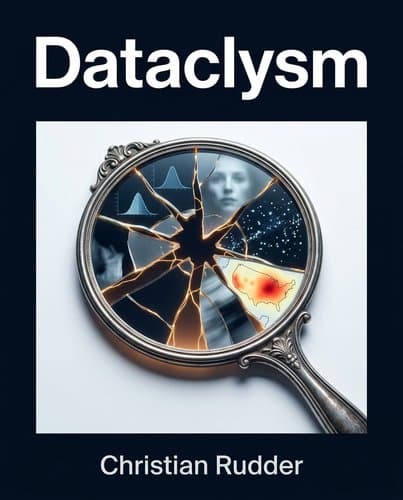
21480734_dataclysm
by Christian Rudder
Online behavior strips away the polite fictions we tell ourselves—revealing that our private ratings, searches, and clicks expose racial biases, age-based…
In Brief
Online behavior strips away the polite fictions we tell ourselves—revealing that our private ratings, searches, and clicks expose racial biases, age-based attraction, and hidden preferences that flatly contradict what we'd claim in public. Big data catches humanity with its mask off.
Key Ideas
Anonymous behavior reveals true preferences
When no social audience is present — in a search bar, a private rating, an anonymous vote — people reveal preferences dramatically different from what they'd report in a survey. Treat stated preferences with significant skepticism.
Male attraction to youth never ages
Male attraction to women in their early twenties is age-independent: a 50-year-old man's private ratings look almost identical to a 20-year-old's. Knowing this geometry helps explain why older women's dating pools shrink even when nothing about them has changed.
Polarization outperforms consensus for engagement
Trying to be universally appealing online is counterproductive. High variance (some people love you, some don't) generates dramatically more engagement than consensus mediocrity — the same principle applies anywhere reputation and attention matter.
Aggregate discrimination without individual bad intent
Racial bias in dating isn't driven by a subset of explicitly prejudiced users; it appears as a consistent mathematical discount distributed across a population that self-identifies as progressive. Individual intent and aggregate outcome can be entirely disconnected.
Digital signals expose hidden personal traits
Your digital behavior — Likes, searches, message patterns — is already being used to infer intelligence, sexuality, personality, and political affiliation with high accuracy, using signals you'd never think to manage. The only way to beat the test is to opt out of digital life entirely.
Safety features paradoxically prevent genuine connection
The features that make online connection feel safer (photos, filters, stated preferences) are often the same features that prevent genuine connection from forming. When OkCupid removed photos, real conversations happened at dramatically higher rates.
Who Should Read This
Science-curious readers interested in Behavioral Psychology and Social Psychology who want to go beyond the headlines.
Dataclysm
By Christian Rudder
11 min read
Why does it matter? Because the data knows things about you that you've never admitted to yourself.
You think you know yourself pretty well. Your values, your preferences, the kind of person you'd be if nobody was watching. Here's the uncomfortable part: nobody is watching — not when you're typing into a search bar at midnight, not when you're quietly rating a stranger's face on a dating app, not when you click something you'd never admit to clicking. And that's exactly when the truth leaks out. Christian Rudder co-founded OkCupid and spent years watching what tens of millions of people actually did when they thought the moment didn't count, and what he found is that the gap between who we say we are and who the data reveals us to be is vast, consistent, and sometimes genuinely damning. Dataclysm isn't a book about technology. It's a book about us — rendered in the one medium where we finally stop performing.
The Numbers Don't Flatter You — And That's the Point
Surveys lie — not because respondents are dishonest, but because being watched changes behavior. When nobody's watching, something stranger and more reliable takes over. That's the founding premise of Christian Rudder's Dataclysm, and he lands it with a single statistic that's hard to shake.
Rudder co-founded OkCupid, a dating site that accumulated tens of millions of user ratings — people scoring each other on attractiveness, one quiet private judgment at a time. When he aggregated 51 million of those ratings (men scoring women), the result followed an almost perfectly symmetrical bell curve, clustered around average, gently tapering at both ends. Statistically, it's nearly identical to a model of pure, unbiased decision-making. Given that these men swim daily in a media environment of algorithmically optimized pornography and digitally sculpted advertising, the fact that their private opinions land so close to the mathematical ideal is, as Rudder puts it, a small miracle. Men, left to their anonymous verdicts, are remarkably generous and balanced.
Then he shows you the women's curve, and the floor drops out. Women rated roughly 80 percent of men as below average in attractiveness. Rudder translates this into more familiar terms: map the same distribution onto IQ scores, and you have a world where women believe the majority of men are clinically impaired. The two curves sit side by side in the book like a before-and-after of what social pressure does to our stated versus actual preferences. Neither result is flattering — to men or women — but that's exactly the point. A survey would never surface this. An algorithm, indifferent to your self-image, just counts what you actually did.
Men Age. Their Taste in Women Doesn't.
Think of a man's taste in women as a compass needle that got magnetized at twenty-two and never properly recalibrated. He grows up, earns a salary, learns to make pasta, starts to understand what women are actually saying when they describe their feelings — but the needle doesn't budge.
Rudder found this in OkCupid's private ratings, tens of millions of votes cast without any prompt beyond 'judge this person.' Men at every age from twenty to fifty rated women in their very early twenties highest. A twenty-year-old man doing it, fine — that's symmetry. A thirty-five-year-old, perhaps less surprising than we'd like. But a fifty-year-old? His private votes cluster in the same place as a college junior's. Rudder named the phenomenon Wooderson's Law, after the Matthew McConaughey character in Dazed and Confused who famously keeps getting older while his girlfriends stay the same age. In a strict mathematical sense, a man's age and his romantic target are independent variables — one moves, the other doesn't.
What makes it stranger is the gap between the compass needle and what men say out loud. When asked directly, men claim they want someone roughly their own age. But the private votes tell a different story, and the gap between the two only widens as men get older.
For women, this creates something close to a structural trap. A thirty-two-year-old woman sets her search filter to twenty-eight through thirty-five and starts browsing. A thirty-five-year-old man sets his to twenty-four through forty — and then, in practice, almost never messages anyone over twenty-nine. Neither finds the other. The woman's search is calibrated to a reality the data says doesn't exist: men who have aged into wanting women their own age. Rudder's image is precise: the men are drifting toward some permanent horizon of youth, while the women stand on shore and watch them go.
Being Polarizing Beats Being Pretty
What if trying to be likeable is the worst possible dating strategy? Rudder's answer, pulled from OkCupid's rating data, is essentially yes — and the math is uncomfortable enough to sit with.
Take two women who both score a 3-star average. The first got there the boring way: nearly every man rated her a 3. The second got there through civil war — half the men gave her a 1, the other half gave her a 5. Same average, completely different reality. The divisive woman receives roughly 70 percent more messages. Push that further and it gets almost absurd: a woman in the bottom fifth of the site for attractiveness, if her ratings are sufficiently polarized, gets contacted about as often as a woman sitting comfortably in the top third. Variance — how scattered the votes are — turns out to matter almost as much as the average itself.
Part of that is obvious: the men rating her a 5 send most of the messages. But here's where it gets strange. The men handing out the 1s don't message her — almost nobody contacts someone they rated poorly. And yet their low scores still generate attention from everyone else. Having people who dislike you, on its own, makes more people want you. The mechanism Rudder proposes is competitive instinct: a man drawn to someone unconventional senses that other men are turned off, which means less competition, which makes her feel more attainable. The diamond-in-the-rough fantasy needs the rough. A conventionally pretty woman with near-universal approval reads as over-subscribed — too obvious, too contested — and the on-the-fence guy moves on without messaging.
The practical implication is almost too simple to trust: leaning into whatever makes you polarizing is more effective than softening it. Universal approval and invisibility are the same thing.
The Photo Is Destroying the Connection It Promises to Enable
On the morning of January 15, 2013, an OkCupid engineer flipped a switch and erased every profile photo on the site. For seven hours, tens of millions of users could see each other's names, essays, heights, politics, favorite books — everything except what anyone looked like. The site's own data called photos the single most important piece of information OkCupid provided. Removing them, in Rudder's words, created a pit of despair.
What actually happened was the opposite of despair. Messages sent during those seven photo-free hours received replies at a rate roughly 40 percent higher than normal. Contact info — phone numbers, email addresses — changed hands at nearly double the usual rate. People weren't retreating from each other without photos. They were moving toward each other faster.
Then the photos came back at four in the afternoon, and you can watch the damage in the data. Conversations that had been building across the blackout — pairs of people who'd been genuinely connecting for hours — suddenly withered. Those threads lasted about four fewer messages than a matched control group. Contact info exchange dropped by a similar margin. People who had never seen each other and were apparently doing fine abruptly remembered that they were supposed to care what the other person looked like, looked, and found reasons to stop writing.
OkCupid also ran a companion app called Crazy Blind Date, which matched strangers and sent them to meet with no photos and no prior conversation. Ten thousand people showed up and left behind post-date ratings, which Rudder cross-referenced against OkCupid's attractiveness scores. Physical attractiveness had no relationship to whether the date went well — men reported a good time on 85 percent of their blind dates, women on 75 percent, and those numbers held flat regardless of how the couple matched up on looks.
Here is the uncomfortable thing the experiment describes. The photo — the feature that defines online dating, the one that drives nearly every click — reliably raises your standards while reliably lowering your odds. Take it away and people connect more freely and seem happier when they finally meet. Put it back and they spook. The tool designed to help you find someone you'll like in person turns out to be corroding the very thing it promises to build.
The Racial Discount Nobody Thinks They're Applying
The racial bias in dating data isn't coming from a minority of prejudiced people dragging down otherwise clean numbers. It is the numbers, distributed evenly across a population that, by every self-reported measure, considers itself enlightened.
Here is the sharpest version of that contradiction. OkCupid's compatibility algorithm — the one that matches users on stated beliefs, needs, and sense of humor, with no photo involved — finds that Asian, black, Latino, and white users are essentially equal. Race, in this purely internal measure, matters less than religion or politics, about as much as astrological sign. Then the photos appear, and a consistent hierarchy snaps into place. Non-black men rate black women roughly three-quarters of a star lower than everyone else. The penalty holds across OkCupid, Match.com, and DateHookup — three platforms with different designs, different price points, and different demographics. The same pattern runs through all of them. There is no cluster of outliers to blame. The math works out to millions of ordinary, unremarkable individual decisions, each one so small it barely registers, adding up to a systematic discount.
Rudder's users are not who you picture when you picture racists. They are younger and more educated than the national average. They vote liberal by a margin of two to one. And 84 percent of them answered a profile question — 'Would you date someone who expressed strong negative bias against a particular race?' — with an unequivocal no. Which means, statistically, the vast majority of people applying the discount would also refuse to date someone who applied the discount. They do not experience their own behavior as bias. It doesn't feel like anything. It feels like preference, like chemistry, like a face that doesn't quite do it for you. The mechanism is not malice. It is what psychologists call schema — the invisible sorting architecture the culture built inside you before you were old enough to audit it. Rudder's phrase for what the data reveals is worth sitting with: 'I'm describing our world, mine and yours.' The bias isn't elsewhere. It is running quietly in the background of people who would be genuinely offended to hear that it is.
The Search Bar Knows What You'd Never Say Out Loud
Think of the search bar as a confessional booth with no priest and no penance — just a blinking cursor and the understanding, somewhere in the lizard brain, that no one is watching. That absence of audience is what makes it different from every other data source ever built. Surveys have always struggled with social desirability bias: people answer questions in ways that make them look good, even on anonymous questionnaires, even on dating profiles seen by no one but the algorithm. The ask, it turns out, is the problem. The moment you frame a question, the respondent starts editing.
Google doesn't ask. It waits. And what people type into that blank rectangle, alone with their thoughts, is something social science has never had access to before.
Seth Stephens-Davidowitz used that access to answer a question argued about since 2008: how much did racism actually cost Barack Obama at the polls? He went back to the years before Obama became a national figure — 2004 through 2007 — and built a state-by-state index of racial hostility from search data, deliberately avoiding anything contaminated by feelings about Obama himself. Then he compared each region's index against how Obama actually performed versus how a generic white Democratic candidate should have performed given the political climate. The result was a clean, uncomfortable line: the higher the animus index, the worse Obama did. Denver had the fourth-lowest racially charged search rate in the country; Obama hit his predicted 57 percent there. Wheeling, West Virginia — seventh highest — was supposed to deliver the same 57 percent and gave him under 48. Across the whole map, Stephens-Davidowitz estimated Obama lost somewhere between three and five percentage points to racism that never showed up in a single poll. At five points, that swing would have flipped more than half the presidential elections since World War II.
The search bar also captures what no election result can — the texture of that animus in real time. The racial slur at the center of American bigotry is entered into Google seven million times a year, appearing 30 percent more often than 'apple pie' and roughly thirty times more often than it surfaces on Twitter, where an audience is present and the edit button in the brain switches on. The gap between those two numbers is a precise measurement of how much the mere presence of other people changes what we're willing to say. Which is exactly what a confessional booth is for — except this one has been recording the whole time.
A Tweet, a Flight, and Eleven Hours of Waiting for Someone's Life to Collapse
On December 20, 2013, Justine Sacco — a communications director at a major internet company — typed a clumsy joke about race and AIDS into her phone at Heathrow Airport, boarded an eleven-hour flight to Johannesburg, and turned off her phone. She had fewer than 500 followers. She had no idea anything was happening.
By the time her wheels touched down, 62 million people had seen the hashtag #HasJustineLandedYet. Google's autocomplete had started returning her flight number and arrival time as the top suggestions for her name, because that's what people were actually searching — the algorithm, indifferent as ever, just held up the mirror. Strangers drove to the Johannesburg airport to be there in person for the moment she reconnected. Others settled in at home with beer and chicken wings, narrating their anticipation in real time. Christian Rudder, who had worked with her, watched the whole thing from his computer and felt sick: the excitement people took in the prospect of destroying someone they'd never met was visible in every tweet. She lost her job before she could respond to a single message.
Rudder reaches for the stoning metaphor deliberately. In ancient legal codes, collective execution wasn't incidental — it was the point. No one person struck the killing blow, so no one person carried the guilt. The community acted as one, was purified as one, and moved on. Online mobs follow identical logic. The thousands of people who piled onto Sacco had almost nothing in common — their Twitter bios ran from "Lobbyist" to "Imperfect Christian" to "Daughter of the Sea, Sister to the Wind" — except a target and a trending hashtag.
Twitter turned social punishment into a points system. Retweets tick counters upward in real time; being first or cruelest earns you followers you can watch accumulate. This probably taps something old: gossip as social capital, information about powerful people as a form of power itself. The incentive isn't hatred, exactly. It's something closer to scoring, and the score is visible to everyone. The mob doesn't need bad actors to explain it. It needs a platform that rewards showing up.
You're Already Taking an IQ Test. You Just Don't Know the Questions.
What if the most revealing psychological profile you'll ever generate isn't a test you took — it's Tuesday afternoon, you're procrastinating, and you're clicking thumbs-up on a video of curly fries?
In 2012, a team of British researchers built a prediction engine that ran entirely on Facebook Likes. No status updates, no comments, no typed words of any kind — just the quiet accumulation of clicks. They could determine whether a user was gay or straight with 88 percent accuracy for men, whether someone was white or Black with 95 percent accuracy, whether their parents had divorced before they turned 21 at 60 percent. The tool also worked as an IQ proxy, correlating Like patterns against separately administered intelligence tests with real predictive power. The strongest single predictor of high intelligence in the dataset was an affinity for curly fries. Nobody, including the researchers, can explain why. Which is the point. You cannot study for this test. You cannot even see the questions.
You think you're managing your digital presence: curating photos, choosing what to say, deciding what to reveal. The inference engine doesn't care about any of that. It's reading the exhaust. A concrete version: every photo you've taken on a smartphone carries an embedded Exif file that logs not just when but where the shutter clicked, down to latitude and longitude. You didn't type that. You didn't choose to share it. It went anyway. Multiply that by every scroll, every 2 a.m. click, every moment you lingered on something without touching it — and the profile being assembled has nothing to do with what you meant to say.
The people building those inference engines aren't hobbyists. They work at the scale of global digital traffic — every call, every message, every signal that moves by wire.
The tension Rudder refuses to dissolve is that these same tools have identified drug side effects before the FDA could, tracked flu outbreaks across twenty-five countries, and found predictive signals that could genuinely improve lives. The infrastructure is neutral only in the way a floodplain is neutral: it holds everything equally, and what it does with the water depends entirely on who controls the gates.
The Mirror the Data Holds Up
The uncomfortable thing the data keeps trying to tell you isn't that you're a hypocrite. Hypocrites know what they're doing. The gap Rudder keeps measuring — between the preference you'd report and the vote you'd actually cast, between the bias you'd condemn and the one quietly running in your own ratings — isn't a character flaw you could fix with sufficient introspection. It's structural. It's in the interface, the schema, the cultural firmware installed before you had any say in the matter. That's where the hope actually lives. If the gap were just weakness, the only answer would be trying harder. But if it's architecture, it can be studied, mapped, shown to people in a form they can actually see. That's what the numbers, at their most honest, are offering: not judgment, but a mirror held steady. The reflection isn't flattering. It rarely is. But being genuinely seen — even by a dataset — is closer to being known than most of us ever get.
Notable Quotes
“I have six times as many Twitter followers as all the other candidates combined.”
“What Is Beautiful Is Good.”
“What Is Beautiful Is Good”
Frequently Asked Questions
- What is Dataclysm about?
- Dataclysm exposes the gap between how people present themselves online and how they actually behave through analysis of millions of users' behavioral data. Christian Rudder uses data from OkCupid and broader digital records to reveal hidden patterns in attraction, racial bias, and self-perception. The book demonstrates that when no social audience is present—in search bars, private ratings, or anonymous votes—people reveal preferences dramatically different from what they'd report in surveys. This behavioral data provides a clearer, less flattering, and more useful picture of human nature than stated preferences or self-reports ever could.
- What does Dataclysm reveal about male attraction patterns?
- Dataclysm reveals that male attraction to women in their early twenties is age-independent: a 50-year-old man's private ratings look almost identical to a 20-year-old's. This geometric pattern helps explain why older women's dating pools shrink even when nothing about them has changed—not because of female aging, but because male preferences don't age accordingly. The data undermines common narratives about changing tastes with maturity. Understanding this pattern provides crucial insight into how dating markets function differently for men and women across their lifespans, revealing structural inequities that remain invisible from individual perspectives.
- What does Dataclysm reveal about racial bias in online dating?
- Racial bias in dating isn't driven by a subset of explicitly prejudiced users; it appears as a consistent mathematical discount distributed across a population that self-identifies as progressive. Individual intent and aggregate outcome can be entirely disconnected—people who consider themselves unbiased still participate in aggregate patterns of racial discrimination through their private preferences. Rudder's data shows these biases emerge consistently across all user groups, suggesting systemic rather than individual pathology. The book demonstrates how good intentions at the individual level fail to prevent discriminatory outcomes at scale.
- How does Dataclysm explain digital behavior and online design features?
- Your digital behavior—Likes, searches, message patterns—is already being used to infer intelligence, sexuality, personality, and political affiliation with high accuracy, using signals you'd never think to manage. Dataclysm reveals that the features making online connection feel safer (photos, filters, stated preferences) are often the same features preventing genuine connection. When OkCupid removed photos, real conversations happened at dramatically higher rates. Rudder argues that attempting to be universally appealing online is counterproductive; high variance generates more engagement than consensus mediocrity. Understanding these dynamics exposes the tension between perceived safety and authentic connection.
Related Book Summaries
Read the full summary of 21480734_dataclysm on InShort