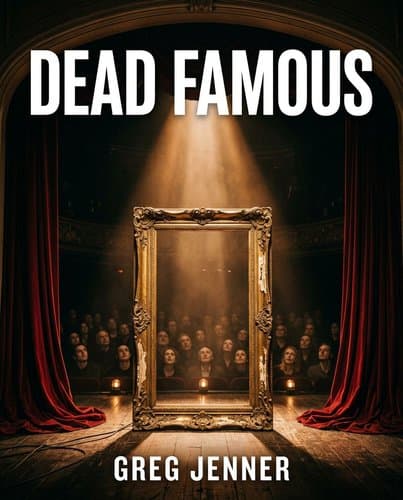
48868613_dead-famous
by Greg Jenner
Celebrity isn't a modern invention—the same mechanics that made a broke 1814 actor London's biggest star are driving your feed today.
In Brief
Celebrity isn't a modern invention—the same mechanics that made a broke 1814 actor London's biggest star are driving your feed today. Greg Jenner reveals the surprisingly ancient playbook of fame: gatekeepers, manufactured candor, and fans who unknowingly run the very machine they think they're just watching.
Key Ideas
Overnight Success Has Invisible Infrastructure
When someone appears to go viral overnight, look for the invisible decade behind them: the specific gatekeeper who took a desperate chance rather than a visionary bet, and the media infrastructure that happened to be primed. The accident is real — but it's never the whole story.
Celebrity Requires a Specific Checklist
Celebrity is not just 'being famous.' It has a specific checklist: unique persona, widespread media coverage, private life consumed as drama, and a commercial brand others can exploit. Being talented, admired, or widely known doesn't automatically qualify — and most famous people in history fail at least one criterion.
The Audience Owns the Image
Celebrity myths overwrite real people almost immediately, and the subject usually can't stop it. Once the public has claimed an image, it belongs to the audience rather than to the person it depicts — which is why Grace Darling's family couldn't correct the record even after her death.
Image Crafting Is Centuries Old
Image management is not a modern PR invention. Celebrities have been staging 'candid' moments, engineering personas, and losing control of their own visual brand since the 1760s. The only thing social media changed is the speed — not the mechanics.
Fans Drive the Celebrity Machine
Fans have always had more power than they feel. Hollywood studios responded to fan mail demands and built archetypes accordingly. Knowing this changes the relationship: you're not observing the celebrity machine from outside, you're one of the people running it.
The System Extracts More Than Returns
The machinery around famous people — managers, press agents, gossip columnists, studios — has always extracted more from celebrities than it returned. The most sophisticated stars across history are the ones who hired someone ruthless enough to fight the machine on equal terms.
Who Should Read This
History readers interested in World History and Cultural Studies who want a deeper understanding of how we got here.
Dead Famous
By Greg Jenner
9 min read
Why does it matter? Because the celebrity machine you find embarrassing is three hundred years old — and you've been powering it all along.
We assume our celebrity obsession is a symptom of something broken — that we traded serious culture for Instagram feuds and parasocial spirals somewhere around the invention of the smartphone. It's flattering, that story. It lets us feel like we fell from grace.
Here's the uncomfortable correction: every mechanism we treat as a modern embarrassment — the overnight discovery myth, the manufactured image, the screaming mob outside the hotel, the body sold as a brand, the gossip press feeding off the very stars it pretends to expose — was fully operational before the photograph existed. Before recorded music. Before film. Two centuries before the algorithm decided what you'd see next, the same machine was already running on ink, rumour, and human desperation.
Edmund Kean Became London's Hottest Star in a Week — After Five Years of Failure Nobody Remembers
In June 1809, Edmund Kean (short, dark, with the kind of oddly intense face that shouldn't have worked on stage but absolutely did) trudged 178 miles from Birmingham to Swansea with his pregnant wife. He'd blown his advance on drink and had to beg for more along the way. Not the behavior of a man on the cusp of greatness.
Five more years of this: begging in the streets of York, scrawling unanswered letters to London theatre managers, dragging his family through Ireland and Scotland on thin wages, watching his eldest son grow sick and die. By January 1814, when Kean finally walked onto Drury Lane's stage, he was grief-stricken and still a nobody. The theatre that hired him was barely solvent (burned down five years earlier, swamped in rebuild debt, hemorrhaging audiences to a rival house). Booking Kean wasn't inspired talent-spotting; it was a panicked gamble by an institution with nothing left to lose.
It worked. Kean played Shylock to a thin, snow-deterred crowd and gave a performance of such demented intensity — howling and whispering and raging, his dark eyes doing work his rasping voice couldn't — that the audience went berserk. Two journalists happened to be in the crowd. One of them was William Hazlitt of the Morning Chronicle, a Shakespeare obsessive who couldn't believe what he was watching. Both filed rapturous reviews. By morning, thousands of Londoners knew Kean's name. Within a week the theatre was packed.
The story feels like a fairy tale about perseverance rewarded. But take out any single element and Kean stays a footnote. No desperate Drury Lane: no contract. No Hazlitt in that sparse crowd: no review to spark the frenzy. No printing press to carry the review across the city by morning: no packed house that week. What looks like talent breaking through was talent, institutional desperation, and a media ecosystem colliding at once.
Greg Jenner's book Dead Famous starts here because this is the argument: celebrity has never been accidental, and it has never been simply about talent. The mechanics — desperate gatekeepers, lucky timing, the right amplification infrastructure — are ancient and consistent. We didn't invent them. We inherited them.
Famous Is Not the Same Thing as a Celebrity — The Difference Explains Everything
Is everyone famous also a celebrity? The question sounds like pedantry until you realize that conflating the two obscures how the machine actually works.
Jenner's test case is Sir David Attenborough — beloved by millions, trusted more than almost any living Briton, capable of drawing 80,000 cheers at Glastonbury. Nobody knows his private life. No magazine runs "How to get the Attenborough look!" because the public has never demanded access to the person behind the documentaries. What Attenborough has, Jenner calls renown: a reputation built on admiration for work, with no voyeuristic appetite attached.
That appetite is the thing celebrity adds. Take Julius Caesar: his face stamped on coins, his name in every Roman mouth. He clears the obvious bars. But Jenner is also looking for a private life consumed as entertainment and a commercial ecosystem built around the person as a brand. There's no evidence ordinary Romans paid to access gossip about Caesar's affairs, or that merchants built businesses packaging his persona for sale. Nell Gwyn, the actress turned royal mistress whose body and scandals electrified 1660s London, comes strikingly close on the drama front. But the printing infrastructure to sustain that curiosity at scale wasn't there yet.
Celebrity required specific conditions: loosened press restrictions, cheap printing, a literate middle class hungry for gossip, and monarchs too dull to monopolize public attention. That last one mattered more than it sounds. When George I arrived in 1714 barely speaking English and spending more time in Hanover than London, royal spectacle stopped filling the public's appetite for drama. Something else had to. Those conditions converged in early 18th-century Britain. Before then, people could be famous, glorious, or notorious — but the machine that would make celebrity self-sustaining, feeding private-life drama into commerce and back into print, had none of its fuel yet.
The Most Effective Celebrity Myths Are Built Without the Celebrity's Consent
At 4:45 on a cold September morning in 1838, Grace Darling peered through a telescope from the Longstone Lighthouse and spotted survivors clinging to a rock a mile offshore — all that remained visible of the wrecked paddle steamer SS Forfarshire. What happened next was genuinely brave: Grace and her father William rowed out through a howling gale, made two trips, and pulled nine people to safety. William's knowledge of the local rocks was essential to the whole operation.
The newspapers had a different story in mind.
Within a week, regional papers were reshaping the account. By the time it reached national and international outlets, Grace had become the heroine who woke her reluctant father and convinced him to act. Some versions dropped William entirely, leaving her rowing alone into the storm. One journalist set the template with prose so overheated it read more like scripture than reporting, and his version was the one that spread. The truth didn't move as fast.
What converted a brave woman into an unstoppable cultural force, though, was a peculiar stack of coincidences. She had crossed into territory Victorian culture reserved for men: only men were supposed to face the open sea in a gale. Grace had done the impossible, which made her baffling and irresistible. She was a lighthouse keeper's daughter, not an aristocrat. Earthy, authentic, somehow representative of something the whole country wanted to feel about itself.
And then there was her name. The Scotsman said the quiet part out loud: had she been called Smith or Higginbottom, even this deed would have won her less fame. Grace Darling. It literally means "Divine Salvation Beloved." No advertising agency could have manufactured that.
She died four years after the rescue. Her family spent years trying to correct the fabrications. They failed. The image had already escaped the person, and once the public owns a celebrity, they're not giving it back. Grace Darling — the one in the newspapers, the Staffordshire pottery, the letters begging for her hair — was never quite the woman who actually rowed.
The 'Candid Moment' Is a Three-Hundred-Year-Old Staged Performance
Think of the last time a celebrity posted something that felt genuinely unfiltered: the grainy kitchen selfie, the rumpled hotel-room interview, the "I just woke up like this" story. The whole effect depends on your believing nobody planned it. That belief is almost certainly wrong, and it has been wrong for at least 260 years.
In 1762, David Garrick — the most famous actor in Britain, so frequently painted he practically had a painter on retainer — hired the German-born court painter Johan Zoffany and installed him in his house. The portrait Zoffany produced is a strange one: Garrick in apparent backstage solitude, wig removed, head shaved (a daily ritual for habitual wig-wearers), looking slightly egg-shaped and considerably less glamorous than his public image. When the painting came up for auction in 1819, a story circulated that Zoffany had hidden in a cupboard to sketch his host unawares, making this an early prototype of the paparazzo lurking behind a bin.
The cupboard story is exactly what Garrick wanted you to believe. He was the man who commissioned a specific five-curl wig, "the Garrick cut," that became fashionable across London. Wigs were his brand. The theatrical de-wigging was a calculated gift to his audience, an invitation to feel they'd glimpsed something real. Ruth Scobie's reading of the painting: Garrick hired Zoffany for precisely this purpose. The portrait was "a choreographed, layered performance of private life." The real Garrick — the one his friends actually endured — couldn't stop performing long enough to be decent dinner company. James Boswell described him as so desperate to be the funniest person in the room that he exhausted everyone in it.
What Jenner finds interesting isn't the cynicism (celebrities managing their image is a given). It's the complicity. Garrick's audience needed the cupboard story to be true. They wanted to believe in the unguarded moment badly enough to invent a whole fiction around it. The public wasn't duped; they were willing participants in a myth about access.
The staged candid and the exhausting performer were the same man. The manufactured image was more human than the person it replaced.
The Press and the Celebrity Are Codependents Who Pretend to Be Adversaries
In October 1906, Anna Held woke on a luxury sleeper train to find her jewel collection gone — somewhere between $120,000 and $300,000 in stones. She went to the mayor, went to the police, and her husband Florenz Ziegfeld did what he always did: called the newspapers.
This time, the newspapers weren't playing along.
For years Ziegfeld had fed the press a steady stream of fabrications. He had a dairy farmer fake-sue him over milk supposedly used in Held's beauty baths. When Held fell off a bicycle, Ziegfeld issued a press release claiming she'd leapt off deliberately to save a judge from runaway horses. Everyone knew none of it was true, but the papers ran it anyway, because the audience enjoyed the performance.
That's the dynamic Jenner keeps surfacing. The press and the celebrity aren't adversaries. They're business partners producing a joint product called public fascination, each needing what the other supplies. Ziegfeld had packaged himself and Held so completely as a unit (the press had taken to calling them "ZiegHeld") that the arrangement ran on momentum, truth optional.
On that train, something real happened. When Ziegfeld knocked on the same doors he always knocked on, reporters folded their arms. Held's genuine devastation landed in print as just another stunt. One Cleveland paper published a poem — a poem — asking whether the robbery was advertising. Ziegfeld had cried wolf so many times that when the wolf arrived, he was invisible.
The codependency only works while both parties hold up their end.
Fans Don't Follow Celebrities — They Build Them, Then Resent Them
The comfortable story about celebrity is that audiences respond to whoever the media presents them. The truer and more unsettling version is that fans have always been the architects, and the industry has mostly been responding to their demands.
By 1928, Hollywood's studios were drowning in over 32 million letters a year, a logistical mountain that cost nearly two million dollars just to answer with forged autographs and form thank-yous. But more interesting was what the letters actually said. Sorted through, a clear demand had emerged: audiences wanted a tough-talking, rugged hero. The studio didn't have one. So they built one.
Clark Gable was a journeyman stage actor with no particular interest in the outdoors. He didn't hunt, didn't fish, and had no feel for the square-jawed, punch-a-bear masculinity his fans were about to demand. MGM cast him for the silhouette, dressed him in flannel and denim, photographed him against staged wilderness backdrops, and pushed the images through fan magazines. Audiences got their tough-talking hero. Gable got one of the biggest careers in Hollywood history. The transaction looked seamless.
Except every element of his persona was invented in direct response to what audiences had asked for. The fans dreamed a specific human being into existence, became devoted to him, and then defended him — all while worshipping a version assembled entirely from their own desires. They were devoted to their own reflection, borrowed in Gable's face. In the end, they were devoted to themselves — to the man they'd needed him to be.
Celebrity culture never quite admits this part. Fans and the industry speak as though they're in a relationship (fans consuming, studios producing), but the actual dynamic is collaborative, and the moral weight lands somewhere different than people assume. The audiences who wrote 32 million letters didn't just buy Gable's image. They commissioned it. We built them. We just prefer to forget that part.
The Market for Fame Is As Old As the Roman Empire — and the Famous Person Was Usually Last to Profit
When did fame become a commercial machine? Most people would place it somewhere in the twentieth century. The actual answer is older than Christianity.
A Roman charioteer named Gaius Appuleius Diocles won 34 percent of his 4,357 races and earned enough in prize money to fund the entire Roman military for roughly three months — the modern equivalent of $15 billion, by one estimate. The structural logic is identical to modern sports: crowds paid to watch, rivals whose failures amplified the spectacle, fandom converting one man's excellence into a collective obsession. Nothing about that logic is new.
What changed, slowly, was who actually captured the money. For most of celebrity's history, the famous person finished last. Stars were stamped onto tobacco cards, clay pipes, and soap without their permission or a fee. The machine extracted everything it could and moved on.
The sophisticated move was hiring someone ruthless enough to fight it on your behalf. In 1921, a man named Christy Walsh reportedly disguised himself as a beer deliveryman to get into Babe Ruth's hotel room. He found the world's most famous athlete earning five dollars an article. Walsh pioneered the ghostwritten athlete column as a commercial product, commissioned fake scientific studies proving Ruth was physiologically superior to ordinary humans, turned his pension contributions into newspaper photo ops, and fined him $33,000 for financial carelessness — money funneled into an untouchable savings account. By 1927, Ruth was earning the modern equivalent of $10 million a year. The machine was still running. Ruth had simply hired someone to run it with him.
Celebrity isn't a corruption of something more authentic. It's a technology for crowds to decide together what matters, and to price that decision.
The Machine Runs Because You're Reading This
Here's where Jenner lands: body image issues, can't watch himself on television without flinching, once had to involve the police over a fan. The man who spent years mapping every gear of the celebrity machine is still inside it. So are you. Every refresh, every strange pang of grief when someone you never met dies — that's not a character flaw. It's a technology as old as Rome, the same structural impulse that made a charioteer's funeral pyre an event worth weeping at in public. Dead Famous doesn't tell you to stop engaging. It asks something harder: to keep engaging honestly — knowing that the attention you pour into the machine is also what runs it, and deciding, with that knowledge actually in hand, what you want the machine to make next.
Notable Quotes
“white and pink, delicate as a shell, and close to the head”
“her ear is not concealed always for she has all sorts of headdresses on stage.”
“I have refused to show my ears to others who have made the same request, because it seems a very inconsequential request …”
Frequently Asked Questions
- What is Dead Famous about?
- Dead Famous traces the history of celebrity from antiquity to the present through historical case studies. Greg Jenner reveals that celebrity's core mechanics—unique persona, media amplification, and commercial exploitation—have remained unchanged across centuries. The book demonstrates how fame is manufactured, how public images escape their subjects' control, and how audiences actively participate in the celebrity machine. Rather than treating celebrity as a modern invention, Jenner shows it's a structured system with consistent patterns throughout history, challenging popular assumptions about fame and talent.
- What does Greg Jenner say defines celebrity?
- Celebrity requires a specific checklist of criteria, and having talent or admiration doesn't automatically qualify someone as famous. According to Jenner, celebrity needs: a unique persona, widespread media coverage, private life consumed as drama, and a commercial brand others can exploit. Most famous people in history fail at least one of these criteria. This distinction matters because it shows celebrity is not simply "being famous" or widely known—it's a specific cultural status requiring multiple elements. Understanding this checklist helps explain why some accomplished people never achieved true celebrity status despite their achievements and recognition.
- Why does Greg Jenner say viral success is never accidental?
- "When someone appears to go viral overnight, look for the invisible decade behind them: the specific gatekeeper who took a desperate chance rather than a visionary bet, and the media infrastructure that happened to be primed." According to Jenner, the accident is real—but it's never the whole story. Behind seemingly spontaneous fame, there's always infrastructure, gatekeepers, and timing. This perspective reframes how we understand viral moments: they're not random bolts of luck but intersections of preparation, opportunity, and infrastructure. Recognizing this "invisible decade" helps explain why some people catch viral moments while others with similar talents don't.
- Did image management start with modern PR and social media?
- No—celebrities have been staging candid moments and engineering personas since the 1760s, according to Jenner. Image management is not a modern invention but rather a consistent feature of celebrity throughout history. What social media changed is the speed of image circulation, not the fundamental mechanics of how celebrities lose control of their visual brand. From portraits to photographs to Instagram, the dynamics remain the same: subjects attempt to control their image while audiences interpret and reshape it. This historical perspective reveals that digital celebrity is merely an acceleration of centuries-old patterns.
Related Book Summaries



Read the full summary of 48868613_dead-famous on InShort