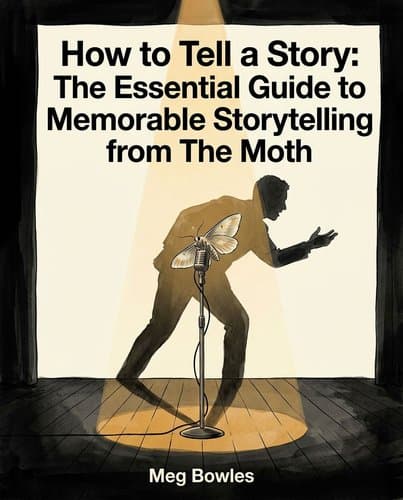
58735007_how-to-tell-a-story
by Meg Bowles
The stories you're most afraid to tell—your failures, humiliations, unresolved regrets—are exactly what make audiences lean in. The Moth's master storytellers…
In Brief
How to Tell a Story: The Essential Guide to Memorable Storytelling from The Moth (2022) teaches the craft of personal narrative through techniques developed by The Moth, one of the world's leading storytelling organizations.
Key Ideas
Three Elements Define Real Story
Find the story by locating three things: the moment a pattern broke, the decision it forced, and how you changed — if you can't name all three, you have an anecdote, not a story
Lead with Failure Before Achievement
Lead with your failure or embarrassment before your achievement; listeners connect to the mistake more than the repair, and meeting you at your worst earns your later success
Craft Single-Sentence Story Thesis
Write your story's one-sentence version — plot plus arc in a single sentence ('It took X for me to finally understand Y') — and use it as your editing lens; cut anything that doesn't serve it, but don't open with it
Start in Middle of Action
Open mid-action, never with setup or context: your first sentence should make someone wonder 'what happened next?', not 'why am I hearing this?'
Memorize Bookends, Know Territory
Memorize only your first line and your last line; rehearse the territory (scenes, beats, stepping stones) until it belongs to you, then let the story drive itself from the stage
Discomfort Signals Right Material
When you feel reluctant to tell a particular story — when you want to bail at every stage of finding it — treat that discomfort as the signal you've found the right material, not a warning to protect yourself or your audience
Establish Personal Stakes First
Before performing, make sure your audience knows what you stood to lose — stakes are always personal, never inherent to the situation, and without them even a dramatic event leaves listeners unmoved
Who Should Read This
People working on personal growth in Public Speaking and Persuasion, especially those tired of generic motivational advice.
How to Tell a Story: The Essential Guide to Memorable Storytelling from The Moth
By Meg Bowles & Catherine Burns & Jenifer Hixson & Sarah Austin Jenness & Kate Tellers & Padma Lakshmi & Chenjerai Kumanyika
10 min read
Why does it matter? Because the story you keep editing out of your life is your most powerful one.
The assumption most people carry into storytelling is that they lack the raw material — not enough drama, not enough adventure, not a life that warrants an audience. That's the wrong problem entirely. What actually kills connection is the editing you do before you even open your mouth: the instinct to sand down the embarrassing part, fast-forward past the failure, land on the version where you come out looking reasonable. The Moth, a live storytelling organization that has put thousands of people onstage, keeps finding that the story they've been protecting themselves from telling — the one with the humiliation intact, the unanswered question still open, the thing they couldn't bring themselves to say — is not their most dangerous material. It's their most powerful. This book makes the case for why, and then hands you the tools to prove it yourself.
Everyone Has a Story — The Problem Is You Keep Narrating Around the Most Charged Part
Chenjerai Kumanyika had just finished pitching his story to Catherine Burns, The Moth's artistic director. He'd laid out the whole arc: his rise as a hip-hop artist, gold records in three countries, over a million people — then the slow fall, the temp jobs, the rebuilt career as a professor and journalist. The centerpiece was an irony almost too neat: he'd met the actor Laurence Fishburne on his own music video set during the flush years, then run into him again while working security at a film festival. That second time, Kumanyika hid rather than be seen in his discount suit.
Catherine asked one question: that second meeting sounds terrible, but it clearly wasn't the end of the story — so what actually happened?
Something planetary shifted inside him. He didn't have an answer. Not because nothing had come after, but because some part of him had never left that lobby. He'd moved his life forward without processing the fall. He couldn't resolve the story in the telling because he hadn't resolved it in his life.
The ending came from a temp agency waiting room, where a Spooks song played overhead and the other applicants nodded along, unaware who'd written it. The worth of what he'd made had never depended on his fame. The line he woke with the next morning became his close: you sometimes have to discover who you aren't before you can understand who you are. When he delivered it at rehearsal, Catherine nodded. That's the ending.
He only found it by first admitting he didn't have one.
The Audience Leans In When You Fail, Not When You Succeed
Accomplishments keep listeners polite. Failures make them lean forward.
The instinct to lead with achievement, to establish credentials before asking for attention, is almost universal, and almost always wrong. Michael Massimino spent years training for a single Hubble Space Telescope repair mission. NASA had invested millions. He and his crew rehearsed every possible problem. When he finally floated in space, tethered to the shuttle and a foot from the telescope, he started removing the protective access panel — and stripped the screw. Couldn't get it out. The panel that was supposed to be the routine part, so unremarkable it never made the training scenarios, was now blocking everything. Floating there, Massimino began imagining his children's future science textbooks: "We would know if there was life on other planets… but Gabby and Daniel's dad broke the Hubble Space Telescope."
That single image is the story's gravitational center: an astronaut in orbit worrying about his kids' school embarrassment. Not the mission briefing. Not the years of training. Not even the eventual repair, though he figured it out and the telescope was saved. The hook is one stripped screw and the very human spiral of catastrophizing that follows. Most of us will never leave the atmosphere. But anyone who has spent months preparing for something important only to be undone by something small and stupid knows exactly what he felt in that moment. That recognition is the connection.
The Moth's directors have watched this dynamic operate for decades. When storytellers lead with their wins (the promotion, the award, the sold-out arena), audiences stay polite but distant. When they lead with the humiliation, the miscalculation, the moment they got it exactly wrong, something shifts. Trust forms. The storyteller is no longer performing at the listener; they're confessing to them. Genuine confession makes a listener feel seen rather than outclassed.
None of this requires being naturally confessional. You just have to find the version of events that includes the stripped screw, the thing you've been quietly leaving out because you assumed it undermined your credibility. The stripped screw doesn't. It is your credibility.
An Event Is Not a Story Until the Person in It Changes
Think of the difference between a photograph and a scar. Both record something that happened. Only one of them changed the person who has it. That's the gap between an anecdote and a story, and it's where most people lose their material.
Ellie Lee's father owned a grocery store in Boston's Chinatown. One night it burned. The details were remarkable: the city had turned off the hydrants for a parade and hadn't restored the water pressure, and as the store went up, fireworks from the restaurant above exploded into the street. Those fireworks are what make people lean forward. But they aren't the story.
The story arrived when Ellie saw three elderly women on the sidewalk, crying. One of them said: "Where are we gonna go now that we don't have a home?" Her father hadn't built a business. He'd built the place his community gathered, a fixed point in a neighborhood where people otherwise had nowhere. The fire exposed what the store actually was. And Ellie, who had grown up watching her father work, saw him clearly for the first time.
The fireworks survived into the final story. Their meaning had changed completely.
The Moth's directors work from a private compass: a single sentence that encodes both plot and arc. Ellie's is "It took a disaster for me to appreciate the important role my father played in our community." To build one, you need two pieces: what happened, and what you finally understood because of it. Swap one word and a different story emerges from the same night — change "disaster" to "success" and you're no longer telling a story about being humbled; you're telling one about vindication. Same fire, different meaning. The sentence never appears in the performance. It's the editing lens that decides what stays.
The drama of the fire earns a listener's attention for about thirty seconds. What keeps them — what makes someone say to a friend the next day, "I heard this story about a grocery store fire" — is the moment the person in the story became someone who understood something they hadn't before. The event is the occasion. The change is the story.
The Emotion You're Most Tempted to Skip Is the One Doing the Work
Mike DeStefano was a Bronx comedian — gruff exterior, soft interior — who had never spoken publicly about his wife Franny's death from AIDS. When he agreed to tell the story at The Moth, it centered on the day he broke her out of hospice for one last motorcycle ride. She was in a hospital gown, IV in, morphine bag swinging overhead. He got the bike up to eighty on I-95. She was screaming with happiness. "That wind," he said, "just blew all the death off of us."
That line does something to a listener. But it only does what it does because of everything that came before it — twenty minutes in his first live telling: how they met, what Franny was like before she got sick, what it cost to watch her disappear by degrees. By the time DeStefano started the bike, the audience knew exactly what was at stake. Strip the emotional scaffolding and it's a reckless ride. With it, it's an act of grace.
The Moth's directors keep returning to the same claim: emotion is the mechanism by which listeners enter a story, not decoration. When you omit what you felt, you give listeners a sequence of events to track rather than an experience to enter. They follow the plot at a polite distance. Stakes become impossible to feel because stakes are always tethered to a frame of mind. What was in jeopardy was in jeopardy for you, in a specific emotional state, and without that state the jeopardy is just abstract.
The thing people get wrong is thinking emotional vulnerability means waiting until you feel nothing. The Moth's directors borrow a phrase from a Lutheran minister: preach from your scars, not your wounds. Healed ground, not numb ground. Strong feeling doesn't disqualify you. The check isn't whether you still feel it. It's whether you can steer.
Your First Sentence Opens a Question. Your Last Sentence Has to Answer It.
Emotional readiness gets you into the story; craft is what lets a listener follow you out. Your ending has one job: return to the question your opening raised and answer it from the other side of having lived the story. Same specific material, transformed vantage point.
Cynthia Riggs was 81 when a package arrived from Howie, a man she'd last seen 62 years earlier in a marine biology lab. Inside: every paper-towel cryptogram they'd passed back and forth during those months, preserved in archival plastic. A new coded note sat on top. Deciphered, it read: "I have never stopped loving you. Howard." Howie was 90. Cynthia had spent the intervening decades surviving a brilliant, abusive husband who stalked her for years after their divorce, someone who had taught her to keep doors firmly shut. When she told the story, she and Howie still hadn't met again. Her ending was a purchased airplane ticket. She'd be on her way in a few days. The story stops where her agency stops, not where the outcome is known. That's the form: a return to the question of whether this particular woman would open a particular door.
The most common trap is the Perfect Bow — resolving things so cleanly that the mess making the story matter gets erased. A close second is what the directors call Fable Time with Aesop: you step outside your own experience to announce what the listener should take away. Both traps make the same mistake: they leave the territory of lived experience and summarize from a distance.
The question your opening posed has a specific shape. Your ending has to be built to that exact shape: no larger, no neater, no more certain than the truth allows.
Don't Memorize Your Story. Memorize the Territory.
January 2004. A small, cold theater in rural Massachusetts. Mark Katz walks on stage to tell a story about writing speeches for Bill Clinton — a story he knows cold. Two sentences in, he stops. Tries again. Stops. "I'm sorry," he says, and leaves. The audience freezes. Nobody knows what to do.
He returns after intermission with a joke and finishes beautifully.
His diagnosis: he was reciting words in a particular order, and when one word slipped, the whole chain broke. He had no way back in. What saved him the second time wasn't knowing the words better — it was the scene. He put himself inside the holding room: a tuxedo, an egg timer, the President standing in front of him. Once he was there, the story moved him through it.
Memorize the territory, not the words. That's the Moth's instruction. Think of your story as a road you know, not a script you've transcribed. You can reenter from any point if you know where you are. You can't if you've turned it into a song that only works from the beginning.
One exception: commit your first and last lines to memory. The first pulls you through the opening nerves; by the third sentence, the story takes over. The last ensures you land rather than circle. Everything between is territory, not text.
The True Story Is Still Doing Work After You Walk Off Stage
A true story doesn't stop when the lights come up.
Ten years after Tajikistan's civil war, a war no one had publicly discussed, The Moth staged a show in Dushanbe. A music professor told the story of playing the Moonlight Sonata for soldiers to keep them from destroying instruments. The audience recited a Tajik poem together. The community called it a breakthrough. A decade of public silence, broken in one evening.
What happens at the scale of a community happens at the scale of two people. Hector Black was in the courtroom when Ivan Simpson was sentenced for murdering Black's daughter. Black had learned by then that at age eleven, Simpson watched his mother drown his little sister in a pool while he and his brother escaped. He still stood and told Simpson he wished him God's peace. Then Simpson asked to speak: "I'm so sorry for the pain I have caused." Black couldn't sleep that night. Simpson had nothing, and he'd given the only thing he had. What Black had said in that room, his grief and his mercy out in the open, made room for something that wasn't there before.
Then there's what a true story does to one stranger sitting in the dark.
Samuel James was at the post-show dinner in Portland, Maine, still reeling from the adrenaline of a full house, when his expression changed. He looked up from his phone. A woman who had been in the audience had found him online. She wrote to say she'd learned that same evening that her son's fifteen-year-old friend was being placed in the foster system. Her first instinct was to offer her home. Then doubt moved in: did she have the resources, the ability, the right? She had just spent an evening listening to Samuel describe growing up across a string of foster homes and shelters until a friend's family finally opened their door. She decided to put herself forward. What he'd been willing to say out loud had made it possible for her to act. Everyone at the table went quiet.
What Samuel told was a true story: his own, built from memory and shaped over weeks of workshop. The lights came up, he walked off, the applause stopped. The story kept working. A boy the teller had never met would end up in a home, or not, partly because of what one woman heard in a theater that evening.
You can't predict which detail lodges in which person, or what decision it unlocks. You can only tell it with enough fidelity to carry real weight. The story you walk away from is not finished. It's already inside someone else, doing work you'll never track.
The Discomfort Is the Signal
There is a story you haven't told. You know which one — you've circled it for years, rehearsing reasons to spare people, or yourself. Mike Birbiglia has a name for that feeling: you know you're going in the right direction when you want to bail at every stage. That impulse to protect yourself, to soften the edges, to reach for the version where you come out looking better — that's not wisdom. It's proximity to the real material. The story you've kept safely inside you is already doing nothing for anyone. The one that makes you flinch is the one that will find someone in a dark room somewhere and tell them, without them ever knowing your name: this happened to me too. That's not a risk. That's the whole point.
Notable Quotes
“Where are we going? We're going to Saudi Arabia?”
“I'm going to pick you up at six o'clock tomorrow morning, we're going to rehearse, and you're going to be great.”
“That is so weird. I'm in California, I'm not in Alaska. Why is there sunlight?”
Frequently Asked Questions
- What's the difference between a story and an anecdote according to The Moth?
- According to The Moth, a story requires three essential elements: "the moment a pattern broke, the decision it forced, and how you changed — if you can't name all three, you have an anecdote, not a story." This distinction is crucial because true stories show transformation. An anecdote is just something that happened; a story demonstrates how that happening changed you. Finding all three elements helps you move beyond entertaining fragments into narratives with real emotional weight and meaning. This framework ensures your audience experiences genuine arc rather than just a series of interesting events.
- How should you open a story to grab listeners' attention?
- Open mid-action, never with setup or context. Your first sentence should make someone wonder "what happened next?" not "why am I hearing this?" This principle means jumping directly into a moment of tension or action rather than providing background information. The goal is immediate engagement—listeners should feel curiosity pulling them into your narrative from the very first word. By skipping preamble and context, you create momentum that carries people through your entire story and makes them invested in discovering what unfolds next.
- How should you memorize a story for performance?
- Memorize only your first line and your last line; rehearse the territory (scenes, beats, stepping stones) until it belongs to you, then let the story drive itself from the stage. This approach gives you security at the critical opening and closing moments while allowing flexibility in the middle. By rehearsing the landscape of your story rather than exact words, you internalize its shape and can respond naturally to the performance moment. This method balances preparation with spontaneity, helping you sound authentic rather than recited.
- Should you lead with your success or failure when telling a story?
- Lead with your failure or embarrassment before your achievement. Listeners connect to the mistake more than the repair, and meeting you at your worst earns your later success. This counterintuitive approach reflects how audiences build trust and empathy with storytellers. Starting with vulnerability and honesty creates a foundation for genuine connection. The struggle is more relatable and interesting than the triumph alone. By revealing your lowest point first, you make your eventual progress more meaningful and strengthen your credibility. This sequencing transforms your story from self-promotion into authentic testimony.
Related Book Summaries
Read the full summary of 58735007_how-to-tell-a-story on InShort