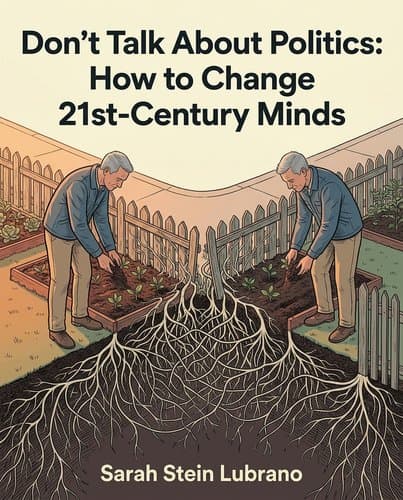
217387756_don-t-talk-about-politics
by Sarah Stein Lubrano
Political debates entrench beliefs rather than change them—so stop arguing and start engineering conditions. This counterintuitive guide reveals how shared…
In Brief
Don't Talk About Politics: How to Change 21st-Century Minds (2025) draws on social psychology and political research to explain why debates entrench beliefs rather than shift them. It offers practical alternatives — from gateway actions and deep canvassing to rebuilding shared physical spaces — giving readers concrete strategies to actually move people toward their views without triggering defensive resistance.
Key Ideas
Shared experiences change minds better than debate
Stop spending energy trying to win arguments or debate opponents — the research consistently shows this entrenches rather than shifts beliefs. Direct that energy toward creating shared experiences instead.
Gateway actions trigger cognitive dissonance
If you want to change someone's political view, start with a gateway action (composting, a food co-op, a neighborhood project) that creates the cognitive dissonance that makes belief-change feel necessary rather than threatening.
Listen, explore doubt, share your story
When you do have a political conversation, use deep canvassing technique: ask them to rate their position on a scale, invite them to articulate their own ambivalence, listen without judgment, then share your personal story — argument last, if at all.
Debate rewards performance, not belief change
Treat the 'debate me' challenge as a trap rather than an opportunity. The format rewards performance and entrenchment; declining isn't cowardice, it's strategic.
Rebuilding social infrastructure is political action
Social atrophy is a physiological process, not a mood — rebuilding your social infrastructure (physical spaces, regular face-to-face contact, organizations with real membership) is a political act, not a lifestyle preference.
Target passive allies over hardened opponents
Focus persuasion energy on passive allies and neutral observers, not active opponents — the 'spectrum of allies' framing means you're usually trying to move people who are already partially sympathetic, not convert the hardened.
Public infrastructure enables collective democratic reasoning
The privatization of public space, local journalism, and digital platforms isn't just economically unfair — it's epistemically catastrophic. Supporting public infrastructure is a prerequisite for the kind of political reasoning we claim to value.
Who Should Read This
Curious readers interested in Social Psychology and Persuasion and the science of how the mind actually works.
Don't Talk About Politics: How to Change 21st-Century Minds
By Sarah Stein Lubrano
14 min read
Why does it matter? Because the way we argue about politics is making things worse, not better.
You already know how to fix political polarization. Talk more, listen better, find the right argument, share the right article. The only problem is that none of it works — and the research on why is quietly devastating. Political beliefs aren't conclusions people reach after weighing evidence; they're identities people inhabit through daily life, social belonging, and physical routine. Which means that trying to change someone's mind through better discourse is roughly like rearranging furniture to fix a crumbling foundation. Sarah Stein Lubrano has spent years at the intersection of cognitive science and political theory, and what she found is that the sequence we assume — reason first, behavior follows — is almost exactly backwards. The actual levers are unglamorous: who you eat with, what spaces you share, what you do before you think about why. After this, sitting through a televised debate will feel like watching people rearrange the furniture while the foundation cracks.
The Argument You Just Made Won't Change Anyone's Mind
In the spring of 2024, Donald Trump became the first former American president convicted of felony crimes. Researchers tracking public opinion asked Republican voters a simple question before the verdict: should someone convicted of a felony be eligible to serve as president? Seventeen percent said yes. They asked again immediately after the conviction. Fifty-eight percent said yes. What changed between Tuesday and Wednesday wasn't the evidence — it was the threat. Voters didn't reason their way to a new principle about electoral eligibility. They needed Trump to remain a viable candidate, and so they quietly rebuilt the rules around that need.
Political scientist Sarah Stein Lubrano argues that this is how political beliefs actually work: they aren't conclusions we arrive at, they're the infrastructure we live inside. Shift a belief and you shift your identity, your sense of community, your sense of what makes you a good person. That's not an update; it's a demolition project. No wonder we resist.
Most of us don't think of ourselves this way. We tend to imagine that we reasoned our way to our politics — read the right books, weighed the evidence, landed somewhere defensible. We assume that if we could just explain things clearly enough, other people would do the same. Lubrano calls this 'reasoning-as-commerce': the idea that political ideas circulate in something like a marketplace, where good arguments outcompete bad ones and minds change accordingly. It's a flattering picture, especially for people who spend their lives working with words. The psychology doesn't support it. Confirmation bias leads us to treat friendly evidence as proof and hostile evidence as probably cherry-picked — and when that fails, cognitive dissonance doesn't produce honest reconsideration; it produces rationalization, the rapid mental construction of reasons why we were right all along.
The Spanish colonizers of 1513 understood this dynamic, in their way. They carried a legal document called the Requerimiento — a declaration read aloud on beaches to Indigenous peoples, often without translation, explaining that the Pope had granted their lands to the Spanish Crown. Failure to immediately accept this transfer justified whatever followed: enslavement, violence, seizure. The logic was that the information had been provided. Comprehension was the listener's obligation. Resistance was their fault.
That structure — present the argument, assign blame for non-conversion, proceed as planned — hasn't disappeared. It just runs through dinner tables and social media threads now. The assumption underneath is that a good argument, delivered once, should be enough. When it isn't, we blame the audience. Lubrano's point is that this gets the causality exactly backwards: the resistance isn't a failure of understanding. It's the immune system doing its job.
Debate Is a Trap, Not a Tool
The demand to 'debate me' sounds like an invitation to reason together. It isn't. It's a structural trap, and the research on what debates actually accomplish is embarrassing for everyone who's ever spent hours preparing talking points.
Two political scientists, Caroline le Pennec and Vincent Pons, spent years tracking nearly 100,000 voters day by day across 56 televised debates in 31 elections — spanning the US, Canada, Europe, and New Zealand — to find out when people actually made up their minds. Their answer: debates didn't move them. Undecided voters stayed undecided. Decided voters stayed put. The Kennedy-Nixon debate of 1960 — where Nixon sweated and Kennedy gleamed — created the myth of the decisive televised confrontation, but it was almost certainly a novelty effect. Strip away the mythology and you find that the format converts no one.
This isn't a mystery once you understand the psychology. Minds don't change during debate because debate is the wrong instrument for the job. Belief isn't a proposition sitting in a tray waiting to be updated — it's woven through your daily life, your professional identity, your sense of who you are. When a counter-argument threatens the belief, it threatens all of that. So you don't reconsider; you refortify. You dismiss the source, locate the flaw in the logic, and come out more certain than before. Debate doesn't break through this. It triggers it.
Donna Zuckerberg — classicist and author of Not All Dead White Men, which tracks how misogynist online communities mine ancient Greek texts for talking points — has been on the receiving end of this dynamic repeatedly. Men demanding she debate them aren't seeking a real exchange, she notes. Whatever she does, she loses: show frustration and she's irrational; stay breezy and she's not taking it seriously; engage their actual points and she looks like she's conceding ground. Every move is a losing move. The only exit is refusal, which they immediately declare a concession. The 'debate me' challenge isn't intellectual curiosity wearing a mask. It's aggression wearing one.
What debates do accomplish, it turns out, is damage — mainly to the people already on your side. When UK Conservative candidates Liz Truss and Rishi Sunak pulled out of their final 2022 leadership debate, party insiders were candid about why: the debates were exposing internal splits and making their own voters like them less. That's the actual political calculus — not 'can I win over the undecided' but 'can I avoid demoralizing the people who already agree with me.' The format produces theater, not persuasion, and the theater mostly entertains people who've already decided.
People Change Their Minds After They Change Their Behavior
Imagine you've just moved to a new city and, for purely practical reasons, you start cycling to work. You didn't become a cyclist because you read persuasive articles about carbon emissions or urban planning. You did it because the bike was cheap and parking was impossible. But six months later, you find yourself genuinely annoyed at drivers who cut across bike lanes, reading about cycling infrastructure, and wondering why your old city never invested in it. Your behavior changed first. Your politics followed.
This is the sequence Lubrano argues we systematically get backwards. We assume persuasion flows from argument to belief to action — convince someone, and they'll eventually do things differently. The research says the arrow points the other way.
Kristin Laurin, a psychologist who studies how people adapt to constraints, ran a neat natural experiment around San Francisco's ban on plastic water bottles. Before the ban took effect, a significant chunk of residents opposed it. One day after it became law, many of those same people had quietly switched to supporting it. Not because they'd read a new study on microplastics overnight. They'd simply recalibrated their beliefs to match the new reality they were going to be living in anyway. They were thinking — but the thinking was driven by the new situation, not by anyone's argument.
Your brain hates disagreeing with what you're already doing. So once an action is locked in, whether you chose it or not, most minds will quietly resolve that discomfort by shifting the belief to match. You're not being forced to stop using plastic bottles; you've decided plastic bottles were probably a bad idea anyway. The belief follows the fait accompli.
This has uncomfortable implications in the other direction too. If action shapes belief, then limiting someone's available actions tends to limit their thinking. Laurin found that people most aggressively rationalized restrictive policies when they felt those circumstances were unavoidable. Trapped situations produce trapped worldviews. A person who genuinely cannot see a different way of living will often end up deciding the life they're already living is the right one.
For anyone trying to actually change minds — not just win arguments — this reframes the whole project. The Cooperation Town network in London figured this out without needing to read the psychology literature. They run food co-ops where working-class members collectively buy groceries in bulk, bringing the weekly food bill down to around £3. Nobody joins because they've been persuaded that the food system is broken. They join because they want cheaper vegetables. But in the process of negotiating batch prices with supermarkets, they discover firsthand how much produce gets thrown away to maintain the illusion of constant abundance. The education is baked into the action. The political understanding grows out of the participation, not the other way around. As Lubrano puts it: if you want to change people's minds, you must first change their lives.
A 30-Minute Doorstep Conversation Can Outperform 14 Years of National Debate
So if debate doesn't work and neither does simply explaining yourself, is persuasion just impossible? The research suggests no — but only if you get the mechanism exactly right.
In the early 2010s, a group of canvassers in Miami spent about ten minutes each with residents on their doorsteps, trying to shift views on transgender rights. Standard stuff: make the case, share a few facts, move on. It didn't work. Then researchers Joshua Broockman and Joshua Kalla tested something different — canvassers, many of them trans themselves, taking up to thirty minutes with each person. They'd open by asking residents to rate their position on a scale of one to ten. Almost nobody picks one or ten, which means almost everyone has to start by acknowledging they're not entirely sure. The canvasser then asked why they weren't at zero, letting the resident articulate whatever genuine ambivalence they already carried. Then the canvasser shared something the resident couldn't argue with: their own life. What it actually felt like to be told you must use the bathroom of a gender that isn't yours. No abstract principle, no statistic — just a story from someone present. Finally, they asked the resident where they stood now.
The shift that resulted was larger than the nationwide movement toward accepting gay men and lesbians that unfolded across fourteen years between 1998 and 2012. In a single conversation.
Kalla's explanation for why it works gets at something counterintuitive. The canvasser's non-judgment matters first, because most people walk into any political conversation braced for attack. When that attack doesn't come, the defenses come down — and the resident can actually think rather than just defend. The personal story matters second, and differently: it doesn't arrive as an argument, so there's nothing to refute on logical grounds. You can punch holes in a statistic; you can't cross-examine someone's memory of standing outside a bathroom door. And then asking the resident to say out loud where they now stand — that's the part that converts a private wobble into something that sticks. Articulating a shift, even to a stranger on a doorstep, makes it harder to quietly slide back. None of this is argument. It's structured listening, narrative exchange, and a relationship, however brief.
What deep canvassing shows is that persuasion isn't impossible. The conditions for it just look almost nothing like what we assume. You don't change someone's mind by delivering a better argument. You change it by creating a context where they feel safe enough to examine their own ambivalence, encounter someone's actual experience, and say a new position out loud. Those conditions almost never exist in debate. They exist in friendship, in trusted communities, in conversations where neither person is trying to win. The format we've built our entire political culture around — two people behind podiums, clock ticking, audience watching — is precisely the format least likely to produce the thing we claim to want.
The Problem Isn't Bad Arguments — It's the World We've Built for Thinking In
Deep canvassing works. But it works by artificially recreating conditions of trust and encounter that our built environment has systematically destroyed. Which is why the Elon Musk story matters.
At 2:30 in the morning in February 2023, Elon Musk called an emergency meeting of X's engineers. His tweet about the Super Bowl was performing worse than President Biden's. By the next day, his engineers had built an algorithm change that inflated Musk's posts' reach by a factor of a thousand. The owner of what he'd publicly called 'the digital town square' had quietly wired the square's speakers to point at his own podium.
Musk didn't corrupt something that was working cleanly — he made visible what had always been structurally true. Before he arrived, Twitter's own algorithm already amplified right-leaning content and deprioritized images of non-white people, something the company's internal researchers had documented themselves. The problem isn't one erratic billionaire. It's that the road was always owned by someone, and the owner always built it to go where they wanted.
Lubrano uses 'infrastructure' the way engineers do: not as metaphor but as material fact. Infrastructure is the stuff that shapes your options before you make any choices. Roads determine where you can drive. Algorithms determine what you can see. The layout of a neighborhood determines who you meet. These systems shape what it's even possible for you to think, long before any argument reaches you. And across the last four decades, the infrastructure that makes genuine political reasoning possible — public spaces, local media, the kind of place (the barbershop, the pub, the community center) where people actually meet, civic organizations — has been handed to private owners or simply left to rot.
The effects aren't just political. They're physiological. Chronic social isolation, which has been rising across Western countries for decades, causes the brain to physically shrink in the regions governing memory, emotional regulation, and social judgment. And the cruelest feature of this process: once it advances far enough, people stop feeling the urge to reconnect. The loneliness alarm shuts off. You don't feel lonely; you just stay home. The capacity to want social contact erodes along with the contact itself.
No conversational technique fixes this. Deep canvassing works — but only because it recreates, briefly and artificially, the conditions of genuine human relationship. The reason those conditions feel artificial is that we've destroyed the spaces where they used to occur naturally: the coffee shop that became a delivery-only ghost kitchen, the park replaced by a private playset in a private yard, the union hall that became a parking lot. What we're treating as a persuasion problem is actually a built-environment problem. You can't reason your way to a better road layout.
Winning Isn't a Dirty Word — But It Requires the Right Strategy
The most clarifying thing Steve Bannon ever said wasn't about immigration or trade. It was to David Brooks, who kept suggesting that politicians should talk more to their opponents. Bannon wasn't interested. 'We're not looking to compromise,' he said. 'We're looking to win.' What followed was stranger: Bannon started describing how his movement works — people making friends they'd never otherwise have met, joining a common cause, showing up every day with something to do. He was describing community and daily action as political technology. Brooks diagnosed it as proto-authoritarianism. Both were right.
Lubrano uses this exchange not to rehabilitate Bannon but to ask why the left keeps losing the argument he's already stopped having. The answer arrives in the form of a discomfort most readers will recognize: isn't engineering people's social environments to shift their politics just manipulation? Aren't we supposed to let people reason for themselves?
The honest answer is that no one is reasoning for themselves right now. Your beliefs about politics, work, and what you deserve are already being shaped — by the hours your employer claims, the neighborhood you can afford, the platforms a handful of billionaires have redesigned to maximize your outrage and their ad revenue. The choice isn't between a manipulation-free zone and strategic social engineering. It's between whose engineering, toward what ends. Offering someone a genuine community and a concrete role in it — a composting program, a food co-op, a housing campaign — is less a trick than a form of respect. You're giving them a structure in which they can try out a different way of living, rather than leaving them to think abstractly in a void while larger forces shape the walls around them.
This is the reframe the whole book has been building toward: rebuilding the physical and social infrastructure of shared life isn't a soft precondition for politics. It is the politics. The 53% of UK adults who took no political action in 2019 — a figure from the Hansard Society's audit of political engagement — weren't apathetic by nature. They were living in a world that had systematically eliminated the places and relationships through which political identity forms. Meanwhile, activists — despite being more likely to follow the news and more likely to be unhappy about what they find there — turn out to be measurably happier than non-activists who hold identical views. The difference isn't the cause. It's the doing: the agency, the community, the daily sense that something depends on you showing up.
The prescription, then, is neither naive nor manipulative. It's structural. Build more of the world where people can think together — the third places, the civic organizations, the publicly owned platforms — and the political reasoning follows. Not because good arguments finally get heard, but because you can't talk someone into a set of politics they have no lived experience of. You have to build somewhere for them to stand first. A food co-op will do. So will a doorstep.
The Infrastructure Was Always the Politics
Here's the uncomfortable gift Steve Bannon left on the table: the person most committed to dismantling democratic life may have understood democratic motivation better than most of its defenders. Not argument. Not evidence. Belonging — a cause to show up for, people who expect you, something that needs doing today. The left's reflex has been to counter this with better facts, sharper rhetoric, a more airtight case. Lubrano's wager is that this misses the level where belief actually forms. You don't think your way into a political identity. You live your way into one — through the food co-op, the composting program, the doorstep conversation where someone finally listens before they speak. The only question is whether you're going to start building.
Frequently Asked Questions
- What is Don't Talk About Politics: How to Change 21st-Century Minds about?
- The book explains why traditional political debates entrench rather than shift beliefs, drawing on social psychology and political research. It argues that direct argument is counterproductive and offers alternative strategies for actual persuasion. Author Sarah Stein Lubrano demonstrates that changing minds requires avoiding debate formats. Instead, the book recommends gateway actions (like community projects or food co-ops) that create cognitive dissonance, deep canvassing techniques that invite ambivalence and listening, rebuilding physical social spaces, and targeting passive allies rather than active opponents. The work treats political persuasion as creating conditions where belief-change feels necessary rather than threatening.
- What are the key takeaways from Don't Talk About Politics?
- Stop trying to win debates—research shows this entrenches beliefs rather than shifting them. Instead, create shared experiences through gateway actions like community projects that generate cognitive dissonance. When having political conversations, use deep canvassing: ask people to rate their position, invite them to articulate ambivalence, listen without judgment, then share your story. Avoid 'debate me' challenges as they reward performance over genuine change. Recognize that rebuilding social infrastructure and physical spaces is a political act. Focus persuasion on passive allies and neutral observers, not entrenched opponents. Finally, support public infrastructure as essential for healthy political reasoning.
- What techniques does Don't Talk About Politics recommend for changing minds?
- The book outlines several practical approaches beyond traditional debate. Gateway actions—concrete community participation like composting programs, food co-ops, or neighborhood projects—create cognitive dissonance that makes belief-change feel necessary rather than threatening. Deep canvassing is another key technique: ask someone to rate their current position on a scale, invite them to articulate their own ambivalence, listen without judgment, then share your personal story. The book also emphasizes rebuilding shared physical spaces and regular face-to-face contact as political acts. Importantly, it advises declining 'debate me' challenges, treating them as performance traps that entrench rather than shift positions.
- Why does political debate entrench beliefs rather than change them?
- Drawing on social psychology research, the book explains that debate formats are designed to reward winning arguments rather than exploring genuine disagreement. Direct confrontation triggers defensive resistance, causing people to cling more firmly to existing beliefs. When you try to win arguments, you activate psychological mechanisms that protect worldviews rather than open them. Effective persuasion requires different conditions: shared experiences, invitations to articulate ambivalence without judgment, and conversations structured around personal narrative rather than logical argument. The debate format itself is problematic—it's a performance medium that entrenches positions.
Related Book Summaries


Read the full summary of 217387756_don-t-talk-about-politics on InShort