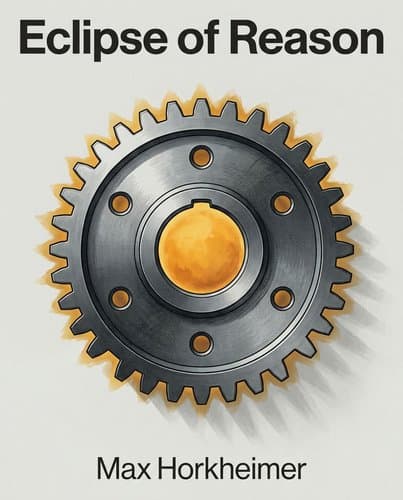
441559_eclipse-of-reason
by Max Horkheimer
Western reason was never humanity's liberator—it was engineered from the start to dominate, and once stripped down to pure calculation, it lost the ability to…
In Brief
Western reason was never humanity's liberator—it was engineered from the start to dominate, and once stripped down to pure calculation, it lost the ability to question whether any goal is worth pursuing. Horkheimer exposes how "rational" thinking became the perfect servant of any master, including the worst ones.
Key Ideas
Instrumental Reason Cannot Decide Moral Ends
When someone defends a moral or political position using the language of 'reason,' 'nature,' or 'science,' ask what those terms structurally cannot say. Formalized reason — reason as pure calculation of means — is equally available to any end and cannot adjudicate between them. The rhetoric of rationality is not a guarantee of rational content.
Dogmatism Hides in Self-Exemption From Critique
Any system of thought that stops questioning its own foundations is practicing dogmatism, regardless of how anti-dogmatic its self-description is. The positivist demand for verification applies to everything except the demand for verification itself. Watch for the moment any philosophy declares its own ground rules exempt from scrutiny.
Repression Without Meaning Generates Resentment
Suppressing natural impulses without offering genuine compensation doesn't eliminate them — it converts them into resentment that seeks a socially licensed outlet. Institutions that repress without substituting real meaning generate the destructive energy they then need enemies to absorb.
Abundance of Choice Destroys Autonomous Judgment
The quantitative expansion of consumer choice can coincide with the elimination of genuine spontaneity and independent judgment. More options than any medieval nobleman had, and less capacity to choose on the basis of self-formed values — these are not contradictions but two sides of the same process.
Every Proposed Solution Contains Its Disease
Every proposed cure for a cultural crisis — restore religion, restore science, restore community — must be interrogated with the question: what faculty is authorizing this cure, and does that faculty escape the same critique applied to the disease? The crisis tends to reappear inside every proposed solution.
Who Should Read This
Thoughtful readers interested in Ethics and Cultural Studies willing to slow down and wrestle with ideas.
Eclipse of Reason
By Max Horkheimer
11 min read
Why does it matter? Because the tool we trust to tell us right from wrong has been quietly reduced to something that cannot tell us anything at all.
- The war is over. The death camps have been liberated. The democracies have won — using their science, their industry, their rational planning — against a regime of barbarism. The expected conclusion: reason works. Use more of it.
Max Horkheimer, writing that same year, arrives at something far stranger: the problem isn't that we used too little reason. It's that reason itself, the scientific and calculating kind we celebrate, was never designed to ask whether an end is worth pursuing. It can tell us how — never whether. Which means it works just as well for slavery as for liberation, just as well for the death camps as for the Declaration of Independence. The Enlightenment didn't fail. It succeeded. That's the problem. This book is about what we built when we thought we were building freedom.
The Reason That Can Justify Chattel Slavery Can Justify Anything
On the evening of December 19, 1859, Charles O'Conor took the stage at the Academy of Music in New York City. He wasn't a plantation owner or a Southern firebrand — he was one of the most celebrated lawyers in the country, a man once nominated for the presidency by a faction of the Democratic Party. And he was about to deploy, with evident care, the full vocabulary of Enlightenment reasoning to defend chattel slavery. It was "not unjust," he told his audience. It was "just, wise, and beneficent," ordained by nature, confirmed by philosophy, sanctioned by justice. Every word he used was borrowed from the tradition that produced the Declaration of Independence.
Horkheimer's question, watching this from across a century, is devastating in its simplicity: why couldn't reason stop him?
The answer turns on a distinction Horkheimer draws at the very start of his argument. Two fundamentally different things have gone by the name "reason" in Western history. The first, what he calls objective reason, held that reason isn't just a tool in the human mind but a force running through reality itself. Plato believed the structure of the universe revealed which ends were worth pursuing. Spinoza held that clear enough sight of reality was itself transforming, pulling you toward care for the whole rather than just yourself. Ethical conduct was something you arrived at through understanding, not something you chose. On this view, reason could look at any institution and ask: is this actually good? Does it correspond to the real order of things?
The second kind, subjective reason, asks only: does this work? Is it efficient? Does it serve the goals already in place? It is the faculty of matching means to ends, of calculating probabilities, of getting from here to there. What it cannot do, almost by definition, is evaluate where "there" is. The ends themselves lie outside its jurisdiction.
For roughly two thousand years, Horkheimer argues, Western thought treated subjective reason as a partial, limited expression of something larger. The Enlightenment changed this. In attacking religion and mythology as irrational, philosophy ended up destroying the very concept of objective reason that had given it authority. By the nineteenth century, Bertrand Russell could state plainly that ethical judgments possess no property analogous to truth. Science can verify facts; morality is outside that domain. He offered this as intellectual honesty. Horkheimer reads it as the completion of a long collapse.
Which brings you back to O'Conor. He wasn't misusing reason. He was using it exactly as a purely formal, means-end calculating tool is designed to be used. Given certain premises about social order, productivity, and the presumed facts of human hierarchy, slavery was stable, efficient, and self-perpetuating. Subjective reason, stripped of any capacity to ask whether those premises were worth holding, could only optimize around them. The words "nature" and "justice" still appeared in his argument, but they had been hollowed out — they no longer referred to anything outside his preferred conclusions. They were serving the argument, not testing it.
This is the part that should stay with you: a reason that cannot evaluate ends is not a neutral tool. It is an engine that will run on any fuel you give it, toward any destination, and call the journey rational the whole way there.
The Philosophy That Demands Proof of Everything Cannot Prove Its Own Foundation
If a philosophy demands that every claim submit to the test of verification, what happens when you test that demand itself?
In 1943, John Dewey and Ernest Nagel offered their diagnosis of the cultural crisis: people had lost confidence in scientific method and were retreating into intuition, mysticism, and revealed truth. The cure was to restore that confidence. No statement, on this view, deserves acceptance unless verified through observation and experiment. Everything else is superstition.
Here's the problem. The principle that "no statement is meaningful unless verified" cannot itself be verified through observation. When you press positivists to justify why observation is the proper test of truth, they appeal to observation again. The circle closes. Horkheimer's name for this is petitio principii (begging the question), and it sits at the very foundation of a school that had staked its reputation on the charge that other philosophies rest on unjustifiable assumptions.
The neo-Thomists, Catholic philosophers reviving the medieval tradition of Thomas Aquinas, at least knew they were standing on faith. They acknowledged their presuppositions. The positivists had the same kind of foundation and couldn't see it, which makes their situation, philosophically, worse.
The dogmatism of the church is, in a way, more rational than a rationalism so fervent it overshoots its own rationality. The college of cardinals must answer to the Gospels — a fixed text that can, at least in principle, be turned against the institution. An official body of scientists, under positivist theory, answers only to currently accepted scientific procedure, which is itself declared the measure of truth. The cardinals have something external they must reckon with. The positivists have only a mirror.
Nagel called any attempt to place limits on scientific authority a form of bad faith, reaching for exactly the censorial power that science had once revolted against in the hands of the church. The positivists' ideal of open intellectual competition and the monopolistic pressure to conform to their method are not opposites — both reduce thought to a contest over which ideas prevail, not an inquiry into which ones are true.
A positivism that equates truth with current scientific procedure cannot evaluate the ends that science serves, only optimize within them. The disease gets a new name, not a cure.
The Nazi Rally Was a Civilization Watching Its Own Suppression Erupt
The usual reading treats fascism as a collapse: reason overrun by barbarism, civilization cracking under the pressure of its own suppressed violence. Horkheimer's reading is more uncomfortable than that.
Picture a rally in National Socialist Germany. The speaker has the crowd's full attention, and now he does something that brings the house down: he impersonates a Jew. The crowd erupts into raucous, almost hysterical laughter. For a moment, everything that has been forbidden is permitted.
What that scene reveals isn't civilization failing. It's civilization working exactly as designed.
The mechanism starts in childhood. Humans are born mimics. Before rational learning kicks in, the child absorbs the world by imitating it: the parents' gestures, their laughter, their anxiety. Civilization must convert this mimetic impulse into disciplined, goal-directed behavior. The formula replaces the image; the calculating machine replaces the ritual dance. Every pressure a child encounters, from parents to playgrounds, is a demand to suppress the raw imitative drive and redirect it toward acceptable, productive ends.
But the impulse doesn't disappear. It waits. And if civilization never offers genuine compensation for what it suppresses — if the sublimations don't pay off, if renunciation serves only the system itself — the impulse accumulates behind a dam. The question is what opens the floodgate.
The Nazi rally opened it. The crowd wasn't simply being whipped into hatred. They were being given something rarer and more powerful: a socially licensed moment to do what they'd been forbidden to do since childhood. The speaker's impersonation of a Jew was an act of mimesis (the most primitive form of expression, the thing civilization most rigorously trains out of people), performed in public, with official sanction, before thousands. The laughter wasn't incidental to the persecution; it was the persecution's psychological fuel. A forbidden impulse finally given room.
Here's where it gets genuinely strange. Look at the people leading this revolt of nature against civilization. Nazi propaganda had spent years circulating a specific caricature of the Jewish merchant, and Goebbels, the Reich's chief propagandist, physically resembled it. The man engineering that figure's destruction looked like the figure himself. Hitler's gestures, abrupt and theatrical, could have been lifted from Chaplin's parodies of pompous strongmen. The demagogues were enacting nature's revolt while serving its repression. Their clowning was never naive. The performance was calculated to invite the crowd's suppressed drives into the open so those drives could be weaponized.
Horkheimer's point is that fascism wasn't a retreat from rationalization. It was rationalization deploying the revolt against itself. The Nazis enlisted precisely the people industrial modernity had squeezed out: small artisans, rural tradespeople, housewives. Their suppressed rage was real. The channels through which it was directed were engineered. Nature's rebellion against domination became the instrument through which domination tightened its grip. The peasant who rallied to overthrow the machine lost his independence and became a cog in the very machinery he thought he was smashing.
That's the trap Horkheimer keeps finding: the rebellion always arrives already domesticated. Declare nature the supreme law against civilization, and civilization will have already put the declaration to use.
Liberal Competition Built the Individual and Then Consumed It
Liberalism didn't fail to protect the individual — it built the individual and then digested it. This is Horkheimer's harder claim, and it cuts against every nostalgic appeal to restore the system's original promise. What the Nazi rally made spectacular, the ordinary labor market makes routine: the self dissolved not into a screaming crowd but into the nearest available job description.
The bourgeois entrepreneur who anchored liberal society was, for a time, genuinely individual in a way that mattered. He owned property he expected to pass to his children. He had to plan across decades, which meant he had to actually think: about markets, politics, what his grandchildren might inherit. This long horizon gave his reasoning substance. He saw the community and the state as resting, literally, on people like himself. The individuality wasn't ornamental; it had a material base.
But liberal competition, operating by its own logic, converted this arrangement into its opposite. The mechanism Horkheimer identifies is almost mathematical: each individual sealed off by the pursuit of self-interest ends up resembling every other individual pursuing the same thing. Market competition produces not a society of distinct individuals but a society of interchangeable types. By the time large economic combines have replaced independent entrepreneurs, what the system calls individualism is just the rhetoric of individualism, useful to corporations seeking exemption from regulation and completely detached from what it names.
What the entrepreneur's successor finds is a world where survival depends not on thinking across generations but on fitting into the nearest available organization. The future has collapsed to the near term. There's no property to transmit, no long horizon to plan across. The rational response, in the narrow means-end sense, is mimicry. From birth, the individual learns that the only way to get along is to give up the hope of genuine self-realization. He imitates his play group, his classmates, his athletic team, each of which demands more complete assimilation than any nineteenth-century parent or teacher could have enforced. Conformity isn't imposed from outside; it is adopted as the only available logic of self-preservation. The individual survives by mimicry, the oldest biological strategy there is.
Against this, Horkheimer offers a single reversal: the actual individuals of our time are not the celebrities or the inflated personalities of popular culture. Those figures live as images; they are produced by their own publicity, shaped by it, indistinguishable from it. The real individuals are the anonymous dead of the concentration camps. They refused mimicry when mimicry was the price of survival. They held something the system could not absorb — a judgment, a refusal, a sense of what they would not become — and the system destroyed them for it. The proof of individuality, in this world, was that the machinery noticed it and ground it down. The system that promised to protect individuality has made individuality an act of martyrdom.
There Is No Original, Healthier Reason to Return To
A reader willing to accept Horkheimer's diagnosis might still reach for the obvious remedy: go back. Restore the objective reason of the Greeks. Revive the Enlightenment's original confidence. Recover some pre-industrial community before calculation devoured everything. Horkheimer's final move is to close that door.
The disease of reason, he argues, isn't something that happened to reason at some unfortunate turn in Western history. It is what reason is, in civilization as we have known it. Reason was born from the drive to dominate nature — to convert the world from an environment to be inhabited into a resource to be exploited. That birth is the origin of the pathology. Here is where the argument becomes genuinely difficult to sit with: the same calculating gaze that organized the concentration camps was latent from the moment the first human being looked at the surrounding world as something to be seized and used.
This isn't metaphor. Horkheimer means it with clinical precision. The paranoia that builds logically constructed systems of persecution (the systematic logic of genocide) isn't a grotesque departure from reason. It is reason's own structure exposed. Any form of thinking that consists purely in the pursuit of aims, that processes the world as raw material for goals set elsewhere, carries this tendency in its architecture. The camps didn't represent reason's breakdown. They represented its completion.
Which rules out every cure on offer. The neo-Thomists want to revive medieval cosmology. Ortega y Gasset, the Spanish philosopher best known for The Revolt of the Masses, diagnoses the masses as spoiled children and prescribes more cultivation. The prescription reveals him as a symptom, not a remedy. If mass culture's real damage is that it has crowded out genuine thought, then a philosopher who packages that diagnosis for mass audiences is performing the very substitution he's condemning. Robert Lynd, a sociologist Horkheimer takes seriously, wants to replace religion with a social creed authenticated by scientific method. The moment you describe spiritual longing in those terms, it has already become meaningless. The language of the cure disavows what it proposes to cure.
What's left? Not a program. Horkheimer is explicit — nearly aggressive — about this. Philosophy that turns itself into activism, propaganda, or a blueprint has abandoned philosophy. The world has enough people converting ideas into commands.
The legitimate function philosophy can still perform is negation: the patient, relentless exposure of what mutilates human beings, the refusal to let any ideology or social order rest in the comfort of its own self-justification. Not the construction of a better system — the critique of every system's claim to be final. In this role, philosophy is something like civilization's memory, the mechanism that keeps the past from vanishing into the triumphalist narrative of whoever currently holds power.
The book's last line earns what the whole argument has built toward it. To keep exposing what our civilization calls reason, to refuse to let it settle into its own self-assurance, is the only honest thing reason can still do for itself.
The Diagnosis With No Prescription
Here's what Horkheimer leaves you with: not a program, not a method, not a better set of premises to swap in for the ones he's dismantled. The refusal is intentional. Any philosophy that converts its diagnosis into a blueprint — that says here, do this instead — has already rejoined the problem: a procedure confident in its own authority, unable to justify its foundations, optimizing toward ends it cannot evaluate. The cure would wear the disease's face.
What he offers instead is discomfort. An awareness that the tools you use to think — about justice, nature, reason itself — carry the same pathology he spent the book tracing. That awareness isn't comfortable and it isn't actionable. But it's what keeps any civilization from making peace with itself too soon, from assuming that history has finally arrived somewhere worth staying. He would call it thinking, but he means something specific: not arriving at better answers, but refusing to let any social order's account of itself go unchallenged. The book ends without a program. It doesn't end without a posture.
Frequently Asked Questions
- What is Eclipse of Reason about?
- Eclipse of Reason traces how Western rationality transformed from a tool for evaluating human ends into purely instrumental calculation of means. Horkheimer argues that when reason became formalized—stripped of any capacity to judge whether goals themselves are worthwhile—it became equally serviceable to any objective, moral or immoral. This shift devastated our ability to ground values in rational thought. The work exposes how appeals to "reason," "science," or "nature" often mask an underlying inability to ask whether any given end deserves pursuit. Rather than guaranteeing rational content, rationality became a rhetoric obscuring substantive judgments about what makes life meaningful.
- What are the key takeaways from Eclipse of Reason?
- A central insight is that formalized reason—reason as pure calculation of means—cannot adjudicate between competing ends and is equally available to any goal. When someone defends a position using "reason," "nature," or "science," these terms structurally cannot justify the end itself, only whether the means efficiently achieve it. Another crucial takeaway concerns institutional repression: when systems suppress natural impulses without offering genuine compensation, those impulses convert into resentment seeking socially licensed outlets. Horkheimer observes that expanded consumer choice often coincides with eliminated genuine spontaneity and self-formed values. This isn't contradiction but two sides of the same process. The work also reveals how every proposed cultural cure tends to reproduce the original problem internally.
- What does Horkheimer mean by the 'eclipse of reason'?
- The "eclipse of reason" describes reason's transformation from substantive critique to mere instrumental calculation. Originally, reason evaluated whether ends themselves were worthy—it could ask "should we pursue this?" Now formalized reason only asks "how efficiently can we pursue this?" This eclipse means reason lost its capacity to justify values or adjudicate between competing goals. Instead, reason became a neutral tool equally serviceable to any objective. This formalization didn't eliminate reason's power but redirected it entirely toward means-calculation, leaving humanity without rational grounds for choosing which ends to pursue. The "eclipse" is not reason's disappearance but its evacuation of normative content.
- Is Eclipse of Reason worth reading?
- Eclipse of Reason remains invaluable for diagnosing contemporary rationalization. It teaches readers to interrogate appeals to "reason," "science," and "nature"—recognizing these rhetoric often mask inability to justify underlying ends. Horkheimer's framework is essential for anyone encountering modern institutional discourse, from policy justifications to technological innovation rhetoric. Beyond diagnostic utility, the work reveals how any proposed solution to cultural crises tends to reproduce the problem internally: restore religion, restore science, restore community—each authorization risks repeating the original critique. For readers seeking to distinguish genuine rational justification from rationalized ideology, this text provides irreplaceable analytical tools and deepens understanding of modern rationalization's costs.
Related Book Summaries
Read the full summary of 441559_eclipse-of-reason on InShort