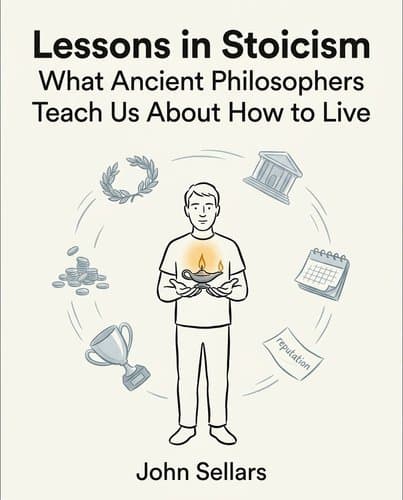
43566091_lessons-in-stoicism
by John Sellars
Every form of mental suffering you experience is a judgment you're making — not a fact imposed on you. Ancient Stoic philosophers identified the exact moment…
In Brief
Every form of mental suffering you experience is a judgment you're making — not a fact imposed on you. Ancient Stoic philosophers identified the exact moment between event and reaction where that judgment lives, and show you precisely how to intervene there.
Key Ideas
Pause Between Event and Interpretation
Before reacting to anything — a criticism, a setback, a piece of bad news — pause. The gap between what happened and what you think about it is where your wellbeing is actually determined.
Govern Your Judgment of Emotions
Your physiological reactions (heart racing, flinching, tears) are outside your control and don't need to be fought. The judgment you make in response to them is within your control. Intervene there, not after the emotion has formed.
Pursue Endeavors Without Binding Happiness
Pursue health, wealth, and relationships with genuine effort — the Stoics explicitly say these are worth pursuing. But never make your sense of wellbeing conditional on achieving them; that hands control of your happiness to forces you cannot govern.
Premeditate Loss to Reduce Shock
Practice premeditation of evils: briefly and regularly imagine losing what you value most — health, a relationship, your income. Not to create anxiety, but to reduce shock and correct the irrational assumption that your luck will hold indefinitely.
Use Mortality to Reject Procrastination
Hold mortality in mind not as a threat but as a corrective. Asking 'could this be my last day?' isn't morbid — it's the antidote to the assumption that licenses putting off life until later.
Honor Your Roles Despite Emotions
Identify your roles — parent, colleague, friend, citizen — and take their duties seriously. Abandoning a role under the cover of emotion (too painful, too difficult) is a logical contradiction, not a justified response.
Universal Duties Transcend Self-Interest
Your obligations extend outward in concentric circles to all of humanity, not just your immediate circle. When local customs or self-interest conflict with basic duties to other people, the larger obligation takes precedence.
Who Should Read This
Thoughtful readers interested in Stoicism and Ethics willing to slow down and wrestle with ideas.
Lessons in Stoicism: What Ancient Philosophers Teach Us About How to Live
By John Sellars
9 min read
Why does it matter? Because "being stoic" means almost the opposite of what you think.
The popular image of the stoic: jaw set, eyes dry, unmoved by anything. A person who has simply decided not to feel. That image is wrong — and the three Roman Stoics at the center of this book would have found it embarrassing.
What Seneca, Epictetus, and Marcus Aurelius actually argued is stranger and more useful: that nearly all non-physical suffering — anxiety, resentment, fear, disappointment — isn't caused by events. It's caused by the split-second judgment we pass on events. A setback doesn't produce despair; the conclusion that it's a catastrophe does. And here's the part that changes everything: judgments are the one thing entirely within our control. Which means the capacity to stop suffering has always been ours. That's not coldness. That's the most hopeful thing anyone has ever said about the human mind.
Stoicism Was Never About Feeling Less — It Was About Diagnosing What Makes You Suffer
Zeno, the movement's founder, worked this out by pushing back against a harsher tradition. The Cynics, most famously Diogenes of Sinope (who lived in a barrel and owned almost nothing), held that virtue required total rejection of possessions. Zeno admired this, then noticed the flaw: if wealth is truly an "indifferent" (neither good nor bad in itself), why actively prefer poverty to prosperity? Aristotle had already observed that generosity requires having something to give.
So Zeno drew a distinction. Health, money, reputation: valuable, worth pursuing, natural to want. But not good in the way character is good.
Four centuries later, a man known as Epictetus — Greek for "acquired," a word that tells you exactly how he entered the world — was banished from Rome by an emperor who considered philosophers dangerous, and set up a philosophy school on the western coast of Greece. The school opened with a declaration: the philosopher is a doctor, and this place is a clinic for sick souls.
Not a temple. Not a debating hall. A clinic. The claim is precise: people come to philosophy because something specific is wrong with how they think, and that wrongness generates real suffering.
This is what most people get wrong about Stoicism. The word has come to mean tight-lipped endurance — the soldier who doesn't flinch. But the Stoics weren't interested in suppressing emotion. They were interested in diagnosing its source. And their diagnosis pointed to one particular mistake: confusing things that have value with things that are genuinely good.
None of them, alone or combined, can produce a happy life. Trading your integrity for fame or money means surrendering the one genuinely good thing for a mere indifferent. That's not stoic endurance. That's the failure Stoicism was built to prevent.
You Control Almost Nothing — Which Means You Control Everything That Actually Matters
Think about the last time something went wrong: a job you didn't get, a conversation that soured, a plan that fell apart. Your instinct was probably to ask: what could I have done differently? That's a reasonable question, and often a useful one. But underneath it runs a deeper assumption: that control means shaping outcomes. That the person who has things handled is the person whose plans succeed.
Epictetus sorted the entire contents of human life into two bins. In the first: judgments, desires, impulses (the things genuinely up to us). In the second: the body, possessions, reputation, worldly success. His opening claim was blunt. Most human unhappiness is simply the result of getting these two bins confused, of treating second-bin things as if they belong in the first.
The obvious reading is a distinction between internal and external, mind versus world. But Epictetus was making a narrower, stranger claim. He wasn't saying we control everything in our minds. We don't choose which memories surface, which sensations arrive, which emotions stir. What we control is something more specific: our judgments. What we think about what happens to us. And because judgments generate desires, which generate actions, this narrow category drives everything downstream.
The problem is that we make most of our judgments so fast, so habitually, that we stop noticing we're making them at all. We start treating things as inherently good (the promotion, the house, the relationship) as if the value were sitting inside the object rather than being added by us. Marcus Aurelius, who governed an empire and read Epictetus obsessively, developed a technique to interrupt this. Before judging a luxurious meal, he reminded himself what it actually was: the dead body of a fish. An expensive robe: dyed wool soaked in shellfish blood. Not cynicism — precision. He was trying to see the object before his valuation landed on it, to catch himself in the act of assigning worth.
The exercise sounds strange until you see what it reveals. If you can dissolve the value of something by describing it accurately, that value was never in the thing. You put it there. And what you can put there, you can also withhold, or redirect.
Here the argument turns unsettling. If you've made your sense of wellbeing dependent on a second-bin outcome (landing the job, keeping the relationship, achieving a specific result), you've handed your happiness to something you can't control. The frustration you feel when those things don't go as planned isn't really about the events themselves. It's the product of a judgment you made about what those events mean, layered on top of a prior judgment that the outcome was essential to your wellbeing. The suffering has two authors, and both of them are you.
Epictetus's paradox resolves itself here. Control almost nothing? True. But the one thing you do control, the judgment you make about what happens, is the entire determinant of whether you suffer or not. You've been spending your energy on the second bin. The first bin was always available.
You Can't Stop the First Wave — But You Can Choose the Second
A man comes to Epictetus's school to complain. His brother has turned cold and resentful, and he wants to know what to do about it. Epictetus's answer is immediate: nothing. You cannot do anything about your brother's anger, because it belongs to your brother. But Epictetus shifts. The man standing in front of him is upset, and that is a different problem, one he can actually fix.
The exchange is the Stoic diagnosis of emotion in miniature: two separate states, belonging to different people. The brother's anger is out of reach. The man's distress is not, because all emotions, the Stoics argued, are products of judgments we make. The man is suffering because of how he has interpreted the situation. Interpret it differently, and the suffering dissolves.
There's a complication. Emotions don't feel like choices while you're having them, because by the time one is fully formed, it's no longer under your control. Seneca, who served under Nero and knew firsthand what arbitrary power felt like, compared being in the grip of anger to being thrown off a building. The falling is not reversible. The Stoic intervention can't happen inside the emotion. It has to happen before.
Seneca broke the sequence into three stages. First, involuntary physical reactions: a flinch, a spike of fear, a racing pulse, entirely outside your control. Second, a judgment made in response to what just happened. Third, the emotion itself, which once formed runs its own course and cannot be reasoned with, only waited out. The only place the chain can be broken is stage two, the moment of judgment, before the emotion forms.
Stage two passes in an instant — which is why the intervention can't be taught as an in-the-moment trick; it has to be a trained habit. Epictetus offers a test. If someone criticizes you, pause before reacting and ask whether they're right. If they are, they've identified something you can now fix: a benefit. If they're wrong, the error is entirely theirs. Either way, nothing has harmed you. The only harm comes from skipping the pause and letting the provocation carry you into anger. You are, as he put it, complicit in your own provocation.
The Practice That Feels Morbid Is the Most Rational Thing You Can Do
Rehearsing disaster in your mind feels like the opposite of healthy thinking. It seems to manufacture suffering in advance, to borrow grief before it's owed. But this intuition, Seneca argued, has the logic exactly backwards.
Around AD 40, Seneca wrote a consolation letter to a woman named Marcia, who had lost a son three years earlier and couldn't stop grieving. What struck him wasn't the initial loss (that was devastating, and no philosophy pretends otherwise). What struck him was the persistence of her suffering, and the particular shape it had taken. Marcia's grief, he thought, was being sustained partly by shock. She had never genuinely reckoned with the possibility that her son might die before her, even though she knew, as anyone does, that everyone dies and could die at any time.
So when it happened, she had no way to absorb it. The death arrived as an aberration, a violation of expectations she'd never examined. Three years later, those expectations were still being violated, still generating the same freshness of shock. Grief had calcified into a habit of mind.
Seneca's prescription sounds harsh until you sit with it: she should have thought about this before it happened. Not obsessively. Not in a way that poisons every moment with her son. But clearly enough that the knowledge — he will die; you will die; this is what life is — had actually been metabolized rather than stored in a mental drawer marked "true but do not open."
It's irrational to think "I didn't expect this to happen to me" when you've watched it happen to others repeatedly. Grief, job loss, illness, the collapse of security you thought was permanent: these arrive for everyone, in every century, without exception. Expecting your luck to simply hold indefinitely isn't hope. It's a failure to pay attention to the evidence.
Seneca called it the premeditation of evils, and it's been the most misunderstood piece of Stoic practice ever since. It isn't pessimism. It isn't the manufacture of anxiety. It's the mental equivalent of learning to swim before you fall into the water. When loss arrives, and it will, the person who has genuinely reflected on that possibility isn't less sad. But they're less destroyed, because the event fits into a picture of the world they've already honestly assembled.
Mortality Isn't the Enemy of a Good Life — It's the Condition for One
Why do most people fully appreciate their lives only when those lives are nearly over?
Seneca's answer, written in the first century AD, is that we run on a false assumption: that time is unlimited. We know, in the abstract, that we'll die. Most of us live as if that knowledge doesn't apply until some distant future. Retirement, maybe. Or eighty. The assumption goes unexamined, and so it licenses indefinite postponement of whatever actually matters.
He sorts the ways people waste their lives, and the list is uncomfortable to read. Some people chase wealth for luxury goods that end up in rubbish bins before they're done. And distraction compounds everything: the constant noise, the interruption, the pull of things that feel urgent but amount to nothing. Seneca calls this the defining condition of the preoccupied life: one where "living is the least important activity." The habit generates restlessness. You can no longer relax or concentrate. The value of life becomes legible only when almost none of it remains.
The corrective Seneca offers is specific: hold in mind that today could be your last — while planning as if it won't. The two thoughts coexist without contradiction. The first dissolves the assumption that a long future is guaranteed and decisions can wait. With that gone, urgency appears on its own. The things deferred until retirement, until success, until some unnamed condition is finally met — they acquire their actual weight.
Epictetus changes the frame entirely. Every possession, every person, every year is a loan from Nature, not yours to keep. The right response to loss isn't grief at what was taken, but recognition that what was borrowed has been returned. Grief at a loss, like the assumption that time is unlimited, mistakes a loan for an inheritance.
The Inner Work Was Never a Retreat — It Was Preparation for Greater Obligation
A Roman senator named Helvidius Priscus walked into the Senate chamber knowing exactly what he was risking. The Emperor Vespasian had been using imperial power to override senatorial authority, and Helvidius — a lifelong student of Stoic philosophy — planned to say so openly. He was warned to stay away. He appeared anyway. When told that further opposition would end his career, he kept speaking. He was eventually put to death for it.
Epictetus, who recounts this confrontation, does not present Helvidius as someone who lost. He presents him as someone who understood what his role required. Helvidius was a senator; senators had a duty to defend the body's authority. That the emperor might kill him for it was a fact about the emperor, not a reason to become a different person. He gave up his life rather than his role — which is precisely what years of Stoic practice, all that careful attention to judgment and character, was meant to make possible.
Here's the reversal most people miss. The Stoic emphasis on inner work — examining your judgments, clarifying what you actually control — can look like a philosophy of self-enclosure: the retreat into the inner citadel, leaving the world to its chaos. But the inward turn is preparation, not destination. You examine your values and discipline your reactions so that when you return to your actual obligations — as parent, neighbor, citizen, officeholder — nothing can buy your compliance or make you flee when staying is what the role demands.
Marcus Aurelius named Helvidius in the Meditations — private notes he never meant anyone to read. That makes it different from a public speech: he wasn't praising Helvidius for effect. He was writing down what had shaped his thinking about what political life is for. The inner work, done seriously, produces not withdrawal from the world but the capacity to face it fully — including its emperors.
The Finding That Rewrites the Stereotype
What two thousand years of practice showed individuals, a modern research program set out to test. Since 2012, researchers running an annual program called Stoic Week have tracked thousands of people living by Stoic principles for one week, measuring character traits before and after. The trait that changed most wasn't equanimity. It wasn't detachment or composure under pressure. It was zest — energy, enthusiasm, appetite for life. That's the reversal the philosophy has always carried inside it. When you stop treating your wellbeing as something that lives in outcomes you can't control — the promotion, the approval, the luck holding — you don't end up with less feeling. You get it back. The Stoics weren't teaching people to want less. They were diagnosing a particular error: outsourcing the question of whether your life is good to things that were never equipped to answer it. Stop doing that, and you find you have considerably more life on your hands.
Frequently Asked Questions
- What is Lessons in Stoicism about?
- Lessons in Stoicism identifies "the root of human suffering — mistaken judgments about what actually matters," drawing on Epictetus, Marcus Aurelius, and Seneca. John Sellars provides readers with a practical framework for reclaiming control over their inner lives and meeting their obligations with clarity rather than anxiety. The book explains why Stoic insights remain actionable today, showing Stoicism as a dynamic approach rather than detached resignation. Central to practice is understanding the gap between events and judgments—the space where wellbeing is determined.
- What are the key takeaways from Lessons in Stoicism?
- The book's central insight is that "the gap between what happened and what you think about it is where your wellbeing is actually determined." Sellars emphasizes that physiological reactions like heart racing or tears are involuntary, but you control the judgment that follows. A crucial practice is premeditation of evils—regularly imagining losing what you value most, not to create anxiety but to reduce shock. Additionally, the book stresses pursuing health, wealth, and relationships genuinely, but never making your wellbeing conditional on achieving them.
- What does Lessons in Stoicism teach about obligations and roles?
- Sellars teaches that you should "identify your roles — parent, colleague, friend, citizen — and take their duties seriously." He explains that abandoning a role under emotional difficulty is "a logical contradiction, not a justified response." Beyond immediate circles, "your obligations extend outward in concentric circles to all of humanity." The book emphasizes that when local customs or self-interest conflict with basic duties to others, the larger obligation to humanity takes precedence. This creates an ethical framework grounded in universal duty and connection.
- Is Lessons in Stoicism worth reading?
- Lessons in Stoicism is worth reading for anyone seeking practical wisdom for everyday life challenges. Sellars makes ancient philosophy accessible and immediately applicable, offering clear frameworks rather than abstract theory. The book appeals to people struggling with anxiety, perfectionism, or the pressure to control outcomes beyond their power. By grounding Stoicism in concrete practices like premeditation and pausing before judgment, Sellars demonstrates how 2,000-year-old insights speak directly to modern concerns. Readers gain actionable strategies that create psychological resilience without requiring life circumstances to change.
Related Book Summaries
Read the full summary of 43566091_lessons-in-stoicism on InShort