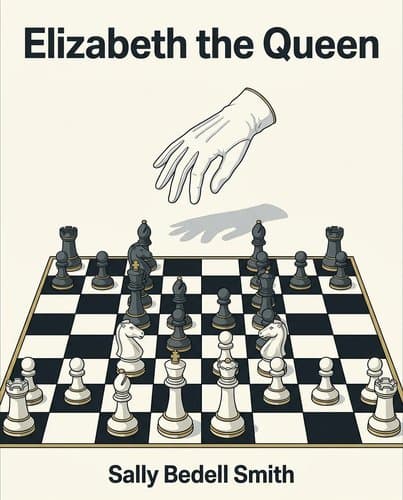
12722468_elizabeth-the-queen
by Sally Bedell Smith
Behind the stoic public mask, Elizabeth II was a woman of iron will, earthy humor, and fierce private convictions who turned restraint into power—revealing how…
In Brief
Behind the stoic public mask, Elizabeth II was a woman of iron will, earthy humor, and fierce private convictions who turned restraint into power—revealing how the qualities we most admire in remarkable leaders are constructed through discipline, not born through temperament.
Key Ideas
Deliberate practice builds enduring identity
Discipline chosen early enough becomes identity — Elizabeth's composure wasn't temperament, it was a skill set assembled over decades of deliberate training, which means the qualities we most admire in high-performing people are often more constructed than innate
Strategic silence concentrates institutional influence
Restraint is a form of power — the Queen's constitutional obligation to stay neutral meant she exercised influence through timing, presence, and what she withheld rather than what she said; in contexts where speaking out undermines credibility, strategic silence can be more effective than advocacy
Personal identity subordinated to institution
The performance and the person eventually merge — after sixty years, Elizabeth II and the crown became indistinguishable, which is both the cost and the achievement; institutions that endure are often built on individuals who subordinate personal identity to institutional logic
Essential constraints guide effective adaptation
Adaptation within limits beats either rigid tradition or wholesale reinvention — each of the Queen's crises (Suez, Diana's death, the Annus Horribilis) was survived by making the minimum necessary concession while preserving the core; knowing which elements are load-bearing and which are decorative is the real strategic skill
Selective warmth amplifies emotional impact
Warmth deployed selectively carries more weight than warmth distributed freely — the Queen's emotional restraint made the moments when she did show care — soup at midnight for Timothy Knatchbull, the bow to Diana's coffin — land with a force that constant expressiveness never could
Who Should Read This
Readers interested in Political Figures and Memoir, looking for practical insights they can apply to their own lives.
Elizabeth the Queen
By Sally Bedell Smith
12 min read
Why does it matter? Because the stoic grandmother you think you know was a performance — and behind it was one of the shrewdest political operators of the 20th century.
The woman the world watched for seventy years — still, composed, unreadable — was apparently a menace behind the wheel. She drove her estates at speeds that made passengers grip the door, gestured like a Roman when she talked, and could stack a plate of sandwiches with the focused precision of someone who'd arranged them a thousand times and still cared how they landed. The public saw the measured pace, the careful gloves, the diplomatic deflection. The inner circle saw someone else entirely. Sally Bedell Smith spent years collecting those two images and pressing them together until the friction becomes the story: how does a person sustain that much disciplined erasure — never a visible opinion, never an unguarded word in public — while quietly shaping governments, anchoring empires, and outlasting thirteen prime ministers? The answer isn't passivity. It's a specific and patient kind of power, one that works precisely because it looks like nothing at all.
The Public Mask Was Built, Not Born
When Elizabeth was thirteen, she began making a twice-weekly carriage ride to the study of Sir Henry Marten, vice provost of Eton College, where she would spend the next six years working through one of the densest texts in the English legal canon: Sir William Anson's three-volume The Law and Custom of the Constitution. The sessions were awkward at first — Marten could barely look her in the eye and kept accidentally calling her 'Gentlemen.' But Elizabeth settled in and did something that would define her reign before it began: she opened her pencil and started underlining. In Anson's description of Anglo-Saxon kingship as 'a consultative and tentative absolutism,' she marked two words — consultative and tentative. She understood, even then, that her power would live in restraint. When biographer Robert Lacey later examined those faded volumes in the Eton library, the annotations amounted to a blueprint for the Queen she would become.
That constitutional education ran alongside a parallel curriculum in physical discipline. Her mother taught her to sit upright and away from the back of the chair — a posture she could hold for hours. She used role-playing exercises to help Elizabeth overcome shyness, impersonating the Archbishop of Canterbury so her daughter could practice holding her own in distinguished company. The body, the manners, the self-possession: all of it trained, not inherited.
The war completed what the tutorials had started. Confined to Windsor Castle through most of her adolescence, Elizabeth spent years mixing with Grenadier Guards officers, developing the conversational steadiness that would later unnerve prime ministers. Then, in 1945, she quietly joined the Auxiliary Territorial Service and spent three weeks learning to strip engines, bleed brakes, and drive a three-ton truck through London traffic. She later told a friend it was the hardest she'd ever worked — and the only time she'd been measured honestly against her peers. On VE Day, she and Margaret slipped out of the Palace and dissolved into the celebrating crowds, anonymous for one last night before the work of being Queen began in earnest.
She Chose Philip Because He Wouldn't Bore Her
Elizabeth chose Philip the way she did everything that mattered: quietly, completely, and without asking permission. When he proposed at Balmoral in the summer of 1946, she said yes on the spot — no consultation with her parents, no period of reflection. This was a woman who would spend the next seven decades following protocols so faithfully that the protocols seemed to have been written by her. That instant, unqualified yes is worth sitting with.
She had decided on him at thirteen, when she watched the eighteen-year-old naval cadet move through a lunch at Dartmouth with the ease of someone who had already learned to carry his own weight. The courtiers surrounding her father were horrified. Philip had no money, no land, and German sisters whose husbands had connections to the Nazi Party. They called him a penniless interloper to his face and a 'Hun' behind his back. Her mother quietly preferred the sons of England's great estates — future dukes with acreage and pedigree. Elizabeth paid none of it the slightest attention.
What she saw, according to their mutual cousin Patricia Mountbatten, was a man with enormous reserves of love and nowhere to put them. His mother had been committed to a sanatorium when he was eight. His father spent the rest of his life in Monte Carlo with a mistress. Philip's entire inheritance, when his father died, fit into a few trunks: some clothes, a shaving brush, a signet ring. The palace establishment saw a liability. Elizabeth saw what that kind of childhood costs a person, and she saw that the cost had not broken him.
His irreverence was part of it too. He roared up to Buckingham Palace in a black sports car, charmed her governess, dragged her sister Margaret into corridor games, and radiated the cheerful indifference of someone who had never needed royal approval. Every other candidate her mother favored arrived with the careful deference of men who understood their place. For a woman whose entire life was managed by hierarchy, Philip's breezy immunity to it was the rarest thing imaginable.
The Crown Ate Everything — Including the Mother
How do you hold an empire together when the empire starts at home? Elizabeth II never answered that question cleanly, and the price of the ambiguity landed hardest on the people closest to her.
Philip saw it first. In the months after the accession, Churchill and the Queen Mother blocked his attempt to give his children the Mountbatten surname, insisting the family remain Windsor — a decision Elizabeth accepted rather than fought. Philip's response became one of the most quoted lines of the reign: he told friends he was 'nothing but a bloody amoeba,' the only man in the country denied the right to pass his name down. The fury was real. But what it actually revealed was the architecture Elizabeth had chosen — the institution came first, always, even when the institution was being wielded against her husband by a prime minister and a mother she couldn't bear to cross. She was, as her courtiers noted, very young. She would learn to hold her ground. Not yet.
The same logic governed her as a mother, though it was harder to defend. By her own admission she used the red boxes — the leather dispatch cases of state papers that arrived every single day of her reign — as a retreat from the messier work of raising children. Charles suffered the most visible consequences. Diffident and emotional where his father was blunt and physical, he was packed off to Philip's old school, Gordonstoun, despite being temperamentally unsuited to its spartan regimen. The misery was not a secret — the Queen herself wrote of his 'dread' before returning after holidays. But the combined logic of Philip's authority over family decisions and her own aversion to confrontation held. The bet was that duty shaped character, and that a sovereign who bent her priorities toward the nursery would have less to give the nation.
Anne came out more or less whole. Charles did not. What's clear is that Elizabeth never mistook composure for indifference, even when the people around her did. The crown ate everything, and she knew exactly what she was feeding it.
She Was the Most Powerful Person in the Room — Without Ever Saying So
The Churchill example is the section's best entry point, so start there. When Churchill arrived for one of their Tuesday audiences having missed an important cable from the British ambassador in Iraq, the Queen asked him, with studied lightness, what he had made of that particularly interesting telegram from Baghdad. He had to admit, on the spot, that he hadn't read it. He returned to Downing Street in a cold fury, read the cable, and found it exactly as significant as she had implied. No accusation, no lecture. Just a question that arrived like a mirror. Churchill later told his aides she had the instincts of someone far older than her years. What she had, more precisely, was the patience to let other people's gaps speak for themselves.
Her version of political power looked, from the outside, like a chess grandmaster who never touches the board — the game played through the questions she asked, the silences she held, the moments she chose to show up in person.
That quality scaled up to the international stage in ways that weren't subtle at all, even if the mechanism was. In late 1961, Ghana's president Kwame Nkrumah had been drifting toward the Soviet Union, and the British government desperately needed him kept inside the Commonwealth. Death threats and bomb blasts in Accra gave Macmillan reason enough to cancel the state visit — but Elizabeth refused to waver, reportedly irritated by what she called the 'fainthearts' in Parliament pushing for her to stand down. She flew to Accra, danced publicly with Nkrumah at a state ball, and let the Ghanaian press run photographs of a British queen who was clearly unafraid. The population went, as one BBC correspondent put it, 'out of their minds for her.' When Macmillan called Kennedy afterward, he framed it plainly: the Queen had taken the risk, and now the Americans had to match it. JFK announced U.S. funding for the Volta Dam within two weeks. Ghana stayed in the Commonwealth.
She attended a dinner, danced, refused to cancel a trip — and the outcomes were as concrete as any treaty, the deniability total.
The Coronation Chair Was Also a Confessional
Behind the high altar at Westminster Abbey, hidden from the television cameras and the seven thousand guests and the watching millions, the Archbishop of Canterbury reached under his robes and produced a flask of brandy. He passed it to the newly crowned Queen and her exhausted maids of honor, each of them carrying more than forty pounds of velvet and gold and centuries of accumulated ceremony. They each took a sip, and then Elizabeth II walked back out to finish the job.
That flask is the detail that cracks the spectacle open. The coronation of June 2, 1953 has come down to us as pageantry — the Gold State Coach, the eight gray horses, the dress embroidered with shamrocks and ferns, the peers crowning themselves in unison while the cannons fired in Hyde Park. But for Elizabeth, none of that was the point. When Canon John Andrew, a friend of the royal family, was asked about the ceremony's meaning to her, he was precise: the anointing, not the crowning, was what mattered. The moment when she sat alone under a canopy held by four knights, wearing only a plain linen shift over her gown, while the archbishop poured consecrated oil in the shape of a cross onto her palms and forehead — that was the moment she regarded as permanent and unrepeatable. She had been consecrated before God to serve her people. 'She cannot abdicate,' Andrew said. 'She is there until death.'
She took that literally. Asked by an attendant whether she was nervous that morning, she admitted she was — then immediately said she thought her horse Aureole would win the Derby. It wasn't deflection exactly. It was the woman who would spend the next six decades processing state papers every single day of her life except Christmas and Easter, not because anyone required it, but because she had decided, somewhere in that linen shift, that duty wasn't a role she performed. It was simply what she was. The anointing didn't change what she would do. It explained why she would never stop.
The Covering Shed and the Bedroom Intruder Reveal the Same Woman
The Queen you picture — head scarf, sensible shoes, gloved hands accepting flowers from schoolchildren — is largely accurate and entirely incomplete. The woman underneath that image spent time standing in the corner of a breeding shed at Sandringham watching two thousand pounds of highly strung thoroughbred biology sort itself out, and described the experience as unremarkable. Her stud manager Michael Oswald put it simply: she knew how it worked, and she was very matter-of-fact about it. The leather boots on the mare's hind legs to prevent a fatal kick didn't make her blink. This was a woman who could identify a horse's great-great-grandmother from a sales catalogue and who once noticed, from a single visit as a foal, that a stable had mixed up two of her yearlings years later. The covering shed was just another part of the job she happened to know more about than most professionals.
Then there is the morning of July 9, 1982, which made the breeding shed look routine. At 7:15 AM the Queen woke to a slamming door — unusual enough that she knew immediately something was wrong — and found a barefoot man in a T-shirt sitting at the foot of her bed, blood dripping from a piece of broken glass onto her sheets. She told him to leave. He ignored her and started talking about his problems. She hit the emergency button twice. No response. She called the switchboard twice. Slow response. So she listened to his troubles for ten minutes, found common ground asking about his children, maneuvered him toward a pantry on the premise of finding cigarettes, and waited. When a chambermaid stumbled across them in the corridor, the Queen later reproduced the woman's startled Yorkshire accent for friends with evident amusement. When police finally arrived and one officer paused to straighten his tie, she said: 'Oh come on, get a bloody move on.'
Two scenes, decades apart, the same stillness. Not the stillness of someone numb to experience — the composure of someone who simply never found the world particularly alarming.
The Warmth Was Always There — She Just Rationed It
Late on a Friday night in September 1979, a fourteen-year-old boy arrived at Balmoral Castle carrying bandages and grief. Timothy Knatchbull had survived the IRA bomb that killed his twin brother, his grandmother, and his great-uncle Lord Mountbatten just weeks earlier. He came up the drive in the dark, still healing. The Queen met him in the corridor at a stride — her grandson's generation recalled her moving like a mother duck gathering in lost young. She kissed him, fed him soup and sandwiches, walked him to his room, and had started unpacking his bags before his older sister gently told her to go to bed. Timothy later described what followed as 'almost unstoppable mothering mode.'
Hold that image against this one: in the days immediately following the bombing, the Queen could not bring herself to write a condolence letter to the Brabourne family. Only Philip wrote. A doctor close to the family explained her silence with characteristic precision — she was the kind of private person who felt that anything she put in a letter would be inadequate, so why try. Yet around the same time, when a family friend sent a note about the death of one of her corgis, the Queen replied with six pages. Her sister-in-law Pamela Hicks understood the logic: a dog doesn't matter enough to get the words wrong, so the feelings pour out. A human loss that matters too much locks everything shut.
People who called the Queen cold consistently missed this. The warmth was never absent — it operated according to its own internal grammar. In situations where the emotional stakes were manageable, it flowed freely: those midnight sandwiches, the monitored bedtimes for Timothy in the days after, the way she sat next to him at lunch and let him talk at his own pace without probing. The higher the stakes, the more the institutional reflex took over — the fear of inadequacy, the sense that to attempt feeling publicly was to expose both herself and the other person — and sealed everything off.
When the Performance Nearly Broke, She Rewrote the Rules
On the afternoon of November 20, 1992, her forty-fifth wedding anniversary, the Queen drove to Windsor Castle in a mackintosh and wellies and stood in the courtyard watching the roof of the home she loved most collapse into smoke. Her hands were pushed into her pockets. The image that came off the wire services that day captured something no portrait painter had ever managed: her ultimate solitude. A spotlight in the Private Chapel had ignited a curtain, and by the time she arrived, nine state rooms were gone and the fire was still moving.
What followed was a masterclass in controlled concession. The Heritage Secretary announced that the government would cover the restoration — entirely reasonable, since royal residences can't be commercially insured. The tabloids, carrying months of accumulated fury at Andrew, Fergie, Charles, and Diana, turned the Windsor fire into a referendum on royal entitlement. The Daily Mail led the charge. Within days, a tax plan her private secretary Robert Fellowes had been quietly advancing for months was suddenly urgent. The Queen gave it her approval faster than her advisers had expected. She would pay income tax on her private income. She would reimburse the government for Civil List payments to her children. She would open Buckingham Palace to paying visitors to fund the restoration — a concession her mother had opposed, and one the Queen herself had worried would 'lift too much veil.' The whole package landed before Christmas.
None of it was capitulation. Each concession was calibrated. She paid tax on the income she could afford to tax and structured the inheritance exemptions so the institution's private resources couldn't be bled out by succession. She opened the state rooms during August, when she was at Balmoral anyway, so the Palace's working rhythms remained intact. The opening ended up generating enough revenue to cover three quarters of the restoration cost and fund ongoing maintenance. What looked like retreat was actually management: give ground on the symbolic terrain, protect the inheritance structure and the Palace's working rhythms. The next sentence made that concrete anyway, so the reordering pays off here.
She applied exactly the same logic five years later, when Diana's death triggered the closest thing to real danger the monarchy faced in her reign. Standing at the Palace gates on a Friday afternoon with cellophane flowers banked six feet high along the railings, stopping to ask a girl whether she'd been queuing long. The solution followed the same pattern: one carefully chosen break with tradition — a live broadcast delivered in front of an open window with the crowds visible behind her, the phrase 'as a grandmother' inserted at the suggestion of Alastair Campbell, Tony Blair's communications director, who was effectively the spin doctor nudging her toward populism — and then the bow to Diana's coffin, unscripted, as the gun carriage passed. That bow cost her nothing she valued. It returned everything the week had put at risk.
The More She Disappeared Into the Role, the More Powerful She Became
Lord Salisbury once said the Queen's presence 'occupies space' in such a way that coups, dictatorships, and rule by decree become procedurally harder — not because she acts to prevent them, but because she exists in a position they would have to displace. You can't stage a coup against a prime minister without first accounting for a sovereign whose legitimacy runs back a thousand years and whose approval rating, after six decades on the throne, held steady around 80 percent. The math never penciled out. No general ever tried.
This is what constitutional monarchy actually does, stripped of sentiment. The sovereign is a load-bearing wall. You can gut most of the interior — move the furniture, repaint the rooms, tear out what no longer works — but that wall is the thing keeping the ceiling up. No one elected it. It doesn't argue back. It stands there and does its work through pure presence.
The paradox is that this kind of power is built entirely out of self-erasure. Every time she kept her political opinions private, every time she deflected a pointed question or bent to constitutional convention when her own instincts ran the other way, the institution grew more solid. An elected leader with strong opinions is a faction. A sovereign with no visible opinions is a nation. She understood this not as sacrifice but as the terms of the arrangement she had agreed to in that linen shift under the Archbishop's hands in 1953. The more completely she disappeared into the role, the more the role became something no adversary could get a grip on. You cannot argue against a presence that never argues back. She had made herself, quite deliberately, into the wall.
The Yellow Cap of the Winning Horse
There's a moment near the end of the book that keeps returning. At the races — Ascot, the kind of day surrounded by the full apparatus of royal obligation — Philip leans over and asks her, quietly, what she actually thinks of some constitutional business that's been running for weeks. She doesn't deflect exactly. She just starts describing the yellow cap of the winning jockey, the mud on the track, the way the horse moved in the final furlong. By the time she's finished, the original question has simply ceased to exist.
What you're watching isn't evasion. It's a woman so thoroughly merged with her role that the boundary between performance and person had long since dissolved. And here's the paradox the book leaves you holding: the more completely she gave herself over to that role — the more she withheld, observed, and stepped back — the more genuinely untouchable she became. There's nothing to grip. No position to outmaneuver, no candid moment to weaponize.
Notable Quotes
“She’d never let us down.”
“just a plasticene head emerging from a cocoon, with Nurse Rowe proudly standing guard: a simple little cot, with white blankets.… Poor little chap, two-and-a-half hours after being born, he was being looked at by outsiders—but with great affection and good-will.”
“Oh, thank you. But I am so sorry that it means we’ve got to go back to England and it’s upsetting everybody’s plans.”
Frequently Asked Questions
- What is Elizabeth the Queen about?
- Elizabeth the Queen by Sally Bedell Smith draws on extensive interviews and archives to reveal the private woman behind Britain's longest-reigning monarch. The book examines how Elizabeth II built her legendary discipline, wielded influence through restraint rather than speech, and preserved the monarchy across decades of crisis. It serves as a case study in institutional leadership, strategic adaptation, and the power of withheld emotion. Smith explores how the Queen's deliberate training in composure shaped not just her personal character but the survival of the British monarchy itself through turbulent decades.
- What are the key takeaways from Elizabeth the Queen?
- Elizabeth the Queen teaches five core lessons about leadership and institutions. Discipline becomes identity when developed early—the Queen's composure was a constructed skill set refined over decades, not innate temperament. Restraint is powerful; her constitutional neutrality meant she influenced through timing and strategic silence rather than words. After decades of subordinating personal identity to institutional logic, performance and person merge completely. Surviving crises requires distinguishing load-bearing elements from decorative ones; minimum concessions while preserving core identity enable institutional survival. Finally, selective emotional expression carries more weight than constant warmth.
- How did Elizabeth II use restraint as a form of power?
- The Queen exercised influence through what she withheld rather than what she said. Her constitutional obligation to remain neutral prevented direct advocacy, but this limitation became her greatest strength. Strategic silence combined with carefully timed presence allowed her to shape events without undermining credibility. In contexts where speaking erodes authority—particularly for constitutional monarchs—restraint proves more effective than vocal advocacy. Rare moments when Elizabeth expressed emotion carried extraordinary weight precisely because they were exceptional. Her discipline meant warmth deployed selectively had far greater impact than constant expressiveness.
- What does Elizabeth the Queen reveal about crisis management and institutional survival?
- Elizabeth the Queen shows how institutions endure through strategic adaptation within clear limits. Rather than rigid tradition or wholesale reinvention, the Queen navigated major crises—Suez, Diana's death, the Annus Horribilis—by making minimum necessary concessions while preserving core identity. Real strategic skill lies in distinguishing load-bearing elements from decorative ones. The monarchy survived because Elizabeth understood that abandoning everything for novelty and clinging to tradition both court disaster. The path required knowing which elements defined institutional survival. Institutions that last are built on individuals who subordinate personal identity to institutional logic while maintaining strategic flexibility.
Related Book Summaries

Read the full summary of 12722468_elizabeth-the-queen on InShort