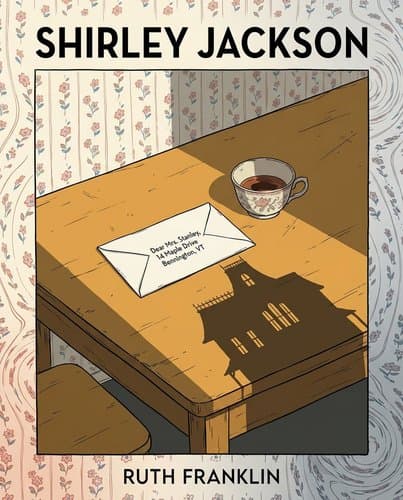
28789677_shirley-jackson
by Ruth Franklin
Shirley Jackson's genius wasn't despite her contemptuous mother, unfaithful husband, and suffocating domestic imprisonment—it was because of them.
In Brief
Shirley Jackson's genius wasn't despite her contemptuous mother, unfaithful husband, and suffocating domestic imprisonment—it was because of them. Ruth Franklin's definitive biography reveals how Jackson's horror fiction and domestic comedy were always the same investigation: what happens when home becomes a trap.
Key Ideas
Armor and cage are one thing
The persona you build to survive a hostile culture can outlast you. Jackson's witch persona gave her cultural oxygen and ensured her Times obituary called her 'Author of Horror Classic' — the costume she wore to protect the writer became the reason critics never took the writer seriously. Armor and cage can be the same object.
Horror and domesticity investigate identical danger
Jackson's two apparent careers — literary horror and domestic comedy — are one continuous investigation. Both ask what happens when the home becomes a trap. Reading them as separate genres misses her entire argument: the most terrifying word in The Haunting of Hill House is 'home,' and the domestic comedy ends with a woman poisoning her family at the dinner table.
One document filed in two formats
The fiction and the marriage are the same document, filed differently. Franklin's method — reading unpublished drafts against unsent letters against published novels — reveals that every James Harris story, every woman who can't find her way home, every daemon lover who breaks his promise is also a record of twenty years of swallowed rage. Biography is not context for the fiction; it is the fiction, in rougher form.
Physical illness serves as psychological strategy
Psychic restriction often takes a physical address. Jackson's agoraphobia was not separate from her locked heroines — it was the same force, and Franklin argues it was unconsciously functional: if she cannot leave the house, she cannot leave Stanley. What presents as illness can also be the self's last defense against an impossible choice. The distinction may matter less than the cost.
The typewriter spell makes life shapeable
'Experience plus magic equals fiction' — Jackson's formula, delivered in the most domestic terms possible, is not mystical. The magic is the act of transforming what is unlivable into something shapeable. The same mechanism that turned a swallowed rage letter into the James Harris stories turned a year of agoraphobia into a diary ending with 'laughter is possible.' The typewriter was always the spell, and it usually worked.
Who Should Read This
Readers interested in Memoir and Classic Authors, looking for practical insights they can apply to their own lives.
Shirley Jackson
By Ruth Franklin
9 min read
Why does it matter? Because the scariest thing Shirley Jackson ever wrote wasn't "The Lottery" — it was a diary entry.
You think you know Shirley Jackson. The witch of American letters. The woman who wrote "The Lottery" in one inspired sitting, mailed it off, and was as surprised as anyone when the letters started arriving — outrage, bewilderment, canceled subscriptions. That version of Shirley Jackson is mostly fiction, which is fitting, because she invented it herself. Ruth Franklin spent years inside the unpublished drafts, the FBI surveillance files, the unsent letters Jackson composed in fury and then quietly filed away — and what she found was someone far more interesting than the legend: a formally precise literary artist who was simultaneously raising four children, tolerating a serially unfaithful husband, and converting everything that was destroying her into fiction that knew, from the inside, what her contemporaries only glimpsed from the outside: how a woman could vanish inside the life she was supposed to want. The horror and the household comedy were never two careers. They were one investigation, conducted under the same roof.
The Witch Was a Strategy, Not a Self — and the Culture Punished Her for Both
A reporter from the Associated Press arrives looking for a witch. Shirley Jackson, two drinks in, obliges. She talks fluently about incantations, black magic, the practical uses of witchcraft in daily life. W. G. Rogers files a piece headlined "Shirley Jackson Is 'Sure 'Nuff' Witch." It produces a phrase that will follow her for decades: "Miss Jackson writes not with a pen but a broomstick."
What she tells her parents afterward: most of it she'd invented on the spot, drawn from mystery novels she'd been reading.
Ruth Franklin's biography argues that for Jackson, witchcraft was a way of staking a claim that mid-century American culture had otherwise blocked off: I have power here. The books she actually studied ran to hundreds of volumes: witchcraft trial records, demonological histories, accounts of women who got what they wanted and were feared for it. To call yourself a witch was to borrow some of that authority.
The persona was also exhausting to maintain. Franklin finds two draft biographical notes in Jackson's archive. One is the properly sanguine housewife note. The other opens with impatience — "I am tired of writing dainty little biographical things" — and proceeds to describe a house where she has drawn protective charms in black crayon on every door sill and digs for mandrakes by the light of the full moon. Neither is exactly true. Both are performances for different audiences, which is the point.
Meanwhile, the persona was being weaponized without her control. Pyke Johnson, her publisher's publicist, called every reporter he could find to tell them Jackson had used witchcraft to break a publisher's leg. "Boy, that story is sure going to sell copies," he told her, slapping her on the back. Jackson watched it happen with visible distaste and kept wearing it.
When she died at forty-eight, the New York Times headlined her obituary "Author of Horror Classic." Not novelist. Not heir to Henry James. The witch had swallowed the writer entirely.
In Every Jackson Novel, the Scariest Word Is 'Home'
Jackson's horror and her domestic comedy are the same investigation conducted from different distances, and the distance is always the width of a front door.
The entity haunting Hill House — whatever pounds on bedroom doors in the night, writes in blood on the walls, pulls Eleanor Vance helplessly through darkened corridors — repeats one word. "Home." Not "death," not "beware," not some suitably Gothic warning. Eleanor's final breakdown has her racing through the rooms crying that she is home at last, before she drives her car into a tree. The novel's most terrifying word is also the most ordinary one, spoken millions of times daily in houses exactly like the ones Jackson was describing in her cheerful memoirs for women's magazines. Which version you see depends entirely on how close you're standing to the material.
Jackson's great-great-grandfather was Samuel C. Bugbee, San Francisco's first architect, who built the Nob Hill mansions for Leland Stanford, Charles Crocker, and the other railroad barons of the 1870s. Each became a Gothic stage set almost immediately. All were destroyed in the 1906 earthquake. When Jackson began researching Hill House in 1958, she wrote her mother asking for photographs of Bugbee houses. Geraldine sent clippings and added that she was "glad [the Crocker house] didn't survive the earthquake."
The ancestral Gothic was real before it was fiction. The house as trap, as character, as the place where domestic order curdles into something unnameable — Jackson didn't invent this. She inherited it, grew up alongside it, and spent thirty years finding new ways to make you feel it.
Every Swallowed Rage Shows Up Somewhere — in Throat Infections, Daemon Lovers, and Haunted Houses
In the summer of 1939, Stanley Hyman (her husband, the critic) mailed Shirley a letter from New York disclosing, somewhere in the middle of it, that he had slept with the redhead in his apartment building and hadn't used a condom. He was worried she might be pregnant. Also enclosed: the latest chapters of his book-in-progress, for her thoughts. Please confirm, he signed off, that she still loved him despite his "ridiculous transcendental groin."
Jackson wrote back immediately. "Instead of slapping your wrist I ought to kick you in the face you bastard," she began, and kept going. She didn't send that letter. She waited a few days, then sent another one, calm, focused entirely on feedback for his book, not one word about the redhead. Days later she was hospitalized. The doctors moved through possible diagnoses before landing on a virulent throat infection. She couldn't eat or drink. She lost fifteen pounds.
Franklin is blunt about the timing: within days of swallowing everything she most needed to say, Jackson fell ill with a swollen throat.
What cannot be spoken gets filed: into the body when the pressure is acute enough, into the fiction when there is time. That is the marriage's operating system. A decade of unsent letters eventually arrived in the stories of The Lottery. James Harris, drawn from an old English folk ballad about a demon who makes promises he never keeps, walks through Jackson's stories as a man in a blue suit who disrupts women's lives just enough to send them past the point of return. There's the secretary who waits for her fiancé named Jamie Harris, who may never have existed. Franklin makes the connection explicit: Jackson saw Stanley as a daemon lover who had swept her out of her parents' world, and the witchcraft chronicles she studied obsessively described men who made promises they didn't keep. "He promised her she would never want for anything," one witch confesses about the devil in the seventeenth-century text Jackson loved. "And ever since she hath wanted all things."
In September 1958, Jackson wrote Stanley a letter cataloguing twenty years of broken promises. Near the end: "You once wrote me a letter telling me I would never be lonely again. I think that was the first, the most dreadful, lie you ever told me." She was deep in the manuscript of The Haunting of Hill House at the time. Eleanor Vance wakes in the dark, clutches a hand beside her, screams when she realizes she cannot say whose hand it is. That question — whose hand is this, in the bed beside me — is the marriage's essential question, now filed as fiction, finally sent.
The Story That Became a Cultural Monument Was Written by a Pregnant Woman Putting Away Groceries
What actually happened on the morning Shirley Jackson wrote "The Lottery"?
The myth, which Jackson told in lectures and which Franklin traces to one published after her death, goes like this: clear June morning, baby in a stroller, inspiration strikes on the walk home, story written in a single sitting before her son got back from kindergarten, first draft so clean it needed almost no revision, sent to her agent the next day.
The archive says otherwise. Jackson submitted the draft in March, three months before the June 26 publication date. The New Yorker's fiction editor Gus Lobrano had reservations and requested revisions. The Old Man Warner speech — the passage where a villager snarls that there's always been a lottery, that the corn depends on it, that abandoning the ritual means going back to living in caves — was added at Lobrano's direct request. The story's thematic anchor wasn't Jackson's instinct. It was her editor's note.
The magazine's founder Harold Ross, in a letter to Hyman, captures the limits of everyone's understanding: it was "a terrifically effective thing" and would "become a classic in some category." The editors of what Franklin considers arguably the most anthologized American short story of the twentieth century could not name the category, and most of the nearly 300 letter-writers who wrote in couldn't either. A psychiatrist at the University of Cincinnati thought it was factual reportage; a Twentieth Century-Fox producer wanted to know where such rituals still occurred; Jackson noted wryly that more readers expected Tessie Hutchinson to win a washing machine at the end than understood she was being stoned to death.
Here is what Franklin recovers, and it's the reading that makes everything else click: Jackson was pregnant with her third child when she wrote it. She omitted this from every public account. Tessie, the lottery's victim, forgets what day it is because she was finishing her dishes; she shows up disheveled, self-conscious, late. Jackson herself had put away her groceries before sitting down to write. The mirroring is exact: the story works simultaneously as universal allegory and as the portrait of a specific woman in a faded house dress, defined entirely by her family, whom the community murders for being exactly the person she always was. The most anthologized story in American high school English curricula is a feminist horror story. Most readers never realized. Jackson never said.
She Wrote Herself Into Hill House, and the Door Locked Behind Her
December 2, 1963. Shirley Jackson sits at her typewriter on yellow copy paper (the same she's always used) and tries to follow her editor Pat Covici's prescription: one hour every morning, write whatever surfaces. Not fiction necessarily. Just words. "punctuate at least," she scolds herself within the first paragraph. Her legs still give way when she tries to leave the house. The postmaster, she is convinced, believes she is crazy, so she avoids him. A ringing telephone triggers panic. She has been nearly housebound for a year.
What surfaces on the yellow pages is the logic of the thing she can't explain to her doctors. Ruth Franklin, reading the diary Jackson never showed anyone, finds that what she calls her unnamed "obsession" — the emotion she identifies as shame, the thing she "cannot bring herself to put down the words" for — is the fantasy of leaving: a furnished room somewhere, her clothes hanging up, her reading glasses on the nightstand, no address books, no souvenirs, just herself. The obsession isn't Stanley's affair with his graduate student Barbara Karmiller. It's what the affair has finally made her want to do.
The agoraphobia was working. If Jackson couldn't walk to the car, she couldn't drive away. The same force that had pulled Eleanor Vance into Hill House, that irrational conviction that a trap can become a home, had turned on its author. Jackson had written in her notes for the novel that "the house is Eleanor." By 1963 she was telling a friend she had written herself into the house. The fiction and the marriage shared a floor plan, and she was locked inside both of them.
What she does with this is characteristically Jackson. She applies the only instrument she trusts. "My mind is so full of troubles that there is no room for writing," she admits on the first morning, then immediately notices that the sound of the typewriter in the empty house is comforting. She tells herself, across multiple entries, that "writing is the way out," using the phrase the way Merricat uses her buried silver dollars: as a talisman against forces she can't name out loud. She cannot write about leaving Stanley, so instead she writes about not being able to write about it, converting even the blockage into material.
The Character She Was Finally Writing When She Ran Out of Time
April 1965, Syracuse University's Gifford Auditorium. Shirley Jackson walks onstage in a red dress, hair loose down her back, and begins reading aloud from the novel she has not yet finished. The students fill every seat. The woman who couldn't walk to her own mailbox three years earlier is now standing before the university where her career began, introducing a narrator named Angela Motorman: forty-four years old, size forty-four, recently widowed, and entirely pleased about all of it.
Angela is what you'd get if you took Merricat Blackwood — the feral, house-bound young murderer of We Have Always Lived in the Castle — and somehow got her out into the world as an adult. She has sold all her dead husband's furniture, remarked that he was "a lousy painter," and boarded the first available train to a city she's never visited. She finds a boardinghouse whose landlady keeps three rules, the last being that any spirits you raise, you put back yourself. Angela can see what the cat sees under the dining room table, knows who's calling before she picks up the phone, and finds all of this unremarkable. When she jokes that she has "plenty of room" for all the food she keeps eating, it's the first time in Jackson's fiction that a large woman regards her own body without apology.
Jackson had spent two decades writing women imprisoned by houses, marriages, and their own flinching interiors. Eleanor Vance couldn't leave Hill House. Merricat couldn't leave the family estate. Come Along with Me is seventy-five unfinished pages of a woman who leaves: boards a train, picks a city at random, and announces she has everything she wants.
She died less than three months after that Syracuse reading. But the lecture is the truer ending: Jackson in red, the auditorium crowded, reading a woman who had sold the furniture and boarded a train, the first character she'd written who actually made it out.
What "Laughter Is Possible" Actually Means
The fiction was always running ahead. Jackson spent thirty years writing women who discover — usually in the wrong house, the wrong marriage, the wrong body — that they have more room than anyone suspected. Eleanor. Merricat. The woman on the train in the unfinished last novel. Franklin's biography makes clear that Jackson was one of them, and that she figured it out only in the last eighteen months of her life. The diary, the yellow paper, the reading at Syracuse — those are the evidence. Then she went upstairs for a nap. laughter is possible.
Notable Quotes
“there are few if any descriptive passages in the English language that are finer”
“It is the sort of quiet epiphany every writer hopes for: words that somehow transcend the sum of the parts.”
“shows that the circumstances that exist there, supernatural though they may appear, in fact constitute”
Frequently Asked Questions
- What does Ruth Franklin's Shirley Jackson reveal about the author's life?
- Ruth Franklin's biography reveals how domestic constraints became the engine of Shirley Jackson's fiction. Jackson's life was shaped by a contemptuous mother, an unfaithful husband, and agoraphobia—conditions that Franklin argues transformed her writing into a continuous investigation of entrapment. By reading unpublished drafts and letters against published novels, Franklin shows that Jackson's horror and domestic comedy both explore what happens when home becomes a trap. The biography demonstrates that Jackson's protective persona as a horror writer ultimately limited how seriously critics took her literary work, showing how armor and cage can be the same object.
- How does Ruth Franklin connect Shirley Jackson's horror and domestic comedy?
- Ruth Franklin argues that Shirley Jackson's horror and domestic comedy are not separate careers but one continuous investigation of domestic entrapment. The most terrifying word in The Haunting of Hill House is 'home,' while Jackson's domestic comedy ends with a woman poisoning her family at the dinner table—both explore the same fundamental question about what happens when home becomes a trap. Reading them as separate genres misses Jackson's entire argument about the violence lurking within domestic spaces. Franklin's method of comparing published novels with unpublished drafts and letters reveals the unified purpose beneath Jackson's seemingly disparate work.
- What is the connection between Shirley Jackson's marriage and her fiction?
- According to Ruth Franklin, Shirley Jackson's fiction and marriage are the same document, filed differently. By reading unpublished drafts against unsent letters and published novels, Franklin reveals that every James Harris story—every woman who cannot find her way home, every daemon lover who breaks his promise—is also a record of twenty years of swallowed rage. Franklin's biographical method demonstrates that biography is not merely context for the fiction; it is the fiction in rougher form. This approach shows how Jackson's marriage to Stanley directly shaped her most significant literary investigations into entrapment and escape.
- How did Shirley Jackson's agoraphobia shape her writing?
- Shirley Jackson's agoraphobia was not separate from her locked heroines but the same force, according to Ruth Franklin's biography. Franklin argues the condition was unconsciously functional: if Jackson could not leave the house, she could not leave her husband Stanley. Her physical and psychological restriction took the form of a specific domestic address, paralleling her characters' entrapment. Jackson's formula—'experience plus magic equals fiction'—shows how the typewriter transformed what was unlivable into something shapeable. The same mechanism that turned rage into the James Harris stories transformed agoraphobia into creative output.
Related Book Summaries

Read the full summary of 28789677_shirley-jackson on InShort