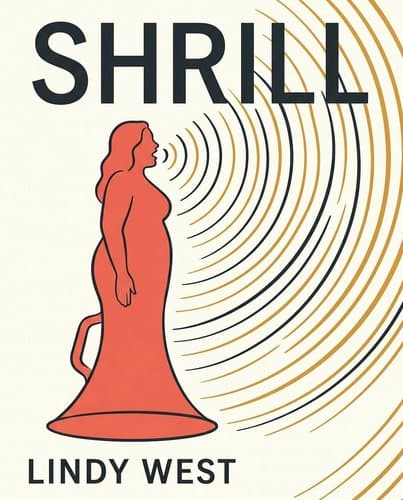
29340182_shrill
by Lindy West
Refusing to be ashamed of your body isn't a quiet personal victory—it's a political act that exposes exactly who benefits from your silence.
In Brief
Refusing to be ashamed of your body isn't a quiet personal victory—it's a political act that exposes exactly who benefits from your silence. Lindy West dismantles the machinery of fat shame with savage wit and proves that the ferocity of the backlash is the surest sign you've hit something true.
Key Ideas
Shame operates as control mechanism
Shame is not a motivator — it's a control mechanism. West's core insight is that fat shame doesn't help people lose weight; it keeps them too exhausted and humiliated to claim any power. 'Shame doesn't work. Diets don't work.' The whole apparatus exists to manage, not help.
External rejection builds body acceptance
Body acceptance isn't about convincing yourself you're beautiful. West's turning point was looking at Leonard Nimoy's photographs of fat women until they stopped making her uncomfortable — a deliberate, external intervention, not an internal shift. She was rejecting what had been installed, not generating self-esteem from scratch.
Public visibility expands possible futures
Going public with stigmatized experience is categorically different from accepting it privately. Every time West said 'I am fat' in print, she was changing the inventory of possible selves available to the next girl who couldn't see herself in any future. The private and the public versions of the same act have entirely different consequences.
Backlash confirms uncomfortable truths
The backlash you receive when you tell the truth about your experience is often the clearest evidence that you're right. West's harassment mob, trying to prove comedy has no misogyny problem, proved it by threatening to rape her for saying so. The evidence they generated was more powerful than any argument she could have made.
Pain drives ordinary cruelty
Forgiveness is not required, but it clarifies something important: the people who harm you online are usually not monsters but ordinary people in pain who've chosen cruelty as their expression of it. That's both more disturbing and more hopeful than a monster, because it means the pattern can change.
Ordinary acts build new worlds
Every ordinary public act in a body that culture has declared unacceptable is world-building. A proposal, a byline, a tweet, a refusal to apologize for taking up space — these aren't personal victories. They're structural interventions in what the next person believes is possible.
Who Should Read This
Readers who connect with first-person stories about Memoir and Social Issues and want to see the world through someone else's eyes.
Shrill
By Lindy West
10 min read
Why does it matter? Because the shame you've been carrying isn't yours — it was put there.
Most people treat body shame as a private reckoning — honest feedback from a reliable source. Lindy West spent decades believing that too. Then the evidence: children's cartoons that taught her fat women are either mothers or monsters, call-in shows like Loveline where women who phoned in about their bodies had already agreed to be mocked for it, strangers who pressed weight-loss cards into her hands on the street like a courtesy. Shame doesn't rise up from inside. It's installed, piece by piece, joke by joke, before you're old enough to recognize what's happening or refuse it. Shrill is the story of what happens when a woman decides to refuse it anyway. And why that refusal, which feels like the most personal act imaginable, turns out to be unavoidably, violently public.
Before You Could Defend Yourself, Culture Had Already Decided What You Were
When Lindy West was a toddler, a jazz musician named Bob Dorough — the composer behind "Three Is a Magic Number" from Schoolhouse Rock — signed a copy of his record for her. "Dear Lindy," the inscription read, "get big!" A sweet wish from a family friend to a small child. As a teenager, West hid the record. She couldn't risk anyone seeing it. They would think she'd taken it too literally.
That gap, an innocent blessing quietly becoming a piece of evidence to conceal, is what this book opens by exposing. West wasn't born ashamed of her body. The shame was installed. Not through a single traumatic moment but through a curriculum so ambient it passed for the air itself.
The curriculum was the media. West catalogs every fat female character she can recall from childhood: eleven figures from animated films, puppet shows, and children's movies. Lady Kluck from Robin Hood: a four-hundred-pound chicken, genuinely brave and funny, stripped of any sexuality because motherhood apparently assigns a body to a different category entirely. The Queen of Hearts: loud, irrational, governing by execution, the foundational template for every hysterical-woman joke that came after. The sea witch Ursula, reframed by West as a political dissident unfairly smeared by an establishment king — but taught to millions of children as a cautionary figure, a warning about what fat women become when they stop being useful. Mrs. Potts from Beauty and the Beast, who apparently gave birth to Chip just four years before the film's events yet is presented as ancient and spherical, while King Triton, father of seven, has the sculpted torso of a competitive athlete.
Fat women in these stories were sexless mothers or cartoonish villains. When romance was permitted, it arrived as condescension: two misfit-shaped people finding each other while the rest of the world exhaled quietly, relieved they'd sorted themselves away from the broader pool.
Two slots. Mother or monster. The menu ends there.
You don't arrive at that conclusion consciously. You absorb it. By the time you're old enough to notice what culture handed you, it's already inside, a set of parameters around what a body like yours is allowed to be. The shame didn't come from the mirror. It came from everything arranged around it.
Shame Isn't a Feeling — It's a Schedule You've Been Living By
She pretended accessories were "her thing" because she couldn't shop at regular stores and was too mortified to explain why. For a decade, she didn't swim. These aren't quirks. They're what a body does when the world isn't built for it.
Think of a phobia managed rather than treated. You don't experience fear every waking moment — you just quietly reroute: different bridge, different road, problem solved. The avoidance becomes so habitual it stops feeling like avoidance. You forget there was ever a choice.
West spent years routing around her body this way. She ordered salad when friends had fish and chips. She invented reasons to avoid skiing, hiking, sailing: anything that might require her body to be scrutinized, accommodated, or found wanting. "Staying small" wasn't a figure of speech. It was a daily itinerary.
The most precise record of that itinerary is what West does to fly on a plane. Window seats only — because the wall affords an extra inch or two to compress into. She arrives two hours early even for domestic flights, not because she's anxious about missing the plane but because showing up late means rushing, and rushing means arriving at her seat flushed and breathing hard, which announces her body before she's even sat down. She visits the bathroom multiple times before boarding to eliminate any chance of needing to get up mid-flight, because getting up means asking someone to move, which means reminding them what they're sitting next to. She lingers at the gate to board first, so no one waits in the aisle while she folds herself in. Before reaching her row, she quietly asks a flight attendant for a seatbelt extender, doing it at the front of the plane so neighbors won't hear the call button and learn what category of passenger they've drawn.
That is the bill for a domestic flight. Not a transatlantic one.
The decade without swimming wasn't a period of sadness about her body. It was a recurring appointment she kept, automatically, in exchange for avoiding the moment someone might look at her and find her wanting. The compliance had become its own calendar. She wasn't just living in her body. She was running logistics for it.
Posting a Photo of Your Fat Body Online Was the Most Political Thing She Ever Did
Accepting your own body in private and claiming it in public are categorically different acts. One is a thing you do for yourself; the other is a thing you do to the world.
West figured out the private part first, and the method was almost embarrassingly literal. She started looking at photographs of fat women online, beginning with Leonard Nimoy's The Full Body Project — black-and-white images of fat women naked, laughing, fearless. Her first response was discomfort: these were things supposed to stay hidden. But she kept clicking back. The images went from uncomfortable to ordinary to, one day, beautiful. She stopped going to the nutritionist. Something had unclenched.
But private acceptance has a ceiling. It changes how you feel when you look in the mirror; it doesn't change what it costs someone else to look at themselves. West could feel that ceiling in her own workplace, where her boss, Dan Savage, kept writing about the "obesity epidemic" in terms that lampooned the people it described. She'd tried private routes: a careful email, a vague swipe on the company blog. Nothing moved.
So in February 2011, she posted a full-body photograph of herself (captioned with her exact age, height, and weight) alongside a four-point argument she titled "Hello, I Am Fat." The argument didn't ask for sympathy. It rejected the premise. When critics raised healthcare costs, she named what the obesity-epidemic rhetoric actually ran on: it's easier to mock individual fat people than to fix food deserts, corn subsidies, or poverty. When they cited concern for her health, she pointed out that shaming destroys mental health, and that nobody invoking concern had ever mentioned that.
The fourth point was different in kind. She didn't argue that fat people can be healthy too. She refused the framework entirely: thinness isn't the goal. She wasn't a before photo waiting for its after.
The shame, it turned out, was not load-bearing. She said no publicly, and the building didn't fall. Strangers started writing to tell her the post had changed something small but real in how they saw themselves. Private acceptance had done nothing for them. The public no had.
She Loved Comedy Her Whole Life. Then Comedy Tried to Break Her.
West had been making this argument in print for months before it went to television.
The debate on the FX late-night show Totally Biased ends with Jim Norton, the comedian West has been arguing with about rape jokes for twenty minutes, suggesting to the host that the best possible conclusion would be for him and West to "make out for a while." Sexualizing the woman he'd been debating, on air, as a punchline, at the close of an argument about women being dehumanized in comedy. No comment needed.
This is not the worst thing that happens next.
Norton posted the clip to his social media the following morning, and by the time West woke up her phone was flooded. The messages arrived in hundreds and then thousands: Twitter, Facebook, her email, the comment sections of anything she'd ever written. Their argument was uniform — she was too fat to rape, which therefore invalidated everything she'd said about rape culture. West began writing brief rebuttals, almost mechanically: that fat women get raped too, that rape is not a compliment, that an assurance she'd never have to worry about rape is less certain than it sounds.
What the mob had given her, in trying to dismantle her argument, was the clearest evidence for it. They were invoking rape as something that could be withheld from an undeserving woman, a gift she was too ugly to receive. That's exactly what West had been arguing was embedded in a certain strain of rape humor: that rape reflects on the victim's status, tied to a woman's desirability rather than a perpetrator's violence. The harassers didn't see this. They were too busy proving it. She did.
She compiled the messages, sat in an armchair at home, and had her husband film her reading them aloud for nearly five minutes, deadpan, no visible emotion, just the words and her face. The video worked because it stripped away every argument about her motives. Here were the words. Here was the person they'd been sent to. She had, she realized, won.
The tide reversed. Prominent comedians declared support. The mayor of Seattle tweeted solidarity. Norton wrote an essay asking his fans to stop, and then on his radio show introduced the concept of rape culture to an audience that had no patience for it. His co-host considered this for a moment and allowed: maybe they were, in fact, a little rapey. The spark was there.
West had won the argument. She also stopped being able to watch stand-up. The accumulated hostility had settled into a message she couldn't shake: she was not wanted in a space she'd loved since adolescence, since she was recording Conan off cable every night hoping to absorb its powers. She'd gone into this fight to make comedy more open, to keep it hers. By the time she'd succeeded, it didn't feel like hers anymore.
The Cruelest Troll Had Read Her Father's Obituary
What do you actually do when someone weaponizes your dead father against you?
About eighteen months after her father died — she watched the particular quality of his presence leave the room before the rest of him did — West discovered a Twitter account called "Paw West Donezo." The profile photo was a real picture of her dad at his piano, the one where he'd once penciled note names on the keys to teach her. The bio: "Embarrassed father of an idiot. Other two kids are fine though." Location: "Dirt hole in Seattle." The person who built this account had read the obituary West wrote two days after her father's lungs gave out. He knew the hospital. He knew the siblings. He knew exactly how fresh the wound was.
It landed during what West calls Rape Joke Summer, when she was absorbing hundreds of threats daily and considered herself armored. This one got through.
The standard advice is don't engage: silence starves trolls, engagement rewards them. West rejected the logic: staying quiet meant the account stayed up, her dead father's voice permanently available for anyone who wanted to put words in his mouth. She wrote about it at Jezebel, openly and in grief. Within hours, the troll emailed an apology, deleted both accounts, and attached a $50 donation receipt to Seattle Cancer Care Alliance, designated in her father's memory.
West notes this had never happened. Scholars who study trolling confirm it: public remorse is not what trolls do.
She followed up months later and they recorded a two-and-a-half-hour conversation for public radio. He was not a monster. He'd been about seventy-five pounds overweight, stuck at a bad job, recently dumped. West's writing about fat self-acceptance had enraged him in ways he couldn't then articulate. He admitted the misogyny easily. Women's voices growing louder and less tentative had felt threatening, and he'd considered himself a decent person (mother, sisters, girlfriends) while systematically hunting women online to wound them. When West asked whether he'd gotten any sense of her father as a human being from the obituary, he said: "I knew he was a dad that loved his kids." She asked how that made him feel. "Not good. It would not leave me." He wrote the apology the next day. West: "I didn't mean to forgive him, but I did."
Both men occupied the same brain: the one who built a fake dead-father account to wound a stranger, and the one the obituary wouldn't leave alone. The trolls aren't a separate species. They're people whose pain found a target. That's the most disturbing possible conclusion — and, West insists, the most hopeful one, because people can be reached.
A Public Proposal to a Publicly Reviled Body Is a Political Statement
West and Aham were at a bar one evening, holding hands, when a woman who recognized her from her writing greeted them warmly — then asked whether they were roommates. Not "how long have you been together?" Roommates. The leap required to land there, past two people holding hands, tells you everything the culture considers plausible. A conventionally desirable man choosing a fat woman is so improbable that strangers skip right over it.
When Aham proposed — publicly, at a bar full of their people, cello and bass playing — West assumed grand gesture and nothing more. But when she asked why, he told her she'd once said, while drunk: thin women get public proposals, like the man is winning a prize. Fat women get proposals conducted in secret, as though the man is confessing a weakness. She'd told him: don't do that to me.
So he didn't. And in not doing it, he'd made an argument. Same ring, same speech, same tears — but when a couple meets every cultural expectation, an engagement is personal. When a couple shouldn't exist according to those expectations, the same engagement is political. It corrects something, publicly, that the culture insists isn't broken.
Saying no to a troll, posting a photo, walking down an aisle without hiding — none of it stays only personal. When you live in a body the culture wrote off, claiming it publicly is construction work. You're building the world, whether or not you signed up for it.
The Girl Who Wanted to Build Worlds
West wanted to build worlds at fourteen. She took a programming class, got ignored by the teacher for two sessions straight, and walked away. She spent the next twenty years apparently doing something else. She never stopped. Every time she put something true about her body into public language, she was laying a foundation — not for herself only, but for the next person who couldn't find themselves in any story.
At some point she finds the Bob Dorough record. Reads the inscription. It says what it always said. Now she knows what kind of instructions those were.
Notable Quotes
“Nu uh! I never said anything u guyz srsly!”
“I am thoroughly annoyed at having my tame statements of fact—being heavy is a health risk; rolls of exposed flesh are unsightly—characterized as 'hate speech.'”
“Rolls of exposed flesh are unsightly”
Frequently Asked Questions
- What is Shrill by Lindy West about?
- Shrill traces how Lindy West learned that refusing to be ashamed of her fat body is an inherently political act, not just a private one. The memoir examines how shame functions as a control mechanism in culture, why publicly claiming stigmatized identities changes what others believe is possible, and what the culture's hostile reaction to that refusal reveals about itself. West draws on her career as a feminist writer to explore these themes, demonstrating that personal body acceptance carries profound structural and political implications for how others see themselves and their futures.
- What does Shrill teach about shame as a control mechanism?
- According to West, "Shame doesn't work. Diets don't work." Fat shame doesn't help people lose weight; instead, it keeps people too exhausted and humiliated to claim any power over themselves. West's turning point wasn't generating self-esteem from scratch but rather deliberately rejecting what had been installed through external intervention. She looked at Leonard Nimoy's photographs of fat women until they stopped making her uncomfortable. Body acceptance isn't about convincing yourself you're beautiful; it's about interrupting the machinery of shame that keeps you paralyzed and prevents you from claiming space and power.
- Why is going public with stigmatized identity important in Shrill?
- Going public with stigmatized experience is categorically different from accepting it privately. "Every time West said 'I am fat' in print, she was changing the inventory of possible selves available to the next girl who couldn't see herself in any future." The private and the public versions of the same act have entirely different consequences and implications for future generations. When a person claims space and visibility in a body the culture deems unacceptable, they're engaging in world-building. A proposal, a byline, a tweet, a refusal to apologize for taking up space—these ordinary acts aren't merely personal victories. They're structural interventions in what the next person believes is possible.
- What does Shrill say about responding to backlash and harassment?
- The backlash you receive when you tell the truth is often the clearest evidence that you're right. West's harassment mob, trying to prove comedy has no misogyny problem, proved it by threatening to rape her for saying so. The evidence they generated was more powerful than any argument. Forgiveness isn't required, but it clarifies something important: people who harm you online are usually not monsters but ordinary people in pain who've chosen cruelty as their expression. That's both more disturbing and more hopeful than a monster, because it means the pattern can change.
Related Book Summaries

Read the full summary of 29340182_shrill on InShort