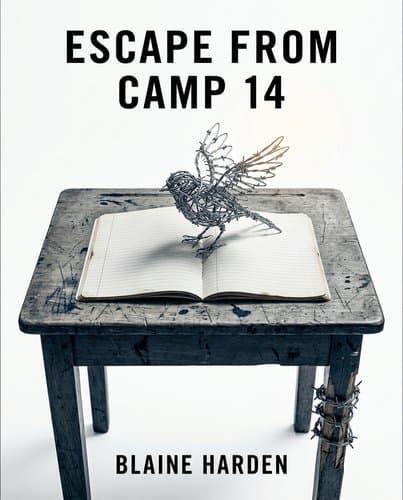
11797365_escape-from-camp-14
by Blaine Harden
Born inside North Korea's most brutal prison camp, Shin Dong-hyuk never knew love, family, or conscience—making his escape the only firsthand account that…
In Brief
Escape from Camp 14 (Marc) tells the story of Shin Dong-hyuk, the only known person born and raised inside a North Korean political prison camp who escaped to the West. Through his account, Blaine Harden examines how the camp system systematically dismantles human conscience, empathy, and family bonds — showing readers what totalitarianism destroys at its most fundamental level.
Key Ideas
Indoctrination Transforms Betrayal Into Survival Strategy
The North Korean camp system's most sophisticated weapon is not violence but pedagogy — it engineers children from birth to view betrayal as survival and family as competition, making atrocities like Shin's betrayal of his mother a designed outcome rather than a moral failure
Conscience Requires Empathy's Foundational Conditions
Conscience is not innate — it is cultivated. Shin's story is a controlled experiment in what happens when a state methodically removes every condition under which empathy develops: family bonds, shared history, religion, privacy, and safety
Self-Interest First Seeds Moral Conscience
The first free choice of Shin's life — not snitching on Park — was explicitly selfish, not moral. The book argues this is how conscience actually begins: not with virtue but with a calculation that someone's presence is worth more than the reward for betraying them
Deception Training Undermines Survivor Testimony Credibility
Trauma testimony is inherently unreliable not because survivors lie maliciously, but because the camp conditioned Shin to view deception as survival. Harden builds his entire account on Shin's word, then reveals Shin lied about the central event for years — a reminder to hold any single witness account with appropriate humility
Emotional Capacity Rebuilds Incompletely and Painfully
The guilt Shin feels as an adult for a mother he never loved while she was alive is evidence that emotional capacity can be rebuilt, but the book is honest that this process is slow, incomplete, and accompanied by suffering that arguably rivals what he endured inside the fence
Who Should Read This
Readers interested in Memoir and Political Figures, looking for practical insights they can apply to their own lives.
Escape from Camp 14
By Blaine Harden
12 min read
Why does it matter? Because the person who informed on his mother was not a monster — he was a system's most successful product.
Most of us assume survival instinct is something clean — primal, animal, fundamentally human. You run from the fire. You protect your children. You grieve your dead. Blaine Harden's account of Shin Dong-hyuk dismantles that assumption. Shin was born inside North Korea's Camp 14, a total-control zone housing fifteen thousand people in open-air slavery, and he was engineered from his first breath to see betrayal as the only rational act. He informed on his mother and brother, watched them executed, and felt relief — not grief, not guilt, only the clean animal logic of a child who had been taught, since before he could read, that love was a liability and loyalty to guards was survival. The most disturbing thing this book reveals isn't the violence. It's that Shin's response was the designed outcome — and that becoming human afterward is the harder, slower, unfinished escape.
A Child Can Be Built Without Love, Conscience, or God
His arms are bowed from childhood labor. His right middle finger ends at the knuckle, cut off by a guard after he dropped a sewing machine. His shins, from knee to ankle, are scarred where the electrified fence burned him as he crawled through it. Shin Dong-hyuk was born in 1982 inside Camp 14, a North Korean political prison roughly the size of Los Angeles, and he is the only person known to have escaped one of these facilities after being born there. His body is a record of the place. The more disorienting fact isn't written on his skin: he never heard the word love. Not as a suppressed feeling, not as a concept he learned and then abandoned. The word simply did not exist in the world he was handed.
Consider what he did with his mother's lunch. She would leave for the fields each morning and he would eat his own ration immediately, then eat hers. When she came back hungry and beat him with a hoe, he absorbed the blows — and did it again the next day. This wasn't sociopathy. It was the logical behavior of a child for whom another person's hunger registered as irrelevant data. He didn't think of it as cruelty because cruelty requires a prior concept of care.
When survivors of the Nazi camps write their memoirs, they mourn a demolished world — the father's shop, the grandfather at holiday dinners, the faith that used to anchor everything. Shin has no demolished world to mourn. He didn't lose God; he was never introduced to the idea. The camp didn't strip his humanity away. It was the only architecture his humanity was ever built inside. His case isn't about what violence does to a person. It's about what the total absence of love, from birth, produces — and what that absence looks like when it walks out the other side of a fence and tries to become a person.
The Camp Didn't Just Punish — It Taught Children to Do Its Work
A six-year-old girl walks to the front of the class and kneels. Her teacher, a uniformed man with a pistol on his hip, raises a long wooden pointer and begins striking her skull. She collapses. Shin and his classmates carry her home to her family at the pig farm, and she dies that night. The next morning, no mention is made of it. The teacher faces no consequences. And Shin, recalling this years later, describes what he felt at the time as nothing more complicated than agreement: she had stolen five kernels of corn, and the punishment was just.
That reaction — a child watching another child beaten to death and thinking yes, this is right — wasn't a failure of moral development. It was proof that moral development had worked exactly as intended. The camp's educational system didn't simply expose children to brutality. It taught them to administer and endorse it.
The curriculum ran on two levers. The first was shame: children were told repeatedly that their parents' crimes ran in their blood, that they were inherently tainted, and that the only path to partial redemption was to inform on the people around them. The second was collective punishment: when a work quota wasn't met, the entire class lost its lunch. Sometimes for a week. Every child had a material interest in monitoring every other child. Trust wasn't just discouraged — it was structurally impossible.
By the time Shin beat a disobedient classmate with his own hands — joining the group thrashing on the teacher's command — he wasn't being coerced. He had been educated. That's the distinction the camp spent years building.
The Rice Betrayal: Shin Informed on His Mother to Get a Better Job Title
The night it happened, Shin was given a small reward for good behavior — which in Camp 14 meant being a reliable informant — and sent home to eat with his family. His mother served him watery corn porridge, the same tasteless gruel he had eaten every single day of his thirteen years. Then he woke up in the dark to voices from the kitchen, peered through the bedroom door, and saw her cooking rice.
Rice. His brother, He Geun, who had abandoned his post at the cement factory without permission, was getting rice — a food so rare in the camp that its absence had marked every meal of Shin's life as a reminder of his subhuman status. His mother had been stealing it grain by grain from the farm where she worked, hoarding it in secret. For his brother's escape. Not for Shin.
The inequality between those two bowls was the trigger. Not ideology, not even a coherent moral calculation — just the hot, clarifying fact that his brother was eating something precious while he had gotten nothing. And underneath the jealousy, something colder: fear. He knew the camp's rules — anyone who witnessed an escape plan and stayed silent would be shot. His mother had just made him a liability to himself.
Shin told his mother he was going to the toilet. He walked out and did not stop walking until he reached the school, where he woke a friend and then found a guard. Here is the detail that lands hardest: he tried to negotiate. In exchange for his mother's life and his brother's life, Shin asked for two things — more food, and the grade-leader position he had always wanted, which would exempt him from future beatings. The guard agreed to both, took the information, and Shin went back to sleep.
He went back to sleep.
For years after his escape, Shin told a different version — that he had been blindsided by the news of the escape attempt, an innocent boy interrogated by four-star officers for a crime he knew nothing about. He maintained this story through government debriefings, psychiatric evaluations, a published memoir, and dozens of press interviews. He only confessed the truth to Harden in a California hotel room, after explaining that he'd been afraid people would ask him whether he was even human. The lie itself is the data point. Shin knew, even after leaving the camp, that the world outside it had a different accounting system — one in which a child trading his mother's life for a job title registered as something monstrous. Inside Camp 14, it registered as Tuesday. He had been built, piece by piece, across thirteen years, to perform exactly the calculation he performed. The system didn't fail that night. It worked.
He Watched His Mother Hang and Felt Angry — at Her
The camp's deepest achievement was not the violence it inflicted but the grief it removed. Shin watched his mother hang and felt angry at her — not grief, not guilt, not the complicated horror you'd expect from a thirteen-year-old watching his mother die. Just anger. She had nearly gotten him killed, and as far as he was concerned, she was receiving what she had earned.
By the time they led her to the gallows, she looked bloated and swollen from weeks of interrogation. Guards forced her onto a wooden box, bound her arms, gagged her, and looped a noose around her neck — then left her eyes uncovered. She scanned the crowd from the platform and found Shin's face. He refused to hold her gaze. When they pulled the box away and she began to struggle, his only conscious thought was that she deserved it.
Some context for how he got there: weeks earlier, Shin had been suspended over a tub of burning charcoal, a metal hook pierced through his lower abdomen to keep him from writhing away from the flames. He woke in his cell soiled with his own waste, his lower back blistered down to weeping flesh. His dominant emotion throughout was not guilt about his mother but bafflement that the guards hadn't credited him for the tip. He had been tortured by the same system he'd served, and his response was closer to a labor dispute than a moral reckoning. The injustice, to him, was procedural.
That is the vertigo of this book. Shin was not a broken person. He was a completed one — the finished product of an institution that had spent thirteen years replacing the circuitry that produces grief with the circuitry that produces compliance. His mother raised her eyes to find him one last time, and he looked away. Not from shame. From resentment. The camp hadn't just taken his childhood; it had taken the part of him that would have known what he lost.
The First Person Who Was Ever Kind to Shin Was a Stranger in a Torture Cell
The underground cell where Shin recovered after torture was the first place in his life where someone reached toward him without pulling away.
The other prisoner's name was Kim Jin Myung, and he asked to be called Uncle. He was around fifty, skin hanging loose over bones, and he had been in the camp's underground prison for years. When Shin arrived — thirteen years old, back blistered down to weeping flesh, too feverish to stand — Uncle became his nurse. Every meal, he used a wooden spoon to scrape pus from the infected burns, then rubbed salty cabbage soup into the wounds as a disinfectant. He massaged Shin's arms and legs daily so the muscles wouldn't waste. He carried the chamber pot over and hoisted Shin onto it so that waste wouldn't touch the raw skin. This went on for roughly two months.
Shin found it puzzling. Not moving, not beautiful — puzzling. He had no category for behavior that cost something and asked nothing back. The care Uncle provided was so outside anything Shin had known that his nervous system had no language for it yet.
What broke through was food — or rather, the description of it. Uncle talked about roasting pork, boiling chicken, eating clams at the seashore. Shin had eaten corn porridge every day of his life. These stories were practically science fiction, and they worked: his appetite came back, and with it, something that resembled the will to survive rather than just the inability to die.
When guards eventually came to move Shin out, Uncle held both of his hands. He promised they would meet again outside. Shin did not want to leave. In the years after his escape, he would think of this stranger — this man whose last name he barely knew, in a windowless cell beneath a prison — more often and with more warmth than he ever thought of his parents. Shin would have to learn to be a person from scratch, starting from a wooden spoon and a bowl of salty soup.
Freedom Was Just Another Word for Grilled Meat
What drove Shin Dong-hyuk out of Camp 14? If you expect the answer to be human rights or liberty or hatred of the regime, it was meat. Specifically, the image of grilled meat — chicken, pork, beef, described by a fellow prisoner who had eaten them in Germany, Hong Kong, and the Soviet Union — that kept Shin awake at night and eventually pulled him through an electrified fence.
The prisoner was Park Yong Chul, a taekwondo instructor from Pyongyang with a diplomat's résumé and a condemned man's schedule. The camp superintendent assigned Shin to befriend Park and report everything back. Instead, Shin spent a month doing the opposite, listening as Park explained that the world was round, that a country called China existed next door, and that in its restaurants an ordinary person could simply walk in and fill his stomach. When Shin asked where Pyongyang was — the capital city fifty miles from where he'd spent his entire life — Park didn't laugh at him. He answered carefully. That patience itself was new information.
What lodged wasn't the geography. It was the food. Shin hadn't heard about freedom and experienced longing; he heard about a plate of roasted pork in Hong Kong and experienced longing. The descriptions weren't metaphors — they were the thing itself.
When Shin decided not to report any of this to the superintendent, he was clear-eyed about his reasoning: Park's stories were worth more than the extra cabbage ration he'd earn by informing. He weighed it and stayed quiet. The first free choice of his life was a transaction, not a conversion.
The escape completed the logic with terrible consistency. On January 2, 2005, during a wood-cutting detail near the camp's eastern fence line, Park froze at the moment of action. Shin grabbed his hand and dragged him toward the wire. Park reached it first, shoved through the lowest strands, and was immediately electrocuted. Shin, knocked down by the icy ground, arrived seconds later to the smell of burning flesh and the sight of sparks. Park's body had pulled the bottom wire to the ground. Shin crawled over him, using his friend's smoldering corpse as insulation, and emerged on the other side with his legs burned from ankle to knee.
He stood alone in temperatures below ten degrees Fahrenheit, no coat, no map, no longer anyone to tell him which direction China was in. The man whose entire vision of the outside world had been built around Park's knowledge was now without Park. What remained was hunger, momentum, and third-degree burns. The book's most triumphant moment is also its most stripped-down one: Shin hadn't escaped toward something. He'd fallen through a gap made by his friend's death, into the cold, alone.
Crossing the Border Cost Two Packs of Cigarettes and a Bag of Candy
A teenage soldier stopped Shin near the North Korean border, looked him over, and said he was dying of hunger. Did Shin have anything to eat? Shin handed over bean-curd sausage, cigarettes, and a bag of candy. The soldier pocketed the food, then offered a piece of advice: the crossing was easiest near the bridge, and the river beyond it was frozen solid. Be back before seven — that's when the shift changed. He'd held the world's most fortified ideological border for the price of a snack.
This was January 2005. The regime that had tortured Shin for dropping a sewing machine was now staffed, at its edges, by sixteen-year-olds too hungry to care who walked past them. The 1990s famine had done what no outside power managed: it ate the system from inside, turning border guards into freelance toll collectors and state law into a price list. Shin didn't breach the border so much as purchase passage through it, then walk across the frozen Tumen River — breaking through the ice halfway and crawling the rest of the distance on his hands and knees.
In the weeks between escaping Camp 14 and reaching the border, Shin wandered through a North Korea that astonished him at every turn. He watched people laugh openly in the street and braced for guards to intervene. He saw colors on clothing, heard haggling over prices, and felt the same jolt each time: not that the country was poor and dark, but that ordinary life was happening at all without someone stopping it. Freedom, encountered this way, was less a liberation than a perceptual crisis — a world whose rules he had to learn to read again, one stolen coat and forfeited bowl of rice at a time.
He Escaped the Camp But the Camp Had Not Escaped Him
Freedom is not the same as recovery, and crossing a border is not the same as becoming a person. Shin Dong-hyuk got out. The camp did not.
The most clarifying moment in his long aftermath comes at a Korean American church in Seattle, where Shin stands in a gray suit before a full congregation and introduces himself not as a survivor but as what the camp made him: a predator, bred from birth to inform on anyone around him and feel nothing afterward. He tells them that when a guard beat a six-year-old classmate to death over five corn kernels, he didn't think much about it. Then he says something that stops the room — that he has learned to cry, that he feels like he is becoming human, that he escaped physically but not yet psychologically. The congregation's faces show shock and grief. Shin's voice shows neither. He is reporting from a distance he is only beginning to close.
The guilt Shin carries now — for his mother, for Park, for the child he was — is not evidence that the camp failed to break him. It's evidence that it succeeded. He once asked a pastor's wife in California who had become something like family: why are you kind to me — don't you know what I've done? He told her he disgusts himself. That self-disgust is new. Inside Camp 14, when his mother was hanged, he felt angry at her for the trouble she'd caused him. The grief came later, from outside, learned the way you learn a language after childhood — with effort, with an accent you never fully lose.
What you see in Shin today is a man constructing a conscience in real time, late, from scratch, using borrowed materials. Which makes the question the book leaves you holding harder to shake.
It's not whether Shin is a good person. It's more corrosive than that: what do you owe someone who was engineered, year by year, to be incapable of what you'd call humanity — and who is now, at considerable cost, trying to build it? And what does the incompleteness of that project tell you about what the state destroyed? Some things, Shin suggests, cannot be fully reversed. The wire can be crossed. The architecture built inside you before you had any say in the matter takes longer. Maybe a lifetime. Maybe more.
What It Means to Become Human for the Second Time
The man in the gray suit standing before that Seattle congregation had learned to cry. That sounds like a small thing until you hold it against everything that preceded it — the informing, the executions he watched without flinching, the mother whose eyes he refused to meet. He was, at considerable cost and in his thirties, becoming human. That phrase is both the triumph and the charge. The triumph is real: conscience, it turns out, is not entirely destroyed by the conditions that prevent it from forming — only delayed, made harder, made late. The charge is real too: that a government can so methodically dismantle the architecture of a person that its reconstruction decades later, in a church in Seattle, still counts as progress. The 150,000 people still inside the wire have not gotten out. Shin did. For them, the reconstruction hasn't started. That's the question the book plants in you and refuses to answer: what, exactly, are you going to do about that?
Notable Quotes
“I don’t know if I can do this,”
“Can’t we try it some other time?”
“What are you talking about,”
Frequently Asked Questions
- What is Escape from Camp 14 about?
- Escape from Camp 14 tells the story of Shin Dong-hyuk, the only known person born and raised inside a North Korean political prison camp who managed to escape to the West. Through his account, author Blaine Harden examines how the camp system systematically dismantles human conscience, empathy, and family bonds, revealing what totalitarianism destroys at its most fundamental level. Rather than focusing on physical brutality alone, the book explores how an entire system engineered the psychological conditions that destroy the capacity for basic human connection and moral reasoning.
- How does the North Korean camp system destroy conscience in its prisoners?
- The North Korean camp system's most sophisticated weapon is not violence but pedagogy—it engineers children from birth to view betrayal as survival and family as competition. Shin Dong-hyuk's betrayal of his mother represents a designed outcome of this system rather than a moral failure. The camps methodically remove every condition under which empathy develops: family bonds, shared history, religion, privacy, and safety. Harden's account reveals conscience as cultivated through environment, not innate—a controlled experiment in what happens when these conditions are systematically eliminated.
- What does Shin's first free choice reveal about how conscience works?
- The first free choice of Shin's life—not snitching on Park—was explicitly selfish, not moral, yet it marked a critical turning point in his conscience's formation. The book argues this is how conscience actually begins: not with virtue but with a calculation that someone's presence is worth more than the reward for betraying them. This reframes moral development away from abstract ideals toward practical relationships where survival depends on trust. Shin's decision, driven by self-interest rather than principle, demonstrates that conscience emerges from self-interested calculations rather than inherent virtue.
- Is Escape from Camp 14 reliable given Shin's testimony credibility issues?
- Trauma testimony is inherently unreliable not because survivors lie maliciously, but because the camp conditioned Shin to view deception as survival. Harden built his entire account on Shin's word, then revealed that Shin lied about the central event for years. Rather than weakening the work, this transparency strengthens it—readers understand they're learning about a system through a survivor trained to view deception as a survival mechanism. The book serves as a reminder to hold any single witness account with appropriate humility. Shin's testimony ultimately remains invaluable precisely because of its acknowledged fragility.
Related Book Summaries

Read the full summary of 11797365_escape-from-camp-14 on InShort