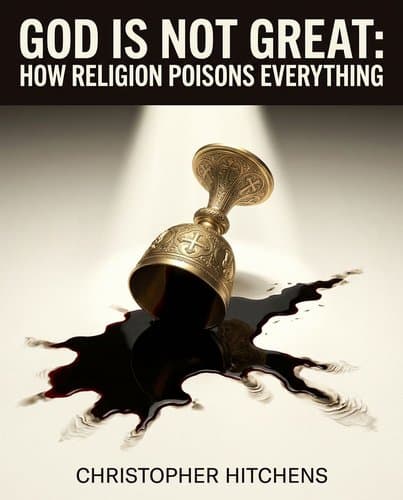
43369_god-is-not-great
by Christopher Hitchens
Religion's track record isn't a matter of faith — it's a documented history of preventable deaths, falsified texts, and institutions that structurally oppose…
In Brief
Religion's track record isn't a matter of faith — it's a documented history of preventable deaths, falsified texts, and institutions that structurally oppose human progress. Hitchens builds his case not from philosophy but from evidence, dismantling sacred claims with the same rigor religion has always tried to silence.
Key Ideas
Religion's documented institutional harms
The case against religion in this book is empirical, not philosophical — Hitchens doesn't argue God is logically impossible, he argues the institutions that claim to speak for God have a documented record of producing preventable deaths, from Nigerian polio outbreaks to Rwandan genocide with clerical participation.
Holy texts reveal human authorship
Every major holy text contains internal evidence of human authorship: Deuteronomy describes Moses's death and uses language ('until this day,' 'since then') that only makes sense if written generations later; the beloved 'cast the first stone' story in John was interpolated by an unknown hand and doesn't appear in the oldest manuscripts.
Biology refutes the design argument
The design argument for God fails not on logic but on biology: the eye is built upside down and backwards, humans exist because a two-inch Cambrian fish survived a mass extinction by contingency rather than design, and 40 to 60 independent evolutions of the eye have been documented — none requiring a designer.
Religious institutions enabled Nazi genocide
The 'godless regimes are worse' objection to Hitchens collapses on the facts: Hitler's very first diplomatic accord was with the Vatican, which ordered 23 million Catholics to abstain from political opposition and made parish records available for racial classification under the Nuremberg laws.
Religion systematically opposes medical science
Religious authority consistently sides against science in medicine — not occasionally, but structurally — because any technology that solves problems without ceremony undermines the monopoly on meaning. The polio fatwa and the Vatican's condom misinformation are the same reflex, separated by a decade and a continent.
Skeptical rationalism has ancient roots
The rational skeptical tradition is not a modern invention but a suppressed lineage: Epicurus concluded the gods don't intervene in human affairs in the 4th century BC; Spinoza was excommunicated for reaching similar conclusions in 1656; Darwin published his private disbelief only after death. The tradition was always there — it just had to hide.
Who Should Read This
Thoughtful readers interested in Ethics and World History willing to slow down and wrestle with ideas.
God Is Not Great: How Religion Poisons Everything
By Christopher Hitchens
9 min read
Why does it matter? Because the comfort you're being sold has a documented body count.
Most readers assume "religion poisons everything" is a provocateur's bumper sticker — the kind of sweeping claim that announces an attitude rather than makes an argument. Hitchens doesn't correct this assumption philosophically. He corrects it geographically: Belfast, Beirut, Bombay, Belgrade, Bethlehem, Baghdad — cities he went to himself, where religious cruelty is visible in the record rather than deduced from first principles. The real question isn't whether God exists. It's whether the institutions that claim to speak for God have earned the reflexive deference most decent people keep giving them. Hitchens thinks the trial record is decisive — and that the tradition of rational inquiry those institutions have always tried to suppress is older, more life-affirming, and considerably less bloody than anything organized faith has ever produced. The bodies come first. The philosophy follows.
'Religion Poisons Everything' Sounds Like Polemic. Then You Visit the Six Cities.
The call from the State Department came the day after Salman Rushdie left Hitchens's Washington apartment. A senior official delivered the message without ceremony: credible intelligence had intercepted threats against Hitchens and his family. The suggested countermeasure — change your address, change your phone number — struck Hitchens as a faintly absurd response to people who killed translators and shot publishers through the spine.
Rushdie had spent those days in Washington to meet President Clinton, moving under security arrangements that novelists don't ordinarily require. He was a British citizen, a writer of fiction, living under a death sentence pronounced by Iran's theocratic government in 1989 — a sentence with a cash bounty and a promised place in paradise for whoever collected it. Khomeini had not read the novel and saw no need to.
What followed was the part Hitchens couldn't shake. The Vatican issued a statement. So did the Archbishop of Canterbury. So did the chief Sephardic rabbi of Israel. Each condemned — the book. Not the death sentence. Not state-sponsored murder as a tool of literary criticism. The blasphemy, they said, was the real problem. When institutions commanding the moral prestige of centuries line up to validate the proposition that a writer deserved what was coming to him, you have learned something about those institutions.
"Religion poisons everything" sounds like a slogan. Hitchens's method in God Is Not Great is documentary. He structures a central chapter around a challenge from a religious broadcaster: would you feel safer or less safe seeing a group of men approaching who'd just come from a prayer meeting? Hitchens replies that he's had this exact experience in six cities beginning with B — Belfast, Beirut, Bombay, Belgrade, Bethlehem, Baghdad — and in each one, answers from personal witness.
The Rushdie affair is the cleanest example because the moral arithmetic is simple: one writer, one death sentence, three major religious institutions siding with the executioner rather than the executed. Religion, Hitchens argues, is not merely correlated with these outcomes. It is the mechanism that makes them feel, to those carrying them out, not just permissible but holy.
The Case for a Designer Collapses on a Two-Inch Cambrian Fish That Almost Didn't Make It
The case for a divine designer doesn't fail because scientists refused to consider it. It fails because of what they actually found when they looked.
Start with the eye — the design camp's favorite exhibit. The human retina is wired backward: photons must pass through blood vessels, ganglion cells, and multiple layers of tissue before reaching the light-sensitive receptors, creating a blind spot that no competent engineer would build in. At least forty distinct versions of the eye, possibly sixty, have evolved independently across the animal kingdom. One deep-sea fish ended up with two entirely separate pairs of eyes, the second pair built through a completely different evolutionary process than the first — because the same problem got solved twice from scratch. No blueprint was being followed. Pure improvisation, with no record of previous attempts.
The deeper blow comes from a limestone quarry in the Canadian Rockies, discovered in 1909, which preserves life from roughly 570 million years ago, during a period of explosive biological proliferation known as the Cambrian. The paleontologist Stephen Jay Gould spent years examining those fossils and reached a conclusion that unsettled even him: if you could rewind the evolutionary tape and run it again, you would very probably get different results. Most Cambrian lineages ended in extinction. One that didn't was a small creature called Pikaia gracilens, the earliest known vertebrate ancestor, the animal from which fish, birds, reptiles, and every human being ultimately descend. It was about two inches long. It survived a mass die-off that erased most of its contemporaries. It easily might not have. Gould was unsparing about what that implies: the existence of all vertebrate life on earth was historical accident, not a plan being worked out across geological time.
What the design argument collides with isn't a counterargument. It's a fact. You are here because one small animal happened to make it through.
The God Who Dictated These Texts Apparently Forgot to Proofread Them
How do you test whether an ancient text was revealed by a god rather than assembled by human hands covering their tracks? Divine authorship should at minimum produce internal consistency: a god wouldn't contradict himself, place events in the wrong historical sequence, or leave behind the fingerprints of later editors. Apply that test, and the scriptures fail it not at the margins but at the center.
Bart Ehrman came to the question as a champion of evangelical Christianity, trained at America's two most prestigious fundamentalist academies, fluent in biblical Greek and Hebrew. Comparing the oldest surviving manuscripts of John's Gospel against later copies, he found that the story everyone knows — Pharisees dragging a woman caught in adultery before Jesus, who replies that whoever is without sin may cast the first stone — does not appear in the earliest texts at all. The writing style differs from John's. The vocabulary is foreign to the surrounding text. An unknown scribe inserted the passage centuries after the Gospel was written. Every sermon preached from that exchange, every film version, every moral intuition borrowed from that scene descends from a forgery so skillfully placed it went undetected for over a thousand years.
Hitchens calls the scriptures human documents. The errors they contain are precisely what forgers leave behind: anachronisms, self-referential slips, editorial seams visible under the right light. Deuteronomy describes Moses's own death and notes, using the phrase "unto this day," that no one knows where his tomb is — language that only makes sense if written long after Moses died, by someone who forgot this was supposed to be his own account.
The Polio Fatwa Is Not an Outlier — It's What Happens When Religious Authority Meets Public Health
In the fall of 2001, Hitchens traveled to Calcutta with the Brazilian photographer Sebastião Salgado on a UNICEF mission to push polio eradication across the finish line. What he found was society women teaming up with sex workers to carry one message into every corner of the city: bring your children, no questions asked, and let them swallow two drops of liquid. The medicine cost pennies per child. An entire poor city had bent its energies toward the idea that children didn't need to be crippled by a disease that was, finally, within reach of elimination.
Then the rumors started. In the outlying districts, religious hardliners were spreading word that the drops were a foreign plot — that this Western medicine would leave children impotent and sick.
By 2005, Hitchens had seen how that logic played out at scale. In northern Nigeria, a country that had already cleared itself of polio, a group of Islamic clerics declared the oral vaccine a US and United Nations conspiracy against Muslim communities. The drops would sterilize believers. Nobody should swallow them. Within months, the disease was back, and not only in Nigeria. Pilgrims carried it to Mecca, then home again, seeding outbreaks across countries that had previously been polio-free, including three in Africa and Yemen. The entire campaign — the cease-fires warring parties in El Salvador had declared to let inoculation teams pass, the decades of accumulated progress — had to be restarted from zero.
This was not an outlier. Cardinal Alfonso López Trujillo, the Vatican's head of family affairs, told audiences that condoms had pores the AIDS virus could slip through. Bishops across Africa relayed the claim to their congregations. The authority that makes such instructions unchallengeable is exactly the problem: it converts a lethal error into an article of faith.
Rwanda Was 65% Catholic When the Priests Helped Identify the People to Kill
The controlled experiment religion's defenders never want to run: take the most churchgoing country on earth, add a genocide, and count the priests in the dock.
Rwanda in 1994 was 65 percent Roman Catholic and another 15 percent Protestant — the most churched nation on the continent. The killing did not erupt from a void. It was preceded by Vatican-authenticated prophecy: a visionary called Little Pebbles reported Marian apparitions at Kibeho, predicting massacre and apocalypse. The Vatican investigated and declared the visions genuine. The bishop of Kigali sat on the ruling party's central committee. Church and state, in Rwanda, were structurally the same institution.
When the killing started, frightened Tutsi civilians did what centuries of instruction had trained them to do: they went to churches. The death squads found that convenient. Priests and nuns pointed out the hiding places. Mass-grave sites, photographed afterward, sat on consecrated ground.
The detail that closes the argument came at Kibeho itself. Bishop Misago arrived with a team of police officers to address ninety Tutsi schoolchildren being held before their scheduled execution. He told them not to be frightened — the police would protect them. Three days later, the police helped kill eighty-two of those children.
When Rwanda's postwar Ministry of Justice considered charging Misago, an official explained the obstacle: "The Vatican is too strong, and too unapologetic, for us to go taking on bishops. Haven't you heard of infallibility?"
John Paul II was not a timid man. He had resisted both Nazism and Soviet rule in his native Poland, and as pope he issued formal apologies for the Crusades, for Christian anti-Semitism, and for the Inquisition. Rwanda, where Catholic clergy were standing trial for genocide while he was alive and still pope, produced no apology. The institution could confess to the sins of the eleventh century more readily than to the sins of 1994.
Nearly everyone doing the killing was a churchgoer. Whether a believer ended up on the side of the victims was closer to chance than to conviction. That's not a mixed record. That's a pattern.
Every Time Someone Mentions Stalin, They're Accidentally Making Hitchens's Point
Imagine someone defending a teacher against charges of producing violent students by noting that graduates of other schools also turned violent. You'd want to check whether those schools borrowed their curriculum from the same source.
That's the structure of the "but Stalin was an atheist" objection. Hitchens's reply isn't a defense — it's a counter-accusation. George Orwell noticed in 1946 that a totalitarian state is, by definition, a theocracy: it demands not mere obedience but the surrender of private thought, conscience, and inner life to an infallible authority. Institutional religion had been demanding exactly that for centuries. Secular absolutism didn't invent this structure. It inherited it.
Then there's the matter of who blessed the fascists. Hitler's very first diplomatic accord, signed in July 1933, was not with another government. It was with the Vatican. The Holy See ordered the Catholic Center Party to dissolve and instructed the country's twenty-three million Catholics to abstain from political opposition. Parish records were made available to establish racial purity under the Nuremberg laws. At his first cabinet meeting afterward, Hitler announced the deal would be "especially significant in the struggle against international Jewry." The Vatican's own secretary of state, the official who had suppressed his predecessor's anti-Nazi encyclical, was later elected Pope Pius XII. Four days into his papacy, he wrote to Berlin expressing devotion to the German people "entrusted to your leadership." The letter was addressed to Hitler.
No Catholic was ever threatened with excommunication for participating in war crimes. Goebbels was excommunicated — for marrying a Protestant.
The danger hasn't receded. It's moved.
Spinoza Was Excommunicated in 1656. The Tradition He Carried Is Older Than Christianity.
In July 1656, the elders of Amsterdam's Jewish community assembled to pronounce a sentence on a twenty-three-year-old lens grinder named Baruch Spinoza. The words they chose were not mild — they cursed him by day and by night, in sleeping and in waking, in going out and in coming in, and called on God to erase his name from the world. The Vatican and the Calvinist authorities in Holland, for once in agreement, endorsed every syllable.
What had Spinoza done? He had argued that God, if real, was nature itself: no room for miracles, chosen peoples, or divinely authored scripture.
His letters carried the word Caute!, Latin for "take care," sealed with a small rose. He outlived the curse by twenty years and died grinding lenses, the powdered glass eventually destroying his lungs.
Hitchens's point is that the suppression was the story all along. Socrates was killed for asking the same kinds of questions in 399 BC. Lucretius's poem nearly vanished in the Middle Ages. Darwin encoded his conclusions in language cautious enough to publish while confessing his actual views only in private letters. The tradition religion calls its enemy was never absent — it just learned to write in invisible ink. As Descartes, who moved to Holland for safety, chose as his motto: He who hid well, lived well.
The Voice of Reason Is Soft — Hitchens's Bet Is That It's Loud Enough
What Spinoza hid behind blank title pages, Darwin buried in private letters, and Rwanda's Ministry of Justice could only say privately about Bishop Misago — it wasn't anything exotic. It was just honest accounting. The voice of reason doesn't boom; it has always had to stay quiet to survive. But it persists, and that persistence is the point. Hitchens isn't asking you to storm anything. The New Enlightenment he calls for is available to any person willing to hold religion to the same evidentiary standard they'd apply to a clinical trial or a used-car salesman. Not contempt — just honesty about the record. The stakes for not doing so are no longer abstract: there are leaders now with theological certainty and nuclear arsenals, and a church that never apologized for 1994 is still deciding what you owe your body and your dead.
Notable Quotes
“So you see, children, how powerful and generous God is. He has made all the trees and grass to be green, which is exactly the color that is most restful to our eyes. Imagine if instead, the vegetation was all purple, or orange, how awful that would be.”
“things are not so ill with you and me as they might have been,”
“half-owing to the number who lived faithfully a hidden life, and rest in unvisited tombs.”
Frequently Asked Questions
- What is God Is Not Great about?
- The book builds an empirical case against organized religion using history, biology, and textual analysis. Hitchens argues that religious institutions have produced preventable suffering, from genocides to public health disasters like polio outbreaks. He examines how holy texts contain internal evidence of human authorship, such as Deuteronomy describing Moses's death using language that only makes sense if written generations later. He traces the suppressed tradition of rational skepticism from Epicurus to Darwin, equipping readers to challenge theology's core claims.
- Does God Is Not Great argue that God is logically impossible?
- No. Hitchens' argument is empirical, not philosophical. He does not argue God is logically impossible; rather, he argues that the institutions claiming to speak for God have a documented record of producing preventable deaths. Examples include Nigerian polio outbreaks where religious opposition to vaccination caused preventable disease, and the Rwandan genocide with clerical participation. Religious authority has structurally opposed science in medicine because technologies solving problems without ceremony undermine religion's monopoly on meaning.
- What textual evidence does Hitchens provide that holy texts are human-authored?
- Hitchens provides evidence that sacred texts were written by human hands, not divine revelation. Deuteronomy describes Moses's death and uses language such as 'until this day' and 'since then' that only makes sense if written generations later. The beloved 'cast the first stone' story in John's Gospel was interpolated by an unknown hand and does not appear in the oldest manuscripts. These inconsistencies undermine claims that sacred texts are verbatim divine communication revealing God's unchanging will.
- How does biology refute the design argument for God according to Hitchens?
- The design argument fails on biological evidence, not logic. The human eye is built upside down and backwards, contradicting claims of perfect design. Humans exist due to contingency: a two-inch Cambrian fish survived a mass extinction by chance, setting in motion the evolutionary line leading to humans. Forty to sixty independent evolutions of the eye have been documented across species, yet none required a designer. This demonstrates that complexity and functionality emerge through natural processes, not intelligent design.
Related Book Summaries
Read the full summary of 43369_god-is-not-great on InShort