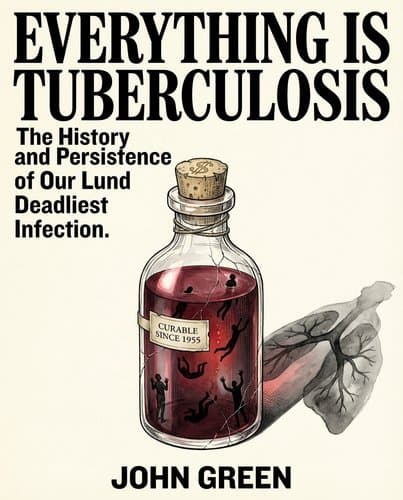
Everything Is Tuberculosis
by John Green
TB has been curable since 1952, yet it still kills 1.25 million people every year—and John Green exposes why: not medical failure, but deliberate political choices rooted in colonialism, racism, and profit that have consistently decided whose lives matter.
In Brief
John Green traces how tuberculosis — curable since the 1950s — still kills over a million people annually, not because medicine failed but because colonial economics, racial ideology, and pharmaceutical profit structures have consistently decided whose lives are worth saving. Through the stories of Henry, Shreya, and generations of invisible patients, Green shows that TB deaths are policy outcomes, not tragedies, and that activists have already proven the system can be changed.
Key Ideas
TB Mortality: Political Choice, Not Medical Failure
TB kills over 1.25 million people annually despite being curable since the mid-1950s — more deaths than malaria, typhoid, and war combined. This is not a medical failure; it is a political choice.
Colonial extraction created the poverty
The countries with the highest TB burden are poor because of deliberate colonial extraction, not cultural or biological factors — Sierra Leone's railroad map runs to the coast for export, not between communities.
Romanticizing TB was explicitly racialized
Romanticizing TB as a disease of sensitive, creative souls was never universal: it was explicitly racialized, making non-white TB invisible to medicine and allowing colonial physicians to ignore epidemic death tolls among enslaved and colonized people.
DOTS compliance theater is not
DOTS, the global standard TB treatment protocol, is built on patient distrust — yet randomized trials show directly observed therapy is no more effective than giving patients monthly supplies. Compliance theater is not medicine; it is control.
Zero new TB drugs were
Between 1966 and 2012, zero new TB drugs were developed. The two drugs that finally emerged were funded with public money but patented by J&J at prices unaffordable to the countries with the highest disease burden — a choice activists successfully challenged in court.
Activist pressure slashed MDR-TB treatment
MDR-TB treatment cost $15,000 per course in the 1990s; WHO declared it untreatable in poor countries. Activist pressure, generic manufacturing, and patent challenges brought that to roughly $300 — a 98% reduction. Cost-effectiveness is a moving target, not a fixed limit.
The STP framework could eliminate
The STP framework (Search, Treat, Prevent) — household-by-household case-finding, 4-month treatment courses, and preventive therapy for household contacts — costs $25 billion per year globally and returns over $40 per dollar spent. TB could be eliminated within a generation.
Who Should Read This
Global health students and professionals, readers interested in how colonialism shapes modern inequality, anyone who wants to understand pharmaceutical pricing and access, public policy advocates, and people who enjoyed John Green's previous nonfiction and want to see him apply his storytelling to systemic injustice
Summary
Why does it matter? Because tuberculosis has been curable since 1955, and we choose not to cure it.
You probably think of tuberculosis the way most people do — a Victorian affliction, Keats coughing into a handkerchief, something the modern world solved and moved on from. Here's what actually happened: in 2023, more people died of TB than from malaria, typhoid, and every war on earth combined. One point two five million people. From a disease we've known how to cure since the mid-1950s.
That gap — between "curable" and "cured" — is not a medical failure. It's a political choice, and it's been made the same way for centuries: by deciding, usually without saying so directly, whose lives are worth the cost of saving. This summary traces that choice through history, through colonial economics, through the specific bodies of specific people with names and families — people like Henry and Shreya, whose stories will stay with you long after the statistics fade.
By the end, you won't be able to call TB a tragedy. You'll recognize it as a decision — and you'll understand what it costs to keep making it.
The Boy Who Looked Nine Was Actually Seventeen
Tuberculosis, you probably assume, is a Victorian problem. Keats coughing into a handkerchief. Something that belongs to sepia photographs and the nineteenth century's particular genius for romanticizing suffering. That assumption is comfortable, and it is wrong.
John Green arrived at Lakka Government Hospital in Sierra Leone reluctantly — he was there to report on maternal mortality, not TB, and he was exhausted and mildly sick. A small boy met him at the entrance, grabbed his shirt, and proceeded to walk him around the entire facility with the confident hospitality of someone who owned the place. The boy's name was Henry. He had spindly legs, a wide goofy smile, and the kind of enthusiasm for connection that Green recognized in his own nine-year-old son. He showed Green a microscope in the lab, walked him past the bare-mattress wards that looked more like prison cells than hospital rooms, and stood with him as a young man nearby vomited blood and bile into a plastic bottle.
Green assumed Henry was a staff member's kid. Then a doctor told him otherwise. Henry was a patient — and he was not nine years old. He was seventeen. He only looked like a child because he had grown up malnourished, his body never given enough to build itself properly, and then active tuberculosis had eaten away at whatever remained. Once Green knew this, he saw Henry differently. The yellow tinge clouding the whites of Henry's eyes was liver toxicity from the treatment drugs. The swelling along one side of his neck was TB that had spread into the lymph nodes. When Henry said the injections felt like fire burning under his skin, he was describing something he endured daily. His entire body was a record of compounding failures: poverty, hunger, infection, and treatment that the doctor quietly admitted would probably not be enough.
A young woman named Marie, whom Green met at Lakka on a later visit, described what recovery from TB does to hunger: it consumes you. She had arrived at the hospital unable to walk, weighing under seventy pounds at five feet three inches tall, her lungs almost entirely destroyed. As she began to heal, she fantasized constantly about eating mud and sticks, imagining them as crunchy on the outside, dense with nourishment inside. A nurse explained that the hospital fed patients three full meals a day, and that this wasn't enough, and that food received no dedicated funding because it wasn't officially classified as part of TB treatment. Some patients, unable to bear the hunger, simply left. They stopped taking their antibiotics midway through the course, which is precisely the condition that allows TB bacteria to develop drug resistance. The system funded the medicine and not the food, then was surprised when the medicine failed.
Green left Lakka not knowing whether Henry would survive. A nurse said only: we will fight for him. That uncertainty is the point of entry, and it doesn't resolve as quickly as you'd expect.
TB Didn't Just Kill People — It Helped Start World War I and Invent the Cowboy Hat
TB didn't just kill people — it helped shape the world they lived in. After returning from Sierra Leone, Green became the kind of person who corners a child dressed as a cowboy at a Halloween party to explain that tuberculosis invented the hat. He's not wrong. In the 1850s, a New Jersey hatmaker named John Stetson developed consumption and headed west, following the medical consensus that dry air could heal what humid city air was making worse. He ended up in St. Joseph, Missouri, where his body cleared the infection on its own. Observing that frontier hats were uniformly terrible — either fur caps crawling with insects or wide straw brims that soaked through in rain — he went home and designed something better. The hat that bears his name is, in a direct sense, a tuberculosis artifact.
Then there's Franz Ferdinand. In June 1914, six conspirators positioned themselves along a parade route in Sarajevo to assassinate the Austro-Hungarian archduke. Three of them were nineteen-year-old Serbians — Cabrinovic, Grabez, and Princip — already dying of TB and convinced they had very little to lose. The attempt was a disaster. Cabrinovic threw a bomb that hit the wrong car, swallowed a cyanide pill too diluted to kill him, and jumped into a river four inches deep. The archduke kept touring. Later, his driver took a wrong turn, stopped to reverse, and found himself idling directly in front of Princip, who shot the archduke and his wife dead. All three consumptive assassins died in prison before the war ended — of tuberculosis. Green nominates TB as a minor cause of World War I, and it's hard to argue.
But Green's real argument runs the other way. These vignettes are dazzling, and they're also a trap. The more important question isn't how TB nudged history — it's how human choices built the conditions where TB could flourish and spread. The disease doesn't have intentions, but it behaves as though it does, finding and following the channels that inequality carves. That's what Henry's story was really about, and it's what everything that follows is about too.
Sierra Leone Isn't Poor — It Was Made Poor
Sierra Leone is not a poor country. It is a country that was made poor, systematically and deliberately, over the course of centuries. Dr. Bailor Barrie, a Sierra Leonean physician, offered Green the sharpest possible proof: look at the railroad map. The colonial rail lines don't connect towns to each other, don't trace the shape of a community with shared interests and internal commerce. They run from mineral-rich inland areas straight to the coast — the shortest possible route for getting diamonds and metal ores onto British ships. The infrastructure is a diagram of extraction. Schools and clinics existed, but only enough to train and maintain the people needed to run the export machine.
The arithmetic of what this cost is stark. In 1950, after roughly 150 years of British colonial rule, life expectancy in Sierra Leone was under thirty — comparable to premodern humans who lived tens of thousands of years ago, long before antibiotics or germ theory. British life expectancy that same year was sixty-nine. This gap isn't explained by geography or natural misfortune. Before the fifteenth century, Europeans generally imagined West Africans as wealthy and powerful, and with good reason: the fourteenth-century Malian ruler Mansa Musa is widely considered the wealthiest individual in all of recorded history. The poverty that followed colonialism was built, not discovered.
Then the slave trade: roughly four hundred thousand people kidnapped from what is now Sierra Leone and sold across the Atlantic. Then a civil war that began in 1991, killed more than fifty thousand people, and forced millions from their homes. Isatu — Henry's mother — was pregnant when rebel forces took Freetown. She moved from house to house with no reliable food, no clinic access, some nights no shelter. When the war ended in 2002, she was thirty-four, her college plans long gone, selling cooking oil in a market. Her phrase for what disease and poverty do together is the chapter's most precise formulation: the money whipped away on sickness. Every leone saved, consumed. This is the specific, constructed environment in which Henry's tuberculosis took hold. The railroad maps and the consumptive aesthetics that romanticized suffering in Victorian drawing rooms share the same underlying logic: one made the dying invisible by design, the other by distance. What follows is the cost of both.
We Romanticized TB Into Killing More People
What if the story a society tells about a disease ends up determining who gets to survive it? When tuberculosis was killing roughly thirty percent of all Londoners by the early nineteenth century, blaming it on drunkenness or sexual immorality had become logically impossible — too many respectable people were dying. So European culture did something stranger: it turned the disease into an aesthetic. The so-called consumptive personality, spes phthisica, held that as the body wasted away, the spirit flowered. Lord Byron announced he'd like to die of consumption because women would find him fascinating in his final hours. Victor Hugo's friends joked he could have been a truly great novelist, if only he'd caught it. Physicians worried aloud that falling TB rates might damage the quality of American literature.
Romanticization came with a specific visual template: pallor, thinness, rosy fever-flushed cheeks, wide eyes sunken from low blood oxygen. These became the markers of European feminine beauty. Women applied belladonna drops to dilate their pupils. Magazines published instructions for painting cheeks to mimic consumptive fever. A YouTube comment from a woman named Jil cuts straight to what this inheritance costs: 'As a fat person, I used to wish for a wasting disease like tuberculosis. It's...it's messed up.' Dozens of people replied with their own versions of the same wish. The aesthetics of dying have never fully left us.
The deeper damage was structural. The consumptive beauty ideal was saturated with whiteness — 'alabaster,' 'marble,' 'translucent' skin, as beauty manuals of the era insisted. White physicians used this association to classify TB as a disease of civilization, meaning a disease only civilized, meaning white, people could develop. One American doctor called it explicitly 'a disease of the master race, not of the slave race.' The circular logic was lethal: only superior people got consumption; enslaved and colonized people weren't getting consumption; therefore their deaths went undetected and uncounted. A physician practicing in colonial India noted in 1829 that it was 'a generally received error' that pulmonary disease there was rare. It wasn't rare at all. It was only invisible to the people with the power to count it. Acknowledging widespread TB among colonized populations would have undermined both the romantic theory of the disease and the colonial project that depended on white supremacy. Romanticization was a mechanism for deciding whose suffering counted.
'To Them I Am Not a Person': How Stigma Became Medicine's Alibi
In 1896, a white American physician named J.F. Miller published an essay arguing that tuberculosis had been virtually absent among enslaved Black people before emancipation — and that freedom itself had made them sick. His proposed remedy was a return to slavery. An anonymous Black physician, reading this, fired back in a medical journal that Miller's argument 'smacked more of the cheap politician playing to passion and prejudice than a doctor discussing a scientific subject.' The real causes, that physician wrote, were obvious: poverty, bad housing, bad sanitation, long hours, high rent, poor food. One man had a diagnosis; the other had an alibi.
The alibi was always the same: something inherent to the suffering group was to blame. Before Koch identified the TB bacterium in 1882, white American physicians had claimed Black Americans were essentially immune to consumption — they lacked the nervous temperament. After Koch, the same logic flipped: now Black Americans were disproportionately susceptible, supposedly due to smaller chest cavities and faster breathing. The science changed; the conclusion did not. Black suffering was biological destiny, not political consequence. And as long as the cause was located inside the victim's body, no one had to look at the housing, the wages, the hospital doors that stayed shut.
Those doors literally stayed shut. Thomas Albert White, a Black veteran, developed active TB after exposure to chemical weapons in World War I. The federal government issued orders for TB hospitals to admit him. Every hospital refused anyway. He died without treatment. The orders existed. The refusals happened. That gap between official policy and actual practice is where the ideology lived.
In Canada, that ideology ran at genocidal scale. In First Nations communities during the 1930s and 1940s, around 700 of every 100,000 people died annually of tuberculosis — already ten times the white Canadian rate. In residential schools, where Indigenous children were forcibly confined away from their families, the rate was 8,000 per 100,000. Eight percent of the children in those schools died of TB every year. Researchers have called this not an epidemic but a result of deliberate neglect. Today, Inuit people are still over 400 times more likely to contract TB than white Canadians.
A young Sierra Leonean woman Green spoke with, abandoned by her family after surviving TB, told him plainly: 'To them I am not a person.' There were times she wished she had died rather than been cured, because the social death that followed was harder to survive than the disease had been. One commenter on a YouTube video about TB survivors wrote that people like her had brought shame on themselves — and the replies agreed. The alibi travels. What stigma promised her was that illness was moral verdict. What it actually delivered was medicine's oldest deflection: the world didn't fail you. You just failed yourself.
A Cure Existed. The World Chose Not to Use It.
TB became curable in the early 1950s. The decision not to cure it everywhere was a choice, made by identifiable people, for documented reasons. By 1990, Ethiopia's TB death rate matched what the United States recorded in 1882 — the year Robert Koch first identified the bacterium under a microscope. Streptomycin had existed for nearly half a century. The RIPE drug protocol had been standard in wealthy countries for decades. In Ethiopia, none of it arrived. The cure existed where the disease was not. The disease existed where the cure was not.
Romanticizing TB as a disease of civilized sensitivity had always depended on a corollary: that certain people — the wrong kind — couldn't really get it, or deserved it when they did. Once applied to non-white populations, that same logic stopped being aesthetic and became administrative. It didn't see TB at all, and when it finally did, it called the dying responsible for their own deaths.
S. Lyle Cummins, writing at the dawn of the antibiotic age, argued that delivering treatment to African patients was inadvisable because they were too 'child-like in respect to mentality and outlook' to be trusted with medicine. This is the same logic that classified TB as a disease only civilized people could contract. The same logic that let First Nations children die in residential schools. The form changes; the function stays constant: locate the cause of suffering inside the victim's body, and you never have to look at the system.
When a global TB treatment strategy finally reached poor countries in the 1970s, it was built on that same distrust. DOTS — Directly Observed Therapy — required patients to travel to a clinic every single day to swallow their pills while a health worker watched. Randomized controlled trials eventually found that handing patients a monthly supply worked just as well, provided they had adequate support. DOTS persisted anyway. Dr. Jennifer Furin, a TB researcher, put it plainly: she knew of no other field of medicine where treatment was designed so completely around distrust of patients.
Consider Robert, a nineteen-year-old Haitian man documented by physician Paul Farmer. Robert traveled two hours each way daily to receive whatever medications his hospital happened to have in stock — which was never the full four-drug regimen. His family sold more than half their land to cover costs. He walked to better hospitals as he found them. He did everything the system asked. He still died in December 1995 at twenty-eight, from TB that had become drug-resistant through years of inadequate treatment, when the second-line antibiotics that would have saved him simply weren't there. Robert was not noncompliant. The system was not underfunded in some abstract, inevitable way. It was built to watch him take pills it couldn't be bothered to fully supply. What it actually delivered was medicine's oldest excuse.
The Drug That Could Have Saved Shreya Cost $3,000. It Cost $5 to Make.
The cure existed where the disease was not. The disease existed where the cure was not.
Shreya Tripathi did her own research. Diagnosed with extensively drug-resistant TB in India, she read through the medical literature, found bedaquiline, and told her doctors: this is what my body needs. Her doctors agreed. The Indian national TB program said no. Their three reasons: the evidence was insufficient (it wasn't — thousands of XDR-TB patients had already been cured with it), the drug was too expensive (only because Johnson & Johnson had set the price that way), and bedaquiline needed to be protected from overuse to prevent future resistance. That last argument is worth sitting with: officials were withholding a life-saving drug from a dying woman to preserve it for hypothetical future patients, while simultaneously allowing untreated drug-resistant TB to spread through the population — the fastest possible route to exactly the resistance they claimed to fear.
So Shreya sued the government. She told her father she knew the case might not be resolved in time to help her, but she wanted her suffering to mean something. She won in the Delhi High Court, forcing bedaquiline into the national program. Her first dose arrived after her lungs had already been reduced to scar tissue. The bacteria died. Her lungs did not recover. She died in 2018, six years after her diagnosis.
The drug that might have saved her can be manufactured profitably for around $130 a course. We know this precisely because that's what J&J charges now, after losing their monopoly. During the years Shreya was sick and suing and dying, the company charged multiples of that — enough to put bedaquiline beyond the reach of most national health programs in the countries where TB actually kills people. The public, including the U.S. government, funded the majority of bedaquiline's development. J&J held the patent, set the price, and issued statements saying their monopoly wasn't blocking access. Meanwhile, Henry — the seventeen-year-old Green met at Lakka who looked nine — woke one morning to find he could only hear out of one ear. He'd been receiving kanamycin, an older injectable drug that causes permanent hearing loss in more than one in five patients. Bedaquiline carries no such risk. Henry said nothing to his doctors, because he feared they'd stop treatment, and stopping treatment would kill him. In 2024, hundreds of thousands of patients around the world were still receiving the injectables regimen, still going deaf, still developing kidney failure — not because bedaquiline didn't exist, but because the pricing structure made it a luxury.
The forty-six years between 1966 and 2012 in which no new TB drugs were developed is not an accident of biology. TB bacteria are slow to develop resistance compared to staph, which replicates ninety times faster. The gap exists because there was no financial incentive to close it. The people dying were poor. When Green's brother Hank was treated for lymphoma, no one ran a cost-effectiveness analysis. The treatment cost roughly a hundred times what curing a TB patient costs. Nobody asked whether it was worth it. That's not a coincidence. It's the logic of a system that prices lives according to whose wallet is attached to them.
'Beat Me Later If This Fails': One Doctor, One Father, One Impossible Bargain
When Henry's injectable drug regimen failed after more than two hundred days at Lakka, his father came to Dr. Girum's office and announced he was taking his son home to die. Three treatments had been tried. Three had failed. His boy lay in a hospital bed all day now, unable to walk across the room without gasping, and the foreign doctor sitting across from him had nothing to show for it. Henry's father stood up and promised that if he was not allowed to remove his son the following morning, he would come back and beat him. Dr. Girum, still learning Krio, didn't catch every word. He caught enough.
Henry, confined to his room down the hall, already knew what was coming. After his closest friend Thompson died that spring — starved for air, what one person described as breathing through a straw all the time — Henry had stopped eating, stopped leaving his room, stopped doing the upside-down sunglasses routines that made the nurses call him 'our happy boy.' Thompson had been older, further along, and Henry had watched him as though looking at a preview of his own ending. At night he lay still and thought not about himself but about Isatu, his mother, already having lost a daughter, and how she would survive losing him too. He thought about businessmen he'd seen walking the streets of Freetown. They wore new shoes — shoes shaped to their own feet, purchased new, belonging to no one before them. Henry had never owned a pair. His feet had always gone into shoes already worn into someone else's shape.
Dr. Girum lay awake that night two thousand miles from his wife and infant, running through what he knew: Henry's lungs looked terrible on X-ray, the newer drugs weren't yet in the country, and even if he could get them, Henry still had a real chance of dying. In the morning, when Henry's father came back ready to punch him, Dr. Girum made an offer instead. All the work they'd done together would be wasted if Henry left now. A new regimen was possible — not promised, not guaranteed, but possible. 'Don't hit me today,' Dr. Girum said. 'Beat me later if this fails.'
Henry's father left to find his son. Henry — eighteen now, legally an adult, with every reason to go home and none of the certainty he needed to stay — told his father no. He would wait for the new drugs. The next morning, Isatu arrived and told Dr. Girum: my husband has given up. I have not. She handed him her son's life as plainly as she had once handed him food through a ward window. Every abstract force in this book — colonial poverty, drug monopolies, hospital systems built on distrust, the fifty-year gap in TB research — had narrowed to this single room, this single bargain: a doctor betting his body that the system could be made to work for one person.
Activists Already Bent These Choices — And Proved It Can Be Done Again
The forces that built tuberculosis into a mass killer are not laws of nature. They are policy choices, and we know this because identifiable people have already changed them.
In the 1990s, the World Health Organization declared drug-resistant TB too expensive to treat in poor countries. A two-year drug course ran between fifteen and twenty thousand dollars, and the standard of care for patients who failed first-line antibiotics was what one doctor bluntly described as putting sick people in a hut on the side of the road and waiting for them to die. Partners In Health ignored this consensus. Working in an impoverished neighborhood of Lima, they treated MDR-TB patients anyway, spending up to twenty thousand dollars per case — money that came, as PIH's Dr. Jim Kim acknowledged, directly at the expense of feeding four thousand Haitian children who also needed food. They achieved cure rates above eighty-five percent. Within two years, the WHO changed its guidelines. PIH and others then discovered that patents on most second-line TB drugs had expired, but generic versions didn't exist because manufacturers claimed there was no market. Activists pushed generic manufacturing into existence. The price fell from fifteen thousand dollars to fifteen hundred.
That chain of choices continued. Phumeza Tisile spent nearly four years in TB treatment, lost all hearing from the injectable antibiotics she was given, and emerged as an activist. Along with fellow survivor Nandita Venkatesan, she challenged Johnson & Johnson in Indian court when the company tried to extend its monopoly on bedaquiline — the drug that treats MDR-TB without destroying hearing — past its 2023 patent expiration by claiming secondary patents on an adjuvant compound. They won. J&J abandoned all secondary patents globally. The price of bedaquiline dropped more than sixty percent almost overnight. By 2023, trials funded by Doctors Without Borders and PIH found that roughly ninety percent of MDR-TB cases could be cured for around three hundred dollars a course. A ninety-eight percent reduction from the 1990s, achieved not by a market correction but by people who refused to accept the price as fixed.
Henry is alive because of that chain. He's now a second-year student at the University of Sierra Leone, studying Human Resources and Management. He runs a YouTube channel documenting life in Freetown — interviewing market vendors, sharing poems, fundraising for clean water. A crowdfunding campaign raised over sixty thousand dollars, allowing him and Isatu to buy a home. He and Green's son, who share a name, call each other the namesakes. When Green asked TB physician KJ Seung how many of the 1.3 million people who die of TB each year would survive with universal access to good healthcare, Seung's answer required no qualification: zero. Not fewer. Zero. Henry's survival is not a miracle. It is proof of concept — evidence that the world we have is the world we chose, and that choosing differently is something humans have already demonstrated they know how to do.
The Choice We Keep Making — and Could Stop
Henry — the boy who looked nine — texts Green one word at a time: Dad. He is studying at university, filming market vendors, raising money for clean water. Thompson, who was equally worthy of every one of those things, is dead. That gap is not biology. It is not fate. It is the accumulated residue of choices — about patents, about funding, about whose hunger counts as a medical variable and whose counts as background noise.
Shreya Tripathi won her case and died anyway. Henry survived. A million others die each year in the space between what is possible and what we have decided to pay for.
The book doesn't let you file this under tragedy, which would allow you to feel sad and move on. It files it under policy — which means it files it under you. The deaths are not happening to us. They are being produced by systems we inhabit and could change. That is a harder thing to hold. Hold it anyway.
Notable Quotes
“TB is not a disease of poverty. It is a disease of policy.”
— John Green, Green's central thesis that the persistence of TB reflects deliberate choices about resource allocation, not inevitable suffering
“The cure existed where the disease was not. The disease existed where the cure was not.”
— John Green, Summarizing how a curable illness continues to kill because treatment access follows wealth rather than need
“The book doesn't let you file this under tragedy, which would allow you to feel sad and move on. It files it under policy — which means it files it under you.”
— John Green, Green's closing argument that TB deaths are produced by systems readers inhabit and could change
Frequently Asked Questions
- What is Everything Is Tuberculosis about?
- It is John Green's nonfiction account of why tuberculosis — curable since the 1950s — still kills over 1.25 million people annually. Green traces how colonialism, racism, and pharmaceutical economics sustain the epidemic, weaving together the stories of individual patients with the structural forces that keep them sick.
- Is Everything Is Tuberculosis worth reading?
- Yes, especially if you care about global health equity or want to understand how historical injustice produces modern suffering. Green combines rigorous reporting with deeply personal storytelling, making complex systems of oppression legible without simplifying them. It is his most ambitious nonfiction work.
- Who is Henry in Everything Is Tuberculosis?
- Henry is a young Sierra Leonean TB patient Green met at Lakka Government Hospital. When Green first met him, Henry looked about nine years old but was actually seventeen — stunted by malnutrition and ravaged by TB. His story threads through the entire book, and he ultimately survives to attend university, representing both the human cost and the proof that better outcomes are possible.
- What is the main argument of the book?
- Green argues that TB deaths are not a medical mystery or an inevitable tragedy but a political choice. The tools to eliminate TB exist and are cost-effective. What is missing is the political will to deploy them equitably — a pattern rooted in centuries of colonial extraction, racial ideology, and pharmaceutical profit structures that consistently devalue the lives of poor and non-white people.
- How does the book connect colonialism to modern TB deaths?
- Green shows that countries with the highest TB burden were impoverished through deliberate colonial extraction — Sierra Leone's railroads were built to move minerals to the coast, not to connect communities. The poverty that makes TB deadly today was engineered, not discovered, and the medical establishment's persistent distrust of poor patients echoes colonial assumptions about who deserves care.
Related Book Summaries
Read the full summary of Everything Is Tuberculosis on InShort